
Europe
LGBT ‘Free Zones’ tossed, UK LGBTQ ranking, Pussy Riot singer escapes
A look at top LGBTQ+ stories from Europe & the UK this week as a court rules against bigotry, the UK falters, plus a true-to life spy novel
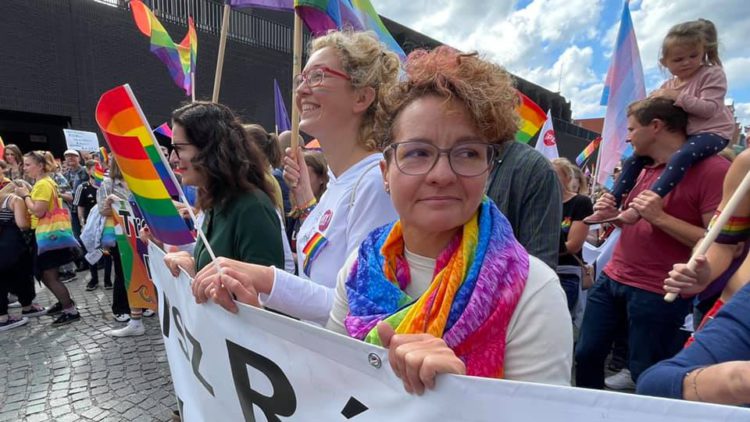
LONDON – LGBTQ+ news from Europe this past week saw a major development in Poland after a Provincial Administrative Court annulled actions taken previously to declare ‘LGBT Free Zones’ by provincial governments.
Large parts of Poland were labelled “LGBT-free zones”, where regional governments declared they were against LGBT ideology. Last fall the executive branch of the European Union, the European Commission, sent letters out last week to the governors of five of Poland’s voivodeships, (provinces) warning that pandemic relief funds totaling over 126 million euros ($150 million) will be withheld over anti-LGBTQ measures passed in their jurisdictions.
Poland has seen a resurgence in the past three years of rightwing religious ultra-conservative groups backed by nationalistic extremists in this heavily Catholic country of 38 million, which have led to passage of measures to restrict pride parades and other LGBTQ+-friendly events from taking place.
Proponents of these measures claim the necessity of the provinces to be “free of LGBTQ ideology” saying this is mandated by average Poles as well as by the anti-LGBTQ+ views of the Catholic Church.
The majority of Polish people support LGBTQ+ rights surrounding marriage and family, according to research by Miłość Nie Wyklucza (Love Does Not Exclude).
The survey found 56% of respondents believe same-sex marriage should be legal to ensure the safety of their children. Even more, 65%, said they felt “a biological parent raising a child with a same-sex partner” fits the definition of family. And 58% of people said a same-sex couple is a family even without children.
Lublin Regional Assembly passed a resolution in April 2019 declaring that LGBTQ+ rights aim to “annihilate” the “values shaped by the Catholic Church” PinkNewsUK reported.
In the same month, Ryki County, a district in Lublin, passed a resolution voting to protect “children, young people, families and Polish schools” from an apparent wave of “homoterror” being unleashed by “left-liberal groups”.
PinkNewsUK also reported that the Provincial Administrative Court in Lublin found the resolutions were “adopted without legal basis and in gross violation of the law” after a legal challenge by the Polish Ombudsman.
They become the eighth and ninth “LGBT-free zones” voided by the courts following interventions by the Polish Ombudsman. Municipal councils in Istebna, Klwów, Serniki, Osiek, Lipinki, Niebylec and the Tarnowski County Council all scrapped such measures in 2019.
This past June, the leaders of 17 European Union countries had signed a letter that urges the EU to fight anti-LGBTQ discrimination. The EU has also called out the anti-LGBTQ measures taken more recently in Hungry.
ILGA-Europe, a Brussels based advocacy group promoting the interests of lesbian, gay, bisexual, trans and intersex people, at the European level, in a statement it sent to the Blade in June after the EU letter was issued, notes that both Hungary and Poland, another EU country in which lawmakers have sought to restrict LGBTQ rights in recent years are at odds with the EU position on LGBTQ+ people.
“For quite some time now, we’ve been informing EU ministers about systematic breaches of EU law committed by Hungary and Poland, which impact on LGBTI rights and the lives of LGBTI people,” says ILGA-Europe.
The UK has dropped to 14th in the ILGA Rainbow Europe’s rankings for LGBTQ+ rights, scoring 53 out of a possible 100
ILGA-Europe, which produces a yearly “rainbow map” of 49 countries across Europe, revealed this past week that the United Kingdom had the most significant drop in ranking for LGBTQ+ equality rights this past year falling from 10th to 14th place.
Leading contributors to the loss in ranking and standing on the ILGA annual listing was due in part to the ongoing battles over transgender rights with a failure by the Tory-led government of Prime Minister Boris Johnson to set gender recognition policies especially in regard to a total ban on LGBTQ+ conversion therapy.
ILGA-Europe’s advocacy director, Katrin Hugendubel, described the UK’s plunging status to The Guardian UK newspaper as “a sad reminder that when governments don’t stand strong on their commitments to advance minority rights, a powerful opposition can use that space to spread hate and division”.
The chief executive of Stonewall UK, Nancy Kelley, warned that “years of progress on LGBTQ+ policy that was achieved under successive administrations has been rapidly eroded by a UK government that has taken its foot off the pedal”.
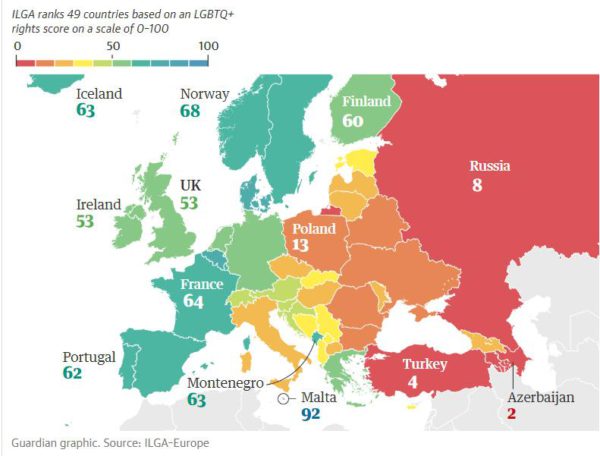
The ILGA highlighted the UK government’s failure to extend a ban on conversion practices to transgender people, as well as abandonment of promised reforms on gender recognition and its equality action plan. It added that the UK also lost points because the government’s equalities watchdog, the Equality and Human Rights Commission (EHRC), was “not … effectively protecting on the grounds of sexual orientation and gender identity” the Guardian reported.
Stonewall’s Kelley called on the prime minister to “step back into the game” as a leader in protecting and promoting LGBTQ+ rights.
“As we approach the 50th anniversary of the first Pride in the UK, we call for his active leadership to rebuild our human rights institutions and to deliver a strategic policy programme that enables all LGBTQ+ people in the UK to live their lives in freedom and safety.”
Maria Alyokhina of Pussy Riot escaped from Russia disguised as a food delivery worker
In what could be best described as a story worthy of a Cold-War era spy novel, the leader of the Russian activist band Pussy Riot fled Russia disguised as a food-delivery worker. Maria V. Alyokhina said in an interview with the New York Times that she was able to get to her girlfriend’s home in Vilnius, Lithuania after evading Russian Federal Security Services agents.
The queer singer-songwriter musician and human rights activist who was on house arrest at the time of her escape was set to be transferred to a penal colony in the Russian Far East after being arrested six times in the past year protesting the policies of Russian President Vladimir Putin and more recently his order for the Russian invasion of Ukraine.
According to the account in the NY Times, Alyokhina left her apartment in the food-delivery worker disguise, and an unnamed friend drove her to the Belarusian border. The problem then became exiting from Belarus to Lithuania as she was turned away at the border twice by Lithuanian border agents.
The Times reported that Icelandic performance artist Ragnar Kjartansson eventually helped Alyokhina acquire the necessary travel documents from an unnamed country that in turn assisted her entering into Lithuania — where many Pussy Riot members had already escaped to, including Alyokhina’s girlfriend, Lucy Shtein.
The band has now kicked off their European tour in Berlin.
Pussy Riot concert with activist after escape from Russia

Serbia
Ana Brnabić becomes world’s first openly lesbian head of state
Former Serbian prime minister succeeded President Aleksandar Vučić on Monday
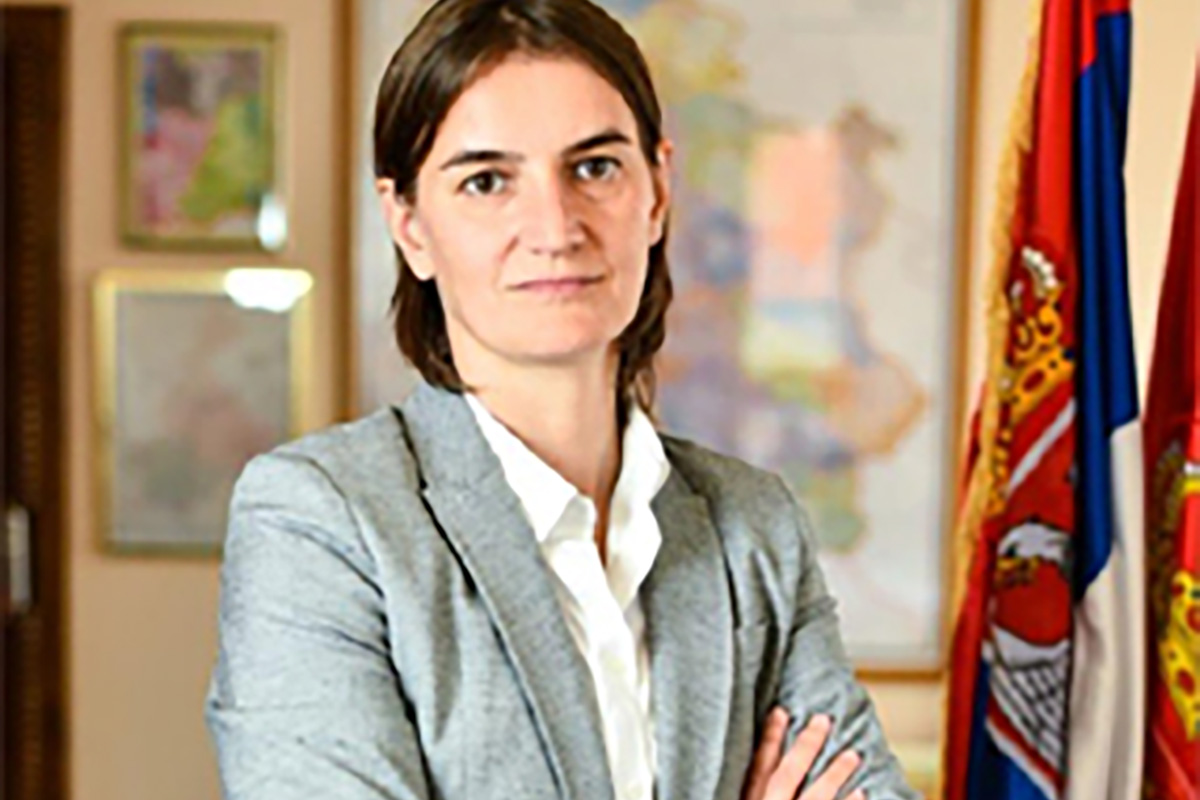
Ana Brnabić on Monday became the world’s first openly lesbian head of state after Serbian President Aleksandar Vučić resigned.
Brnabić was the country’s prime minister from 2017-2024. She was most recently the president of the Serbian National Assembly.
Vučić resigned ahead of parliamentary elections that will take place on Oct. 25. Media reports indicate Vučić could become Serbia’s next prime minister if his Serbian Progressive Party can successfully form a new government. Brnabić until then will be the country’s acting president.
Former Irish Prime Minister Leo Varadkar, who became his country’s first openly gay head of government in 2017, praised Brnabić.
“Congratulations to Ana Brnabić on becoming the world’s first lesbian head of state (president of Serbia),” said Varadkar on social media. “She visited while in her previous office and is a friend of Ireland.”
Congratulations to Ana Brnabic on becoming the world's first lesbian head of state (President of Serbia). She visited while in her previous office and is a friend of Ireland. 12 countries have now had gay or lesbian head of state/government. So far, all in Europe – the… https://t.co/TBpmeeEs9I
— Leo Varadkar (@LeoVaradkar) September 29, 2026
Former Icelandic Prime Minister Jóhanna Sigurðardóttir in 2009 became the world’s first openly lesbian head of government. Former San Marino Captain Regent Paolo Rondelli in 2022 became the world’s first openly gay head of state.
Andorran Prime Minister Xavier Espot Zamora, Dutch Prime Minister Rob Jetten, and Latvian President Edgars Rinkēvičs are openly gay. Former Luxembourgish Prime Minister Xavier Bettel, former French Prime Minister Gabriel Attal, and former Belgian Prime Minister Elio Di Rupo are also gay.
Varadkar was Ireland’s prime minister from 2017-2020 and again from 2022-2024.
Netherlands
Dutch prime minister visits Stonewall Inn
Rob Jetten is the Netherlands’ first openly gay prime minister
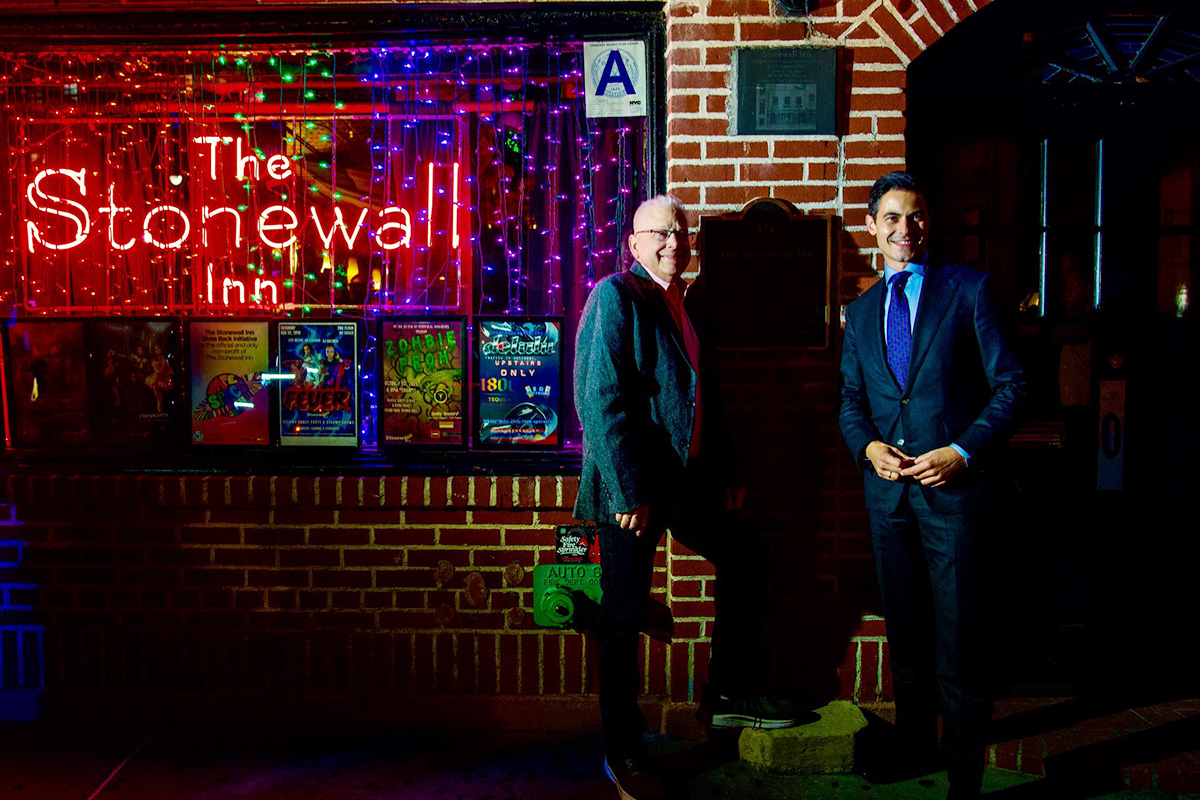
Dutch Prime Minister Rob Jetten on Monday visited the Stonewall Inn in New York.
“The Stonewall Inn is not just a gay bar in New York, but the place where in 1969 riots took place as a reaction to years of discrimination and police violence,” wrote Jetten on X. “This is seen as the starting point of the global LGBTIQ+ emancipation and activism. Nowadays, the bar is a national monument, dedicated to the LGBTIQ+ rights movement.”
“For me, it is impressive and moving to be here tonight. And also fitting, because the defense of human rights is an important part of our foreign policy,” he added. “The Netherlands stands alongside the Stonewall Inn community when it comes to everyone’s right to live openly, safely, and with pride, no matter who you are or who you love.”
De Stonewall Inn is niet zomaar een gay bar in New York, maar de plaats waar in 1969 rellen plaatsvonden als reactie op jarenlange discriminatie en geweld van de politie. Dit wordt gezien als startpunt van de wereldwijde lhbtiq+-emancipatie en activisme. Tegenwoordig is de bar… pic.twitter.com/hJmFYjF91Z
— Rob Jetten (@MinPres) September 23, 2026
Jetten in February became the Netherlands’s first openly gay prime minister.
He opened last month’s World Pride Human Rights Conference in Amsterdam. Jetten also participated in a panel with former Irish Prime Minister Leo Varadkar, former San Marino Captain Regent Paolo Rondelli, and other current and former heads of government who are gay or lesbian.
Jetten is scheduled to speak to the U.N. General Assembly on Thursday.
(Editor’s note: Jetten visited New York’s LGBT Community Center with New York City Mayor Zohran Mamdani before he left the city.)
Turkey
More than 150 people detained outside Istanbul courthouse
Protesters gathered after raids targeted Turkey’s LGBTQ+ community
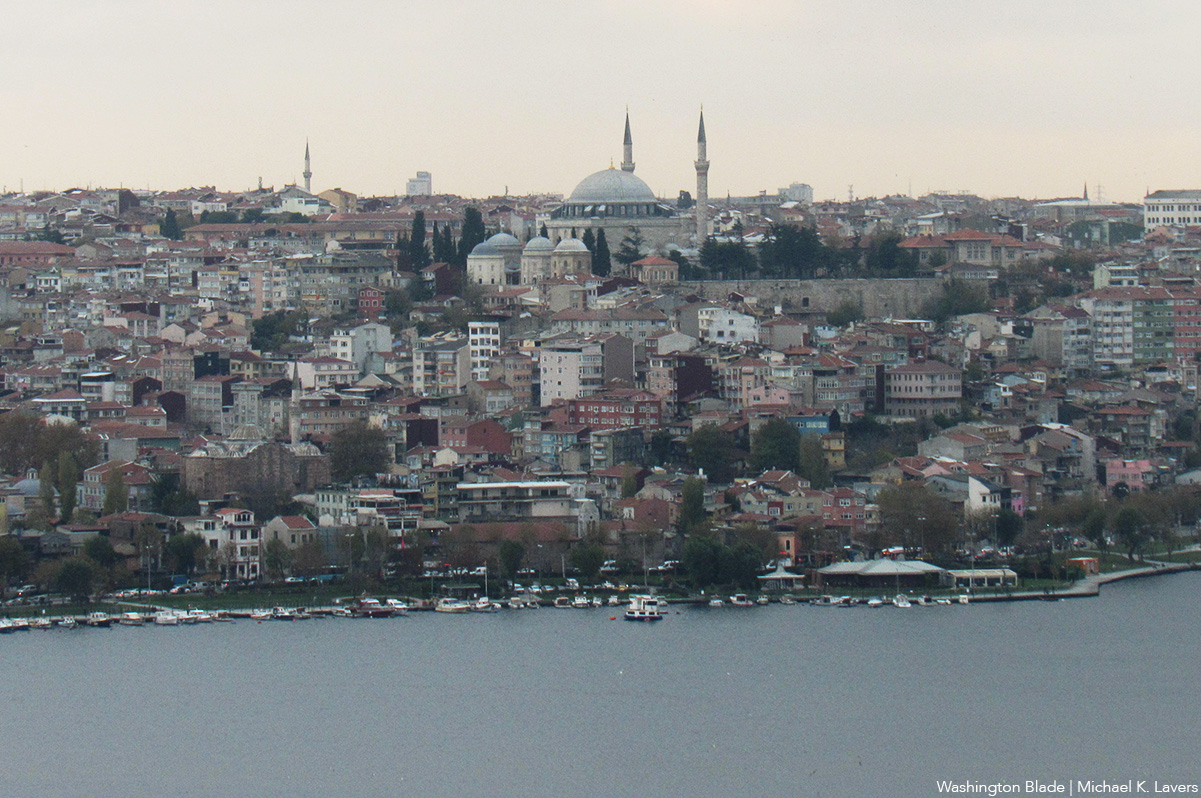
Turkish authorities on Tuesday detained more than 150 people who gathered outside an Istanbul courthouse to protest raids that targeted the country’s LGBTQ+ community.
CNN reported the protesters had planned to speak with reporters outside the city’s Caglayan courthouse, but authorities prevented them from doing so.
Turkish authorities over the weekend detained dozens of people in Istanbul and in other cities during raids that were part of the government’s “My Family is Safe” campaign.
A statement from a group of Turkish advocacy groups the Washington Blade received on Tuesday notes “at least 112 people have been detained in connection with the operations.” The organizations said 43 of those taken into custody are “LGBTI+ rights defenders,” and “at least” 62 of those detained “have been arrested, while judicial proceedings remain ongoing in Istanbul.”
“Among those arrested, at least 16 are LGBTI+ activists or individuals connected to LGBTI+ associations, including founders and members of association bodies,” reads the statement. “Per press statements by the prosecutor’s offices, dissolution cases will also be launched against associations.”
“The majority of those arrested are trans women who are charged with prostitution-related offences,” it adds. “While authorities have framed the operations as part of investigations into alleged crimes such as obscenity, prostitution and child exploitation, human rights defenders and civil society organizations have raised serious concerns regarding the use of criminal law mechanisms and public morality narratives to target legitimate LGBTI+ rights activities. Civil society views the ‘My Family is Safe’ narrative as a smokescreen to distract the public from deep economic crises and actual domestic violence, weaponizing moral panic to scapegoat LGBTI+ rights defenders, who have long been targeted by the government.”
The raids have sparked outrage among LGBTQ+ activists in Europe and elsewhere around the world.
The Congressional Equality Caucus and U.S. Rep. Carlos Giménez (R-Fla.) are among those who have publicly condemned them in the U.S. The Council for Global Equality on Friday is scheduled to hold a rally in support of Turkey’s LGBTQ+ community in front of the Turkish Embassy in Washington.
Hungary
New Hungarian government to scrap anti-LGBTQ+ adoption law
Prime Minister Peter Maygar ousted Viktor Orbán in April
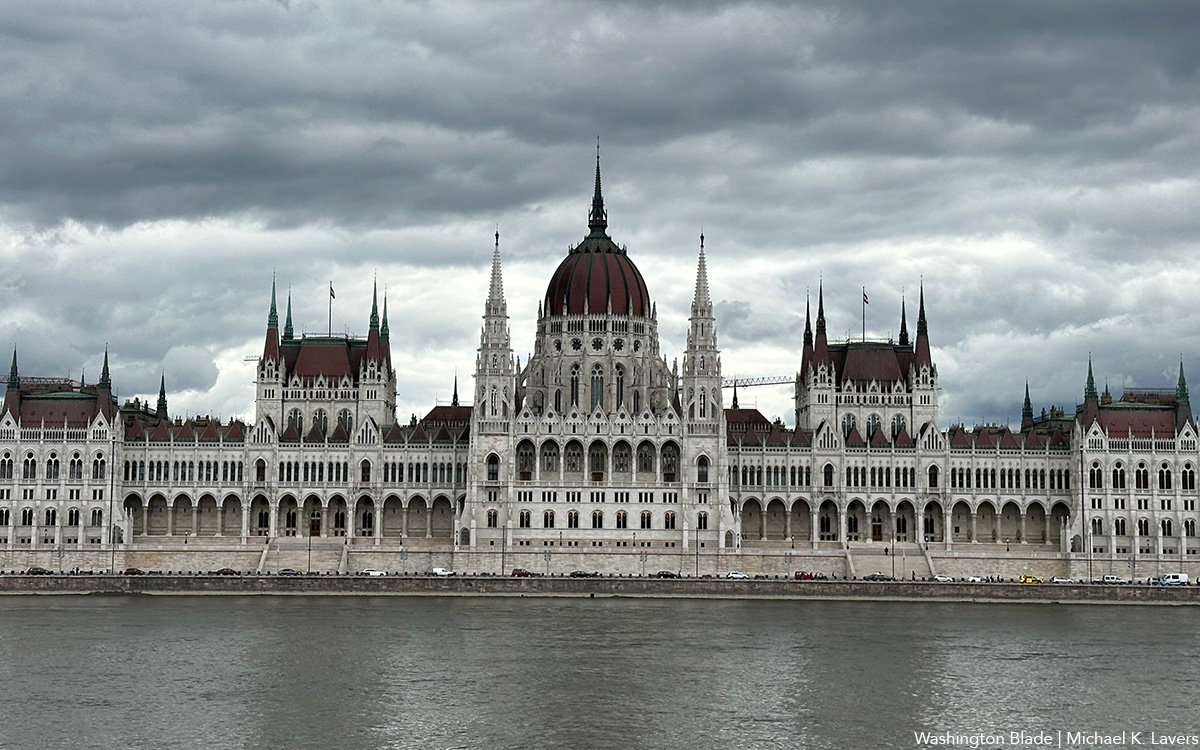
Hungarian Prime Minister Peter Maygar has said his government will amend a law that essentially bans same-sex couples from adopting children.
Lawmakers approved the effective adoption ban in 2020, when then-Prime Minister Viktor Orbán’s government was in power. Maygar announced plans to amend the law on Saturday when he was speaking to supporters in Budapest, the Hungarian capital.
Orbán and his government faced widespread criticism over its anti-LGBTQ+ crackdown that also included laws banning Pride events.
Maygar in April ousted Orbán in Hungary’s elections.
Turkey
Dozens detained after Turkish authorities raid LGBTQ groups, businesses
Raids targeted gay bars, activists’ homes
Authorities in Turkey over the weekend detained dozens of people during raids they carried out against gay bars and LGBTQ activists’ homes across the country.
The BBC reported the raids were part of the government’s “My Family is Safe” campaign.
A statement from a group of Turkish advocacy groups the Washington Blade received on Sunday noted Justice Minister Akın Gürlek said the operation included “162 individuals, nine associations, and 13 businesses across 15 provinces.” Prosecutors in Istanbul, Ankara, Izmir, Aydın, and Mersin are coordinating the campaign.
Kaos GL, one of the country’s largest advocacy groups, was among the targets.
“The authorities have referred to allegations including ‘obscenity,’ ‘facilitating prostitution or providing premises for prostitution,’ exposure of children to allegedly obscene content, drug-related offenses, and other morality-related offenses,” reads the press release the Blade received. “Information from the field indicates that additional allegations, including forming a criminal organization, may appear in some investigation files.”
“The reported inclusion of the offense of “establishing an organization for the purpose of committing crimes” under Article 220 of the Turkish Criminal Code is particularly alarming and, if confirmed, would mark a significant escalation in the criminalization of LGBTI+ human rights activism,” it added. “While LGBTI+ activists and organizations have recently faced and continue to face investigations and prosecutions on grounds such as ‘obscenity’ and alleged violations of the Law on Associations, the use of an organized-crime allegation represents a qualitatively more serious threshold, both in terms of the gravity of the accusation and the potential penalties involved.”
Turkish authorities under President Recep Tayyip Erdoğan’s government over the last decade have cracked down on LGBTQ and intersex activists in the country.
Police in 2015 used tear gas and water cannons against people who were about to participate in an Istanbul Pride march. Authorities in 2017 arrested nearly two dozen people who defied a ban on Pride events in the city.
Police in Ankara, the Turkish capital, in 2019, arrested 18 students and an academic who participated in a Pride march at the Middle East Technical University. They faced up to three years in prison, but a court in 2021 acquitted them. Police in 2022 violently broke up a Pride parade at the same Ankara university.
Turkish authorities in July refused to allow a gay cruise ship — the Scarlet Lady, a Virgin Voyage vessel that Atlantis Events chartered — to dock in Kusadasi, a resort town on the Aegean Sea.
Kusadasi is in Aydın Province, one of the provinces in which authorities conducted the raids. Turkish officials also refused to allow the Scarlet Lady to dock in Istanbul.
A Turkish source on Sunday told the Blade the “My Family is Safe” operation began on the 46th anniversary of a military coup that toppled the country’s government in 1980.
“The fact that this operation began on the night of Sept. 12 — the 46th anniversary of the 1980 coup — is highly significant in terms of the foundations of the prohibitive and repressive mindset directed at the LGBTI+ community,” they said. “Moreover, many LGBTI+ organizations had been subject to official inspections last week.”
“Conducting this operation on a Saturday night shortly thereafter also serves the purpose of heightening fear and anxiety within the community,” added the source.
The source asked the Blade not to reveal their identity.
ILGA-Europe in a statement described the raids as “the systematic dismantling of LGBTI civil society.” Paris Mayor Emmanuel Grégoire is among the European officials who have publicly condemned them.
The Blade will update this story with additional details as they become available.
United Kingdom
Grindr settles UK lawsuit over claims it shared users’ personal information
Plaintiffs allege gay hookup company disclosed HIV status to third parties

Grindr has agreed to pay £26 million ($35.24 million) to settle a lawsuit in the UK over allegations it shared users’ HIV status and other personal information with third parties.
The BBC on Monday reported a lawsuit was filed in the High Court of England and Wales in 2024. A class action lawsuit with more than 11,000 plaintiffs was later filed in the U.S.
Grindr in a U.S. Security and Exchange Commission filing notes the California-headquartered company as part of the settlement it reached on Sept. 2 will pay £13.0 million ($17.62 million) “to the counterparties” by Dec. 31, 2026, and another £13.0 million ($17.62 million) by March 31, 2027.
“As previously disclosed, in April 2025, Grindr Inc. and Grindr LLC, its indirect and wholly-owned operating subsidiary (collectively, ‘Grindr’), were served with proceedings in the High Court of England and Wales, which proceedings were originally issued in April 2024, brought on behalf of UK Grindr users from a period up to early 2020 alleging violations of UK privacy laws,” reads the U.S. Security and Exchange Commission filing.
“On Sept. 2, 2026, Grindr resolved the above-described UK group action related to historical data practices before 2020, when Grindr was owned and controlled by the Chinese conglomerate Kunlun,” it continues. “The settlement includes no findings or admission of liability. While Grindr disputes the allegations, it recognizes and acknowledges the distress and loss of trust expressed by some of its UK users regarding that pre-2020 period.”
The filing further notes Grindr in 2020 “was sold to new owners and appointed new management” and in 2022 became a publicly listed company on the New York Stock Exchange.
“Since 2020 Grindr has overhauled its privacy program with a keen focus on the unique needs of its community,” reads the filing. “Grindr is and remains a safe space for users, committed to transparency, user control, and responsible data practices.”
A Grindr spokesperson in the UK on Tuesday referred the Los Angeles Blade to the filing for comment on the settlement.
Iceland
Iceland implements gender-neutral blood donor rules
New regulations took effect Sept. 1, allow more LGBTQ+ people to donate

New rules that will allow more gay and bisexual men to donate blood in Iceland took effect on Sept. 1.
The Iceland Review, an English-language magazine, notes the new regulations the country’s Health Ministry approved are gender-neutral. Some restrictions, however, remain in place for potential donors, regardless of their sexual orientation or gender identity.
“Specific sexual activity can be linked to higher risk of bloodborne infections, therefore thorough screening is very important in regards to blood donor eligibility,” states the Icelandic Blood Bank on its website.
Potential donors are asked these two questions:
• In the past four months, have you had sex with a new partner?
• In the past four months, have you engaged in what is considered sexual relation of higher risk?
The Icelandic Blood Bank defines “sexual relation of higher risk” as:
• Sexual relation where a condom is not used and relationship duration is less than 4 months.
• Sexual relation outside of pre-existing long-term relationship, where a condom is not used.
• Sexual relation with many individuals (more than one) with/without a condom.
• Sexual relation, where a condom is not used, with an individual whose behavior falls under sexual relation of higher risk.
• Sexual relation where a condom is not used, with an individual that injects narcotics. If more than four months have passed since the last injection, donation is permitted.
• Sexual relation, with/without the use of condom, in exchange for payment.
• Anal sex with/without a condom with a new partner.
• Sexual relation where chemicals are used to enhance sexual experience (chemsex).
• Sexual relation with/without the use of a condom, with an individual diagnosed with HIV, HTLV, Hepatitis B or C, or syphilis.
• Sexual relation with an individual using viral medication (PrEP or PEP) for HIV.
“If yes, evaluation for possible deferral from blood donation needs to be done,” says the Icelandic Blood Bank.
A person with HIV, Human T-lymphotropic virus-1, hepatitis B or C, or syphilis cannot donate blood. A person who has taken PrEP or PEP in the previous four months is also unable to become a donor.
“If more than four months have passed since the medication was taken, viral screening can be done,” says the Icelandic Blood Bank. “If results are negative, blood donation is permitted. Deferral period is longer if administrated intravenously.”
Any potential donor who had “sexual relation with an individual using viral medication (PrEP or PEP) for HIV” must wait four months since their “last sexual relation” before they can give blood.
Anyone who has “ever, even just once, shared a needle/syringe with someone or injected yourself with an illegal substance (non- doctor prescribed), e.g. drugs, anabolic steroids, hormones or peptides.” is permanently prohibited from donating blood.
Iceland is the latest country to lift restrictions for LGBTQ+ blood donors.
The Australian Red Cross Blood Service in April implemented a new policy that allows “gay and bisexual men and transgender people in long-term monogamous relations (of at least six months) to donate blood and platelets for the first time.”
The U.S. Food and Drug Administration in 2023 implemented a new screening policy for potential donors that asked them questions about their sexual activity, regardless of their sexual orientation or gender identity. The previous policy required men who have sex with men to not have sex for at least three months before they could donate blood.
Switzerland
Swiss government backs nationwide conversion therapy ban
Several cantons have already prohibited widely discredited practice
The Swiss government has said it supports a nationwide ban on so-called conversion therapy.
The Swiss Broadcasting Corporation on its website notes the government officially announced its position in a report it published on Wednesday.
Neuchâtel in 2023 became the first Swiss canton to ban conversion therapy.
Lawmakers in Valais and Vaud have also prohibited the widely discredited practice in their respective cantons. Bern and Geneva are among the other cantons in which lawmakers have considered similar prohibitions.
The European Commission earlier this year said all European Union countries should ban conversion therapy.
Switzerland is not a member of the EU, but lawmakers in neighboring Germany in 2020 passed a law that prohibits conversion therapy for minors and for adults who have not consented to undergoing the widely discredited practice.
Several EU countries — Belgium, Cyprus, France, Malta, Norway, Portugal, and Spain — have banned conversion therapy outright.
The Dutch Senate in June approved a bill that would ban conversion therapy in the Netherlands. The lower house of the country’s parliament approved the measure in September 2025.
Greece in 2022 banned conversion therapy for minors.
Bulgaria
Top Bulgarian court rules government must legally recognize trans people
Decision caps off decade-long legal fight
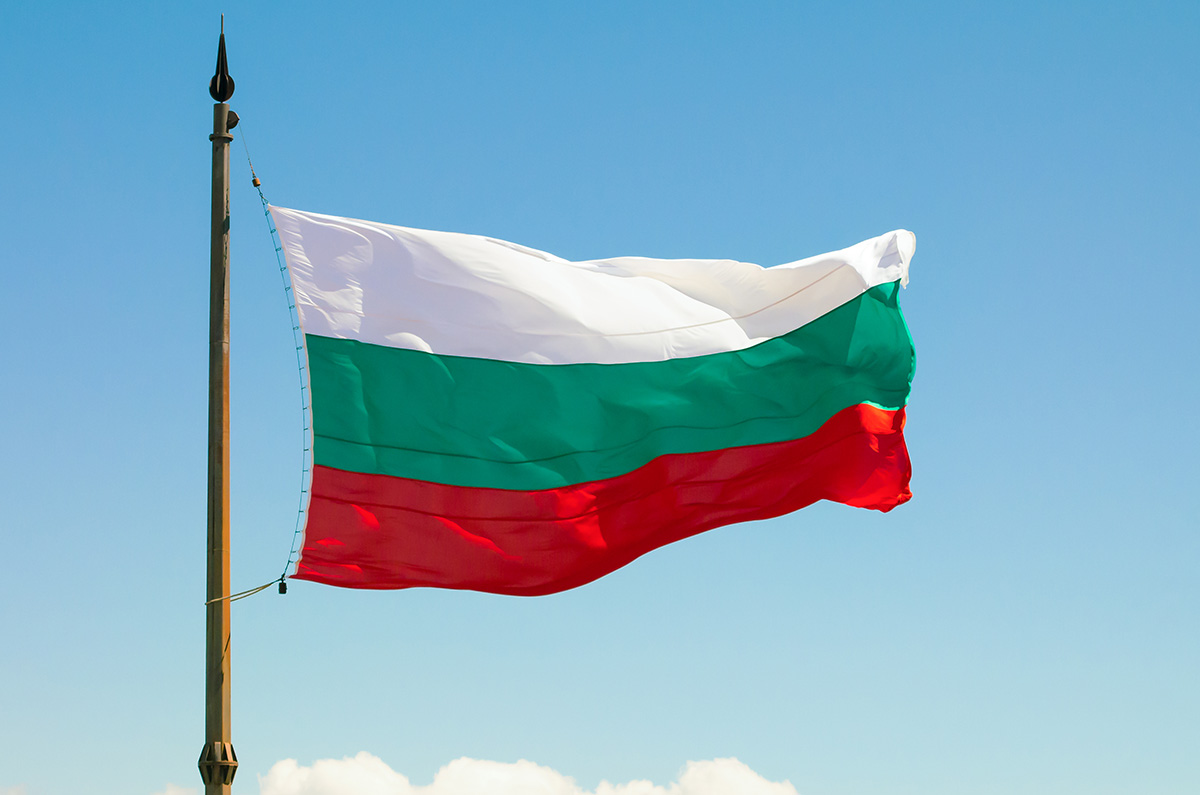
Bulgaria’s top court has ruled the country’s government must allow transgender people to legally change their name and gender on ID documents.
A trans woman from Bulgaria who moved to Italy, had tried to change her gender and name on her Bulgarian ID documents, but courts in the country denied her requests for nearly a decade.
The Bulgarian Supreme Court of Cassation in a 2023 ruling essentially banned trans people from legally changing their name and gender on ID documents.
The EU Court of Justice in Luxembourg, which is the European Union’s highest court, in March ruled in the “Shipova” case that member states must allow trans people to legally change their name and gender on ID documents. The lead plaintiff in the “Shipova” case is among the four litigants in the Bulgarian Supreme Court of Cassation case.
Two Bulgarian advocacy groups — Bilitis and Deystvie — along with TGEU – Trans Europe and Central Asia and ILGA-Europe in a joint statement they issued on Tuesday noted the Bulgarian Supreme Court of Cassation’s July 22 decision “aligns Bulgarian practice with the Court of Justice of the EU, enabling changes to gender markers, names, and personal identification numbers.”
“The judges also concluded that EU law requires Bulgaria to establish a legal procedure for legal gender recognition, which is necessary so that Bulgarian trans citizens can travel and reside freely inside the EU,” they added.
Bulgaria has been a member of the EU since 2007.
The country borders Romania, Serbia, North Macedonia, Greece, and Turkey.
“We are very glad to see that the judges of the Supreme Court clearly stated that it is actually a matter of rule of law for Bulgaria to respect the universal equality and the dignity of all human beings, including trans people for whom human rights-based legal gender recognition procedures are an indispensable element,” said Denitsa Lyubenova, co-chair of Deystvie who represented the four plaintiffs in the Bulgarian courts and the lead litigant in the “Shipova” case at the EU Court of Justice. “The government needs to act swiftly now to put in place an LGR procedure that is fully in line with European human rights case law, which means without any conditions requiring proof of medical, surgical or hormonal treatment.”
The groups also urged the Bulgarian government to codify the ruling into law.
“While lower courts are expected to follow this ruling directly, a court decision is not a substitute for law,” they said. “Bulgaria still needs a fast, transparent, and accessible legal gender recognition procedure written into legislation, not left to case-by-case court precedent. TGEU – Trans Europe and Central Asia, Bilitis, Deystvie, and ILGA-Europe call on the Bulgarian government to start that legislative process now, with meaningful involvement from civil society.”
France
Prominent French activist attacked outside Paris bar
Pierre Picavet hospitalized with internal bleeding, head injury
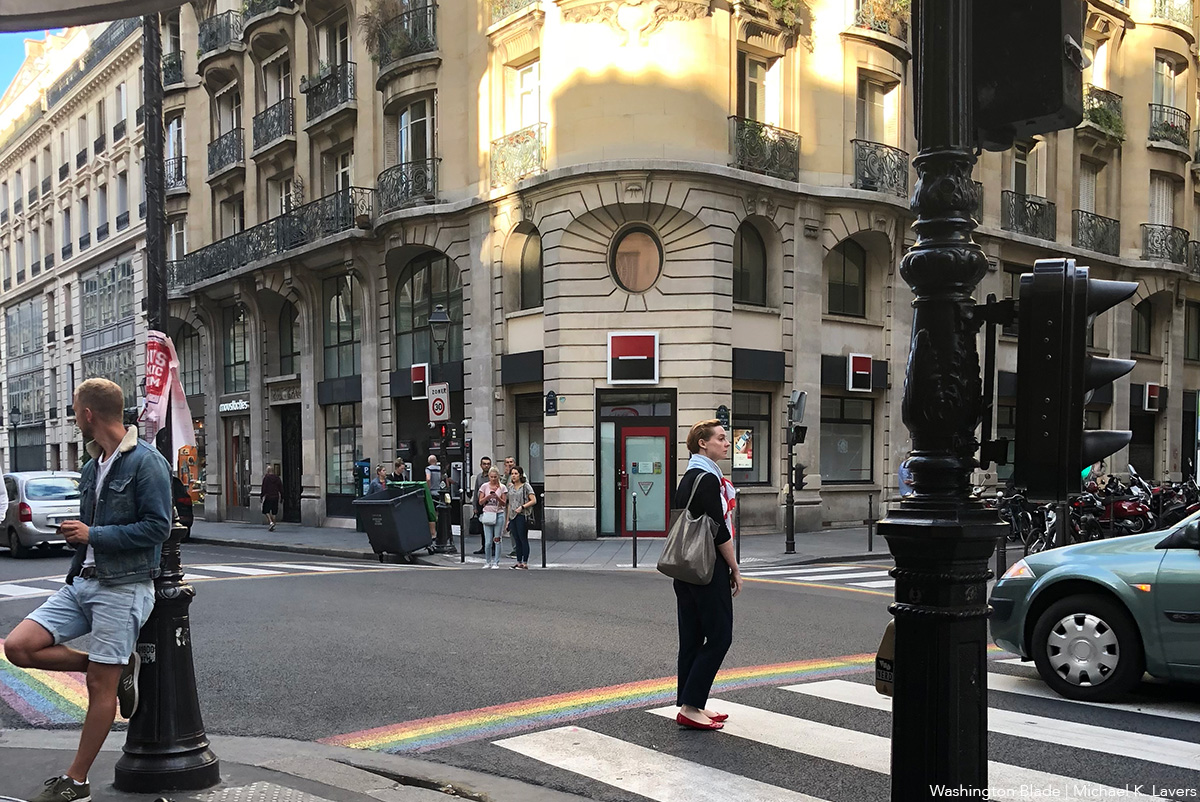
French prosecutors say a man shouted anti-gay slurs at a prominent activist before he attacked him in Paris on Saturday.
Media reports indicate Pierre Picavet, a police officer who is the president of FLAG!, a group within the French Justice and Interior Ministries that defends LGBTQ+ rights, was attacked as he left a bar in Paris’s Marais neighborhood.
The Marais since the 1980s has been center of the French capital’s LGBTQ+ community.
France 24 reported Picavet’s assailant struck him with a bottle. The attack left Picavet hospitalized with internal bleeding, a head wound, and other injuries.
“When I get better, when my wounds have healed, I will continue the fight,” Picavet told Radio France on Monday. “I am particularly shocked, but it tells me that there is still work to do.”
Paris Mayor Emmanuel Grégoire is among those who condemned the attack.
STOP Homophobia (STOP homophobie), a French group that fights against anti-LGBTQ+ violence, on its social media pages published a picture of Picavet in the hospital.
“As a long-standing partner of FLAG!, STOP Homophobia wishes to express its solidarity with Pierre Picavet, his loved ones, and the entire association,” said the group. “STOP Homophobia condemns this assault in the strongest possible terms and reiterates that anti-LGBT violence remains a reality — even in spaces where everyone should be able to move freely and live out their sexual orientation or gender identity without fear of attack.”
STOP Homophobia also praised a bystander who came to Picavet’s aid after the attack, and the first responders and law enforcement personnel who responded.
“STOP Homophobia extends its full support to Pierre, his family, his loved ones, and the entire FLAG! team, and wishes him a full recovery,” said the group.
Reports indicate the assailant, who was born in 2006, was scheduled to appear in a Paris court on Monday at 1:30 p.m. local time.

‘(Out) On the Road’ revels and reveals the joys of queer travel

Ana Brnabić becomes world’s first openly lesbian head of state

529 openly LGBTQ+ candidates running in Brazilian election

Governor Newsom signs 6 pro-LGBTQ bills, vetoes 1

Science takes the runway: HIV Unwrapped at NYFW

Turning grief into advocacy: Debbie Allen shares on loss, love, and the power of speaking out

The trans Handy Ma’am helps where it matters most – at home

Education Department rolls back protections for LGBTQ+ students under Title IX

Lesbian Bar Project co-founder: purity politics could destroy our remaining spaces

‘Lizzie Borden’ might be the best ‘Monster’ yet
-
 AIDS and HIV5 days ago
Turning grief into advocacy: Debbie Allen shares on loss, love, and the power of speaking out
-
 a&e features5 days ago
The trans Handy Ma’am helps where it matters most – at home
-
 National3 days ago
Education Department rolls back protections for LGBTQ+ students under Title IX
-
 Bars & Parties2 days ago
Lesbian Bar Project co-founder: purity politics could destroy our remaining spaces
-
 Television5 days ago
‘Lizzie Borden’ might be the best ‘Monster’ yet
-

 National2 days ago
HRC report: LGBTQ+ students face ‘far greater challenges’ in non-supportive states
-
 California2 days ago
Governor Newsom signs 6 pro-LGBTQ bills, vetoes 1
-
 AIDS and HIV2 days ago
Science takes the runway: HIV Unwrapped at NYFW
-

 Gaming4 days ago
Free slot tournaments are the casino game Californians can play online right now
-
 Brazil2 days ago
529 openly LGBTQ+ candidates running in Brazilian election