
Hungary
Hungarian authorities lift Budapest Pride ban
Country’s new government took office last month
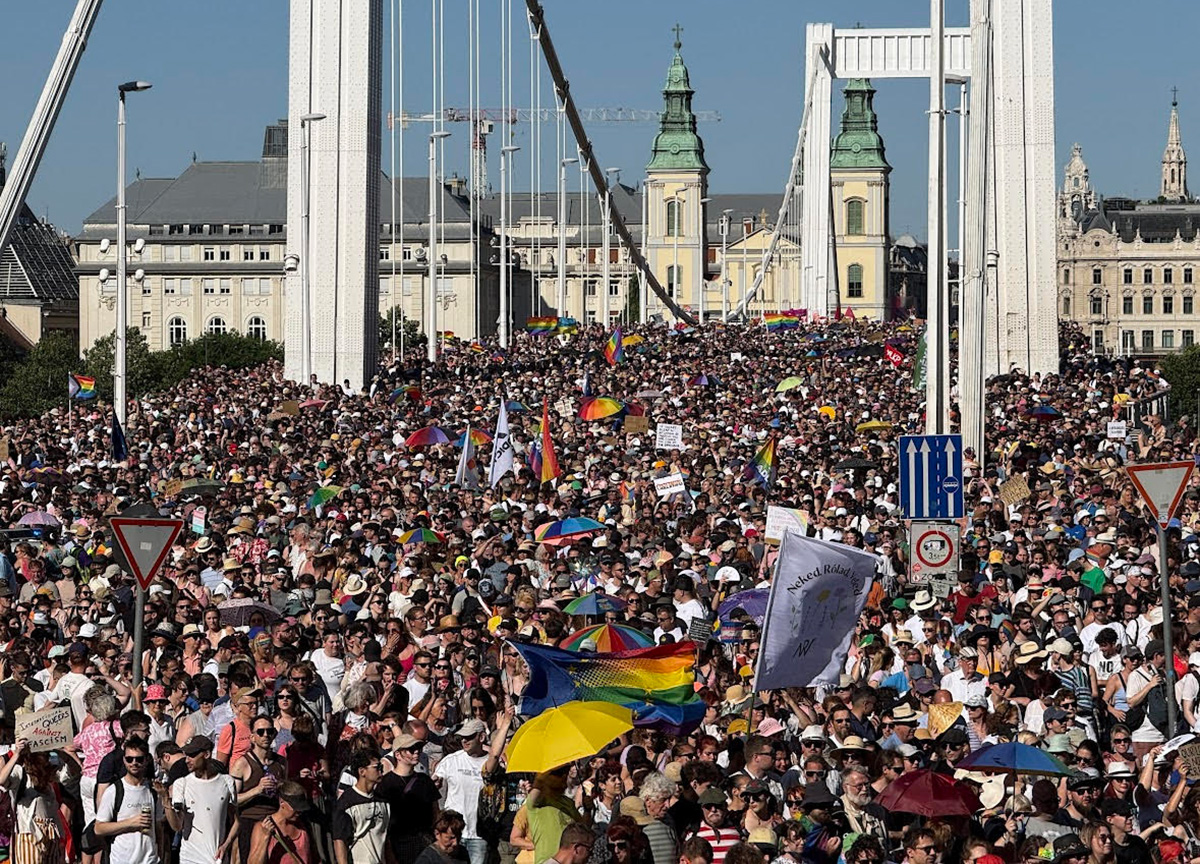
Hungarian police on May 29 announced they will allow the annual Budapest Pride march to take place.
“The Budapest Metropolitan Police has approved the 2026 Budapest Pride Parade and also has issued restrictive orders in relation to three counter-demonstrations,” a Budapest Metropolitan Police spokesperson told Politico.
Budapest is Hungary’s capital and largest city.
Hungarian lawmakers last year passed a bill that banned Pride events and allowed authorities to use facial recognition technology to identify participants. MPs later amended the Hungarian constitution to ban public LGBTQ+ events.
More than 100,000 people defied the ban and participated in last year’s Budapest Pride parade. The event became one of the largest protests against then-Prime Minister Viktor Orbán and his government since he took office in 2010.
Prime Minister Péter Magyar took office last month after his center-right Tisza party ousted Orbán’s Fidesz-KDNP coalition in elections that took place on April 12. The European Union’s top court, the EU Court of Justice, days after Orbán’s ouster struck down Hungary’s anti-LGBTQ+ propaganda law that MPs approved in 2021.
The EU on May 29 announced it will release more than €16 billion ($18.59 billion) in funds to Hungary that it withheld while Orbán was in office.
The Budapest Pride march will take place on June 27.
“We will march freely in fresh air for our rights, for the democratic Hungary,” said Budapest Pride on its Facebook page.




Hungary
Hungarian lawmakers approve bill to remove anti-LGBTQ+ provisions from ‘child protection’ law
Prime Minister Peter Magyar’s government took office in May
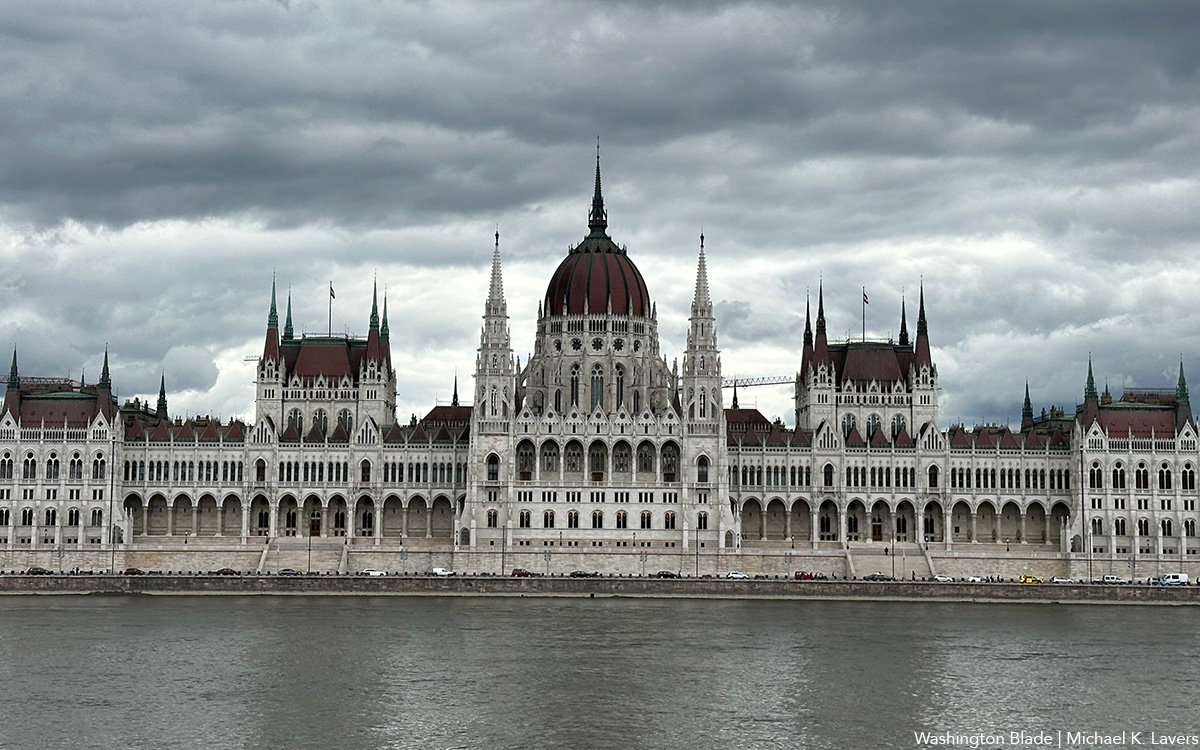
Hungarian lawmakers on Tuesday by a 139-51 vote margin approved a bill that would remove anti-LGBTQ+ provisions from a 2021 “child protection” law the country’s former prime minister championed.
“It shall be forbidden to make accessible to persons who have not attained the age of 18 years advertisement that depicts sexuality in a gratuitous manner or that propagates or portrays divergence from self-identity corresponding to sex at birth, sex change or homosexuality,” reads Act LXXIX of 2021 that MPs approved in 2021.
The European Commission in 2022 challenged the law. Sixteen EU countries eventually joined the lawsuit against it.
Then-Prime Minister Viktor Orbán’s government defended the law. The EU’s top court, the EU Court of Justice, earlier this year struck it down. The BBC reported the EU after Tuesday’s vote released €4.2 billion ($4.67 billion) in funds it froze while Orbán’s government was in office.
“We are very happy that this got adopted,” Tamás Dombos of the Háttér Society, a Hungarian LGBTQ+ rights group, told the BBC. “We’ve been fighting this so-called child protection law for five years. There have been problems with the bill submitted to parliament, but most of those problems have been fixed.”
Péter Magyar became the country’s prime minister in May after his center-right Tisza party defeated Orbán’s Fidesz-KDNP coalition in elections that took place on April 12.
The new Hungarian government in June allowed the annual Budapest Pride march to take place in the country’s capital without restrictions — MPs in 2025 passed a bill that banned Pride events, and amended the Hungarian constitution to prohibit public LGBTQ+ events.
Magyar last month announced his government would amend a law that essentially bans same-sex couples from adopting children.
Hungary
New Hungarian government to scrap anti-LGBTQ+ adoption law
Prime Minister Peter Maygar ousted Viktor Orbán in April
Hungarian Prime Minister Peter Maygar has said his government will amend a law that essentially bans same-sex couples from adopting children.
Lawmakers approved the effective adoption ban in 2020, when then-Prime Minister Viktor Orbán’s government was in power. Maygar announced plans to amend the law on Saturday when he was speaking to supporters in Budapest, the Hungarian capital.
Orbán and his government faced widespread criticism over its anti-LGBTQ+ crackdown that also included laws banning Pride events.
Maygar in April ousted Orbán in Hungary’s elections.
Hungary
Tens of thousands participate in post-Orbán Budapest Pride march
New government allowed event to take place without restrictions

Tens of thousands of people on Saturday took part in the annual Budapest Pride march in the Hungarian capital.
The march took place less than two months after new Prime Minister Péter Maygar took office.
Hungarian lawmakers in 2025 passed a bill that banned Pride events and allowed authorities to use facial recognition technology to identify participants. MPs later amended the Hungarian constitution to ban public LGBTQ+ events.
More than 100,000 people defied the ban and participated in last year’s Budapest Pride parade. The event became one of the largest protests against then-Prime Minister Viktor Orbán and his government since he took office in 2010.
Magyar’s center-right Tisza party ousted Orbán’s Fidesz-KDNP coalition in elections that took place on April 12. The European Union’s top court, the EU Court of Justice, days after Orbán’s ouster struck down Hungary’s anti-LGBTQ+ propaganda law that MPs approved in 2021.
Hungarian police last month announced they would allow the Budapest Pride march to take place without restrictions.
Authorities subsequently dropped charges against Budapest Mayor Gergely Karácsony over his role in organizing the city’s 2025 Pride march. Officials in Pécs, a city near Hungary’s border with Croatia, have also dropped charges against Géza Buzás-Hábel, who organized a 2025 Pride event.
Hungary
Charges against Budapest mayor for organizing Pride march dropped
Country’s new government took office last month
Hungarian authorities on Thursday dropped charges against Budapest Mayor Gergely Karácsony over his role in organizing the city’s 2025 Pride march.
Karácsony spoke at the event, even though then-Prime Minister Viktor Orbán’s government banned it.
More than 100,000 people defied the ban and participated in the march that took place on June 28, 2025. The Associated Press notes the Budapest Chief Prosecutor’s Office in January charged Karácsony with “organizing the unlawful assembly despite a prohibition order.”
Karácsony, who has been Budapest’s mayor since 2019, described himself as a “proud defendant” after his indictment.
“It seems that in this country, this is the price you pay if you stand up for your own freedom and the freedom of others,” he said in a statement, according to the AP. “If anyone thinks they can ban me, deter me, or prevent me and my city from doing so, they are gravely mistaken.”
Budapest is Hungary’s capital and largest city.
Prime Minister Péter Magyar took office last month after his center-right Tisza party ousted Orbán’s Fidesz-KDNP coalition in elections that took place on April 12.
Hungarian police on May 29 announced they will allow the Budapest Pride march to take place this year.
The European Union’s top court, the EU Court of Justice, days after Orbán’s ouster struck down Hungary’s anti-LGBTQ+ propaganda law that MPs approved in 2021. The BBC notes Hungarian authorities cited the decision in their decision to drop the charges against Karácsony.
Authorities in Pécs, a city near Hungary’s border with Croatia, have also dropped charges against Géza Buzás-Hábel, who organized a 2025 Pride event.
Hungary
New Hungarian prime minister takes office
Péter Magyar’s party defeated anti-LGBTQ+ Viktor Orbán last month

Hungarian Prime Minister Péter Magyar took office on Saturday.
Magyar’s center-right Tisza party on April 12 defeated then-Prime Minister Viktor Orbán’s Fidesz-KDNP coalition. Vice President JD Vance less than a week before the election traveled to Budapest, the Hungarian capital, and urged Hungarians to support Orbán.
Orbán had been in office since 2010. He and his government faced widespread criticism over its anti-LGBTQ+ crackdown.
The European Commission in 2022 sued Hungary, which is a member of the EU, over the country’s anti-LGBTQ+ propaganda law. The European Union’s top court, the EU Court of Justice, on April 21 struck down the statute.
The EU while Orbán was office withheld upwards of €35 billion ($41.26) in funds to Hungary in response to concerns over corruption, rule of law, and other issues.
Hungarian lawmakers in March 2025 passed a bill that banned Pride events and allowed authorities to use facial recognition technology to identify those who participate in them. MPs later amended the Hungarian constitution to ban public LGBTQ+ events.
Upwards of 100,000 people last June defied the ban and marched in Budapest’s annual Pride parade.
“Congratulations to [Péter Magyar] on becoming prime minister of Hungary,” said European Commission President Ursula von der Leyen on X.
“This Europe Day, our hearts are in Budapest,” she added. “The hope and promise of renewal is a powerful signal in these challenging times.”
“We have important work ahead of us,” noted von der Leyen. “For Hungary and for Europe, we are moving forward together.”
European Union
Top EU court strikes down Hungary’s anti-LGBTQ+ propaganda law
Ruling issued days after voters outed Prime Minister Viktor Orbán

The European Union’s top court on Tuesday struck down Hungary’s anti-LGBTQ+ propaganda law.
Hungarian MPs in 2021 approved Act LXXIX of 2021.
“It shall be forbidden to make accessible to persons who have not attained the age of 18 years advertisement that depicts sexuality in a gratuitous manner or that propagates or portrays divergence from self-identity corresponding to sex at birth, sex change or homosexuality,” it reads.
The European Commission in 2022 challenged the law. Sixteen EU countries — Austria, Belgium, Denmark, Estonia, Finland, France, Germany, Greece, Ireland, Luxembourg, Malta, the Netherlands, Portugal, Slovenia, Spain, and Sweden — joined the lawsuit. The European Parliament also supported it. Outgoing Hungarian Prime Minister Viktor Orbán, for his part, said his government would defend the law.
The EU Court of Justice heard the case in 2024.
A press release that announced the ruling on Tuesday said Hungary “acted in breach of EU law.”
“The court finds, for the first time, a separate infringement of Article 2 TEU (Treaty on European Union), which lists the values on which the (European) Union is founded and which are common to all the Member States,” it reads. “The aspects of the amending law targeting content which portrays or promotes deviation from the self-identity corresponding to the sex assigned at birth, gender reassignment, or homosexuality constitute a coordinated series of discriminatory measures which are in breach, in a way that is both manifest and particularly serious, of the rights of non-cisgender persons — including transgender persons — or non-heterosexual persons, as well as the values of respect for human dignity, equality and respect for human rights, including the rights of persons belonging to minorities.”
“Consequently, that law is contrary to the very identity of the (European) Union as a common legal order in a society in which pluralism prevails,” notes the press release. “Hungary cannot validly rely on its national identity as justification for adopting a law which is in breach of the values referred to above.”
The Háttér Society, a Hungarian LGBTQ+ rights group, said the ruling “is a milestone for the protection of human rights in the European Union, and it is also a historic victory for LGBTQI people in Hungary.”
The court issued its ruling nine days after Péter Magyar ousted Orbán in Hungary’s elections.
Orbán took office in 2010.
He and his government faced widespread criticism over its anti-LGBTQ+ crackdown that included laws that banned Pride events and other public LGBTQ+ events. (Upwards of 100,000 people last June denied the prohibition and marched in Budapest’s annual Pride parade.)
“Those amendments constitute a particularly serious interference with several fundamental rights protected by the (EU) Charter (of Fundamental Rights), namely the prohibition on discrimination based on sex,” notes the court’s press release.
The EU since Orbán took office has withheld upwards of €35 billion ($41.2 billion) in funds to Hungary in response to concerns over corruption, rule of law, and other issues. Magyar has said he will work with Brussels to unfreeze the money.
ILGA-Europe Deputy Director Katrin Hugendubel urged Maygar’s government to repeal the law.
“With this ruling, the CJEU (The EU Court of Justice) is confirming what we have been saying for six years,” said Hugendubel. “There is now no excuse for the Commission not to require Hungary to quickly withdraw the law. Hungary cannot enter a post-Orbán era without repealing this legislation, including the Pride ban.”
“If Péter Magyar truly aims to be pro-EU, he must place this at the top of his agenda for his first 100 days in office, as an essential part of his EU facing reforms,” added Hugendubel.

Immunology gave HIV survivors the chance to grow old, Proposition 38 is the next step

Common Sense Isn’t Political

‘WOOF’ worthy: Christopher Schellenger shares the unique challenges of playing a dog

Here’s your Palm Springs look at the weekend: Oct 23 – 25, 2026

Latin queer and trans history along the U.S.- Mexico border on display at UC Riverside event

Meet the voice of Palm Springs: an interview with KGAY 103.1’s John Taylor

Fortune Feimster has always taken representation through comedy seriously

EXCLUSIVE: Democrats seek answers on EEOC settlement affecting LGBTQ+ workers

A quick visitor’s guide to Palm Springs before the winter

VIDEO: Interview with executive director of VoteLGBT (Institute for Full Citizenship) in Brazil
-
 Palm Springs4 days ago
Meet the voice of Palm Springs: an interview with KGAY 103.1’s John Taylor
-
 a&e features4 days ago
Fortune Feimster has always taken representation through comedy seriously
-
 Federal Government3 days ago
EXCLUSIVE: Democrats seek answers on EEOC settlement affecting LGBTQ+ workers
-
 Palm Springs4 days ago
A quick visitor’s guide to Palm Springs before the winter
-
 Brazil3 days ago
VIDEO: Interview with executive director of VoteLGBT (Institute for Full Citizenship) in Brazil
-
 Puerto Rico4 days ago
Annual National Trans Visibility March takes place in Puerto Rico
-

 AIDS and HIV4 days ago
AIDS Walk Los Angeles takes to the streets in West Hollywood while raising money for HIV/AIDS Care
-

 Television4 days ago
New ‘Carrie’ attempts to reinvent a classic for new generation
-

 California3 days ago
Nithya Raman makes her case for LGBTQ voters in the race for LA Mayor
-

 Commentary2 days ago
Those dreadful ballot propositions are important