a&e features
‘Queer Eye’s’ Bobby Berk offers dishy, celeb-heavy Q&A
Careful budgeting, understanding tax implications are key
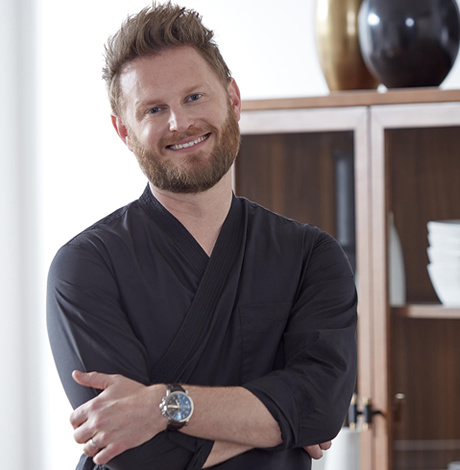
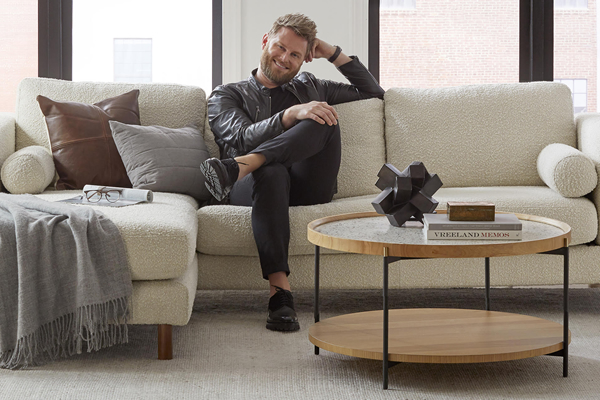
Bobby Berk of ‘Queer Eye’ fame says his new line for ART Furniture has already been warmly received. (Photo courtesy Gardner Group)
Bobby Berk, one of the “Queer Eye” Fab Five, has been making appearances unveiling his new line for A.R.T. Furniture. His designs are available at Ace Furniture (616 N. Western Ave.) in Los Angeles and Furniture Land (4310 San Fernando Rd.) in Glendale. Full details at arthomefurnishings.com.
He spoke to the Blade last week by phone from his home in Los Angeles about his designs, his costars, his gal pal Taylor Swift, his Hollywood adventures and a whole lot more.
BLADE: How’s 2020 been for you so far?
BOBBY BERK: 2020’s been great, very busy. Just wrapped up shooting a podcast a few minutes ago, I’ve got your interview, then I’m running to do a live interview with Channel 9 in Sydney Australia. Been filming some additional shows, been doing a lot of stuff with “Queer Eye,” a lot of great things with my furniture lines, so 2020 already feels like it’s been a full year.
BLADE: Tell us about your new designs.
BERK: So my new furniture line with ART, it’s great because you know people ask me, fans from the show all the time, you know, “I wish you could decorate my house, I with you could pick out furniture for me,” and obviously I can’t with everyone so I wanted to create a line that was accessible to almost anyone. I think it would have been kind of a dick move of me to talk on “Queer Eye” about how changing your home and help change your life and then go out and make a super expensive furniture line that nobody could afford. So I wanted to make sure I partner with a company like ART who is really good at finding that perfect happy medium on price points to where you’re getting good quality furniture but you’re also getting it at a price point that most people can afford.
BLADE: What was the production timeframe roughly?
BERK: I believe we started the process when I was filming season three and four so that would have been late 2018, I think. … We launched it by spring of 2019 … (which) that was for stores to be able to come look at it like Belfort. Then by the time fall hit, it was in a lot of stores. And now this spring … additional stores are getting it that we weren’t able to fulfill in the very beginning first order. We’re dong 10 in about two months, then we’re going to be launching the second collection as well.
BLADE: How has the reaction been so far?
BERK: It’s been a very great reaction. We have had to stage out when retailers like Belfort start to carry it simply because there was such a great response to it, that we couldn’t open up all the stores that were wanting it. When we launched online, back in the fall, a lot of items instantly went out of stock, so it’s been a really great response. You know, it was a line that inspired by things that I would want in my own home so nice, cool, clean aesthetic that can really go with anyone’s decor. When I design, I always try to make sure I think about the ways a piece can not just look good in a home where people like modern, but also a traditional home. My sofas, for example, can bridge the gap between traditional, transitional and modern.
BLADE: To what degree do you curtail or adjust your creative impulses into something you think will sell? Is there conflict in your own head between art and commerce?
BERK: Uh, yeah, ‘cause for me personally, I would go very minimalist and modern, that’s more of my personal aesthetic, so I would always have to kind of find the happy medium between too modern and cold and still keeping it warm where more people will love it.
BLADE: How do you have time to keep all this stuff going with the TV show as well?
BERK: I don’t know (chuckles). I’m never home. I’m sadly gone probably 90 percent of the year the last few years so yeah, I’m just constantly on the road.
BLADE: Is this pace sustainable? What if “Queer Eye” goes another 10 years? Will you rip your hair out?
BERK: Uh, probably (laughs). No, this pace absolutely is not sustainable, I think all five of us feel that way but we also know that you know there’s not always a chance that things will be going this well, so we all need to, not take advantage of it, but utilize the recognition we’ve gotten from “Queer Eye” to do other things. Because of course “Queer Eye” could go on for 10 more years or it may go on for one more year. We never know, so we all want to make sure we’ve found those certain things in our wheelhouse that we’re able to continue to focus on. Before “Queer Eye,” I had a design firm and retail stores so, “Queer Eye” has just opened up more doors for me to be able to do more things with that like my collection at ART. So yeah, is this sustainable how much we travel and work? No, it’s not. But all five of us know that we’re not always going to have the amount of opportunities we have right now, so we need to take advantage of all the opportunities that present themselves and then, you know, in five years — I have a four-five year plan of moving to Santa Barbara and having kids and not working as much.
BLADE: On “Queer Eye,” the other guys spend a lot more face time with the heroes because you’re so busy remodeling. Do you ever feel left out?
BERK: Yeah, yeah, you know. With the other boys, they’re part of the show, they’re literally physically with the hero. You know, Jonathan is cutting their hair, Karamo is having a great conversation and helping them with self help, Antoni is teaching them to cook, Tan is helping them with their clothes — they have to physically be there with them whereas what I’m doing the hero can’t actually see, it’s actually against the rules for them to see it, so I’m often kept away from them simply because they’re not able to see what I’m dong and we want to see a surprise. So we have, I’m sure you’ve noticed in newer seasons, I am with the heroes more, but season one and two, I was barely with them at all. When I would be asked by producers if I wanted to go on a shopping trip wth Tan and help with clothes, I’d be like, “No I’m busy, working, that makes no sense,” but then the show came out and it was like, “Oh, I’m so busy working I’m not on the show.” So, newer seasons, I have a bit more interaction with the heroes than in the past.
BLADE: How did you like Japan and what was challenging about taping there?
BERK: I loved Japan, I’ve spent a lot of time in Japan before, it’s one of my favorite places, especially Tokyo. I love it there just because it’s so organized and clean and it’s such a respectable society. Some of the challenges filming there was space. People would sometimes think it’s easier to design a small space than a large space but it’s actually harder, especially in Japan where in rental spaces, you’re not allowed to hang anything on the walls, you’re not allowed to paint, you’re not allowed to do anything to the floors, so we had to get really creative on building functional loft furniture that we were able to make the space look super different than before without even painting or hanging a piece of art on the walls.
BLADE: There’s obvious camaraderie between you and your co-stars. Were you concerned at first whether your personalities would jell? To what do you attribute that camaraderie?
BERK: You know, the five of us from the start in casting, in final casting, there probably was between 40-50 guys around the various different design, fashion, food — what have you, and at first Karamo, Tan and I we just kind of gravitated to each other and were always hanging out. Then Antoni and Jonathan kind of came into the fold and none of us really thought, “Oh this is the Fab Five,” we just kind of naturally liked each other and I think the casting directors and executives from Netflix and Scout and ITV kind of saw that we had a natural chemistry, that we really naturally enjoyed each other and instead of it kind of being a competition, we were always in there telling each other what was going on and helping each other. So I think our camaraderie definitely helps. It’s not always a natural thing, you put five perfect strangers together who are with each other 24-7, but it’s grown definitely into kind of a sibling relationship. We’re brothers, we’re best friends, there are some moments where we want to wring each others necks, but the great thing about it is, we’ve spent so much time together, we really have developed a feeling of a sibling with each other. We can get mad at each other, but at the end of the day, we’re family, we’re brothers so we get over it and we’re very protective of each other. Sometimes it’s easy, most of the time it’s easy, but sometimes it’s hard. But I think that’s the thing with every relationship.
BLADE: Are you going to Karamo’s wedding?
BERK: Of course.
BLADE: You helping with any of the design?
BERK: Uh, a little bit, but I definitely can’t share what he’s shared with me.
BLADE: What did you think of Jonathan’s decision to come out as HIV-positive? Had he shared that with you previously?
BERK: I was the first one that he told even before we started filming “Queer Eye,” he and I both lived in L.A. at the time and so after casting, we became very close very quickly and he was over at my house all the time and he shared it with me even before we started filming, so I’ve known about it for probably a couple years before he publicly came out about it, so it wasn’t a shock to me. I was happy that he had the strength to do that and that he’s able to help other people by being very public about his status.
BLADE: Have you had many chances to get to know the original “Queer Eye” cast?
BERK: Yeah, I was actually out with them all of them in L.A. two weeks ago. I’ve known Thom Filicia for years, again, before I was on “Queer Eye” as a designer, I really am a designer, so he and I have been in the same industry, we’re always at the same events, we’re always at the same trade shows. And then Carson (Kressley), I’ve known for years. All the others I had met throughout the years, but I’m definitely closest to Thom simply because we’re in the same industry and we’ve known each other so long. But they’re all so amazing, they’re all so lovely, it’s amazing hanging out with them and seeing just how individually unique they all are, just like the five of us are, and how no matter how many years they’ve been apart since the original, when they get together, it’s like they’ve never skipped a beat, it’s cute.
BLADE: So you’d be totally down to do a crossover special of some kind?
BERK: Oh absolutely.
BLADE: Do you like Thom’s design aesthetic? (Filicia, too, has presented at Belfort Furniture.)
BERK: I think it’s beautiful. I think we have a very different design aesthetic. He’s definitely more transitional and traditional, I’m definitely more modern and minimalist, although I would say that both him and I design for the client or for the home. So where my home is very minimal and there’s not a whole lot of stuff in it, for heroes on “Queer Eye,” I can be maximalist for people who want a lot of stuff. So his personal aesthetic is beautiful, he’s done some amazing homes, some amazing condo buildings. But yeah, I love it.
BLADE: Did it bother you that Taylor Swift was, some would argue, rather late to the game in terms of being an LGBT ally?
BERK: You know, of course we always wish somebody would be vocal from day one but I also can very much understand the pressure that she’s been through being basically owned by a record label and being told by a publicist and record labels what you need to say and shouldn’t say, what you shouldn’t get involved in. You know as quote-unquote celebrities, we’re always told, “Oh be as neutral as possible, you don’t wanna offend people on the left or the right, stay out of politics, stay out of issues,” which some of us find much easier than others. You know, I often get myself in trouble because I have a hard time keeping my mouth shut. Jonathan’s the same way and so I can understand why she felt pressured to not be an ally, to not get involved publicly, you know what I mean? … I don’t hold it against her, all I can do is be as very happy that she is using her power to make a difference now and I couldn’t love her more. She’s one of the most sweet, humble, down-to-earth people I’ve met. … You never really know what to expect when you meet somebody like her because a lot of people I’ve met in Hollywood and entertainment come across as one thing and then you meet them in person and they are not at all that thing and it can be very sad and disappointing, so it was a great feeling when I got to meet her and hang out with her and realize that she really is what she portrays out there, she really is this sweet, loving girl who just wants to make the world a better place.
BLADE: Who’s somebody you met who’s markedly different from his or her public persona?
BERK: Hmmm, so yes. So RuPaul, I actually met in 2003, I was a manager at Restoration Hardware in New York and she came in looking for some knobs for some dresser she was doing and he was just the kindest, sweetest most lovely person and then after I had my own stores, he started coming in and shopping in my stores and he would come in and just the sweetest, warmest person. And again, on the show he’s the same way and I’m not saying that he’s not sweet and warm, but one thing I was surprised about when I see him for example at the Emmys, the first time I saw him at the Emmys, he wasn’t very warm, and I was like, “Huh, fame has changed him.” But our publicist at Netflix used to work on “Drag Race,” so he’s very close to Ru, he knows Ru very well, and I mentioned it to him I was like, “Wow, you know, I’ve met Ru multiple times and he’s always like the sweetest, kindest person, I don’t get that from him anymore.” He was like, “No, he just doesn’t like being in the spotlight at events like this so he gets very shy and quiet,” so sometimes you think somebody is some way and they’re not and like. … I thought Ru had gotten cold, ‘cause this industry can do it to you, but then I find out that no, Ru is just as shy and terrified as the rest of us.
BLADE: What was it like filming (Taylor Swift’s) “You Need to Calm Down” video? Surely all those celeb cameos — you were not all there at the same time I imagine?
BERK: All of us were but Tan. He was filming the season finale of “Next in Fashion” that day, so Jonathan and I went from watching the runway show of Tan’s finale directly to Taylor’s set and we met Antoni and Karamo there, so four of us were there together but Tan filmed his separately.
BLADE: Was Ellen or Adam Rippon or any of those people there that day?
BERK: Adam was there, he and I are actually friends. Hannah Hart was there, um — who else was there that day? They’re the only ones I remember being directly around us. The set was so massive and they filmed it over I think a week, so different celebs would come in at different times. Some would film in a studio in front of a green screen, for example Tan’s was shot in a studio, so yeah, we weren’t always there at the same time, that would have been chaos. Oh Todrick Hall was there as well.
BLADE: How is (husband) Dewey? Do you guys get enough time together?
BERK: No, we never get enough time together. He is definitely a very private, very introverted, shy guy. He couldn’t care less about any of the Hollywood stuff, which is actually great. I actually prefer it that way because when I’m at home, I’m back in my normal life. But yeah, no, we can never get enough time together. He’s a surgeon. We’ve been together for 16 years and since “Queer Eye,” he’s just started working less. He’s in private practice, so luckily he’s been able to take a step back a little bit. He usually only works about two days a week then meets me wherever I’m filming.
BLADE: Do you know Nate Berkus? Do you like his stuff?
BERK: I love Nate Berkus. His stuff is great. Both he and Jeremiah. Their taste is impeccable, they’re handsome as hell, they’re the best dads. Yeah, I like them a lot.
BLADE: Do you miss your anonymity?
BERK: Absolutely (laughs).
BLADE: Give me an example.
BERK: I miss just being able to go to the grocery store. Or to Starbucks. You know, I miss being able to just roam around and just do regular things. There’s so many positive things about this and I’m not complaining about the loss of it at all, but, you know, sometimes I wish I could just go to the grocery store and go through all the fruit and shop around but I can’t really do that without getting stopped over and over, so I just pretty much order everything online. Sometimes I’ll go into a Starbucks and a fan will be there and there’ll be a moment of the show that’s really touched them or helped somebody in their family, so they’ll start telling me a story in Starbucks and then be crying, then I’ll be standing there in line holding them and hugging them thinking in my mind, “Oh this is amazing, this is so wonderful, but I really just wanted to get my coffee.” You know, it’s a double-edged sword. Sometimes I wish I could just run in, run out like I used to be able to.
BLADE: Please don’t think I’m asking this because I think you look fat — I truly do not. This is just something I’ve been meaning to ask someone who’s done a lot of TV. Does the camera add 10 pounds?
BERK: The camera adds 10 pounds of gay (laughs). Um, sometimes, yeah. But also when I started filming season five I was 210 pounds and now I’m like 183 so I went from being in very good shape before the show, to putting on a bit of weight during the show because our lives have just been so crazy to now really doubling down and focusing on fitness and not letting myself eat crap on set all the time and not work out.
BLADE: What did you mean 10 pounds of gay? Are gestures magnified?
BERK: Oh yeah, I’m always like, “Damn, do I sound that gay?” Yeah, and I also think it’s because the five of us together, we’re so comfortable together and able to be our true selves that sometimes we really queen out and not give a damn. It’s funny watching yourself.
BLADE: Was it hard to summon the courage to be so open about your past? Leaving home at 15 and all that.
BERK: It was hard because, you know, for quite a few years, I didn’t have a good relationship with my parents …
BLADE: It’s better now?
BERK: Oh yeah, it’s great now. But that’s why it’s a little hard because publicly talking about it, you know, it definitely made my mom sad, it definitely opened up old wounds, it took me a while to be OK talking about it. Sometimes I’m still not OK. Sometimes I’ll get asked about my relationship with my parents in interviews, not in this, but people will really pry and they’ll be like, “Oh well you know, on the show you talked about how horrible they were to you and blah blah blah blah blah, why are you talking to them now?” I’m just like whoah — if I’m able to say I’ve been able to reconcile with my family and we have a good relationship now, why would you try to open those wounds? Why would you try to hurt my mama?
BLADE: Thanks for your time and good luck with your line.
BERK: Thanks!
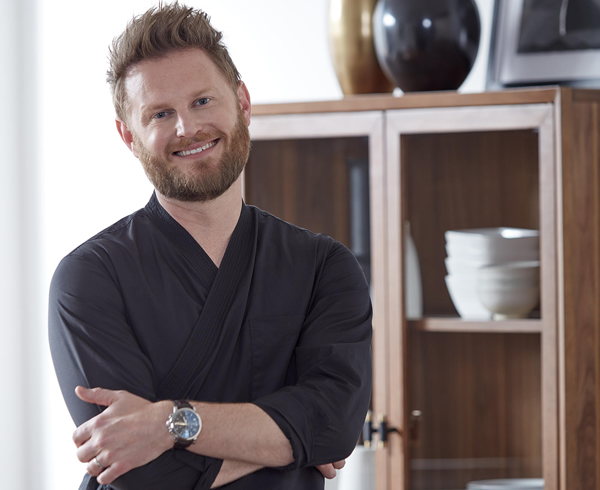
Bobby Berk says loss of anonymity, old family wounds occasionally haunt him. (Photo courtesy Gardner Group)



a&e features
Cameron Esposito will make you laugh (and cry) on ‘King of Drag’ season 2
The new host of this historic series breaks down why we need it today
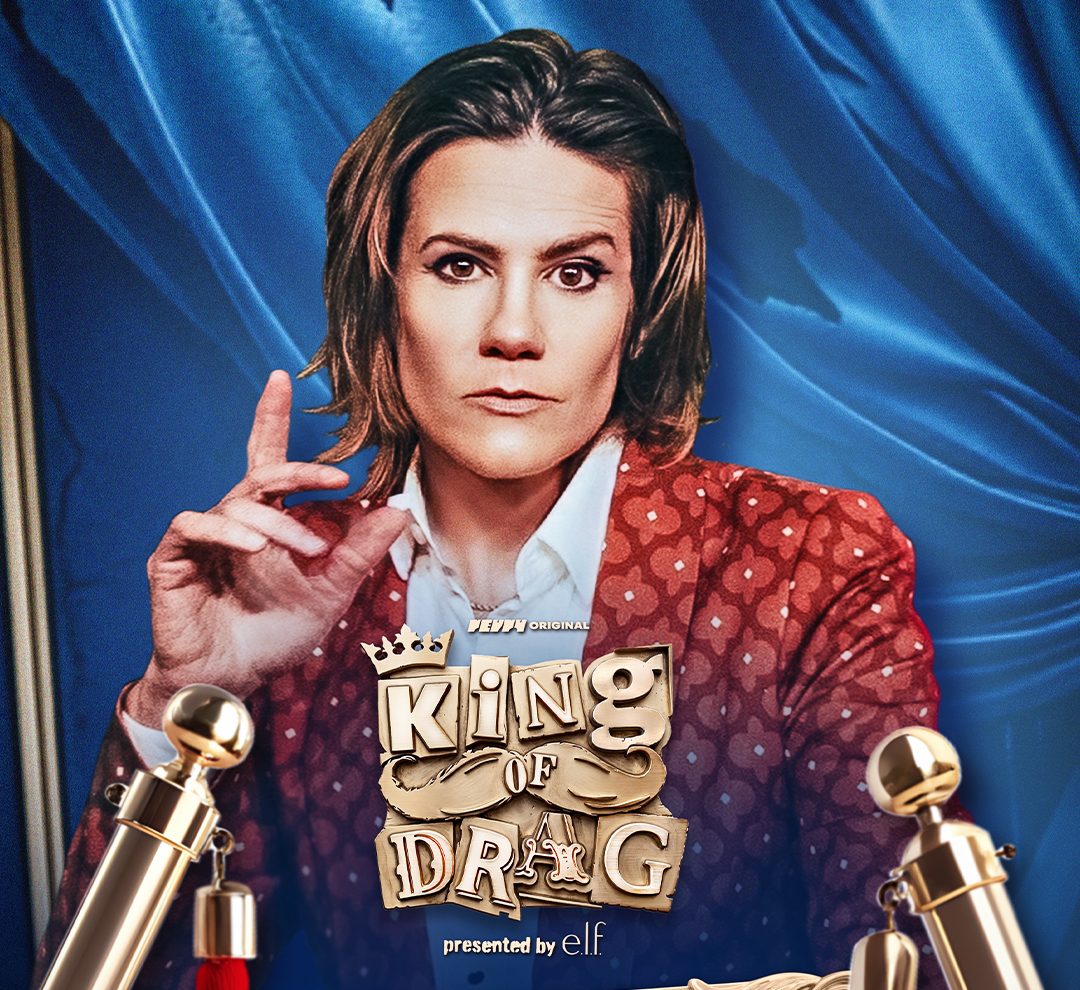
Drag enthusiasts — and fans of LGBTQ+ excellence in general — were thrilled in 2025 when Revry debuted the first-ever drag king competition show, King of Drag.
Joining the pantheon of drag-themed reality series like RuPaul’s Drag Race, this new program finally gave the kings of our community the attention they deserve, introducing viewers to a group of stellar performers who’d been flexing their artistry for years in communities across the country. Filled with a judging panel of queer royalty, complex challenges, and jaw-dropping creations from each contestant, King of Drag ended season one to widespread acclaim and thousands of new fans all over the world.
These watchers were elated when it was announced that the show would be returning in 2026 for a second installment. And they were even more excited to find out who’d be taking over as its illustrious host: historic queer comedienne Cameron Esposito.
This comic has spent the past few decades proving why they’re the perfect person to host a show like King of Drag. Many will know Esposito from their hilarious (and often very twisted) comedy; her many stand-up specials, albums, and guest appearances have earned her numerous accolades. Pair this with her current standing as a vocal LGBTQ+ advocate, and many folks in the queer community regard Cameron as one of our funniest activists today, always ready with a joke and a lesson on why we need to come together and fight against hatred. With that reputation, it was no question that she’d be the best person to fill the shoes of former host Murray Hill, after he stepped away from the program after season one. And in conversation with the LA Blade about the new role, Esposito raved about how excited they were to take on this mantle, saying, “I started [my career] around Kings.”
“They were really socially justice-motivated. They were super fun to watch — very sexy — and funny,” she continued, recounting her early days as a comic in Chicago’s thriving queer nightlife scene. “So having a chance to lift up that community as a host….I’m trying to come up with a lot of sick jokes so that the show is as good as it possibly can be!”
Cameron spoke about what it meant to lead King of Drag season two and how honored she was to guide this whole new batch of Drag Kings. “Any reality competition show is a high-pressure situation, and folks are really putting themselves out there! There’s so much vulnerability in that. So I really hope that I was able to bring some sweet little moments of relief for them. And also for the viewers — I hope the viewers think I’m funny,” she laughed.
Joined by judges Gottmik, Vico Ortiz, and Damian Pelliccione, Esposito worked hard to not only make amazing television, but to finally give these performers the appreciation they’d worked years for. She stressed that beyond the jokes she makes on this season (all of which she assures are hilarious), this was her main reason for joining the series, saying, “One of the biggest things was to focus on the kings. To get these folks the greater recognition that television brings, so that when they go back to their cities or when they’re on tour, people have that extra incentive to get out and see them.”
Because King of Drag understands how these artists have been treated not only by the mainstream media, but by the LGBTQ+ community itself — namely, how many queer people push them aside to focus on more ‘conventional’ images of drag. It’s why so few kings have been allowed on drag-centric shows until now, a glaring erasure that not only undercuts each series as a source of queer culture, but robs these performers of the success that television often entails.
“Trans dudes, queer women, lesbians…we are still, often, at the margins of a larger cultural push,” Esposito explained. “Elevating kings is an opportunity to trust audiences more…[because] I really don’t think that viewers have been given the opportunity to treat us seriously. You know, we might be joking around — but we are not a joke. When you’re talking about our rights, our respect, our safety…knowing people who are actually in this community affects how we’re treated. It affects how people see us, that we’re not just like nameless, faceless nothings.”
“I think it’s time for these kings who deserve recognition, and I also think it’s time to trust and move the needle in a larger context. Because we deserve to feel noticed, because we deserve to be paid. And because we deserve to be safe.”
Cameron Esposito is excited to lead King of Drag with not only the comedy that has defined her career, but the advocacy that guides her every single day. Because this series is not only a competition reality show — it’s a spotlight. A spotlight on a community that faces so many issues yet has never received a platform to openly speak about them. Combine this with a celebration of their astounding art, and King of Drag provides an exploration of drag kings like most queer viewers have ever seen before.
Esposito is proud to play such a huge part in bringing that to audiences today — and she promises to give you some sick, twisted laughs along the way.
King of Drag season 2 drops on Sept. 20th on REVRY.
a&e features
Falcon| NakedSword launches new publishing division, Falcon INK
The gay adult studio publishes two erotic novels
While there’s been an overall movement against LGBTQ people in politics, media, and print, there’s also been a huge gay male erotica boom. Not just Heated Rivalry, but Heartstopper and Red, White and Royal Blue have revealed a huge hunger for erotic male love stories across multiple forms of media. Those books not only found huge fanbases, but drove wildly successful adaptations and launched stars like Connor Storrie and Joe Locke. Ready to enter this landscape is the popular adult film studio, Falcon| NakedSword.
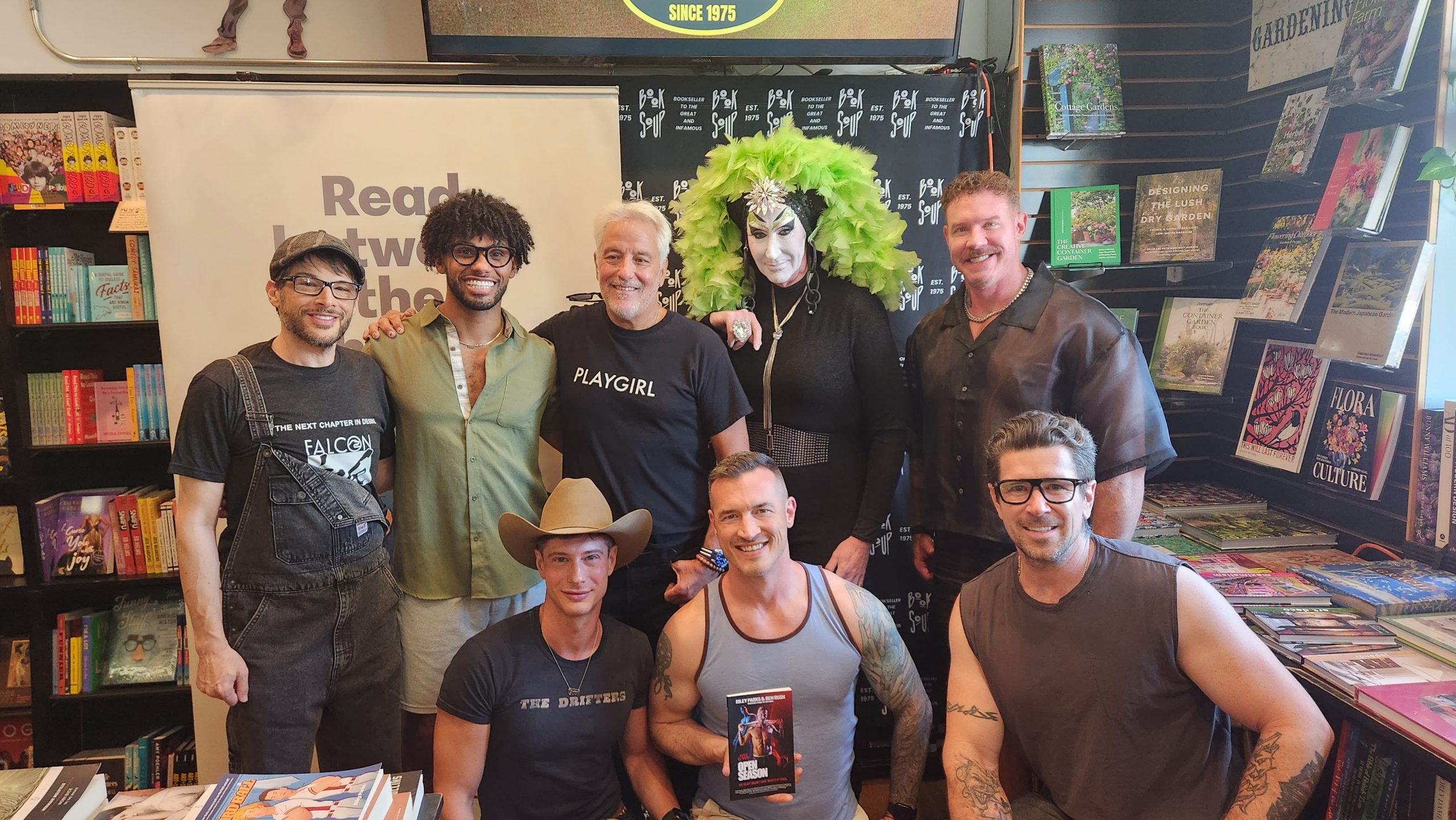
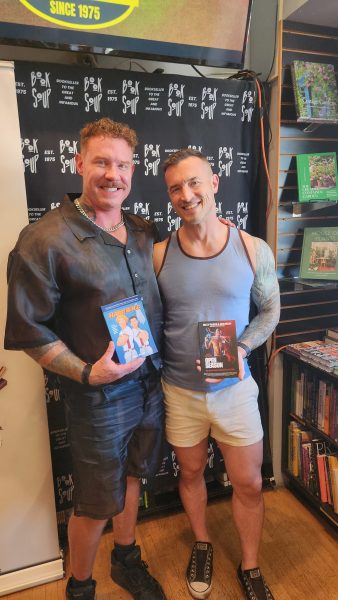
The studio has created a new publishing division, Falcon INK. They celebrated this expansion with the release of their first two novels, Hard Ball and Wild Game: Open Season at Book Soup in West Hollywood on August 29th. The guest list included major players from both behind and in front of the camera, including stars Derek Kage, Beau Butler, Trenton Ducati, Tony Genius, and Eddie Burke. Also present were the studio’s President Tim Valenti, Sister of Perpetual Indulgence and Falcon’s Creative Director, Sister Roma, and writer/director and Co-Chief Content Officer and Chief Creative Marketing Officer, Ben Rush.
The books in question include Hard Ball, which follows two baseball players whose relationship gets way more than heated. Wild Game: Open Season is a prequel to the multiple award-winning film Wild Game, where Kage plays a man desperate for money who enters a dangerous, high-stakes chase. If caught, his captors could do anything they want. Spoiler alert: it’s triple penetration. The book revealed how Kage’s character got to that level of desperation.
This expansion into print media is interesting considering there’s a growing war on queer content in books and adult content. Rigorous age verification laws require viewers to submit a prohibitive amount of personal information to access adult content. Kage is quick to point out, “The written word can be just as intense, just as controversial, if not more provocative than what you see on screen.”
He adds, “The part that bugs me is with age verification, the state could decide this is harmful to minors and make people who want to access it have to show an ID. You have states that are banning books that have LGBTQ+ themes and sexual education in the name of it’s harmful to minors. When you lump it all together, not only is it unconstitutional, you’re making it harder for consenting adults who want to access it.” Then he really hits the nail on the head, exclaiming, “People should be able to read what they want to read and consenting adults should be able to view what they want to view.”
In addition to print media, Falcon| NakedSword is expanding into safe-for-work content with a thriller microdrama, The Last Guest, and has even partnered with an apparel company for their own line of tie-in underwear. Rush was quick to clarify that this is not a shift from their core business model.
Rush shares, “I don’t really see it as a turn away from adult content as much as an expansion of what we can do. We’ve spent years telling stories where sexuality is obviously a major component, but, underneath that, you’re still dealing with character, chemistry, fantasy, romance and humor. Those are the things that make people connect with a story.” The studio has gone out of their way to explore countless genres with films ranging from thrillers and horror to romantic comedies.
Rush adds, “‘Safe-for-work’ content gives us another canvas for that. It allows us to take some of the storytelling instincts we’ve developed and see how far they can go when sex isn’t necessarily the destination.” Now these erotic novels are hardly safe for work but also enter the growing genre of male-on-male sex and romance.
The Heated Rivalry Connection
The runaway success of Heated Rivalry couldn’t be avoided, and Rush was quick to clarify that Falcon INK, while a savvy business move, is not necessarily related to the rise of that hockey romance. In his words, “Their success demonstrates that there’s a huge appetite for queer romance and queer characters, and that the audience extends far beyond what people might traditionally think of as a niche LGBTQIA+ market. But I wouldn’t say we looked at those properties and said, ‘Let’s make our version of that.’ If anything, their success reinforces the idea that queer stories can move between books, television, film, and other media and still find passionate audiences. That’s exciting from a creative perspective.”
Derek Kage adds, “Heterosexual cisgendered women are loving gay stories. I find it fascinating. I also find it a little lucrative. I’ve noticed an uptick in my fan sites: heterosexual women who love watching two men have sex with each other.” He also notes that now cis-female performers are actually enjoying filming more with gay men. HIV concerns really limited male-on-male performers, whether they were gay or straight, but now times clearly have changed.
Tim Valenti adds that this demographic is growing. He shares, “Sure. It is a different demographic. It’s much younger, and female. I can honestly say we now know about 12-13% of our membership is female for our hardcore sites.”
While a different demographic, Rush doesn’t believe there’s much of a real difference adding, ” I don’t think the audiences are completely separate. People who consume adult content also read books, watch television, fall in love with characters, and want rich stories. We sometimes talk about “adult audiences” as though that’s their entire identity as consumers, and, obviously, it isn’t. The interesting part is seeing where those audiences overlap.”
Sister Roma was quick to point out the political importance tied to the success of these stories. She adds, “I think that stories that show queer people in romantic situations are very healthy and important, especially right now, because there are real attempts to take away the right to marry, and there’s so much oppression headed towards our community from every angle. It’s important to show that for people with genuine feelings of love and expression like everybody else, to make people know we’ve always been here; we’re not going away.”
The Future
With a budding cinematic universe and cross-platform storytelling, is this the making of a new media empire? Rush jokes, “I’m not sure I’m ready to put ‘media empire’ on my business card. But I do think there’s something exciting about building a creative brand that isn’t restricted to one format.”
He continues, “If we have characters or stories that people connect with, why should they only live in one place? A book can become something on screen, and a character can have a life beyond one project. The goal isn’t expansion just for the sake of expansion. It’s to create things people genuinely want more of. If that ultimately looks like an empire, I suppose there are worse problems to have.”
Both Kage and Eddie Burke opened up about the unique differences between performing their audiobooks. Whether it’s Burke working on his Southern accent or Kage using his teenage closeted history to get into character and even putting himself in the mindset of the female character, it’s clear these are serious actors who take their art seriously.
Kage adds, “We are actually talented performers. Not only are we talented, but we are also educated, and we love what we do. We are authentic in everything we do. If you can put on a performance while taking 3 dicks at once, that is talent.” He jokes, “Meryl could do it. She could do anything.” Jokes aside, Kage confessed to staying in character to deliver some of his more challenging performances, so it’s not surprising this character would live on in print.
As to whether Kage and his fellow co-stars could find some of the same breakthrough success as the stars of other male erotic stories he shares, “If Hollywood or a major television show or production company needed my talents, I’d happily accept. If you need a deep-voiced, muscley dude who has a way with men and women and anyone in between. Call me.”
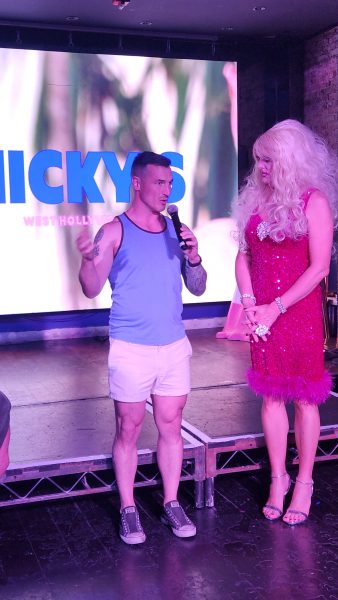
The group ended their night at Micky’s supporting their drag show hosted by Ingenue. They shared Falcon| NakedSword prizes, including free copies of the book. If you’d like to get yours, you can purchase Hard Ball or Wild Game: Open Season as a paperback, digital copy, or audiobook.
a&e features
Defying convention (and physics): ‘Speedball’ Mike Bailey on identity and inclusion in pro-wrestling
All Elite Wrestling’s first non-binary champion talks about early wrestling inspirations, the importance of connecting with fans, and the history (or lack thereof) of queer representation in the squared circle.
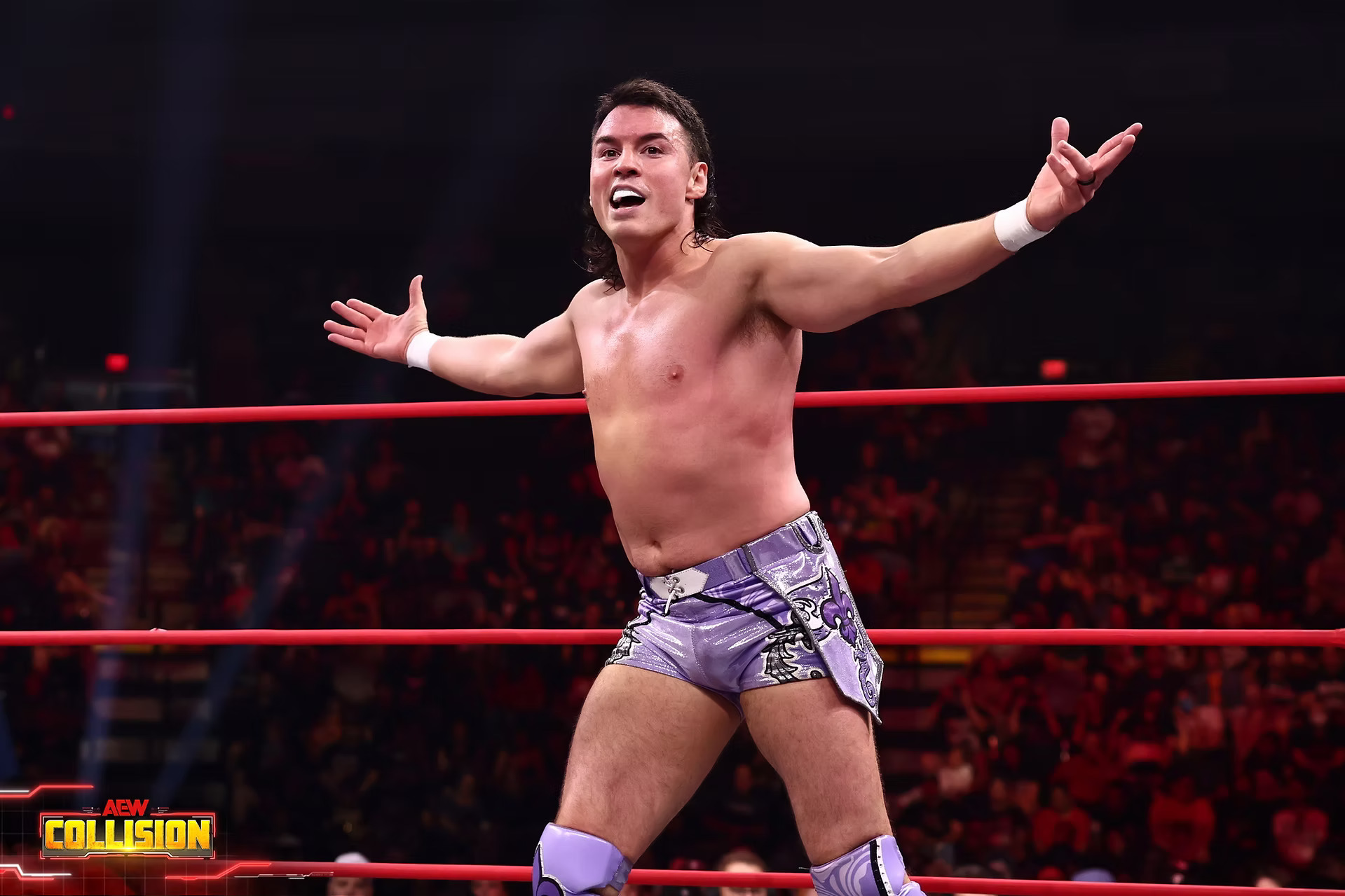
Canadian professional wrestler “Speedball” Mike Bailey may be a regular fixture on national TV as a key member of All Elite Wrestling’s expansive roster, but their path to wrestling stardom is anything but conventional. Nicknamed “Speedball” for his high-velocity, gravity-defying work in the ring, Bailey (who identifies as nonbinary) has spent more than 20 years traveling the globe as a star of the international independent wrestling scene, holding titles in TNA, DDT, and the IWS.
Thanks in large part to a 5-year travel ban incurred in 2016 that prevented him from working in the United States, Bailey’s international career flourished, and after years of globetrotting as a freelancer (and a stint in TNA), Speedball officially signed with AEW in January of 2025. On the road to AEW’s largest annual pay-per-view, AEW: All In, The Blade had the opportunity to talk to Speedball about connecting with fans, representation in wrestling, and how/why the industry can become more inclusive.
Between your YouTube vlogs and your Twitch streams, you’ve cultivated a very deliberate digital presence. What inspired you to start vlogging/streaming, and why is it important for you to maintain those channels now that you’re signed to AEW?
There are a lot of facets to the answer to that question, but the main one is that I believe that in 2026, wrestling is and should be an immersive experience – that’s how it’s going to grow. I think the days of people playing characters that were only able to exist on television in 15-minute weekly increments, because they’re some kind of undead creature that can’t really have a conversation, are not what the wrestling world needs anymore. As is Kayfabe, the whole secrecy behind wrestling. I think these days, if you look at social media, you will see that being open and honest and cultivating an audience that knows you well is the way to go. For professional wrestling, to have the best matches, what I want is an audience who can connect with me and who understands what I’m going through on an emotional level; so that’s one aspect of it.
But there’s a lot more – the reason I started the vlog is pretty much the same reason I started Twitch streaming, which was that during the pandemic, when the world was shut down, I was unable to travel, unable to engage with my audience, unable to see a lot of the friends I’d made around the world of professional wrestling. To try to re-form that connection, I decided I would try to leverage the internet to make up for the fact that I couldn’t be there in person, which is kind of what I’ve had to do my entire career.
If you’re familiar with my story, I was unable to enter the US for five years. During those five years, my focus was on growing my skill set as a professional wrestler, but also my brand, and trying to get as much global recognition as I could. Those five years really highlighted to me the importance of putting yourself out there as much as possible.
Historically, depictions of LGBTQ+ people in professional wrestling have been either negative or non-existent. Could you talk about the importance of AEW not just as an alternative promotion to the mainstream, but as a platform for queer talent?
If you’re familiar with pro wrestling, you’re familiar with its history in this century: where you basically had one promotion that had the monopoly on professional wrestling, and that promotion really was only one person’s vision being put on screen. Over the years, in the early 2010s, social media came about, and it became possible for independent promotions to actually advertise their shows, to build an audience, and to distribute their shows online.
Independent wrestling is intrinsically connected to the audience, right? It’s smaller shows for smaller audiences: if your crowd doesn’t like something, you will find out very, very quickly. So independent wrestling grew to the point that there was a giant hole in the wrestling market between what was presented on TV and what was happening at an independent level, which is so much closer to the audience. Tony Khan saw that gap in the market, and that’s what led him to create AEW. But I think the key here is that in order to be successful and continue to grow, pro wrestling needed to listen to its audience.
It became very, very clear that the homogeneous, uniform professional wrestler that was presented on TV was not representative of the audience who wanted to see professional wrestling anymore. The world is diverse. If people want to see that same diversity reflected in their professional wrestling, there is no reason for it to be reserved for only one kind of person. That is absurd. People want to see queer people. People want to see all kinds of stuff that doesn’t fit the historical mold of what a professional wrestler should be.
Were there any early LGBTQ+ wrestling trailblazers who inspired you?
It’s funny – no, not really, because there kind of weren’t any. But I remember finding a box of Manami Toyota tapes – I think someone had gifted them to my sister when she wanted to be a professional wrestler as well. But I remember watching those tapes of women’s wrestling in Japan, and seeing these women perform in front of a sold-out Tokyo Dome in the early 90s, and getting the sense that “Hmm, I think the way that women are treated on American televised wrestling is ridiculous. Clearly, they’ve drawn a crowd, and they’re able to put on a great show.” Seeing someone like Aja Kong, who is an absolute icon and the exact opposite of what was presented on televised pro wrestling for women at the time, really blew my mind.
Aja Kong is one of the greatest professional wrestlers of all time, and she doesn’t get nearly enough credit, just by getting a ton of credit. But we’re talking about the early 90s here, and this is a mixed-race queer woman who was selling out the Tokyo Dome. Seeing that really opened up possibilities for me. The fact that Aja Kong and Meiko Satomura are routinely ignored in the ‘greatest wrestler of all time’ conversations just shows you how heteronormative pro wrestling historians are, the fact that their careers are largely ignored.
Meiko Satomura, to me, is one of the top five greatest professional wrestlers of all time. Not just because of how good she is in the ring, but because of how her career has transcended decades, what she’s done through her own promotions, and the other wrestlers she’s trained. I think that’s completely incredible, and the fact that they get so little credit is very indicative of how things need to change regarding the way professional wrestling is viewed historically.
As someone who has been wrestling for 20 years, how and when did you know it was the right time to come out publicly?
So I never really ‘came out ’; I never declared anything. In fact, it was quite the opposite. I just rejected the theory of gender, if that makes sense – specifically, by design, there was no declaration. There was just a changing of my vocabulary, the words I used and how I described myself, especially within pro-wrestling, where that kind of thing is very relevant. Baked into the scripts, in the words of pro-wrestlers, there is so much talk of ‘manliness,’ and none of that ever resonated with me. I’m very lucky to have a platform such as pro-wrestling, which is stereotypically hyper-masculine, through which I can show people you don’t have to abide by those standards.
You mentioned the lack of LGBTQ+ wrestling influences you had early in your career – how does it feel to know that the next generation of wrestlers are going to have the likes of Nyla Rose, VENY, and Speedball Mike Bailey to look up to?
I haven’t thought about it too much. I’m glad that I resonate with people, but I feel like there are so many other ways people can resonate with me. Whether it’s non-binary, or trans, or through any other way, what I want people to take away is that you can still succeed if you don’t fit the mold. That is a huge hurdle I think professional wrestling, as an art form and a community, needs to overcome.
I always make extra time for anyone who is part of a queer or any marginalized community, or who otherwise doesn’t fit the mold, to give them advice and help however I can. There needs to be more of a conversation to be had about people who enter the pro wrestling space who have disabilities, and how there is space for those people, and that they belong just as much as anyone else.
a&e features
Are you ready for a ‘Culture Shock’ with Andy Lalwani?
The LA reporter dishes about everything going on with his new podcast

If you’ve been to an event in Los Angeles, then there’s a good chance you’ve had the pleasure of seeing Andy Lalwani’s work firsthand.
The gay reporter has spent almost a decade bouncing around the city’s hottest venues for some of today’s biggest publications. Whether it’s Grindr or Disney — yes, the man has recently done work for both companies — Andy has become known for not only his fantastic carpet interviews, but the engaging social content that he always produces afterward. He offers a simultaneously relaxed yet engaged approach to these moments, with his videos being filled with intriguing conversation from huge stars and a shocking amount of casual laughs.
Pair this constant presence with an engaged social media audience of more than 30,000 followers, and it’s safe to say Andy Lalwani is a true star in LA’s bustling reporting scene. It’s why so many folks across the city were excited when he announced his newest project: the Culture Shock podcast.
“It is so fun to show up to a studio and just have no idea what you’re about to get into,” laughed Lalwani, reminiscing on the past few months since Culture Shock debuted in March 2026. “I want every guest to feel like this is just a great time, to be sitting across from somebody and just getting on. I think the world needs to laugh a little bit more, and that’s what this whole podcast is about.” Culture Shock sees the reporter go from the carpet to the recording studio as he sits down with some of LA’s biggest cultural changemakers. Whether it be musicians like Icona Pop, comedians like Matt Rogers, or even Leland of RuPaul’s Drag Race fame, the podcast has quickly gained an audience who love Andy’s intriguing conversations with each personality.
The host has been overwhelmed with the response from his audience, saying how happy he’s been to see folks enjoying this project — especially because Culture Shock wasn’t created in the best of circumstances. Candidly speaking about what led him to make this show, Andy stated, “I started my podcast when I got laid off from my job.”
“It definitely has a lot of highs and lows when you’re trying to work and break into the [media]…it’s been really hard for LGBT people to be involved in news whatsoever because of the landscape.” It’s an issue that affected thousands of folks in this community, with many queer journalists from big publications — including ones catered to the LGBTQ+ community — being laid off in recent months. But Andy stressed that after years of trying to prove himself to others, it actually felt inspiring to finally get the chance to create something completely unique to him. “Seeing gay people-of-color is hard in the media — behind and in front of the camera — and so being an Indian guy…there’s not a ton of us who do what I do,” he explained. “So once I got laid off, I was like, ‘I just want to own something myself for a change, and not have to report to anyone else.’”
And own it he does, with Andy offering his trademark style of interviewing into each episode of Culture Shock. He was quick to emphasize, though, that the show’s success can’t all be owed to himself. Andy thanked his entire team at Spotify by saying, “Spotify has been really supportive with this endeavor,” describing how they’ve helped him fight through the early nerves of this process. Made up of professionals from around LA, he offered immense gratitude to the many folks in both production and promotion, with the podcast even being featured in the platform’s June spotlight on LGBTQ+ creators.
Lalwani spoke proudly about all that he’s accomplished with Culture Shock, but when asked about the future of the podcast, he calmly stated that he wasn’t sure what would come next — and that was on purpose.
“When you work in media, you think you have it all laid out for you. But for me, if you asked me five years ago where I thought I’d be now: completely different,” he laughed. “But I’m in the prime seat, and I want to keep that going. Maybe expand it even more! I can’t tell you where the next thing is going to be, but it’s…it is just such a joyous, rewarding process to say I’ve taken every skill — production, reporting, on-camera experience — and just like housed it into one. That’s it…it’s just a nice home for myself.”
An earned sense of optimism from a person who’s worked to master the skills audiences hear in every Culture Shock episode. Though while he’s keeping his options open, one thing is for sure: Andy Lalwani is prepared for the many big and bright things that are certainly in his future. And now that he has access to his very own studio at Spotify, he’s excited to ensure audiences listen in on these new adventures every step of the way.
a&e features
Singer Tiffany returns to pop life with new cookbook
The 80s icon gabs about everything from cooking to mall life to Gay Pride
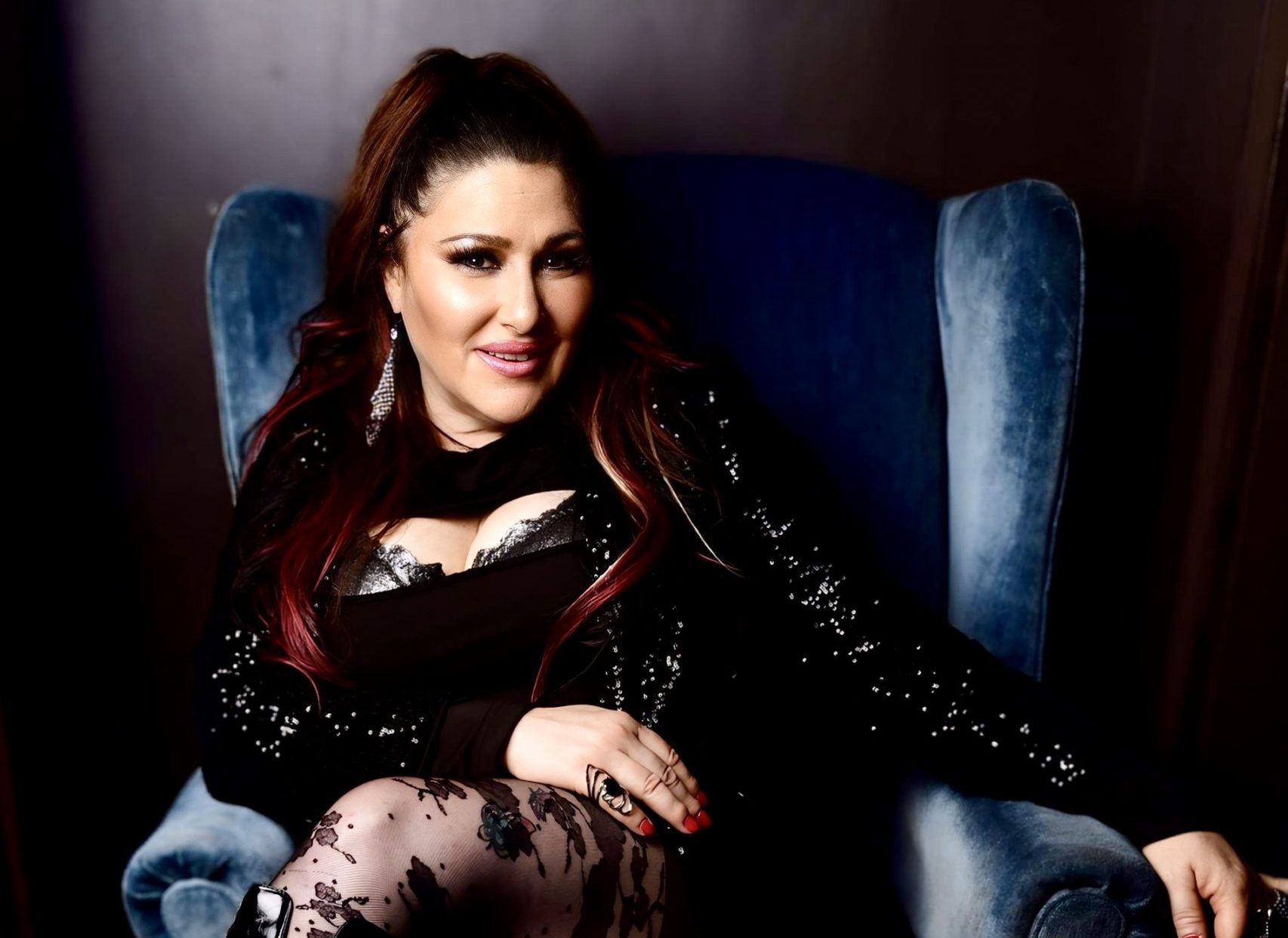
When you think of Tiffany, you might be instantly transported to the 80s and remember the mall girl who made a name for herself with the hit “I Think We’re Alone Now.” Maybe you remember her from her countless reality television appearances or even as Judy Jetson from The Jetsons Movie. She’s really done it all.
If you see her now, she retains her rocker spirit and bubbly energy but also has a brassy mom vibe with big Melissa Schemment from Abbot Elementary energy. She’s done it all, from acting to singing, and her run on the Food Network series Rachael vs. Guy: Celebrity Cook-Off helped ignite an excitement for the kitchen.
Now she’s got a new cookbook, Pop Life: The Ultimate 80s Kitchen Encore, along with a cooking club called Let’s Food with Tiffany. She also continues to perform and is still touring. She took some time from her busy schedule to chat with us about her past, what inspired her new book, and all things mall culture.
Why do you think you have such a big gay following?
I’ve always just tried to be real with my life, the good, the bad, honest. I mean, I love a little bit of glamour, but then I’m also very, very real. I’m very down to earth. Sometimes maybe too down to earth. You’ve just got to live who you are, and I’m a little bit of all of it. I think my gay fan base sees that, like they really allow me to be who I am. And I love that, you know?
Do you have a message for your LGBTQ fans?
I love you guys so much. And thank you for being a part of my world all these years. Thank you for loving my songs. I love the chance to have these meet-and-greets with fans. When people tell me, “Girl, your music means everything to me, it really helped comfort me,” or “It gave me the courage to, or it gave me the strength.” I don’t take it lightly.
What do you like about engaging with your LGBTQ fans?
I love chit-chatting. I love getting all this fashion scoop as well. Sometimes they’re a little too honest, but I really do love performing at Prides. Everybody comes ready to rock. You know, it’s one of the best, best, best audiences because everybody is present and engaging and just ready to have a good time.
Why do you think people resonate so much with your music?
I had a very turbulent childhood; I would often go in my bedroom and play Stevie Nicks
and just pretend I was someplace else, and that wasn’t happening outside my door. And it would soothe me because I was just a kid and my household could get a little crazy. I think some of my songs, even though the pop songs were pop, there was some grit there. Some of the ballads were deep for a young person to be singing them.
Like, what?
Songs like “Could Have Been.” The label didn’t want me to record them. They were like, this is too adult for you. And I was like, “Have you ever seen a 14-year-old in love or heartbroken?” You’re never gonna find anybody else; that’s it. That is the one. And if they break your heart, God forbid, you’re never going to recover, and it’s magnified by a zillion when you’re young.
I really fought to have “Could Have Been” on the album, because it showed I could sing, but I disagreed that it was too adult for me. And, you know, it’s on the album, became number one, and it really is an anthem song for me. It’s my favorite song that I sing.
Do you sing it on tour?
It is the highlight of the show. It’s the one moment we’ve kind of drawn it out a little bit and extended it, so we have the fan moments; everybody sings along. But I think there’s maybe something to the music, and then maybe something to me.
Can you tell me a bit about the progression of your music from then to now?
Learning to stand up for myself, learning to become a songwriter, you know, in the earlier albums I didn’t write and no one really wanted to help encourage that, or develop that. It was happening anyway, so I took some time and just started working with my band members. I’m a big advocate of if one door closes, there’s another door. If you want something, go and get it. And it doesn’t mean that it will happen on a massive level.
Do you have any advice for fans?
If you’re happy with what you’re doing and you feel like you’re growing as a person, and you feel like you’re living what you thought would be the design of your life on any level, that to me is great. It’s great for mental health. It’s great for the spirit. That’s kind of what I’ve done in my life.
Can you tell me about your life now?
I wanted to become a songwriter. I wanted to be a mom. I wanted to move to Nashville and be a hippie dippy doo, you know, and have time off. I live part-time in the UK now. I’m getting really into the culinary world there. I take the train into London; I’ve got my coffee and my dew and all my stuff. But then when I go home to Nashville, I literally kick off my flip-flops, hair in a ponytail, and I’m grounded in the earth. I’m planting stuff. I have an orchard.
When you said my coffee and my dew, did you mean Mountain Dew?
Oh, no, I mean like my sausage rolls or my pasties or whatever else I’m grabbing on the go. I love my M&S, and I always have my cappuccino…it’s called a cup of personality for me. Like, that’s how we start the day.
Can you tell me a bit more about your love of food? Where did that start?
I started traveling when I was so young; I always wanted to go where the locals went. I wanted to shop local. I never took it for granted that I was going to come back to these places because I didn’t know. All of a sudden, I’m in, like, Thailand and India and the UK; I never knew if I was coming back
I was like, I want to go eat where the locals are. So I was always dragging my band because I was so young. I had to have people with me, and I’d be like, it’s adventure time. Let’s go. And I think that’s where, you know, I started to kind of talk to my fans about, “Where’s a good place to eat?” It became a dialogue. And so many people, as you travel the world, are really excited about their food and their music. And they light up when you ask them about it, to be honest with you, so it just became something that I did.
You have a cooking club; how did that start?
During Covid, I had this deep, deep, deep sadness of missing my mom and my grandmother, my dad, and I just started cooking my grandma’s recipes, because it made me happy. I thought, well, I’m gonna show this to my fans, because I think they’re doing the same thing.
So that’s when I started a cooking club, Let’s Food with Tiffany. It was just me in the kitchen hanging out, but talking like this. And it became a weekly thing, and I think it was more than just cooking; it really was a friendship. And once COVID kind of went away
I started traveling again. I just decided I don’t want to give this up.
So after that, I started developing my spice blends: Rockstar Za’atar, Hip Hop Harissa, and Let’s Taco Taco Taco.
I want to do what’s called TIFF takeovers, where I go into restaurants from mom and pop places to high-end places. They’re ticketed events. They get an appetizer, maybe an entree, maybe one of my poptails, don’t know, but whatever I work with the venue on their level. And a Q&A. And then we rock it out. We do a little acoustic show.
Can you tell me about the book?
The cookbook with Chef Alicia [Shevetone]. I met her just as a friend first. A friend connected and said, I think you guys would be girlfriends And sure enough, we were instant girlfriends. And then the creative came. And so many of my records have been like that. So many of my other projects have been like that, where you know you meet people, and you’re like, everybody’s like, oh, you should do something together.
I’m not a chef. I’m a foodie. I’m a newbie, and I think that also makes people feel comfortable. It’s like we’re going on this adventure together; let’s see what we get into. And I literally, that’s, I mean, that’s part of my life in the UK. I am now being exposed to the bigger, broader culinary world, which I love.
I can’t let you go without asking you about malls.
We need fun back. I wish we had the malls back. I’m a big fan of small business myself, and it’s so necessary for people to make different incomes nowadays, and you get those unique, one-of-a-kind pieces in that. But the mall represented gathering. It was a safe place to go. You’d go and pick up something and try something on, and you know, if you had kids, you would drop them off there. They could be in the arcade, the music shop, whatever. It was just a culture.
You walked around; even if you had no money in your pocket, you got dressed up, and you kind of walked around, and you saw other kids from other schools or your school, whatever it was, it was a destination. We don’t have places like that anymore
And it’s very sad, you know, I mean, a lot of the malls are dying all over wherever I go. And, you know, being part of the mall tour was brilliant.
You’re also touring!
I do, so I’m going to Chile, to the Philippines, and then I’m doing Kim Wilde’s The Singles tour in the UK early 2027. Meanwhile, I have the All This Time tour that I’m doing now, which is pure retro. And I have all my pop life parties, so I’m pretty busy right now. You know, just wearing all hats, about to head to New Mexico for a book signing convention, so lots of book signing conventions in my future.
You can read all about Tiffany’s projects, including her tour, on her website. You can also purchase POP LIFE: The Ultimate 80s Kitchen Encore.
a&e features
‘Leo from Rio: Latin Icons’ brings cultural celebration to West Hollywood
This trailblazing show fills the WeHo City Council Chambers with music and community
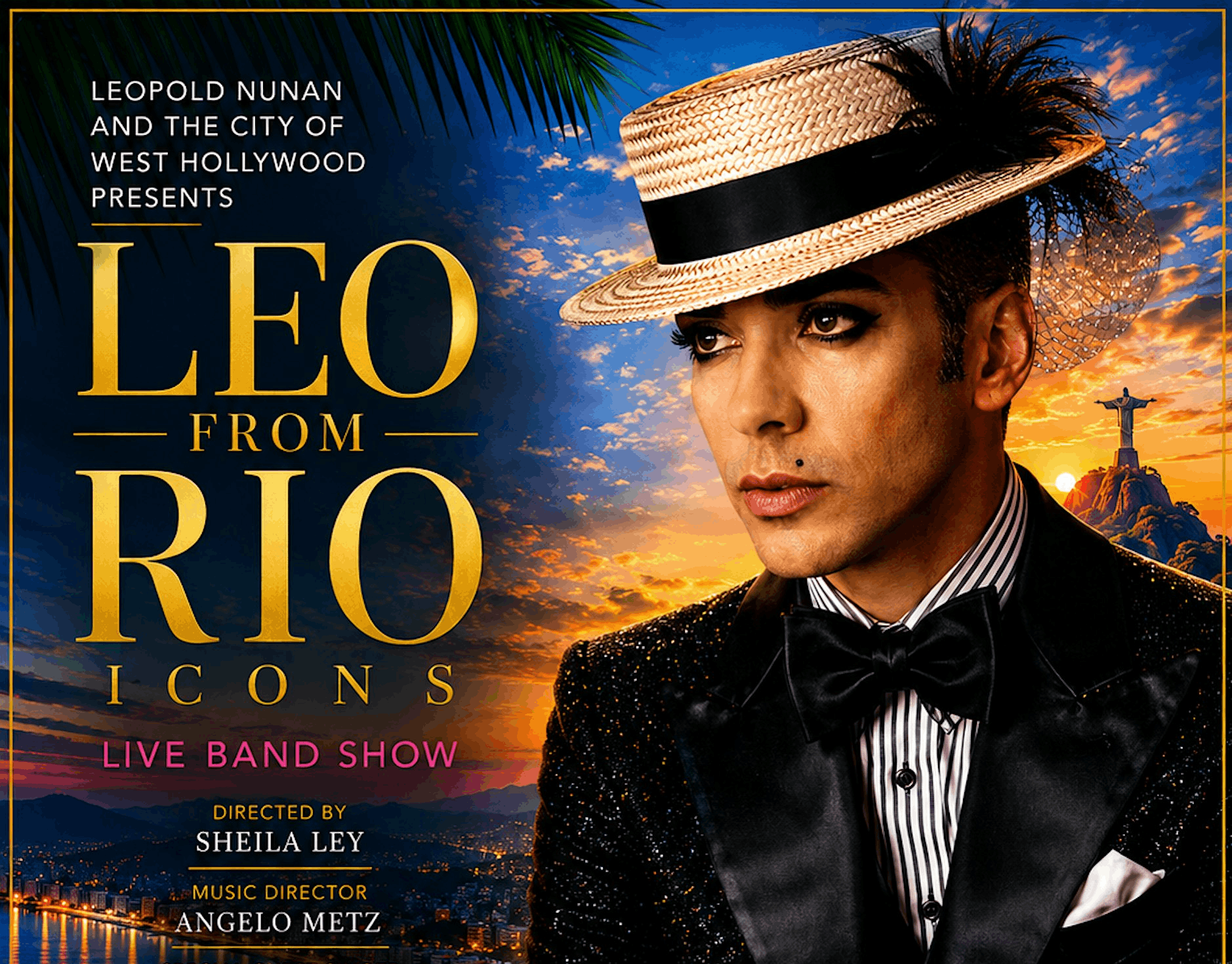
Music has always been a tool for culture.
Whether it be singing, dancing, or the countless other ways that people bring it into the world, music serves as a way for communities to express their cultural pride beyond simple words. It’s also proven to be a channel for rebellion; repressive forces throughout history have attempted to eradicate the musical practices they know bring oppressed classes hope. But despite their best efforts, a part of that music always lived on. Continuing to give voice to cultures that too many people want to silence and offers the authentic freedom that so many groups still fight for today.
Many shows try to capture the cultural power that music has always held. And at this year’s Hollywood Fringe Festival, audiences got to see that power come to life in Leopold Nunan’s dazzling show: Leo from Rio: Latin Icons.
A one-man affair, Leo from Rio sees Nunan don many glamorous outfits and perform as some of Latin culture’s biggest musical icons. From Violeta Parra to Sérgio Mendes, this combination of concert and performance art honors these trailblazing voices who still influence modern Latin music. Leopold sings these legends’ songs — all while dressed impeccably as them — while educating audiences on their cultural impact.
Leo from Rio premiered at this year’s Hollywood Fringe Festival to city-wide acclaim, with critics raving about the expert costume design and the passionate musicality that fills every second of its runtime. Leopold has been overwhelmed with this positive response and credits the show’s success to the many stars who inspired it, saying, “These artists gave us a language before we even knew we needed one. Some of these songs make you think of your mother, your childhood, a country you left…then you perform them in Los Angeles, and suddenly a room full of people from completely different places understands exactly what you’re talking about.”
The only negativity that local critics have aimed at Leo from Rio is that the show had far too short a tenure at this year’s Fringe Festival — well, luckily for them, the show is coming back. And to the delight of returning audience members and intrigued locals alike, this encore performance will be happening in the unlikeliest of places: the West Hollywood City Council Chambers.
“I am an independent Latin queer artist. No major label. No giant machine behind me. And the City of West Hollywood looked at my work and said, ‘We believe in this. Come do it here,’” said Leopold, growing emotional as he discussed the upcoming show. Because on Friday, August 21st at 7 pm, Leo from Rio: Latin Icons will be making its West Hollywood debut by flooding the City Council Chambers with more Latin dancing and music than this municipal building has ever seen.
The performer excitedly discussed how honored he is to be invited into such a powerful space and how ready he is to share this ode to Latin culture with everyone in attendance. It’s something he knows so many people need right now; Leopold is a WeHo local and has seen the bigoted attacks the city’s Latin communities have suffered through in recent years. His status as a Brazilian immigrant has given him a firsthand look at the atrocities people all over LA are facing, recounting, “Right here in West Hollywood, a fellow Brazilian resident, Alex Pereira-Alves, was recently detained by ICE during a routine immigration check-in. The government was preparing to send him to Guyana — a country he has never even visited!” A federal judge has temporarily blocked Pereira-Alves’ deportation, but Nunan stressed how this case is one of countless others that highlight why we need shows like Leo from Rio more than ever.
“When you have a microphone, sometimes you have to use it for more than singing,” he continued. “Celebrating our culture matters right now. We cannot allow our communities to be defined only by struggle…we are incredible artists. We are rhythm. We are creativity. We are JOY.”
This is why the performer sees his upcoming performance as more than just a show. Because beyond the costume changes and singing, every second of Leo from Rio is filled with a deep love for the Latin legacy, one that fights back from the attempted erasure so many are facing today. And to have that love be brought into such an official building, with the support of the local government, makes Leopold confident that this evening will be a reminder of how beautiful Latin culture is. The strength that can be found in honoring this culture, and why locals should celebrate it as loudly as they can — especially in the face of those who want them silent.
“I hope they see what happens when a city actually invests in its artists,” said Nunan, on what he hopes the Los Angeles government takes away from this performance. “You give an independent artist an opportunity, and suddenly that opportunity becomes work for musicians, collaboration, community, culture — and a room full of people sharing something together. That is what supporting the arts can do.”
An inspiring precedent that not only opens up the door for many other artists but also grants Latin locals a night of nonstop community love. All of this packaged into a show filled with costume changes, musical numbers, and dancing? It’s no wonder why Leo from Rio: Latin Icons is loved by the WeHo government, and why it continues to inspire Latin Angelinos today.
a&e features
The ‘Red Light Diaries’ album is a soundtrack of liberation
Advocate Micheal Ighodaro speaks about his new series and finding freedom in music
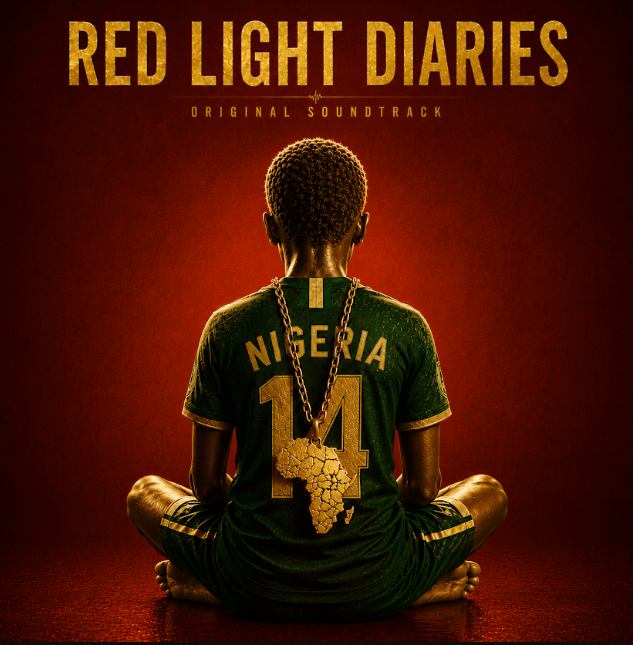
Micheal Ighodaro is a true global advocate, a title the man doesn’t take lightly.
He’s spent his life fighting for his many communities; Micheal escaped violent discrimination in Nigeria as a young gay man, eventually finding asylum in the United States. Since then, he’s committed his life to activism, traveling the world uplifting LGBTQ+ individuals and spreading awareness of the HIV resources he’s helped make possible today. Whether it’s creating Global Black Gay Men Connect (GBGMC) or serving as President of Global Black Pride, Ighodaro is recognized as one of today’s foremost HIV advocates, with his work even earning him the title of ‘Champion for Change’ from former President Barack Obama.
Micheal’s activism has taken on many forms as he’s tried to serve LGBTQ+ populations from all over the world. He’s determined to do whatever it takes to get these people the resources they need, with his newest project being one of the advocates’ most ambitious: Red Light Diaries, an anthology series focused on how HIV prevention shows up across the globe today.
“We needed to find ways to reach people,” explained Ighodaro, when discussing what drove him to create the show. “Sometimes, we are in our bubble when we speak about public health or human rights work…I wanted to find a different way to reach [people] in a way that we are not used to.” It’s a fact that becomes more evident every year; while there’ve been massive developments in HIV treatment and prevention, ongoing stigma makes it difficult for many LGBTQ+ populations to learn about these resources. Micheal and his team at GBGMC wanted a way to truly connect with individuals, to not only educate them but to show how beautifully massive their queer community is today. And, inspired by a certain trailblazing TV show about ballroom culture in the 1980s, Ighodaro created Red Light Diaries, describing the new series as, “Think Pose, but global.”
Each episode of this six-part program focuses on a different person in a different part of the world, with the series actually filming in whatever new location is being featured. Ighodaro emphasized that they wanted to spotlight the reality of being queer in these different spaces, saying, “What makes a black trans person in Atlanta? What makes a sex worker in Nigeria? What makes a bisexual man in London? Who are they — and what does HIV have to do with that?”
Each story showcases these characters’ unique experiences with queer survival, how they navigate their daily lives, and what HIV prevention means to them. Micheal promised that amazing information about HIV access will be packaged within each story — but also, that these lessons aren’t the sole reason for Red Light Diaries’ existence. He didn’t want to just educate folks on facts about queer healthcare. He stated, “[We] want this to be about the people. Yes, we want to share information about HIV prevention…but there is no prevention without the person.”
The series is centered on these people, individuals who may be separated by thousands of miles but are united in the fight to live authentically today. The cast and crew of Red Light Diaries are amazing at helping viewers understand the global humanity within these episodes. But there’s one aspect of this storytelling that Micheal knew would help audiences understand the show’s core themes: the music.
Working with Black queer artists from around the world, Micheal personally wrote a majority of this series’ soundtrack, making sure that they were not only amazing songs but also spoke to the LGBTQ+ pride happening onscreen. “From track one to track twelve, [these songs] are very related to real experiences from the actual series — but also real experiences from my life, from my friends’ lives, and from the artists who wrote the songs.”
Whether it be the pop anthem “Own My Night” or the choral “I Won’t Disappear,” each tune comes from Ighodaro’s own experiences as a young gay man in Nigeria, struggling to survive in a setting that wanted the exact opposite for him. Throughout all of this, though, music and his community helped him carry on, with the man remembering, “There was a time I was with my friends under the bridge in Nigeria when I was 17. I was playing Beyoncé and Gaga; me and my friends hadn’t had food for days, but we were dancing, singing our lungs out…because that’s what brought us joy.”
This kind of radical joy is at the core of Red Light Diaries: the universal fellowship that exists for queer people all over the world. Along with sharing important information about HIV, this series will showcase the joys that LGBTQ+ people find amidst hardship, and why it’s always your community that can help you through these tireless moments. “Because if you’re fighting so much to just exist, then you have to actually exist, right?” Asked Micheal. “Because if you don’t have joy, if you don’t dance, have music…then what are you really fighting for?
While Red Light Diaries has not yet premiered — Ighodaro teases that information about the series’ premiere will drop very soon — the soundtrack recently debuted, showing people not only the great songs but also heartfelt themes that will fill this series. Micheal has many expectations for this groundbreaking program, but for the music especially, he hopes it will help individuals feel more connected with the other LGBTQ+ people just like them all over the world.
A reminder that we are a part of a universal community. And that no matter how alone you may feel, there are always going to be queer people ready to dance and help you find the joy necessary to make it through the hard times today.
You can listen to the full Red Light Diaries soundtrack wherever you stream music.
a&e features
Mad love: ‘Descendants’ star Leonardo Nam on being an out Disney villain
Nam shares his thoughts on everything from Disney villains to fatherhood
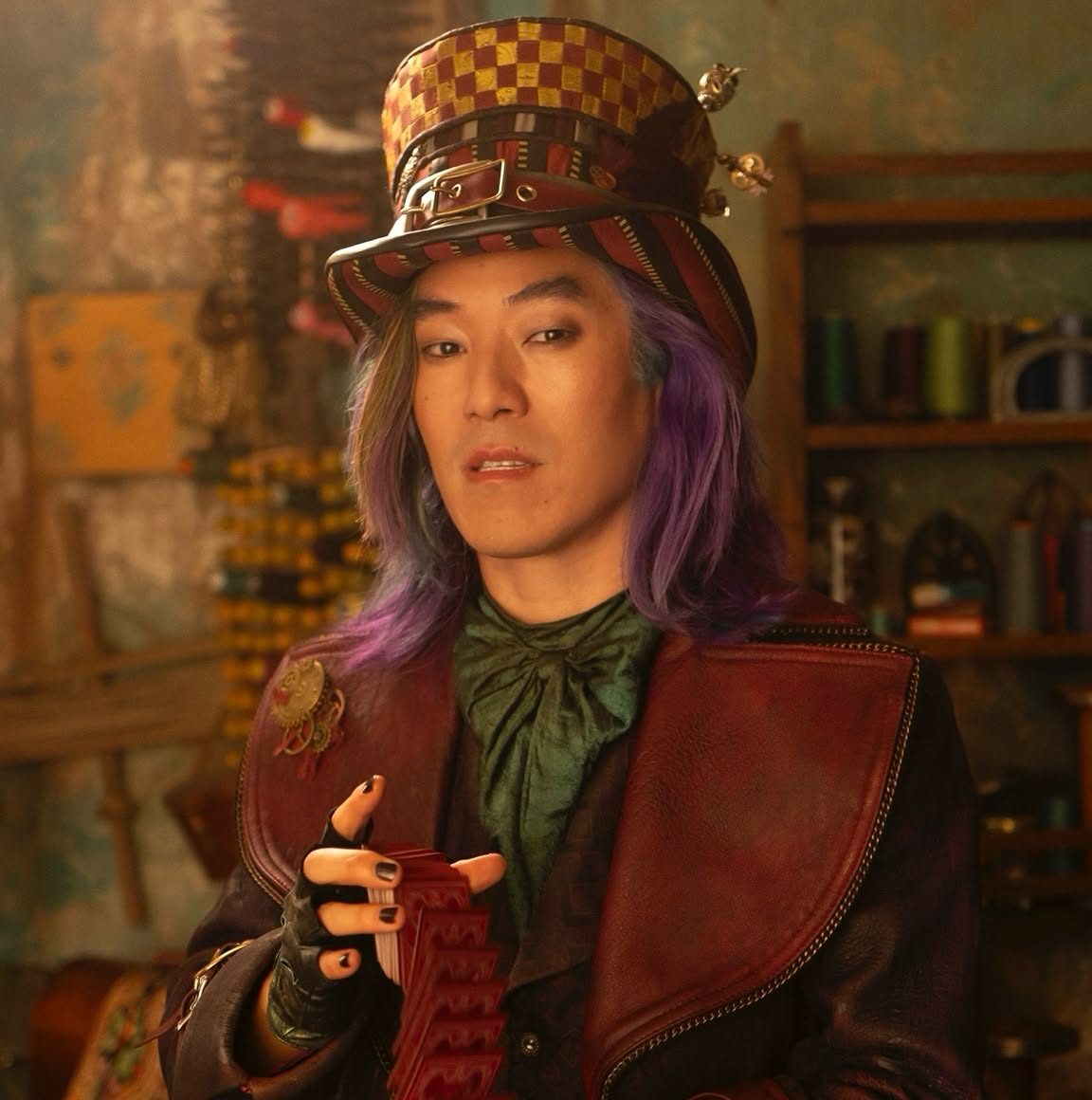
The best way to describe Leonardo Nam, who plays villain Maddox Hatter in Descendants: Wicked Wonderland, is joyfully chaotic. From the jump, he’s sweet, charming, and upbeat. A South Korean born in Argentina and raised in Australia, he’s got a delicious accent and an even better demeanor.
He’s an LA resident, actor, and producer with credits including HBO’s Westworld, Marvel’s Werewolf by Night, Netflix’s Yes Day, The Sisterhood of the Traveling Pants franchise, and The Fast and the Furious: Tokyo Drift. He’s also a husband and father.
His character of Maddox goes from fan favorite to villain and returns as the antagonist in Descendants: Wicked Wonderland. He joins other queer icons who have played villains in the franchise, including Kristen Chenoweth, Cheyenne Jackson, Kathy Najimy and Jamal Sims.
Nam took some time to discuss everything from parenting to Disney to his current villain status.
How do you feel about rejoining the franchise?
LN: Oh, my goodness, I am absolutely loving being part of this franchise again. You know, from the very get-go, I was so grateful that I got to play in the sandbox with Disney and they invited me in. It’s a place where anything goes. Imagination lives here. Then to jump through the rabbit hole into another universe, and to play in Wonderland in this way was just like just delicious, excellent. I loved it
What does it feel like being out, you know, queer person working on a Disney project?
Oh, it feels wonderful to be able to sit here with you right now and to have brought my family to the premiere. That was really important for me. Anyone who’s doing anything in their life that they pour their heart and soul into, it’s really wonderful when you’re able to share that with family, with friends, and with the community.
It was just such a wonderful experience. I’ve got twin boys. My kids are now 9, so they’re kind of right in the pocket of where this hits home for them. I remember when I was 9, watching Disney films and resonating with them, and dreaming about being in this whole new world, and what have you. It’s just so wonderful to share it.
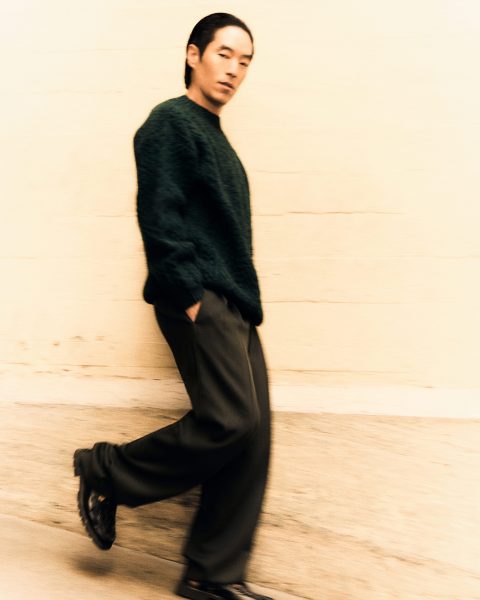
How did it feel to play a villain?
Are you kidding me? That’s just so delicious to play as an actor, you know? When I read a script, and there is a line that references an evil kind of mustache-twirling kind of vibe, everyone is referencing a Disney villain like they’re mocking it, or having fun with it, or being ironic about it. Everyone is referencing an OG Disney villain
Now, to be a Disney villain and to have a villain song is a dream come true. This is so extra for me, and to be able to share this right now in 2026 with my family right now where I am, it feels kind of magical in a way.
So as a father and playing a father, do you feel like you brought anything from home to the role?
I think you bring some of you to every role. I’m so lucky that I get to play in a world with the work that I do with such imagination and also so much heart. And one thing I love about this franchise is that they really boil things down to love and family.
So I felt like, as a father, doing this role was kind of unique. Like I said, my kids are in that right age right now, where I find myself, finding ways of having to really love and celebrate them, and trying to make them feel they belong and that they have a reason and a purpose to live even through the hard times. How to still love and cherish the relationships that you have, and that even though there are things in your life that you may not like or right now seem hard, that it’s not where you stay. It’s not where you’re stuck.
And I think that this movie kind of amplifies that.
On the flip side, was there anything you brought home from your role?
Singing was something I never thought I was going to do in my life. I was kicked out of choir. I definitely had that trauma, and when I knew I was going to sing this song… my kids were upstairs while I was rehearsing in this office, and they would always say to me, “What are you doing?”
Now, after filming it and really facing that fear, looking to transform it through creativity and through the actual work, I came back thinking, hey man, I can do scary things. No matter what, I know I tried my absolute best; I gave it my all, and I’m so glad and grateful that I did, you know? It definitely gave me that sense of like, hey, I can do it even if it scares me; I can do it
There’s a lot of queer icons who played villains in Descendants. Why do you think that is?
First of all, massive, massive, massive fan of the franchise as well. They bring in such quality people, so it feels wonderful to be welcomed into this playground with these greats. And I think a villain can be very theatrical and there can be moments of flamboyance and exaggeration and really, you know, diving into something headfirst.
And I think people, perhaps this is what I resonate with, is that they’ve been an outsider, and they’re finding their way into who they are within this journey. I think that there is a lot that people resonate with, with being an outsider and either the redemption arc or some sort of journey to finding themselves.
Who’s your favorite Disney villain?
That’s a hard one. I mean, I love Ursula; man, it’s a toss-up between her and Scar
Scar is a character that I really took a lot from. I really learned to fall in love again with The Lion King and Scar.
Do you have any message to any LGBTQ Disney fans?
Thank you. I so love being part of this community and in this Disney world. It’s my first entry into it through this franchise. I just absolutely love, love, love being embraced so warmly. And so, if someone else finds some sort of a wonderful kind of being able to see themselves on screen, you know, reflected back to them, I just am so grateful that it can even exist, and I can be a part of that.
You have a pretty great life. Do you have any encouraging words for our readers?
Everyone has their own journey, and I never thought in my wildest dreams that this is a reality that I would be living in: happily married, I have kids with my husband, and we live in LA, and I’m doing this film. I never thought something like this would happen.
I am really grateful that I have continued to say yes to myself and continue to show up even when I am afraid to show up anyway. One thing I know that is true is that together we are stronger. So continue to build community, continue to make friends, continue to link arms with friends and even with strangers, because it’s important that you have a community out there, because when things do get hotter, you are able to rely on these friendships. No one is supposed to figure it out on their own, and I’ve been very lucky and blessed to have such wonderful family and friends and a community that I can rely on and have relied on.
Is there anything else you’re working on?
I recently started a production company, and it’s called Good On Ya, and it comes from an Aussie saying, you know, when someone slaps you on the back says Good on ya, I got your back you know, and so this is really my way of having my own back and amplifying the voices and the stories that I see that are important. And so does that mean that every story is going to be me in it? No, but it does mean that I get to have a say in how this world is created or what this character does and how that is truthful to what I know. And so I’m really excited about that journey. I have a show in development, and then I have another film called A Vintage Crime, and it’s about the largest wine heist in FBI history, and it’s a true crime.
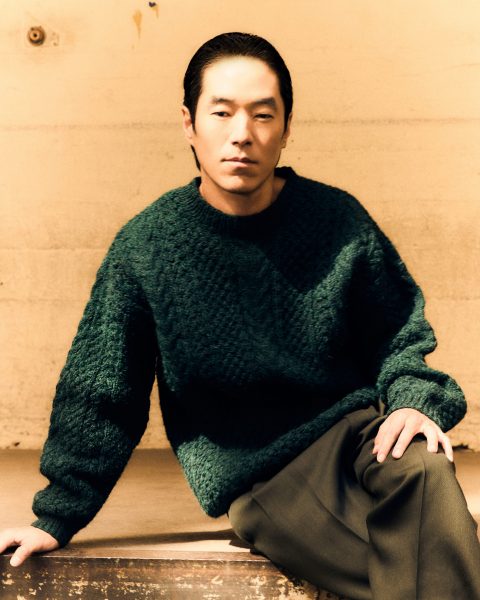
You can check out Leonardo’s performance as Maddox Hatter in Descendants: The Rise of Red and see his turn as a villain in Descendants: Wicked Wonderland, and keep up with him on Instagram.
a&e features
Jason DePuy dishes on his time on ‘Big Brother’ and how the community came out to support
Known as a messy player in the house, DePuy often had to fight to stay positive and stand up for himself.
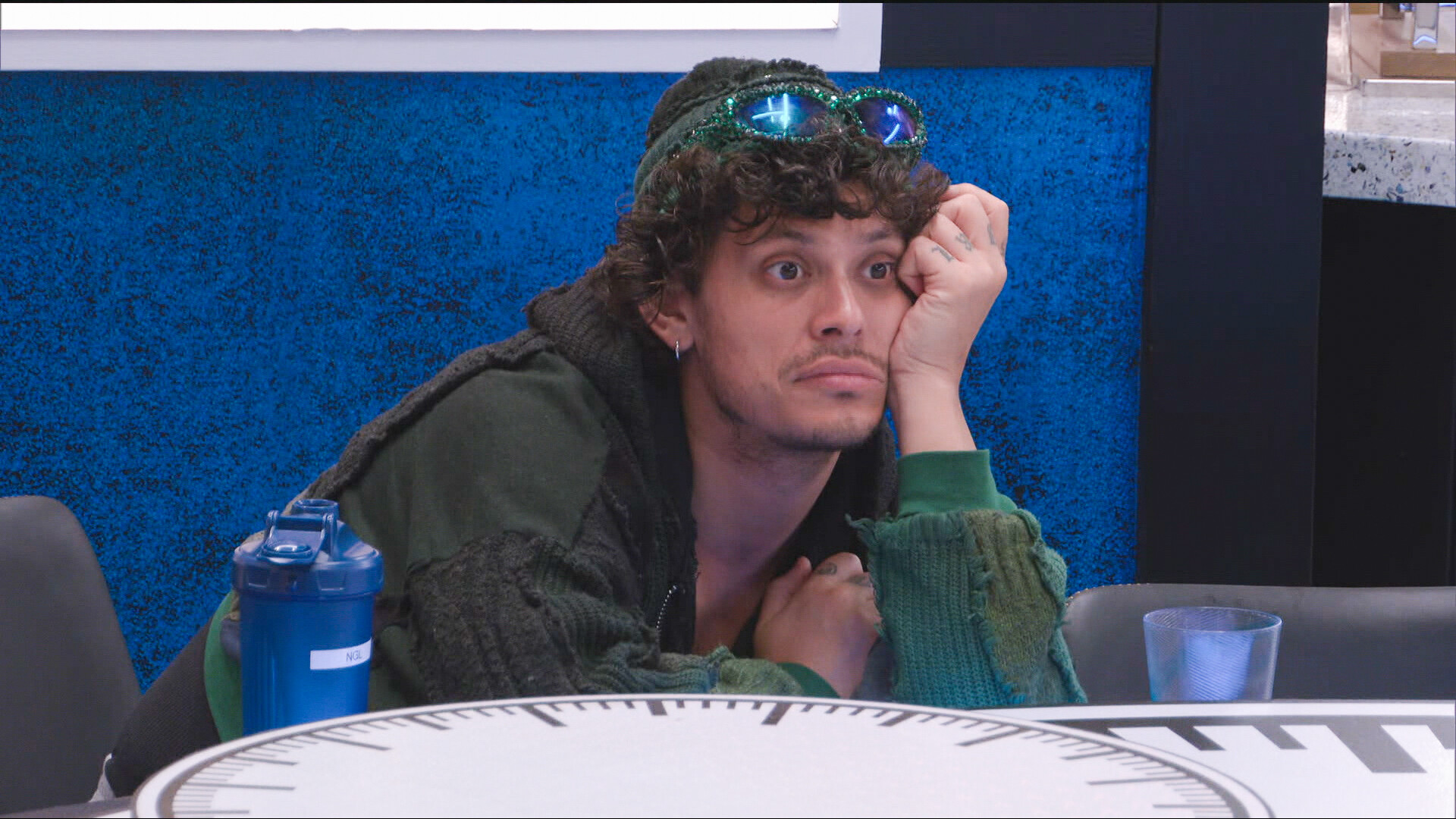
One week after Jason DePuy (known as Salina EsTitties on RuPaul’s Drag Race) was bullied and eventually evicted from CBS’s Big Brother house, the queer drag performer is still emotionally processing his feelings.
During his 24 days in the reality TV competition, De Puy often had a rough time, with fellow cast member Kamuela “Kamu” Kirk making homophobic comments and feeling isolated.
In a conversation with Head of Household Rick Devens, Kirk left viewers upset when he said, “Bro, miss me with the drag stuff. Miss me. I’m still an MMA guy, and I have an image to uphold.”
Former Big Brother contestant Frankie Grande called his words ‘homophobic’ and ‘gross.’ Another comment, where Kirk said he wanted to end DePuy’s career, also received strong backlash online.
Now that he is out of the house, DePuy has been shocked and deeply touched by the love from Big Brother fans and former contestants. We chatted with DePuy for this Blade exclusive.
“To know that my community was rallying for me outside the house was the most wonderful thing. Seeing how much people were just wanting to shower me with love was incredible. Even my friends, I went to say hi and give them a hug, and they’re like, ‘Uh, uh, come here.’ They had to hold me and let me know America was feeling for me in a way that I had no idea.”
He added: “To see that reality was just overwhelming, and I couldn’t ask for more.”
Known as a messy player in the house, DePuy often had to fight to stay positive and stand up for himself.
“No one was coming to my rescue. In real life, it’s easy to block people, but in the house, I didn’t have that luxury, so I had to find it within myself to learn how to speak up for myself in a way that wasn’t nasty or biting. I didn’t attack anyone personally, which is what I was the most proud of.”
DePuy acknowledged he has had a history of putting his foot in his mouth when it came to certain Drag Race moments, being in the public eye, and making a fool of himself. “I’ve learned my lessons; to see how I handled myself in the Big Brother house was amazing.”
While DePuy has been sober for 14 and a half years and has a strong spiritual foundation, in the Big Brother house, he often felt like he couldn’t communicate what he was feeling.
“As a queer person, a person of color, a drag queen, I have to be very careful about how I move. I don’t have the luxury or privilege to just act a certain way or say a certain thing. I have to be very careful; I’m representing me. But who I am is a Latino, a person of recovery, a drag queen, a queer person in the community. I know that there’s a lot of pressure that comes with that. I felt it was safer for me to sit there and just breathe than try to do anything crazy.”
He continued: “I couldn’t speak to the personal attack that was happening in the house, because in my mind I was like, ‘no, this is a game, and I have to play it, put that aside.’”
Not only can viewers watch the episodes, but they can also watch the live feeds of what’s happening. Seeing the fans’ social media posts from people who had watched the episodes and the live feeds also contributed to DePuy realizing that his feelings of discomfort were valid.
“To know that I wasn’t delusional in those moments, that others could see what was happening, has been a lot to take in. Fans and friends let me know the comments made went beyond the game…I’m like, ‘Oh, so my instincts were correct.”
One of the most poignant moments on the live feeds occurred when DePuy was crying, alone in his room, and said how he missed his gay community.
“I really missed my friends. I missed my queer community. We’re so colorful. We’re so loud. We’re so vibrant. We speak off the cuff, and we’re very truthful and honest with how we speak, and it’s fun. We have fun lingo.”
DePuy had to censor his expressions in the house. “Because I can say one thing, but it can mean something different to straight people than it does with my queer brothers and sisters. So, there was a sense of code-switching that I had to do. I had to even put aside some of my queerness in a way sometimes to fit in.”
DePuy was thrilled to be the very first drag queen to ever be cast on the show.
“I’m honored to have been chosen. There’s a million drag queens out there, and to know that I was a contender to come in the house and not even be in drag was like a wow for me. I’m over here in Hollywood, running around these streets with a wig and heels just to make a dollar to survive, and I have to rely on drag to do that. And then to be offered this opportunity and be given the privilege to say, ‘hey, you don’t have to put on the wig for you to be valuable here,’ is just insane to me.”
Prior to his shows, DePuy has been hustling for 15 years, flipping burgers and doing drag at night.
“That has been my life these past since I was 17. So it’s been a long journey; the opportunity to do this out of drag is a very big blessing. I’m honored and grateful to be the representation of my community.”
If you missed Jason on Big Brother: Unlocked, the episode can be seen on CBS.com. He will be back on the show for the finale.
a&e features
What ‘Queer Eye for the Straight Guy’ can still teach us today
‘Queer Eye’ and ‘House of Stassi’ producer David Collins on the lasting impact of the hit series.
It’s hard to imagine where LGBTQ+ television would be without Queer Eye for the Straight Guy, the trailblazing reality series that premiered in 2003.
Each episode of this Emmy-winning show saw a group of gays converge on a struggling man — the titular straight guy — and offer nonstop wit while organizing his endlessly messy life. This program about a group of homosexual helpers took the world by storm, furthering the love of gay television begun by shows like Will and Grace but bringing it into the growing medium of reality TV. Of course, it wasn’t perfect; Queer Eye for the Straight Guy often cast its experts less as multi-faceted queer folks and more as sources of early 2000s gay jokes. But despite these pitfalls, it’s undeniable that the original program explored the realities of being gay in a way audiences had never seen before. It was a monumental piece of LGBTQ+ representation, and its success is largely owed to the man who fought to get this show made: producer David Collins.
Collins spoke with the LA Blade from his Los Angeles home, where he’s spent the past few years living with his husband and his two daughters. David spoke fondly of his many years in this industry, detailing how it feels to be such a huge part of LGBTQ+ history. He explained, however, that he didn’t initially set out to alter how queer people were seen on television. “I never went out to make gay television,” said the producer. “I went out to tell great stories.”
“I’m a hillbilly from Ohio, and I thought I was going to be an editor,” David laughed, looking back on his career. “I interned at the Cincinnati Film Office, and I showed up to work my very first day, and the film commissioner was like, ‘Get to the airport right now and pick [someone] up. Don’t talk to them.’ Well, I ended up picking up Jodie Foster!” Collins raved about this car ride that changed his life, with the pair becoming friends and Foster pushing him to become a producer who puts their own media out into the world. Eventually, he did just that, and after learning about the wild new genre that was reality TV, he pitched a series to Bravo: Queer Eye for the Straight Guy.
“I was obsessed with Esquire magazine, and they had five categories: fashion, grooming, interior design, culture, food, and wine. So I gave them each a gay, and the Fab Five were born!” Collins said, describing how viewers quickly fell in love with the concept and earned the program four seasons and an Emmy for Outstanding Reality Program. He spoke about how proud he felt creating a show that centered real gay people, not characters in a story, remembering, “To stand in the middle of Times Square and look up and see this massive billboard with the original Queer Eye guys…it wasn’t even a dream come true, because it wasn’t a dream I had even fathomed.”
With his series, people were watching actual gay men and learning the realities of a queer culture that had always been portrayed as a danger to society. Collins tearfully recounted hearing about queer people using the show as a way to connect with their family, saying, “What I’m most proud of that’s come out of Queer Eye [are] the conversations that that series has allowed to have people around their kitchen tables with little boys in Ohio like me who were scared to death that they were going to burn in hell because their pastor was telling them that they were a sinner.”
Now, for all of its trailblazing, the program wasn’t wholly positive; the show’s focus on the central ‘straight guy’ meant it rarely delved into the lives of its Fab Five. Collins regretted that lack of depth but understood that earlier audiences weren’t accustomed to such a nuanced look into queerness — that would have to wait til the reboot.
When Queer Eye came out in 2018, audiences were introduced to not only a new Fab Five, but a whole new format (that didn’t rely on a straight person). Now, the series would assist queer folks and allies alike, spotlighting these individuals as well as the queer experts helping them improve their lives. The show has been applauded for its amazing makeovers, but where it truly stands out is its representation, offering a look into individuals across the country and the struggles — along with the immense joys — of being queer in America today.
Fans were disappointed to hear that Queer Eye would be ending after its tenth season, but David stressed that they wouldn’t have to be sad for long. “What I will say to you is this: hang tight,” he teased. “There’s yet another version of Queer Eye to come, and we’re working on that now.” In the meantime, Collins is continuing his work with new shows like the House of Stassi, a series centered on Vanderpump Rules’ prolific waitress. He’s excited about these new projects, but emphasized that his heart will always belong to Queer Eye for the Straight Guy and all that it continues to do for viewers 19 years after its finale.
“It’s not about your new outfit or your new couch or your new whatever. It’s about your humanity,” said Collins, speaking about the core lesson he hopes people take away from the Queer Eye franchise. “It’s about seeing yourself. It’s about dignity. It’s about how confidence breeds success.”
A valuable message that queer folks can benefit from even more now than they did in 2003. And, while it’s unclear just what lies ahead for this franchise, one thing is for sure: Queer Eye for the Straight Guy helped people everywhere understand the power that exists within our queerness. It’s a truth that has impacted countless pieces of LGBTQ+ television today, and it’s one that Collins promises to keep alive through whatever hit show he creates next.

Ross Alan gives permission for queer joy with new album, ‘Audible Serotonin’

Here’s your Palm Springs look at the weekend: Sep 18-20, 2026

When pageantry meets purpose: Patrick Rush brings us Best in Drag Show

Step into the ‘Crush House’ with JJ Aussie and Josh Moore

Jeremy Moss looks to bring LGBTQ+ advocacy from Lansing to Capitol Hill

Indonesia’s top Muslim clerical body proposes criminalizing LGBTQ+ people, advocacy

Fashion icon Bob Mackie dead at 87
Grand marshals announced for 2026 Greater Palm Springs Pride

The 78th Annual Emmy Awards recapped

L.A. DJs Heidi Lawden and FLABBERGAST call for resistance in ‘Children of the Revolution’
-
 India4 days ago
Indonesia’s top Muslim clerical body proposes criminalizing LGBTQ+ people, advocacy
-
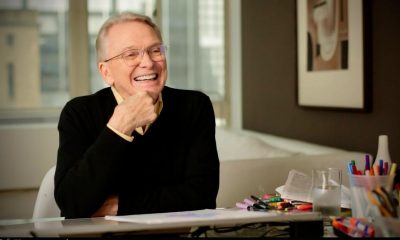 Celebrity News5 days ago
Fashion icon Bob Mackie dead at 87
-
California4 days ago
Grand marshals announced for 2026 Greater Palm Springs Pride
-
 EMMYS4 days ago
The 78th Annual Emmy Awards recapped
-
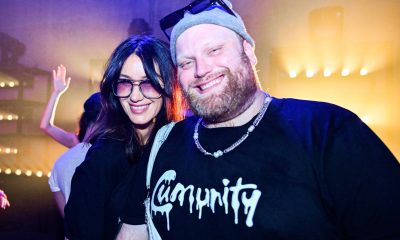 Music & Concerts4 days ago
L.A. DJs Heidi Lawden and FLABBERGAST call for resistance in ‘Children of the Revolution’
-

 Turkey5 days ago
Dozens detained after Turkish authorities raid LGBTQ groups, businesses
-

 Hungary5 days ago
New Hungarian government to scrap anti-LGBTQ+ adoption law
-
 National4 days ago
Advocate, Out parent company adds Trump supporter to board, prompting outrage
-

 Turkey3 days ago
More than 150 people detained outside Istanbul courthouse
-
 Commentary4 days ago
Gov. Newsom could make history for local news outlets nationwide