
News
Trump to reportedly roll back normalization of U.S., Cuba relations
Embargo against the island remains in place
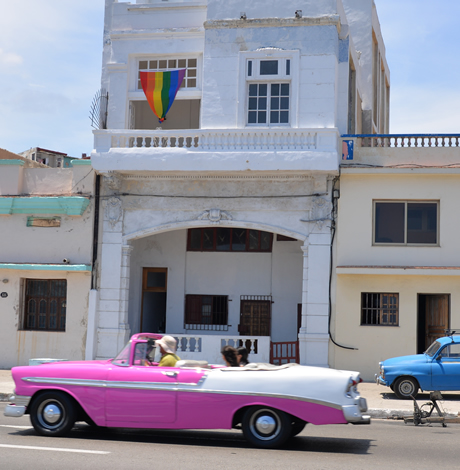
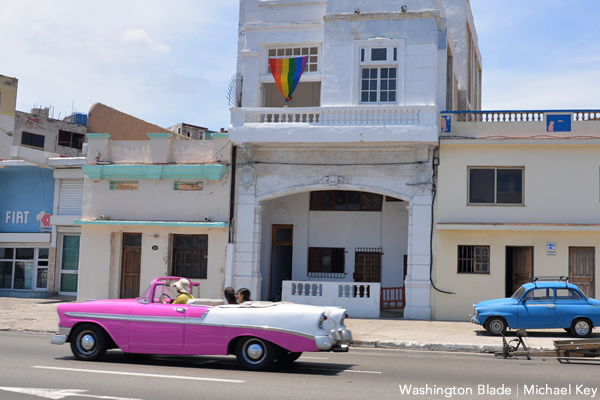
A rainbow flag hangs from the window of an apartment building on Havana’s oceanfront on May 12, 2017. Reports indicate President Trump will roll back the normalization of relations between the U.S. and Cuba later this month. (Washington Blade photo by Michael Key)
HAVANA — President Trump will reportedly roll back the normalization of relations between the U.S. and Cuba this month.
Andrea Mitchell of NBC News on Thursday reported Trump could once again limit travel to the Communist island and tighten trade regulations that former President Obama loosened. Sources told Mitchell it is unlikely Trump will cut diplomatic ties with Cuba or close the U.S. Embassy in Havana that reopened in August 2015.
Mitchell reported Trump would make the announcement in Miami through an executive order that notes Cuba’s human rights record. U.S. Sen. Marco Rubio (R-Fla.) — who endorsed Trump during the Republican National Convention — and Florida Congresswoman Ileana Ros-Lehtinen — a Republican who was born in Havana and left Cuba with her family after Fidel Castro came to power in the 1959 Cuban revolution — are among the most vocal critics of the normalization of relations.
Trump last October said he would “reverse” the normalization of relations between the two countries that Obama and Cuban President Raúl Castro announced on Dec. 17, 2014. He later criticized Obama for signing “a very weak agreement” during an interview with a South Florida television station.
The White House earlier this year said it had begun to review the policy.
Newsweek last September reported Trump’s company violated the U.S. embargo against Cuba in 1998 when it spent $68,000 on a trip to the Communist island that focused on exploring business opportunities. An article that Bloomberg published two months earlier notes four of Trump’s associates traveled to Havana in late 2012 or early 2013 to explore “golf-related opportunities” for the Trump Corporation.
“We do not have anything to announce at this time,” a White House spokesperson told the Los Angeles Blade on Friday.
Cuban activist: Trump is ‘Hitler of the 21st century’
Cubans with whom the Blade spoke last month in Havana and other cities across the country said they support the normalization of relations with the U.S.
“We are hoping to unite and hoping to talk about these differences that have existed for all these years,” said Reynaldo, an activist who works with the National Center for Sexual Orientation, which Mariela Castro, daughter of Cuban President Raúl Castro who spearheads LGBT-specific issues, directs, on May 13 before he and more than 2,000 others took part in a Havana march that commemorated the International Day Against Homophobia and Transphobia. “It is good for us as Cubans.”
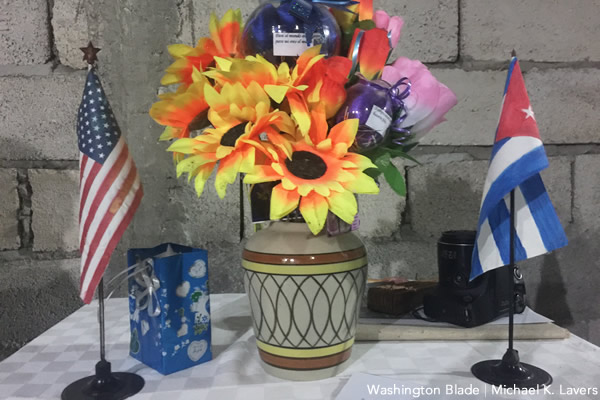
The U.S. and Cuban flags at the Centro Comunitario de Cultura in Santo Domingo, Cuba, on May 16, 2017. (Washington Blade photo by Michael K. Lavers)
Isel Calzadilla, coordinator of Las Isabelas, a social and advocacy group for lesbian and bisexual women in the city of Santiago that works with the National Center for Sexual Education, agreed.
She told the Blade last month during an interview that she spent nearly two months in the U.S. last summer.
Calzadilla said she is unsure whether the U.S. would allow her into the country while Trump is president. She also described him as the “Hitler of the 21st century” because of his administration’s foreign and domestic policy.
Damian Pardo, a Cuban American LGBT activist who founded SAVE, a Miami-based advocacy group, told the Blade on Friday that any changes to U.S. policy towards Cuba “will be largely symbolic as an attempt to deliver on a campaign promise to the Cuban American community.”
“The reality is that most of the changes geared towards engagement are difficult to roll back and are generally supported by the Cuban American community,” said Pardo.
Mariela Castro criticizes embargo during IDAHOT speech
The Cuban government on May 20 sharply rebuked Trump’s Cuban Independence Day statement that, among other things, noted “cruel despotism” and “unjust persecution” on the island.
“The Cuban people deserve a government that peacefully upholds democratic values, economic liberties, religious freedoms and human rights,” it reads. “My administration is committed to achieving that vision.”
Nelson Gandulla, president of the Cuban Foundation for LGBTI Rights, an independent advocacy group that is based in the city of Cienfuegos, claims authorities last month prevented him from meeting with Gender Rights Maryland Executive Director Dana Beyer and other U.S. LGBT activists in Havana. Independent LGBT activists told the Blade the son of a Cuban Interior Ministry official received a fine of less than $2 after he assaulted seven gay men earlier this week in the city of Cárdenas.
Florida Congresswoman Debbie Wasserman Schultz — an opponent of ending the embargo who criticized Obama’s decision to normalize relations between the two countries — told participants of the World OutGames Miami Human Rights Conference in Miami Beach, Fla., on May 27 that Secretary of State Rex Tillerson’s assertion the U.S. may have to set aside human rights in the name of promoting U.S. interests abroad is “morally repugnant and unacceptable.” Americans with whom the Blade spoke in Cuba last month said they support the lifting of the embargo — which Cubans describe as el bloqueo — as part of the normalization of relations.
“The U.S. blockade is a tragedy,” Ruth Eisenberg of Adams Morgan told the Blade before she took part in the International Day Against Homophobia and Transphobia march in Havana on May 13. “It has done such harm to this country and to the people of this country.”
“My impression is that whatever the relations between the countries are, the people of this country want relationships with Americans,” she added. “They want trade.”
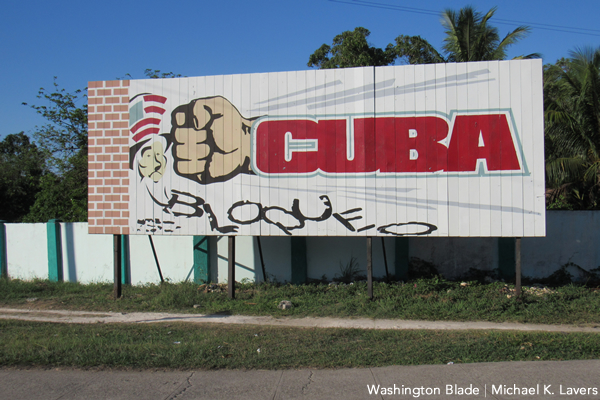
A billboard at an intersection in Cienfuegos, Cuba, highlights opposition to the U.S. embargo. (Washington Blade photo by Michael K. Lavers)
Pardo told the Blade the embargo is not “the real issue for the Cuban American community.”
“Instead, it is making economic concessions tied to the embargo without any betterment of basic civil rights for the Cuban people,” he said. “Many in the community do not support conceding this leverage without greater cooperation from the regime to support basics freedoms, like those of speech and assembly without intimidation and incarceration.”
Mariela Castro and the National Center for Sexual Education have highlighted their opposition to the embargo in previous International Day Against Homophobia and Transphobia events. Mariela Castro did so again on May 13 when she spoke to her supporters who gathered at a pavilion in Havana’s Vedado neighborhood after the march.
“Down with the embargo,” she proclaimed.
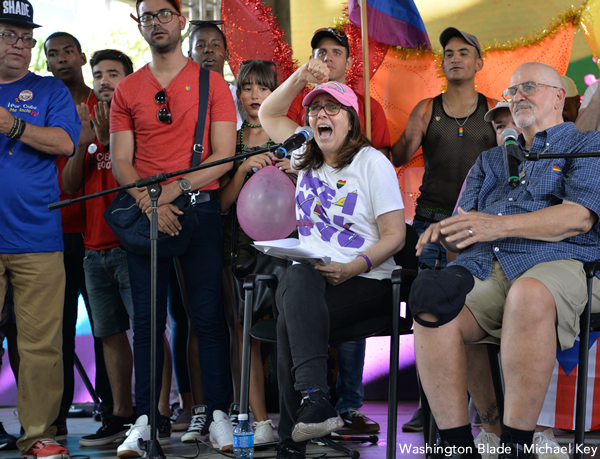
Mariela Castro speaks at the International Day Against Homophobia and Transphobia observance in Havana on May 13, 2017. (Washington Blade photo by Michael Key)
New York City Council Speaker Melissa Mark-Viverito was among those on the stage with Mariela Castro as she spoke.
Mark-Viverito acknowledged to the Blade before the march began there are “elements” who want to reverse the process of normalizing relations between the U.S. and Cuba. She added, however, there is “no turning back at this point.”
“The normalization process that President Obama started is really opening up that door in a way that you cannot close it,” Mark-Viverito told the Blade.
A spokesperson for the Cuban government in Havana did not return the Blade’s request for comment.
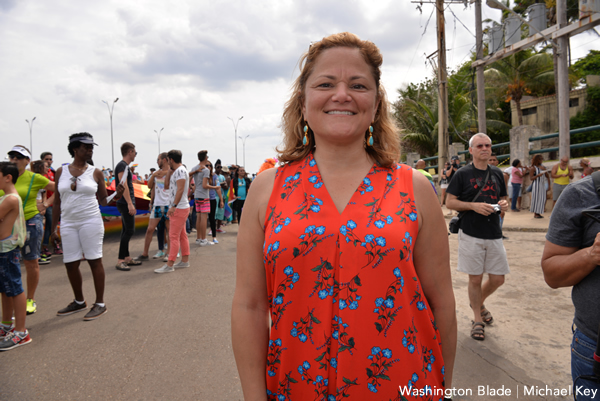
New York City Council Speaker Melissa Mark-Viverito attends an International Day Against Homophobia and Transphobia march in Havana on May 13, 2017. (Washington Blade photo by Michael Key)


Palm Springs
Making waves in the desert: How Brad Fuhr and KGAY keep the Coachella Valley connected
From building Palm Springs’ queer media scene to pushing back against social media censorship, Brad Fuhr is keeping the desert gay, connected, and on the air
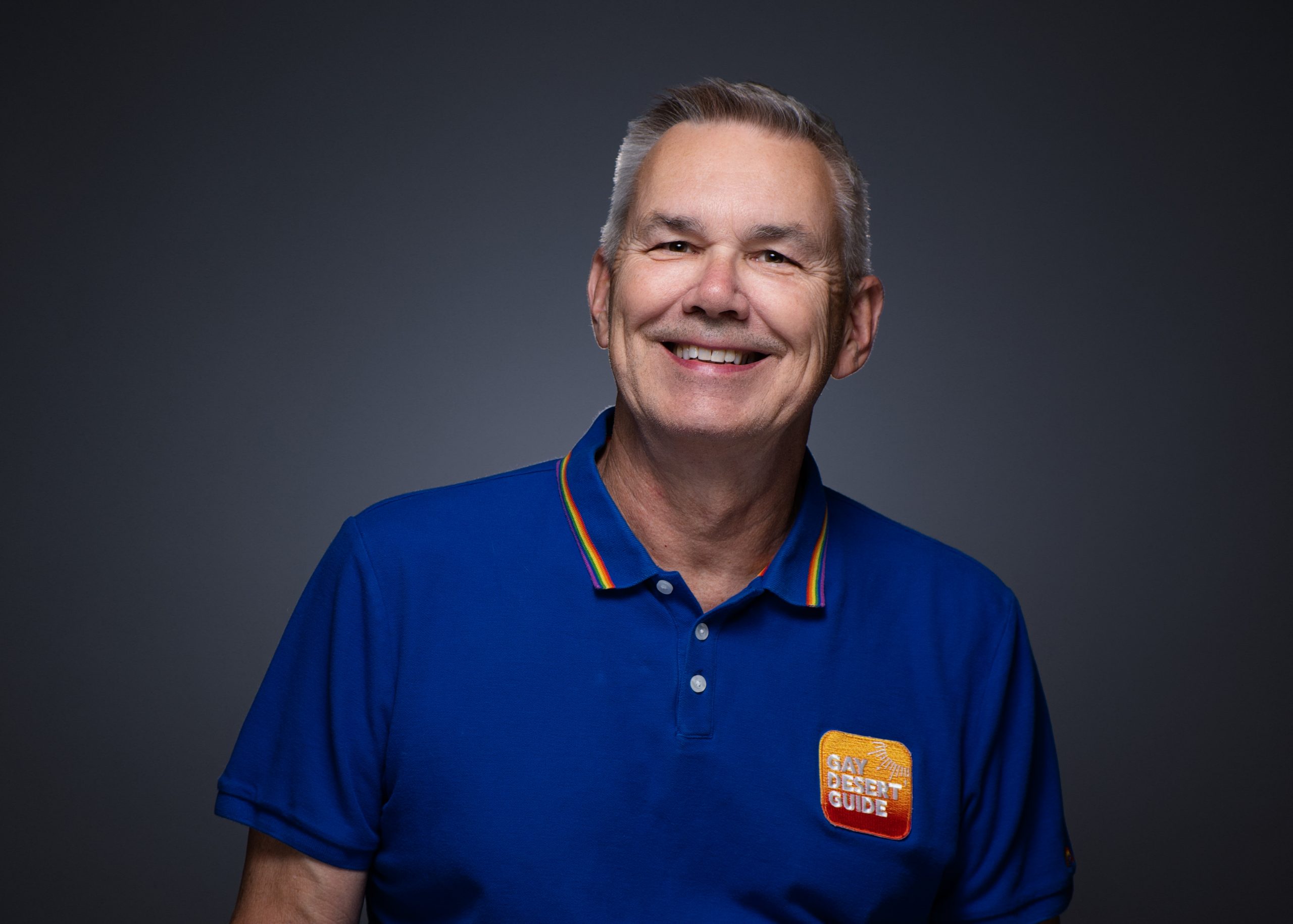
For many years now, Brad Fuhr has been helping LGBTQ+ voices find their frequency, from the radio waves of Chi-town to the evolving entertainment world of Los Angeles, and is now in his Palm Springs chapter. A true veteran of queer media who has spent his career connecting folks through broadcasting and storytelling, Fuhr seized the opportunity to provide the Coachella Valley’s LGBTQ+ community with a comprehensive outlet that goes above and beyond the average tourist brochure. Enter Gay Desert Guide, the digital destination Fuhr launched in 2013 to assist both locals and tourists alike in discovering the people, places, and experiences that make the Palm Springs queer community so very one of a kind.
In his role with KGAY, the LGBTQ+ radio station that made its comeback under his leadership in 2021, Fuhr has helped ensure that queer voices remain part of the local soundtrack. From navigating the seismic shifts in media consumption to taking on the realities of social media censorship, Fuhr has witnessed firsthand how technology can be used to bring communities together, as well as how it can divide them. We talked with Fuhr about fostering queer spaces and what it takes to keep Palm Springs’ vitality in an ever-changing media world.
You have spent decades in broadcasting and media, and now you’ve found yourself a major part of the Palm Springs queer community. What about Palm Springs first compelled you to start a new chapter in this LGBTQ+ desert oasis?
I had been working in LGBTQ media since the 90s in Chicago, where I managed LesBiGay radio and worked for Windy City Times. When I came to Los Angeles, I worked with the progressive talk radio station owned by Clear Channel Radio, then moved over to run Pride Radio, which was their LGBTQ streaming service. So I had a great background that included my years in radio.
After a 2009 downsizing, I went back to work for Emmis Interactive, where we consulted radio stations and print publications on digital strategy. Frontiers Magazine in Los Angeles and Palm Springs Life became clients, and I saw how quickly the media landscape was changing.
Palm Springs Life hired me to consult them in the summer of 2012. I brought the idea of Gay Desert Guide to them – a website focused on the large LGBTQ+ community that lived in and visited Greater Palm Springs. They declined, but said, “If you think it’s a good idea, you should go do it yourself!”
So I took nearly a year to build the site, populate it, and launched it Labor Day weekend 2013.
You also founded the Gay Desert Guide. What was missing in the Coachella Valley that you wanted to provide, and how have you seen it change over the years?
The print publications of the day were either going out of business or were so rudimentary as to not be useful except as “bar rags”. I had watched Frontiers Magazine start to decline as print fell out of favor and websites started being a primary source for discovery. That was true in Palm Springs, where we had some basic LGBT tourist information on the VisitPalmSprings.com site, but it wasn’t deep or broad enough for the amount of information that locals and visitors needed.
Frontiers never covered entertainment or destinations very well, but I knew that’s what people wanted to know about. So I set out to build a comprehensive website that was focused on how people could spend their leisure time. But I built a business directory so that consumers had a place to vet LGBTQ friendly businesses. That helped sustain the site from a revenue standpoint and became a big part of why people visit.
The biggest change has been the popularity of social media and for us to compete for eyeballs on those platforms. We had a huge Twitter/X platform – the #ILoveGay network created by Matt Skallerud and Pink Media. That was driving lots of site traffic until July 4 weekend two years ago when Elon and his people unceremoniously pulled the plug for “community standards violations”. We never got those accounts back.
Recently, Meta stopped allowing us to share content to any groups – obstinately for the same “violation”. Every time one of us shared to any group, we got put in Facebook jail for a longer period of time. We are still fighting it, but so far no luck.
KGAY is undoubtedly a significant voice for the LGBTQ+ community in the area. What was your initial goal for the station? Has this goal evolved over time?
The radio station came out of a nonprofit formed prior to my involvement called Qchella Media. It then recruited community members to be a part of its board of directors. With my experience in radio and my connection to the community, I was hired to be general manager of the station. In fact, I was the one who found the call letters KGAY and helped launch it in 2018. I brought on Chris Shebel as program director, as he had programmed successful dance music stations in Chicago and San Francisco. John Taylor was brought on as morning host, and we hired local DJs to do daily mix shows.
The initial goal of the nonprofit was to use the on-air signal for music and entertainment, and create a podcast platform for longer-form programming and interviews. After less than a year, “creative differences” between the board and station ownership caused us to resign en masse just before Pride 2019.
After the station languished through COVID-19, the owners approached me to purchase the station and keep it in LGBTQ hands. I brought back morning host John Taylor and program director Chris Shebel – we got the band back together and relaunched in July 2021. The station has grown significantly since then, with over 200,000 streaming listeners each month across the globe. Our biggest streaming market is Los Angeles.
On January 1, KGAY moved to 103.1, and I converted our 106.5 frequency to Sunny 106.5, an adult contemporary format which also has appeal in the LGBTQ community.
What are some of the biggest changes you’ve seen in Palm Springs as a whole? What makes the community here distinctive?
Palm Springs is such a unique market and setting in which to do business. We’re very seasonal – just the opposite of a summer vacation spot. So our summers are hot and less busy. But we have 9 splendid months of mostly great weather and opportunities to do so many outdoor activities.
Some of the biggest changes that I have seen include an overall modernization of the city and its infrastructure. Roads have improved, the mix of retail is much better, and we have exciting restaurants and bars that serve a wide swath of the community. We’ve also added new attractions like the Palm Springs surf club and the BMW performance racing track.
The city has become more sophisticated and provides a more elevated experience for tourists. That’s not to say someone on a budget can’t enjoy a quality weekend here; it still is affordable, especially in the shoulder seasons. Hiking trails, nearby Joshua Tree, and the plentiful gay resorts with day passes all make this place special.
As connected as you are in the local business community, what have you learned about doing business in Palm Springs that one could only learn from being involved in it?
I’ve seen so many “business people” come and go. They typically arrive with a splash, but like a shooting star, they flame out and are gone. It’s one of the recurring themes I see here. That’s not to say that someone with an entrepreneurial spirit won’t thrive, but it’s a matter of having humble beginnings and learning the community.
And when you approach it from how you can contribute to the community rather than how much you can take away, people notice and reward you with their patronage. We’ve also become polarized politically. There’s a Facebook group – Gay Men of Palm Springs CA – that is the de facto judge and jury for businesses that are not supportive of our community. That’s not a group to be on the wrong side of. A number of restaurants are purported to be MAGA-owned and have been boycotted by group members, which total over 17,000.
We have a directory on our GayDesertGuide.com website that has vetted local businesses for being supportive of our values, and we will not knowingly take advertising from unfriendly businesses.
Media as a whole has evolved exponentially since the start of your career. What lessons from your early years have remained with you as the industry changes?
In the early 2000s, I worked for a radio company whose CEO challenged us to determine whether the internet was a hobby or a business for our radio stations and magazines. Technology was evolving quickly, and we answered the call by creating engaging websites, loyal listener clubs, and marketing opportunities for the sites.
That resulted in a business unit of the company called Emmis Interactive that I worked for in Chicago at Q-101 radio and at Los Angeles Magazine. I’ve learned to carefully watch where consumer trends are going and to follow those – even at the expense of jettisoning some tried-and-true marketing ways. We’ve had to become much more social media-forward to the point that our Out & About remote broadcasts on KGAY are now video segments shared on our socials and aired on the station simultaneously.
Radio has survived television, podcasts, streaming, and social media. What do you think radio can offer other platforms cannot?
At our heart, we are a local medium with huge reach, and we’re free. No barrier of owning a cell phone or having internet service. More people listen to radio in a given week than use social media. The demographics are certainly different – radio is reaching an increasingly older audience. But that works fine for Palm Springs and for KGAY.
We can paint a picture in the minds of our listeners, and we can give voice to our community members who have a story to tell, a fundraiser that needs help, or a fun show to see in the Coachella Valley. We love having people on the air with us each day. And those interviews are typically also done with video so we can share on our socials.
In your experience, how does local radio impact its local community? Has this role it plays increased or become more significant today as opposed to 20 years ago?
We impact the community by attending vigils for our trans community, leading the Palm Springs Pride parade, and providing marketing support to our non-profits who can’t afford to advertise.
Radio done the right way can be as significant as it was 20 years ago. It’s just that most big corporate radio companies have cut their local on-air talent and their community involvement. I worked for iHeartRadio and was downsized on President Obama’s inauguration day along with over 1,200 others in the company. Those cuts have continued as these companies change focus to podcasting and digital advertising, but forget that the local on-air personality is what engaged people to listen in the first place.
What are some of the more pressing challenges that Palm Springs is facing today that you feel could be better addressed or deserve more attention?
Climate change is affecting us like the rest of the world. From dying Joshua Trees to flooding rains that damage infrastructure, we’re seeing that as a huge issue.
After 20 years of watching Palm Springs change and grow, what is one thing about the city that remains the same?
Palm Springs at its heart remains a small town of 44,000 people, with roughly half made up of LGBTQ+ citizens. I love that about our city – you can walk down the street and see people you know and have developed friendships with. But it feels like a big city when you factor in the 5 million people that pass through our city. So you get the best of both worlds – the small-town feel with big city entertainment, retail, and dining options.
Palm Springs
Here’s your Palm Springs look at the weekend: Oct 16-18, 2026
The sports they are a changin’. With apologies to Bob Dylan (whose concert at Acrisure was disappointing), the phrase describes how our valley is adapting to changing tastes in sports — both in participating and watching.
I’ve been learning about these changing trends and how they will positively affect tourism and our economy. When the LA Lakers announced a new Coachella Valley Lakers team as part of the NBA G League, it brought yet another sport to the area. There will be 24 regular-season home games, with the Acrisure staff doing some quick changes between Firebirds ice and the wooden court for basketball.
This comes at a time when the Firebirds are facing challenges with ticket sales as the current administration raises costs for families on everything from fuel to food. We’re all feeling the pinch and it’s not helping that we pissed off Canadians, too.
On Thursday, Visit Greater Palm Springs brought together many of the region’s biggest sporting events organizers at Acrisure for a dog and pony show. We know well how the BNP Paribas Open brings people and money to the valley, but new this year is the WTA Finals in November. The top 8 women of tennis will start on Pride Sunday, November 8th and be in town through the 15th, with the winner taking away one of the most prestigious trophies in tennis.
Greater Palm Springs used to be known for its golf tournaments. The LPGA Dinah Shore put us on the sports map long before the Indian Wells Tennis Gardens. And lesbians flocked here for a concurrent “The Dinah”. Both have gone through major changes with the golf tournament relocating to Texas and new promoters for The Dinah.
So while golf courses are turning into nature preserves, we are now trying to make the desert into a surfing destination? Counter-intuitive, I know. But the new Palm Desert DSRT Surf will host the ISA World Para Surfing Championship. Who knew?
Then there’s the proliferation of Pickleball, a favorite past time of our former police chief Andy Mills. It’s been growing for both participants and in drawing tournaments here. A major turning point occurred when the USA Pickleball Association (USAPA) partnered with Desert Champions to move the decade-old National Championships tournament to the Indian Wells Tennis Garden, bringing thousands of players and national broadcast attention.
And lest we forget there are the LGBTQ+ specific sports tournaments that come to the valley each year — from tennis to softball and hockey. There’s no doubt that the valley is changing with the times and drawing in new audiences that help contribute to our tourism economy. Game on!
Brad Fuhr, your K-Gay Desert Guide
Palm Springs Pride Equality Walk

Show your pride and support community equality at the Palm Springs Pride Equality Walk on Saturday, October 17. Gathering in the historic Arenas District with an official kickoff at 8:30 am, this inspiring community walk leads participants through downtown Palm Springs before returning to Arenas Road for a festive celebration with music, food, and drinks. The morning will also feature the City of Palm Springs’ proclamation of Palm Springs Desert Winds Day, honoring the Palm Springs Desert Winds Symphonic Band and its 25th Anniversary Season with a free performance by the PSDW Pop Band. The annual walk champions LGBTQ+ visibility and helps keep the upcoming November Pride Festival free and accessible to all. More info

Modernism Week – October

Midcentury architecture and design take center stage as Modernism Week – October returns October 15–18 with an expansive lineup featuring over 50 tours, talks, parties, and design-driven experiences. Highlights of this four-day festival include the Fall Dining Series, Modernism Week After Dark social events, and premier double-decker architectural bus tours. Attendees can also enjoy exclusive home tours, a new Palm Springs Aerial Tramway excursion, and a celebrity homes tour hosted by Bella da Ball. Many activities are free or low-cost, offering midcentury enthusiasts endless opportunities to celebrate iconic desert style at various venues across Palm Springs. More info
Randy Rainbow

Viral satirist and Emmy-nominated comedian Randy Rainbow brings his razor-sharp musical comedy to the McCallum Theatre on Saturday, October 17 at 8 pm and Sunday, October 18 at 7 pm. Performing live, Rainbow skewers current events, pop culture, and politics through glittering Broadway-style song parodies. Known worldwide for his hit web series and best-selling albums featuring collaborations with Marc Shaiman and Alan Menken, his show blends musical theater flair with hilarious stand-up comedy. More info
Center Stage 2026

Celebrate unity and community impact at The Center’s 2026 Center Stage gala on Friday, October 16 from 5:30–10 pm at the Palm Springs Air Museum. This powerful evening supports the essential, life-saving work of the Coachella Valley LGBTQ+ Community Center, with 100% of proceeds directly funding local programs. The event proudly honors the founders of The L-Fund—Betty Berrysmith, Barbara Carpenter, Ruth Debra, Sharon Siegel, and Kate Ullman—with the 2026 Legacy Award for their groundbreaking dedication to empowering cisgender, transgender, and queer lesbians. More info
Casual Concours – Swinging 60s on Route 66

Automotive enthusiasts can admire more than 170 classic automobiles at the 38th annual Casual Concours – Swinging 60s on Route 66 on Saturday, October 17 from 9 am–2 pm. Hosted by Great Autos of Yesteryear at Mission Hills Country Club, this year’s charity car show celebrates iconic 1960s vehicles and the 100th anniversary of Route 66. Guests can view vintage models ranging from the 1930s through the 2000s, enjoy free parking, and purchase lunch at the clubhouse. Proceeds benefit The LGBTQ Community Center of the Desert and Safe Schools Desert Cities. More info
Dracula: A Comedy of Terrors

Get ready for a hilarious, bloodthirsty night of entertainment as Revolution Stage Company kicks off its fourth season with Dracula: A Comedy of Terrors. Running October 15–31, this fast-paced, 90-minute gender-bending stage farce combines gothic horror with Python-esque humor. The story follows a meek British realtor who takes on a terrifying vampire client whose deep pockets are irresistible and whose attraction to his fiancée is concerning. Three women must navigate the chaos to stop the carnage in this dangerously sexy production. More info
Joseph and the Amazing Technicolor Dreamcoat

Joseph and the Amazing Technicolor Dreamcoat runs October 9–18 at Palm Canyon Theatre, bringing Andrew Lloyd Webber and Tim Rice’s beloved musical to life with humor, heart, and choreography. This family‑friendly production celebrates resilience, forgiveness, and the power of dreams through colorful characters and a score that has charmed audiences for decades. More info
Cat on a Hot Tin Roof

Cat on a Hot Tin Roof runs October 9–24, presented by THE BENT. Tennessee Williams’ Pulitzer Prize‑winning masterpiece holds deep significance for LGBTQ+ audiences, exploring repressed homosexuality, internalized homophobia, and the destructive nature of the closet. This production highlights the hidden desire between Brick and Skipper, offering a fresh interpretation of Williams’ groundbreaking work. More info
Desert X Pops Up

Join Desert X for the opening session of the Parker Sessions series on Friday, October 16 from 6:30–8:30 pm at Parker Palm Springs. The evening features board member and contemporary artist Nicholas Galanin in conversation with art collector Nancy Magoon, moderated by Artforum editor Bryan Barcena. Following the discussion, Nicholas Galanin performs live with his indie pop and electronic project, Ya Tseen, blending indigenous perspectives with contemporary soundscapes. Ticket proceeds benefit Desert X’s upcoming 10th anniversary celebration. Optional VIP tickets include an exclusive dinner hosted by leadership. More info
Shoshana Bean

Broadway star and Tony and Grammy Award winner Shoshana Bean graces the stage at McCallum Theatre on Friday, October 16 at 8 pm. Known for powerhouse roles in Broadway hits like Wicked, Hell’s Kitchen, Mr. Saturday Night, and Waitress, she brings her astounding vocal range and chart-topping artistry to Palm Desert. Audiences will be treated to a sensational concert featuring Broadway classics, jazz favorites, and soulful melodies from her Billboard #1 albums. More info
Chris Isaak

Singer, songwriter, and actor Chris Isaak brings his signature blend of rock ’n’ roll, smooth romance, and cinematic style to Rancho Mirage on Friday, October 16 at 8 pm. Performing at The Show at Agua Caliente Casino Resort Spa, the GRAMMY-nominated icon delivers a hit-filled set featuring multi-platinum favorites like “Wicked Game” alongside timeless tracks from his four-decade career. More info
Black Market Trust & Elvis: The Early Years

Enjoy world-class dining and live entertainment from Friday–Sunday, October 16–18 at The Purple Room Supper Club. On Friday and Saturday, October 16–17, vocal jazz quintet Black Market Trust returns with their high-energy blend of American crooner classics and Gypsy jazz guitar. Then on Sunday, October 18, it’s the return of Elvis: The Early Years, featuring Scot Bruce and his award-winning band. More info
No Kings Rally: Vote Early

Make your voice heard at one of five Coachella Valley locations participating in the No Kings – Vote Early! Rally on Saturday, October 17. Community members are invited to gather throughout the morning for peaceful civic engagement and solidarity. Whether you attend at Palm Springs City Hall, Smoketree, Cathedral City Hall, Monterey Avenue and Highway 111 in Palm Desert, or the Indio rally location, there are several opportunities to participate and encourage early voting.
- Palm Springs City Hall: 9 am–Noon
- Palm Springs Smoketree: 9–11 am
- Cathedral City Hall: 9–10:30 am
- Palm Desert (Monterey & Highway 111): 9–10 am
- Indio: 9–10 am
Bea Arthur: The Documentary – “I’ve Done Everything Except Porn”

Discover the remarkable life and career of a television and stage legend during a special encore film screening at the Palm Springs Cultural Center on Saturday, October 17 at 7 pm. Bea Arthur: The Documentary – “I’ve Done Everything Except Porn” features a never-before-seen interview with Bea Arthur herself, offering an intimate self-portrait alongside reflections from famous friends and colleagues. More info
Dolly – The Legacy Tour

Enjoy an evening of sparkling country music, humor, and classic hits when Dolly – The Legacy Tour comes to Rancho Mirage on Saturday, October 17 from 8–10 pm. Taking the stage at The Show at Agua Caliente Casino Resort Spa Rancho Mirage, acclaimed tribute artist Rhonda Medina captures the charm, warmth, and iconic vocals of Dolly Parton. With three decades of professional performance experience, Medina delivers heartfelt renditions of country favorites. Admission to this special tribute performance is completely free with general admission seating available on a first-come, first-served basis. More info
Journey On: Songs of Travel & Self Discovery

Embark on an inspiring musical voyage with Journey On: Songs of Travel & Self Discovery on Sunday, October 18 from 3–4:30 pm at the Palm Springs Cultural Center. Cabaret vocalist Bill Spera hosts an intimate afternoon concert exploring the thrill of new adventures and personal growth through song. He is joined by special guests Kevin Casey, Keith M. Cornell, Mark Duebner, Kim Schroeder Long, and Gene Strange, with musical direction by Chip Prince, Dominique Torres on drums, and Denise Briese on bass. More info
10,000 Maniacs

Legendary alternative rock group 10,000 Maniacs takes the stage on Sunday, October 18 from 7–10 pm for a career-spanning concert at the Palm Springs Plaza Theatre. The band celebrates 45 years of poetic songwriting, lush melodies, and folk-rock classics including “These Are Days,” “Like the Weather,” and “Because the Night.” Lead singer Mary Ramsey performs alongside founding members Jerome Augustyniak, John Lombardo, Dennis Drew, and Steven Gustafson, plus guitarist Ben Medina. More info
Burgers, Boys & Brews Sunday BBQ

Every Sunday from 2:30–4:30 pm, The Social Cafe & Lounge hosts Burgers, Boys & Brews, a backyard‑style cookout featuring fresh‑grilled burgers, hot dogs, sides, bottomless mimosas, bottomless draft beer, and live male entertainment. Come for great music, cold drinks, and a lively crowd ready for a fun, all‑inclusive brunch experience. More info
Native Painting, Ritual and Resilience in the 20th Century

The Agua Caliente Cultural Museum has unveiled A Beauty That Endures, a sweeping new exhibition curated by Tony Abeyta (Diné/Navajo) featuring more than 50 masterworks of 20th‑century American Indian painting. Spanning tribal traditions and artistic lineages shaped by boarding schools and mission institutions, the show highlights the resilience, innovation, and cultural continuity expressed through Native painters across the century. More info
It’s Final Round Voting Time — Best of CV

CV Independent’s Best of Coachella Valley 2026–2027 final voting round is now underway, and this is your chance to help crown the winners across the valley’s most‑loved radio stations, personalities, DJs (and many more categories). Thank you for showing us the love already with a strong nomination phase! Our finalists include KGAY 103.1 and Sunny 106.5 for Best Radio Station; John Taylor, E.J. Tyler and Patrick Evans for Best Local Radio Personality; and the dynamic DJ trio — DJ Galaxy, DJ Eric Ornelas, and MODGIRL — for Best Local DJ. Voting continues through Friday, October 23, so cast your vote and help celebrate your favorites in this year’s Best of Coachella Valley! Vote Today
- Second Annual La Quinta Fall Festival • Families can celebrate autumn with live music, children’s activities, face painting, and local food trucks on Friday from 4:30–8:30 pm at La Quinta Park.
- 1966! Time Capsule – Music Variety Show • Vocalist Tod Macofsky and The Gand Band perform a sing-along musical showcase on Friday from 7–8:30 pm at Spirit Animal at Hotel Zoso.
- Palm Springs Modernism Show • Design lovers and collectors can discover top-tier midcentury furniture, decorative arts, lighting, and contemporary creations from Friday–Sunday at Palm Springs Convention Center.
- Palm Springs Tram Road Challenge • Runners and walkers tackle a 3.7-mile course ascending nearly 2,000 vertical feet on Saturday at Palm Springs Aerial Tramway.
- Medicare Round Table • Insurance broker Charise Karjala leads an educational seminar answering health coverage questions on Saturday from 1–2:30 pm at her office in Palm Desert.
- Unbuttoned: A Boylesque Social Experience • Dancer Michael Silas, former performer for Lady Gaga, presents a bold boylesque show blending dance, storytelling, and comedy on Saturday from 7–8:30 pm at The Social Cafe & Lounge.
- Dance Ranch / Country Dance Saturdays • Dancers can enjoy two-step, waltz, swing, and line dancing on Saturday from 7–9:30 pm at Step by Step Dance Studio. The social evening begins with a Beginner Waltz lesson taught by Alicia Henneck.
- Indio Halloween Trunk or Treat Celebration • Families can celebrate Halloween with trunk-or-treating, bounce houses, face painting, and food trucks on Sunday from 9 am–12 pm at I-10 Auto Mall.
- Sips & Psychics • Guests can enjoy wine or coffee, delicious bites, and personal psychic readings on Sunday from 1–4 pm at Sottovoce Cafe. The fundraiser welcomes pets and supports the Coachella Valley Cat Club and Desert Paws Sanctuary.
- Charged Stillness Exhibition • Local artist Tina Roy showcases vivid paintings reflecting the beauty, drama, and delicate ecosystems of the wild desert from through October 29 at Rubine Red Gallery.
- A Queer Arcana: Art, Magic, and Spirit • An intergenerational group of artists explores esoteric knowledge, witchcraft, and spiritual traditions in a compelling exhibit on view through October 18 at Palm Springs Art Museum.
California
Trans woman says Kyle Brazeal used anti-trans slur, threw purse at her in 2024
WeHo City Council candidate denies he said ‘tranny’ during argument at Gym Bar
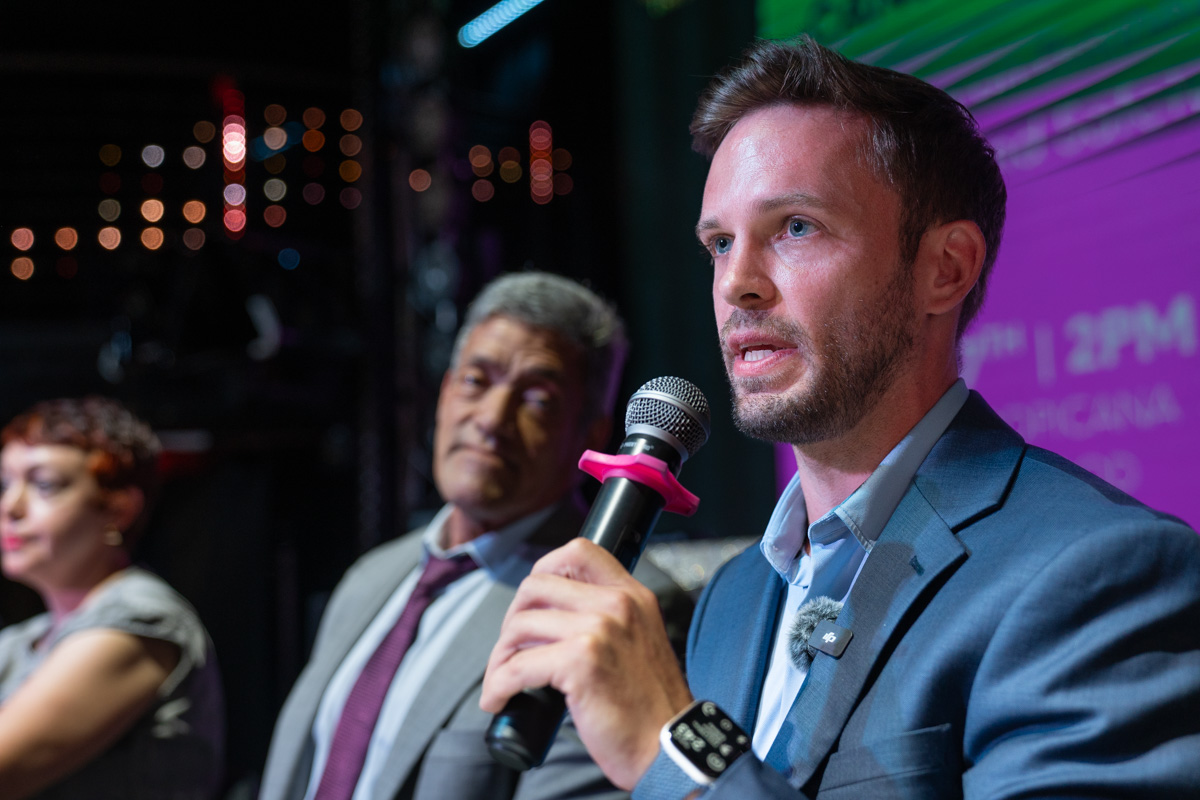
A transgender woman claims that West Hollywood City Council candidate Kyle Brazeal called her a “tranny” and threw a purse at her at Gym Bar in 2024.
The Los Angeles Blade spoke with the alleged victim and two people who say they witnessed Brazeal’s actions that night. The Blade has also obtained timestamped video that places Brazeal at Gym Bar that evening and text messages from the following day describing in detail what allegedly occurred on Sunday, Dec. 29, 2024.
Brazeal said in a written statement that “I categorically deny the allegations.” He added that while he was involved in “a disagreement” at Gym Bar that night, that “this incident is being deliberately misrepresented and weaponized for political purposes in the final weeks of this election.” Addressing the transgender community in West Hollywood, Brazeal said, “I will continue to stand with you as a Council member, just as I did before I was a candidate,” citing his donation to a GoFundMe for gender affirming surgery as evidence of his support.
Upon requesting comment, Brazeal referred the Blade to Rolandos Liatsos, his current campaign treasurer and friend of Brazeal’s who was with him at Gym Bar that evening. Liatsos gave his account of the night and said he never witnessed Brazeal use any slurs or throw the purse.
‘Get out of my way, tranny’
On Dec. 29, 2024, Amber says she went to Gym Bar with a group of friends, including Tommy Craven and Rick Turpin. Amber’s real name is not being used to protect her privacy.
The group arrived at Gym Bar around 5 p.m. The evening started out well. “Just being around friends that night was really good,” Amber said. “There was no problem whatsoever.”
Turpin also recalls having fun. “We were having a good time,” he said. Amber came out as trans a few years earlier and was still adjusting to life as an out transgender woman. “It was nice to see [Amber] embracing her transition and … it seemed like she was feeling herself,” Turpin said.
After chatting with her friends for an hour or so, Amber left to use the bathroom. At the time, Gym Bar had only two single-occupancy restrooms, so there was a line of people waiting to use them. After a few minutes, the line advanced and Amber went into an open restroom.
Soon after entering, Amber said she heard knocking on the bathroom door. She yelled, “Hey, there’s someone in here.” A minute later, the knocking began again. It was a “really rude knock,” Amber said. “So, I felt like I needed to rush through. I felt really uncomfortable.”
For Amber, the situation was especially stressful because of her identity. “I’ve had situations in the past as a trans woman where I have been attacked for using the ‘inappropriate restroom,’” she told the Blade.
Flustered, Amber said she quickly left the bathroom, leaving her purse inside. After exiting, she asked the line of people waiting, “Who was knocking?” she said.
“Me,” she said a man replied while looking down at his phone. He then brushed past her and entered the bathroom while saying, “Get out of my way, tranny,” Amber said. She said she later learned the man’s name was Kyle Brazeal.
Amber was stunned. She had faced transphobia before but not at an LGBTQ bar. Not in West Hollywood.
“I was in a full moment of just frustration, anger,” she said. Amber said she slammed her palm on the bathroom door and stormed off, going back to her friends who were still chatting at their table.
Amber’s friends saw she was upset. “I sat down, and my friends knew something was wrong,” she said. Then Amber told her friends she was called a slur.
“They were, like, wait, what?” she said. “Everybody was in fun-drinking mode, so they didn’t understand what had occurred.”
Amber sat watching the bathroom. As soon as Brazeal exited, she walked over to confront him about what he said.
“What did you call me?” Amber loudly asked him.
At this point, Craven and Turpin heard the yelling coming from the restrooms. The two walked toward the commotion to see what was happening. They saw Amber confronting Brazeal by the door to the bathroom. Craven knew Brazeal beforehand from other community spaces they were both involved with. “I could recognize him right away,” he said. Turpin also said he recognized Brazeal.
Amber said that Brazeal took the purse that she left inside the bathroom and threw it at her, saying, “You left your tranny purse in there.” Craven and Turpin both corroborated Amber’s account of the events, saying that they heard Brazeal use the slur and saw him throw the purse at Amber.
After Brazeal threw the purse and used the anti-trans slur, Amber shoved him and the two got into a shouting match, according to Amber. Craven also recalled seeing “shoving” but did not specify who did what. The two were soon separated by security and staff.
Craven quickly called the owners of Gym Bar, Erik Braverman and Jonathan Cottrell, to inform them of what happened. (Cottrell is also currently running for West Hollywood City Council). Craven had known Cottrell and Braverman for years and considered them friends. The owners then told Gym Bar’s general manager about the incident.
Soon, the general manager spoke with Brazeal and “Kyle was asked to leave the bar,” Craven said. Upon being asked to leave, Brazeal began yelling profanities and “used the word ‘tranny’ toward Amber again,” Craven said. Turpin also recalls Brazeal using the slur as he was asked to leave. “He kept saying ‘tranny,’” according to Turpin.
Video footage taken by Tommy Craven shows Kyle Brazeal outside Gym Bar on Dec. 29, 2024. Craven says the video shows Brazeal after he was asked to leave by security.
The incident left Amber shaken. Afterwards, she sat down with her friends, and Craven and Turpin tried to cheer her up by making jokes about the situation. It didn’t improve her spirits.
“She was jarred; it happened at a bar that she considers a safe space,” Craven said. He described Amber as “a very private person” and said that she was satisfied with how Gym Bar handled the situation and did not file any complaints with law enforcement.
Amber said that time constraints also factored into her decision to not speak to the police. She was living in a housing program with an enforced 10 p.m. curfew, meaning she had to leave the bar soon after the incident occurred to get home in time.
Amber took an Uber to go home and did not see Brazeal again.
‘No throwing of the bag, no hate speech or anti-trans stuff’
But according to Rolandos Liatsos, the incident that evening played out very differently. Liatsos said he went to Gym Bar with Brazeal and a few others to celebrate a friend’s birthday. The two have known each other for more than a decade and are good friends. Liatsos is also Brazeal’s campaign treasurer.
According to Liatsos, after hanging out at the bar, Brazeal went to get in line for the bathroom and was on the phone. Once Brazeal entered the bathroom he saw Amber, whom he had never met before, return to a table with her friends. She seemed very upset.
Brazeal soon exited the restroom, carrying the purse Amber had left. Brazeal walked up to the table and attempted to hand the purse back to Amber but was stopped by her friends who moved to stand between them. Then they started arguing and yelling at each other.
But never at any point did Brazeal throw the purse, according to Liatsos. “There [was] no throwing of the bag, no hate speech or anti-trans stuff,” Liatsos said.
He also claims that he did not see anyone get shoved, or the two parties getting physical in any way. “There was no physical contact,” he said.
After the arguing between Brazeal and Amber’s friends, Gym Bar staff asked Brazeal and his friends to leave. “Good, let’s just go, … let’s defuse the situation,” Liatsos recalled thinking. Soon after, he, Brazeal, and their friends left the bar.
Liatsos later learned from Brazeal that he knocked on the bathroom door as Amber was inside, which he believed upset her. “I see this as a situation escalating from knocking at the door, feeling rushed,” and nothing more, Liatsos said.
He said the claims of transphobic and aggressive behavior were not consistent with what he saw that night and contrary to who he knows Brazeal to be. “I’ve known Kyle for so many years and we’ve been out so many times,” Liatsos said. “I’ve never seen him attacking … any individual.”
Aftermath
The next morning, Dec. 30, Craven sent a text message to a group chat that included Jonathan Cottrell describing what happened and naming the alleged perpetrator as “Kyle (seen in video),” referring to the video that shows Kyle Brazeal outside Gym Bar on Dec. 29.
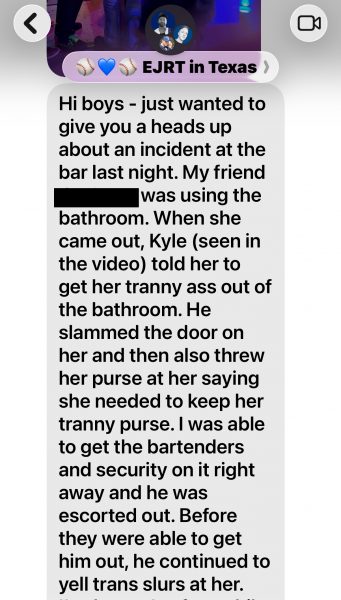
Screenshot of an excerpt of the message sent by Tommy Craven to a group chat with Jonathan Cottrell on Dec, 30, 2024. Identifying details have been redacted.
Braverman and Cottrell told Craven that Brazeal was banned from Gym Bar. However, both Craven and Turpin claim to have seen him at the establishment multiple times after the incident. Cottrell said in a written statement that “it was a temporary ban,” but would not discuss why or when the ban was lifted because Gym Bar “(doesn’t) share internal incident matters.”
This temporary ban is contradictory to a message from Cottrell’s Instagram account that was sent to Amber on Dec. 30, 2024. In it, he states that he would make sure that the “individuals” involved in the incident “don’t ever come back” to Gym Bar.
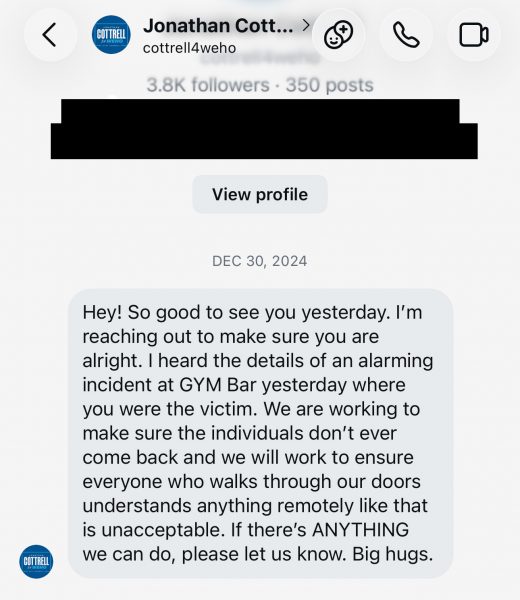
Screenshot of a message sent by Jonathan Cottrell’s Instagram account to Amber’s account on Dec. 30, 2024. Identifying details have been redacted.
The race for City Council
Brazeal announced his candidacy for City Council in April 2026. Craven heard about his campaign in June. “I was aware it was the same person,” he said, immediately recognizing him as the man who allegedly berated his friend a year and a half ago.
Later that month, Craven reached out to Braverman and Cottrell, who had recently announced his own campaign for City Council, to inform them that Brazeal was the same man from the night. “They were definitely surprised by it,” Craven said.
After being made aware that Brazeal was allegedly the same man from the transphobic incident at their bar, the owners did not state anything publicly, following Amber’s wishes. Cottrell has not mentioned anything on the campaign trail even as he and Brazeal have been endorsed by some of the same organizations like Equality California and Sunset West Alliance.
“At the time of the incident, our staff asked the woman involved whether she wanted us to take any further action, and she said she did not,” Cottrell said in a written statement. “This was never our story to tell. Gym Bar has always been a safe space for everyone in our community, and that will never change.”
Craven and Turpin waited to talk publicly about the incident because they wanted to keep their friend’s experience private.
“Ricky and I thought … something [else] would be said to kind of give light to the kind of person that Kyle is without us having to use our friend’s story,” Craven said. “But now because it’s closer to the election [and] stuff has not come to light, I feel the community would be safer knowing.”
Amber did not hear about Brazeal’s candidacy for City Council until last week, when she was informed by friends that a reporter for the Los Angeles Blade was investigating allegations of a transphobic incident involving him. These days, she splits her time between the Los Angeles area and other parts of the country so she has not been following local politics closely. But when she looked up his campaign, she instantly realized that this was the same man from that night. “I saw the face and pictures … and I made the connection,” she said.
“This is something that I need to address,” she added. She said that it can feel “impossible” as a trans woman to call out people who express bigotry without facing “repercussions.” Brazeal’s bid for City Council motivated Amber’s decision to speak publicly about the incident. “He is seeking a position of power in the city,” she said. “He needs to understand that this is stuff that just doesn’t go away.”
Reflecting on the incident, Amber said she’s still shocked and upset. “I was floored that he would use that word in that bar,” she said. By speaking out, she hopes to heal some of the pain caused by Brazeal’s alleged actions and regain her confidence.
“Words do matter and they do hurt and the T-word [used] toward me hurt,” Amber said. “Now I’m trying to use my words to share my story.”
Caleb Kaufman is a California Local News Fellow placed with the Los Angeles Blade. The California Local News Fellowship is a state-funded initiative to support and strengthen local news reporting. Learn more about it at fellowships.journalism.berkeley.edu/cafellows.
Politics
Victory Institute to honor Nancy Pelosi at D.C. conference
San Francisco lawmaker has championed LGBTQ+ rights throughout her career
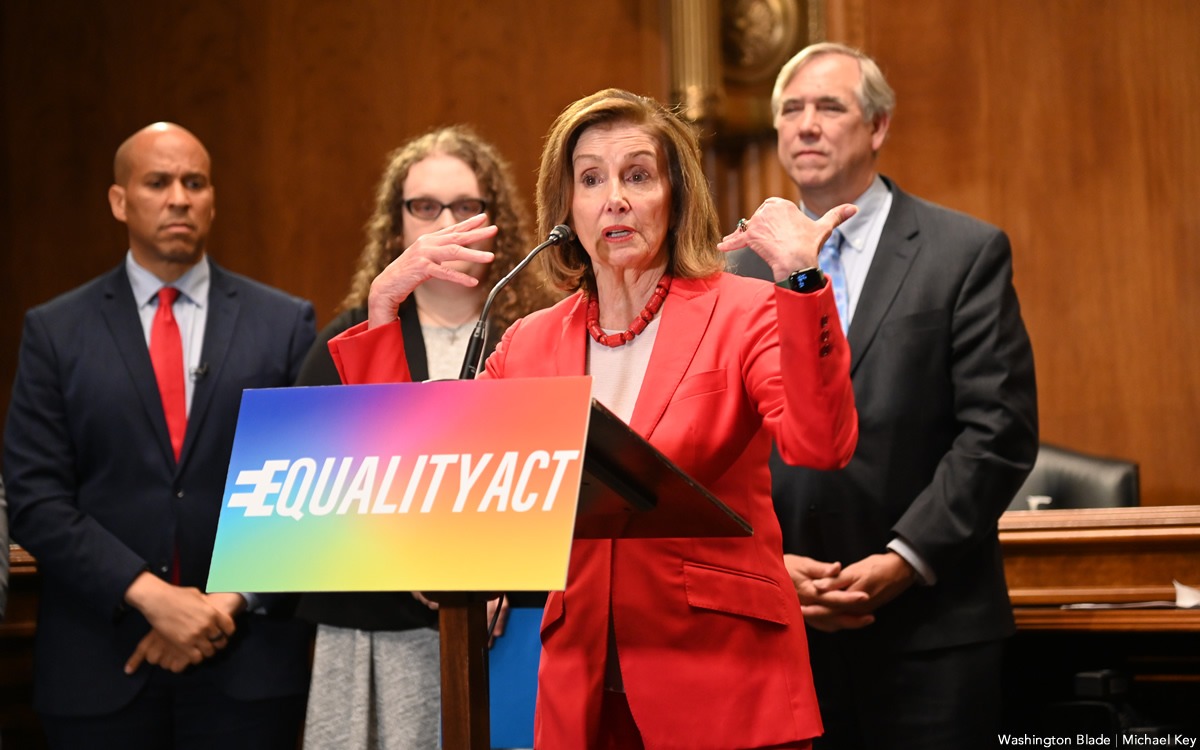
House Speaker Emerita Nancy Pelosi (D-Calif.) will receive the Chris Abele Impact Award at the LGBTQ+ Victory Institute’s 2026 conference in D.C. in December.
The Victory Institute, a national nonprofit that works to get LGBTQ+ elected officials and appointed leaders at every level of government, will honor Pelosi for her work supporting the LGBTQ+ community during her nearly 40 years in public office.
Pelosi has a long history of working with the LGBTQ+ community.
As the representative for San Francisco, a city with a long LGBTQ+ history, she directly pushed legislation to help the LGBTQ+ community.
Pelosi led multiple landmark pieces of LGBTQ+ legislation through Congress, including the repeal of “Don’t Ask, Don’t Tell,” passage of the Matthew Shepard and James Byrd Jr. Hate Crimes Prevention Act, and multiple U.S. House of Representatives approvals of the Equality Act. She also played a central role in congressional efforts to combat HIV/AIDS and oppose restrictions targeting transgender Americans.
The award will be presented during the Victory Institute’s International LGBTQ+ Leaders Conference. This year, it will take place Dec. 3-5 at the JW Marriott in D.C. This will mark the 43rd annual International LGBTQ+ Leaders Conference, which includes three days of networking and skills-building to “strategize the year ahead in our movement for equality.”
During her interview with the Washington Blade earlier this year, Pelosi emphasized that it was the community — specifically, those passionate about fighting for LGBTQ+ acceptance and action — that made her work possible on Capitol Hill.
“Anything that we accomplished, whether it was fighting HIV and AIDS, ending discrimination, passing hate crimes legislation, or ending ‘Don’t Ask, Don’t Tell,’ would never have happened without outside mobilization,” Pelosi told the Blade. “Our inside maneuvering was important, but we couldn’t do our best job without the community. Every chance I get, I thank them for their patriotism because they make democracy function.”
She also touched on the importance of codifying marriage rights for same-sex couples in federal legislation in the event that the issue is take up by the conservative U.S. Supreme Court.
“We passed it in the House again and again,” she said. “The Senate is more difficult because of the procedural hurdles, but we’re not stopping. We’ll stick with it until the job is done.”
Last year, the Victory Institute gave the Chris Abele Impact Award to former President Joe Biden for his outspoken acceptance of the LGBTQ+ community well before it became a mainstream part of the Democratic platform.
Registration for the International LGBTQ+ Leaders Conference is open now on the Victory Institute’s website at victoryinstitute.org/conference.
Politics
Ahead of the midterms, Meta has paid at least 29 anti-LGBTQ+ accounts for their posts
Invite-only Facebook Content Monetization program unveiled in 2024
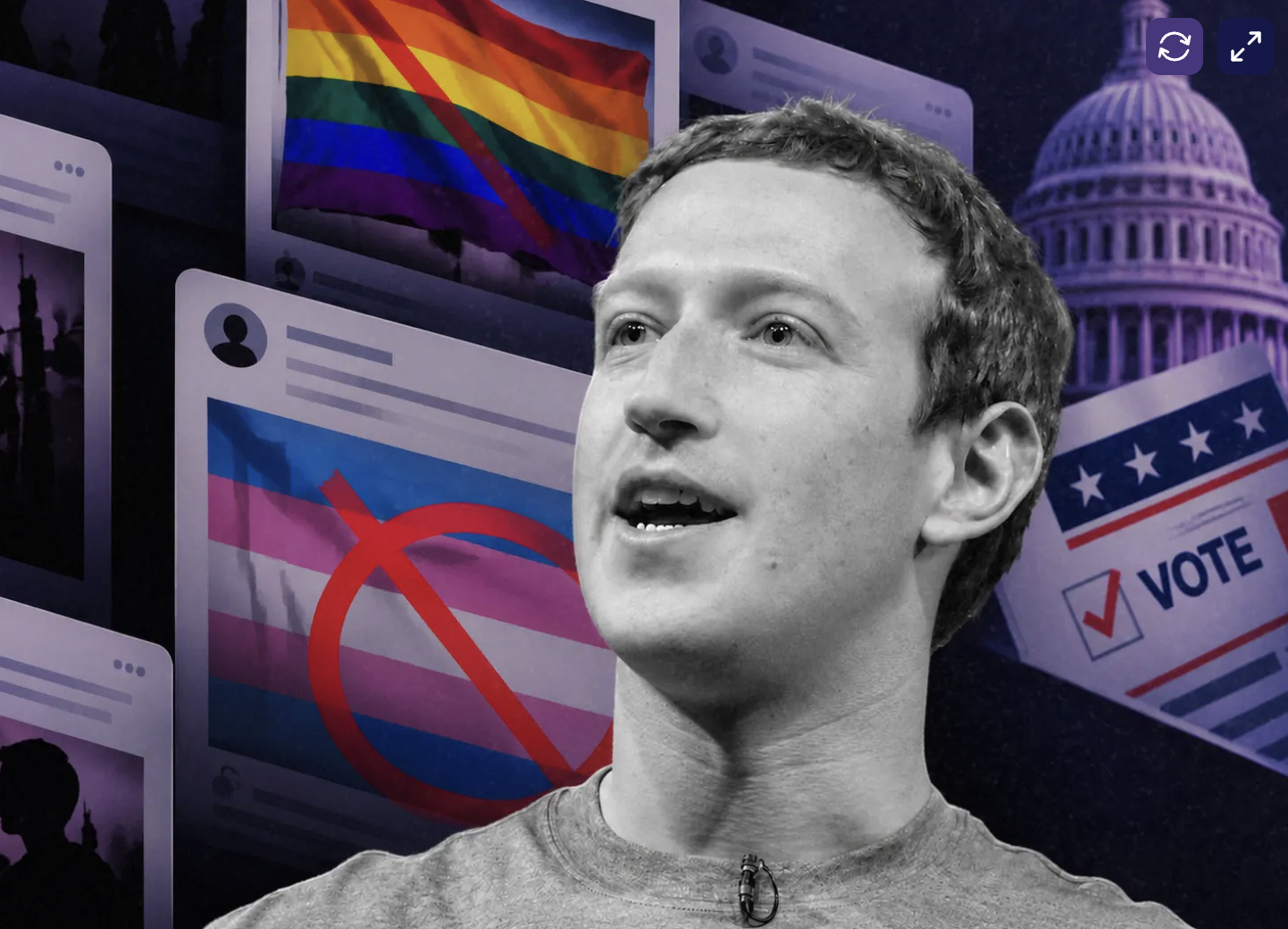
Uncloseted Media published this article on Oct. 14.
This story was reported in partnership with The 19th, a nonprofit newsroom reporting on gender, politics, and policy.
By HOPE PISONI | On Sept. 14, far-right influencer Chaya Raichik, known online as Libs of TikTok, attacked a Washington state high school on Facebook for displaying a Pride flag. “Hey Mercer Island High School, why does your profile photo display a mutilation flag??” she wrote, tagging the school’s account in the post and attaching a photo of the entrance.
A few weeks before, on Aug. 27, neo-Nazi webcomic artist StoneToss posted a strip that used Tim Curry’s death to mock transgender suicide rates. And earlier this month, right-wing political commentator Benny Johnson shared claims that Democrats will “transition your kids while you’re at work” and “hand out gas cards to illegal aliens.”
Meta pays these creators for making posts like these. In 2024, the tech giant unveiled a new invite-only program called Facebook Content Monetization, designed to streamline earnings for creators. Many creators celebrated the move, with some reporting a major increase in their earnings through the program.
However, that program has recently come under scrutiny. In August, the Australian Broadcasting Corporation reported that Meta invited accounts promoting white supremacist and neo-Nazi ideologies.
And after reviewing Meta’s monetization data, Uncloseted Media identified 29 accounts with histories of anti-LGBTQ+ rhetoric that have been invited to the program. These include the three aforementioned accounts as well as podcaster Candace Owens, who has blamed gay men for child abuse in the Catholic church, and Turning Point USA, which has been connected to an assault on a queer Arizona State University professor. Meta did not respond to Uncloseted Media and The 19th’s requests for an interview or for comment.
With the midterm elections looming, some of the accounts Meta pays through the program have been spreading political misinformation. In the first week of October, for example, Benny Johnson made 14 separate Facebook posts connecting the Democratic Party to election fraud.
Courtney Radsch, director of the Center for Media and Digital Governance at Open Markets Institute, says that promoting hateful rhetoric and misinformation like this is especially dangerous during an election season where the increasingly authoritarian Trump-Vance administration, which Meta has courted since its inauguration, has openly discussed attempts to interfere.
“Amplifying and enabling harassment campaigns and centering fringe conspiracy theories through algorithmic curation and monetization opportunities has led to a dissolution of democracy in America,” Radsch told Uncloseted Media and The 19th. “This administration is dismantling democratic oversight and increasing authoritarian control. … You can’t look at your platform policies on monetization without looking at the context in which this is occurring in the U.S. with rising technofascism.”
What is the program?
Meta launched their Facebook Content Monetization program to incentivize more creators to post on Facebook, which has faced an aging user base and competition from newer apps. Those incentives can be substantial — within the program’s first year, content creators who accepted Meta’s invitation to join reported huge increases in their payouts, with some calling it their most lucrative platform. One creator told The Hollywood Reporter that she consistently earned $20,000 to $30,000 per month, while another said his monthly earnings often hit six figures.
While most accounts aren’t big enough to rake in that amount of money, Meta also motivates smaller accounts to join. Starting in 2025, they launched a side program called “breakthrough bonus” that advertises up to $5,000 and an automatic onboarding into Content Monetization for creators from other platforms if they start posting regularly on Facebook.
SK Smigiel, a content creator who posts about LGBTQ+ education and activism under the username justsaysk, joined the program through the breakthrough bonus initiative in April. They say Meta would offer them payouts for completing certain “missions.” For example, Smigiel says they earned $500 a month for posting 10 reels. They say other missions included using trending hashtags and audio or cross-posting to relevant groups. These incentives initially convinced them to post on Facebook due to their poor earnings on Instagram, but they didn’t stick around.
“When I post on Facebook, I don’t even open the post that I’ve made because I already know that … probably 99 percent of the engagement is negative towards me,” Smigiel told Uncloseted Media and The 19th.
Uncloseted Media identified accounts enrolled in the program via data compiled by What To Fix (WTF), a Dutch nonprofit focused on tech accountability. The Meta Monetization Archive is a searchable database of information collected from disclosures released by Meta.
Belén Luna Sanz, policy manager at WTF, says the program represents a broader shift in industry practices. While advertisers once paid content creators directly with companies like Meta taking a cut, platforms now collect all ad revenue and pay creators themselves.
“They’re only paying you royalties depending on how much engagement you are creating on your content,” Sanz told Uncloseted Media and The 19th.
Jason Hong, a professor of computer science at Carnegie Mellon University, says that while inflammatory and misleading content may go against Meta’s policies, both the company and the people posting it are financially incentivized to promote it.
“We know that things that get people really angry get a lot of engagement, we know that disinformation and misinformation … also gets lots of engagement,” Hong told Uncloseted Media and The 19th. “[Meta is] at a fork in the road, and one path is about the morals and ethics and well-being of society and democracy, and on the other path is a really big pile of money.”
‘A reckless rollout’
Since Meta launched the program two years ago, WTF has identified over 18 million accounts in the program. But Sanz says the selection process has been opaque and describes the program’s rollout as “reckless.”
“[The program requires] little to no verification of their identity, there are not enough safeguards and their monetization policies are enforced in a very non-transparent way, so it’s hard to tell whether they are enforcing it properly or not,” Sanz says.
Uncloseted Media found numerous posts that seemingly violate Facebook’s content monetization policies, which state that “content may be subject to reduced or disabled monetization if it depicts or discusses [debated social issues] in a polarizing or inflammatory manner.” Those issues include race, religion, sexual orientation, political affiliation and more.
Libs of TikTok, for example, has called the organizers of an LGBTQ+ pride event “sick sick freaks,” accused pro-LGBTQ+ teachers of wanting to “indoctrinate your children” and decried the “lgbtq groomer cult.” Other posts may violate content monetization policies forbidding “derogatory words” and “hateful conduct,” including Raichik calling “sex assigned at birth” a “retarded term.”
Meta also states that misinformation, which they define as “content that has been rated false by a third-party fact checker,” is “ineligible to monetize,” even though the company ended their third-party fact-checking last year, leaving no clear mechanism to enforce the prohibition.
Meta states that “repeated violations of [content monetization policies] could lead to a temporary or permanent ban on your Page or profile’s ability to use our monetization tools.” However, as of the Monetization Archive’s most recent update on Sept. 15, all of the accounts discussed above are actively enrolled in the program.
The Southern Poverty Law Center has designated several individuals in Meta’s program as extremists. These include Tucker Carlson, who has agreed with claims that gender-affirming care allows adults to “basically molest and abuse children”; James Lindsay and Jack Posobiec, who helped popularize “groomer” rhetoric against LGBTQ+ people; and Alex Jones, whose infamous conspiracy show InfoWars received an invitation prior to its acquisition by The Onion. It also includes Libs of TikTok, which is known for stoking anti-LGBTQ+ harassment — 2024 reports by NBC News and The Washington Post cumulatively found over 80 instances of violent threats against institutions like schools and businesses connected to its posts.
“There does need to be discussion and diversity of opinion allowed in the public sphere,” Radsch says. “However, there is a difference between rational debate and harassment.”
Reports from WTF suggest that Meta doesn’t consistently uphold the program’s other rules either. Despite Meta’s policies stating that “political and government entities are ineligible for monetization,” including “current elected and appointed government officials” and “political parties,” WTF found hundreds enrolled. In addition, Uncloseted Media confirmed membership of at least eight official Republican Party pages, including the Republican Party of Georgia.
A danger to democracy
In recent years, Meta has courted the Trump-Vance administration and its far-right allies, including influencers. Last August, the company hired Robby Starbuck, an anti-DEI campaigner who has promoted conspiracy theories claiming that pesticides turn children gay, as an adviser on preventing “political bias” in their AI systems. And in April, Meta sponsored a party celebrating Isabel Brown, a Daily Wire host who has advocated for people to leave their LGBTQ+ “lifestyles.” Brown and Starbuck are both enrolled in the content monetization program.
Radsch says that being able to control who gets monetized grants Meta significant power over political narratives.
“That can be problematic because it means that they can pick winners and losers, they can pick ideologies, they can discriminate at will, and we have very little way to know whether that’s happening,” Radsch says.
The stakes are high given the upcoming midterms. Misinformation that the 2020 presidential election was rigged inspired the Jan. 6 insurrection. Still, Meta monetizes accounts which spread similar claims. Libs of TikTok has said, “Democrats want to cheat in the elections,” and Johnson responded to reports of new plague cases in Russia by implying that Democrats would use them to rig the election.
“There’s a level of commitment with trying to preserve electoral integrity that needs to be present, especially when there are very delicate elections coming up,” Sanz says. “Disinformation should not be rewarded financially — this is something that even they have in their own policies for monetization.”
What can be done?
Sanz has a “wish list” of new accountability policies that could push back against the anti-LGBTQ+ rhetoric and political disinformation being disseminated through this program. These include labeling monetized accounts and adding mechanisms for users to report monetization policy violations.
Hong adds that platforms should restructure their algorithms and monetization systems to consider factors other than engagement.
“I wish that Facebook would have more kinds of metrics, like societal or individual well-being,” Hong says. “These are kinds of things that would be far better for society, but it is a corporation and this is what they’re trying to do because this is the mandate from the top.”
While Meta is protected from many forms of legal action in the U.S., there may be a path to legal accountability in other jurisdictions. In 2022, the European Union passed the Digital Services Act (DSA), which, among other provisions, requires large online platforms like Facebook to mitigate the potential harms of content disseminated on their platforms. WTF filed a complaint against Meta in European courts last month arguing that by monetizing 11 accounts sanctioned by the E.U. for alleged involvement in pro-Russia propaganda campaigns, the company failed to meet the DSA’s risk mitigation obligations.
Perhaps most importantly, Sanz emphasizes that social media monetization needs more public attention.
“Creator monetization is a very ill-explored area,” she says. “Although there is a good amount of legislation here in the E.U. that gives us a playground to try to incorporate much more responsibility when it comes to monetization, I do think that globally this needs to be the case.”
Jones and Raichik did not respond to requests for comment.
Politics
JD Vance takes swipe at James Talarico’s sexuality during Texas rally
Homophobic joke made during Ken Paxton event
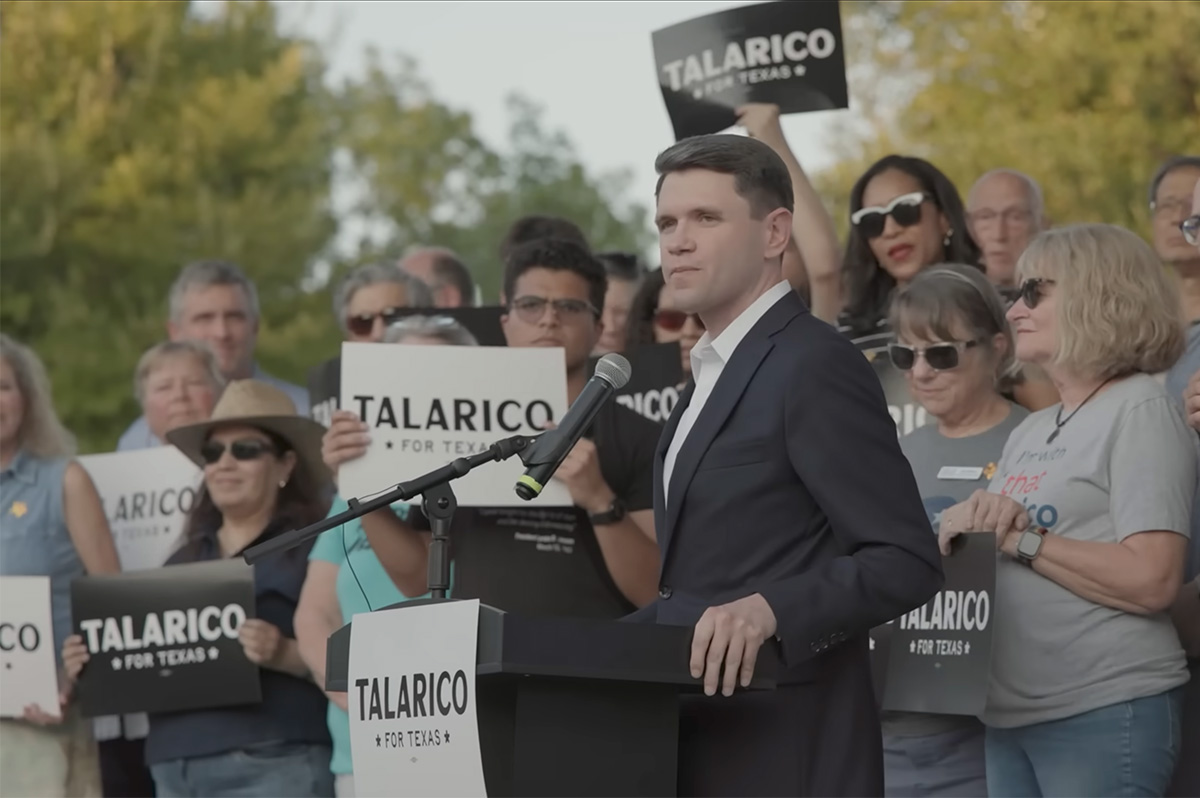
Vice President JD Vance joked that Texas Democratic Senate candidate James Talarico is gay on Tuesday.
While campaigning for Ken Paxton, the Republican Senate candidate and current Texas attorney general, Vance made a joke that seemed to call into question Talarico’s sexuality during a stop in Tyler, Texas.
According to a video uploaded by C-SPAN, Vance responded to a man in the crowd who shouted, “I love you,” at the vice president.
“I love you, too, sir. In a totally platonic way, to be clear. I’m the vice president, not James Talarico,” Vance joked while standing in front of Air Force Two during the rally.
The joke has received negative press coverage and sparked backlash online against the second-in-command at a time when Republicans are struggling to win seats that, months earlier, were widely imagined to be all but entirely theirs.
Talarico, who confirmed he is in a long-term relationship of four years with Brianna Menard, a woman who served as his chief of staff during his time as a Texas state representative, has been an outspoken supporter of LGBTQ+ rights in the Lone Star State, often drawing criticism from right-wing personalities.
Billy Binion, a reporter for Reason, called out the homophobic joke made by the vice president on X, saying, “I remain amazed and mystified that some of the most powerful people in the world think ‘James Talarico seems gay!!’ is a compelling critique. It’s so desperate and small.”
Directly under a repost of the video, another person posted an old, widely circulated image of Vance in drag wearing a long blond wig, with the caption, “For the record James Talarico has never done this.” The post now has more than 62,000 views and more than 3,000 likes.
The comment is also drawing criticism of Vance over his past anti-LGBTQ+ actions while in the U.S. Senate. During his two years as a senator prior to Trump’s selection of him as vice president, Vance opposed the Respect for Marriage Act, which codified marriage rights for same-sex couples in federal law. He also co-authored the Protect Children’s Innocence Act, which would have made providing gender-affirming care to minors a felony punishable by up to 15 years in prison.
Vance has also advocated for banning transgender troops from the military, which has become a defining characteristic of the current administration’s efforts to curb diversity and inclusion in the U.S. armed forces.
Additionally, Vance repeatedly referred to opponents of those actions as “groomers,” including in an April 2022 post on X.
“I’ll stop calling people ‘groomers’ when they stop freaking out about bills that prevent the sexualization of my children,” he wrote at the time.
These actions and the vice president’s homophobic rhetoric contrast with Talarico’s official stance on LGBTQ+ issues. Talarico has been a vocal supporter of LGBTQ+ rights but is facing recent criticism for backtracking on his support for trans girls and women participating in sports.
Under the “Freedom, Family, and Faith” section of his campaign website, Talarico states that one of his goals is to “protect the legality of gay marriage and defend our LGBTQ+ neighbors from government overreach.”
Paxton’s website, on the other hand, directly calls for Texans to vote for him so he can “defeat the radical transgender movement that’s desperate to put men in girls’ sports and woke indoctrination in our classrooms.”
The Los Angeles Blade reached out to the White House, Talarico’s press office, and Paxton’s office for comment on the story but had not heard back by publication time.
Hungary
Hungarian lawmakers approve bill to remove anti-LGBTQ+ provisions from ‘child protection’ law
Prime Minister Peter Magyar’s government took office in May
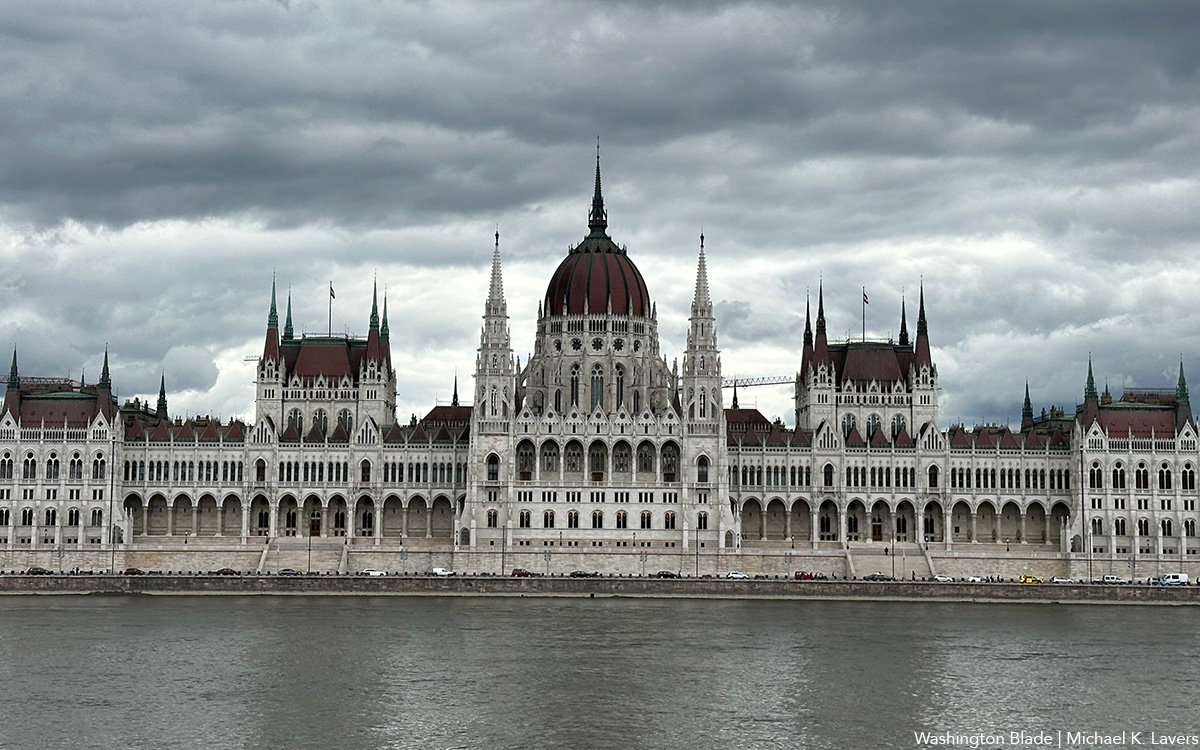
Hungarian lawmakers on Tuesday by a 139-51 vote margin approved a bill that would remove anti-LGBTQ+ provisions from a 2021 “child protection” law the country’s former prime minister championed.
“It shall be forbidden to make accessible to persons who have not attained the age of 18 years advertisement that depicts sexuality in a gratuitous manner or that propagates or portrays divergence from self-identity corresponding to sex at birth, sex change or homosexuality,” reads Act LXXIX of 2021 that MPs approved in 2021.
The European Commission in 2022 challenged the law. Sixteen EU countries eventually joined the lawsuit against it.
Then-Prime Minister Viktor Orbán’s government defended the law. The EU’s top court, the EU Court of Justice, earlier this year struck it down. The BBC reported the EU after Tuesday’s vote released €4.2 billion ($4.67 billion) in funds it froze while Orbán’s government was in office.
“We are very happy that this got adopted,” Tamás Dombos of the Háttér Society, a Hungarian LGBTQ+ rights group, told the BBC. “We’ve been fighting this so-called child protection law for five years. There have been problems with the bill submitted to parliament, but most of those problems have been fixed.”
Péter Magyar became the country’s prime minister in May after his center-right Tisza party defeated Orbán’s Fidesz-KDNP coalition in elections that took place on April 12.
The new Hungarian government in June allowed the annual Budapest Pride march to take place in the country’s capital without restrictions — MPs in 2025 passed a bill that banned Pride events, and amended the Hungarian constitution to prohibit public LGBTQ+ events.
Magyar last month announced his government would amend a law that essentially bans same-sex couples from adopting children.
Turkey
‘Governments that attack LGBTQ+ rights learn from each other’
Turkish authorities on Sept. 12 launched anti-LGBTQ+ ‘My Family Is Safe’ campaign

Sept. 12 is a solemn day for the people of Turkey. It is the anniversary of the 1980 coup d’état — when members of the National Security Council, along with the armed forces, dissolved the Turkish parliament, arrested hundreds of thousands of people, and entered a three-year period of martial law.
On Sept 12, the 46th anniversary of the 1980 coup, the country faced another wave of arrests; this time they targeted the LGBTQ+ community. The government launched the national “My Family Is Safe” campaign, which triggered mass raids and arrests of LGBTQ+ organization leaders, advocates, academics, and sexual health treatment centers for people with HIV. (These include EU-funded organizations launched by the Turkish government in 2005.) Since the nation has seen a decline in birthrate and a swelling economic crisis, this has allowed authoritarian President Recep Tayyip Erdoğan and conservatives in Turkey to use the LGBTQ+ community as the ideal scapegoat.
“This is the cruelest part. It was Erdoğan’s own party that made it easier to found NGOs in 2005 as an EU accession process, and that is how many LGBTI+ groups came to be officially registered.” Ali Yildiz, a linguistics graduate student at the University of Cologne in Germany, told the Los Angeles Blade. “Everything was legal, transparent and official. Now those same registrations are being used as arrest lists. The state is basically punishing those who trusted it. It sounds very much like the Nazis. They also used member lists of associations to persecute them later.”
Yildiz has witnessed the oppression of the Turkish government firsthand: in 2024, he moved to Germany. As one of the board members of a grassroots NGO that focuses on sexual health, Yildiz was at risk of arrest and prosecution.
As part of the “My Family Is Safe” operation on Sept. 12, police raided Yildiz’s family’s former home to find him.
In the aftermath of these raids in Turkey’s major cities, protestors have gathered at Turkish embassies across Europe and the U.S.
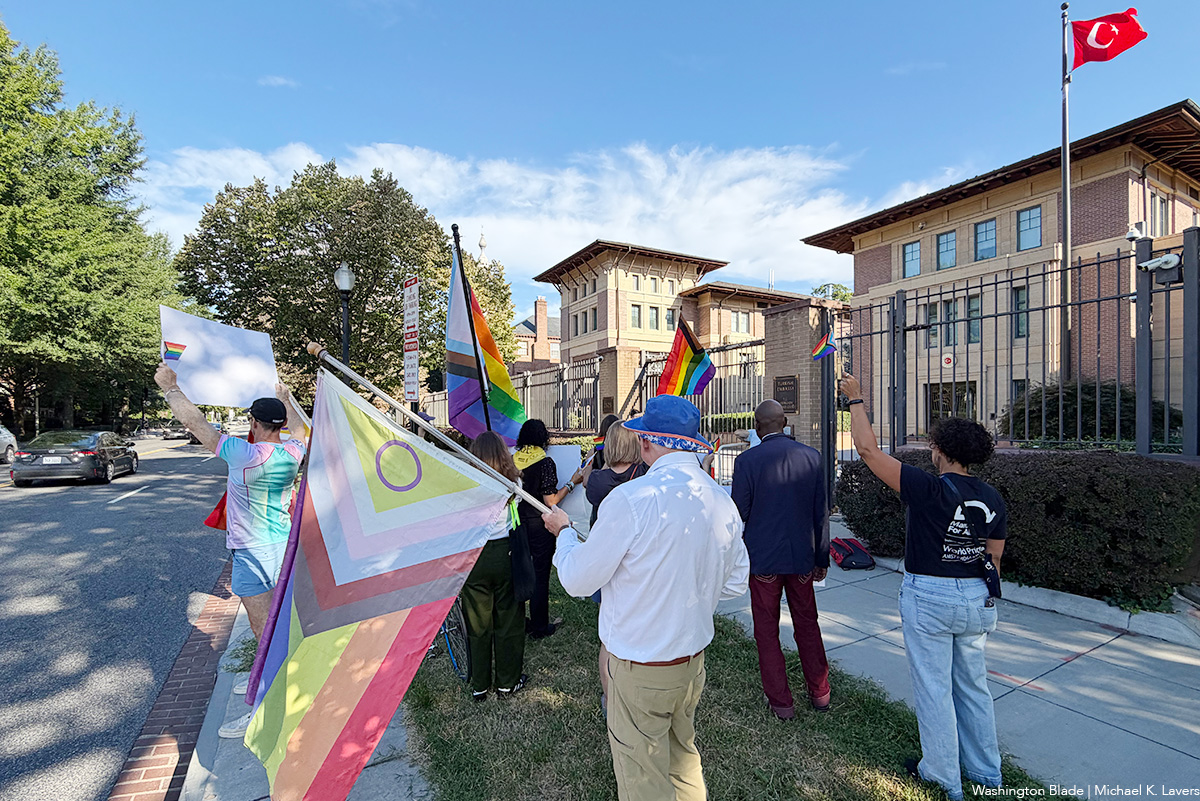
A critical discourse has also emerged as a response to the crackdown across international queer media: how should the West cover oppressive regimes abroad?
“From what I see, the Western reading of Turkey’s crackdown on LGBTI+ people usually goes: it’s a conservative, Muslim country, so this is what you’d expect. I believe that framing is incomplete, and it lets the people responsible off the hook. The Erdoğan regime is also heavily relying on this contextualization,” said Yildiz. “The government is not simply reacting to existing conservatism but is actively shaping it. Look at how operations are presented: raids on LGBTI+ organizations and activists come packaged with claims about drugs, obscenity, sex work, or organized crime on other groups in the news. The evil strategy is to link LGBTI+ people with criminality in the public mind.”
The LGBTQ+ community is not the only group that has been under the weight of oppression. Political opponents and descendants whom Erdoğan deems criminals are also charged with treason.
Istanbul Mayor Ekrem İmamoğlu, who is the leading candidate for the upcoming 2028 presidential elections for the opposition center-left Republican People’s Party, was arrested on terrorism charges in 2024. On the same day, he was nominated as the CHP’s presidential candidate.
For a while, X served as a platform to express discontent with the government, but that changed recently when Elon Musk blocked nearly 500 accounts in Turkey. The Turkish government also banned Grok after the AI system responded to a user’s question about Erdoğan, which government leaders found offensive.
The visibility of these pages has decreased. With a VPN, citizens can still access the pages because they were banned only in Turkey, not internationally.
Discontent with the government is increasing, but so is government oppression.
Not only have LGBTQ+ pages been shut down, but many journalists and academics have also had their pages banned.
The Blade spoke to an anonymous academic living in Ankara, the Turkish capital, who said Erdoğan, U.S. President Donald Trump, and other authoritarian leaders are constantly learning from each other.
“These anti LGBTQ+ policies are being created in the name of preserving traditional family values and are not only a threat to Türkiye,” they said. “It is also a global issue that threatens people everywhere. It should be perceived as an international problem. That is why we LGBTQ+ people need to act in solidarity internationally.”
Because of the compounding human rights crisis happening simultaneously around the globe, visibility has been advocates in Turkey’s main challenge.
Since 2022 there have been a series of crackdowns against opposition parties, academics, labor unions, student organizations, journalist and advocates. Another anonymous academic in Istanbul told the Blade that after the 2022 crackdown, “people were intimidated, and most people did not feel encouraged to organize.”
In the weeks following this recent crackdown, discontent with the Erdoğan government has increased along with inflation and unemployment, not helped by the war in Iran.
“Our leaders do not say anything about the financial crisis,” said the Istanbul academic.
High inflation, high unemployment rates, many factories, and businesses have left Türkiye and transferred their businesses to other countries. And because of the timing of these recent crackdowns, during this financial crisis, many people haven’t been paying attention.
Though for many queer and transgender Turks, post-Sept. 12 life has been radically different.
“I stopped doing drag in order to protect myself, and many queer performance artist friends of mine have also given up this part of their lives,” said one source who asked the Blade to remain anonymous.
“Everybody is not scared, but they simply bring their fear with them to the march and march courageously, because they believe they are on the right side of history,” they added. “However, I think it is important that people in Turkey are not represented only through their experiences of victimization. There should also be spaces where artists, activists, journalists, and other queer people can express themselves in their own words.”
The justification for this crackdown has been preserving “traditional family and conservative values.” The Turkish government has persecuted these offenses with raids, trials, and arrests that have gone beyond just the LGBTQ+ community. It targeted last year musicians, performers, and artists whom they deemed obscene or offensive.
In September 2025, the K-pop-inspired girl band Manifest was investigated for three months. Footage from their shows was banned from the internet, and the remainder of their tour was canceled. All seven members of the group faced 3 1/2 months prison sentences before the charges were ultimately dropped.
“I believe there is no pride for only some of us. Governments that attack LGBTQ+ rights learn from each other.” Yildiz tells the Blade, “Erdoğan borrows from Putin’s playbook, and parts of the Western right eagerly adopt the same rhetoric. This is a call for our community to see how important international solidarity is. People show up every single year for the Pride March, even though they know the police are going to attack. What I see in our community is pure courage.”
Congress
Annie Andrews denounces trans athletes after Trump targets her
President used anti-trans slur to describe SC Senate candidate

Days after President Donald Trump called Annie Andrews, the cisgender Democratic nominee for South Carolina’s U.S. Senate seat, an anti-transgender slur on social media, Andrews came out against transgender girls and women participating in sports.
Trump called Andrews a “trannie” on Truth Social while attempting to garner support for her opponent, U.S. Sen. Darline Graham (R-S.C.), the incumbent seeking reelection in South Carolina.
After the president’s use of the slur was widely reported, the incident provided an opportunity for Andrews to explain her position on the ongoing trans debate that has shaped political discourse in the 2020s, despite trans people making up only 1 percent of the U.S. population, according to the Williams Institute.
She used the opportunity to denounce trans rights and pointed out that, as a physician, she had never performed gender-affirming surgery on minors.
“I want you to hear me loud and clear: I don’t support biological men playing women’s sports, and I don’t support and haven’t ever performed gender surgery for minors,” Andrews said in a political ad.
Despite these recent developments, Andrews has previously voiced support for trans South Carolinians. In 2022, she posted on her X account, criticizing the Save Women’s Sports Act, which was signed into law by Republican Gov. Henry McMaster and restricts trans girls from participating on girls’ sports teams.
“This is shameful legislation that does nothing to protect or support women or children in SC. In fact, it is actively harmful. I will always support trans youth,” Andrews wrote in after the legislation passed.
The Los Angeles Blade reached out to Andrew’s campaign about the comments, and asked if she supports trans rights but did not receive a response.
Politics
On Republican Long Island, gay Democrat Chris Gallant bets on public service over politics
Congressional candidate recently spoke with the Blade
New York’s Long Island, which is just 50 miles from the Stonewall Inn, is a reliably red enclave where President Donald Trump won easily in 2024.
Chris Gallant, an openly gay Democrat running for New York’s 1st Congressional District, which includes Nassau and Suffolk Counties, is trying to capitalize on what he sees as growing frustration with the Republican Party and its ability to deliver for everyday Americans.
The Los Angeles Blade sat down with Gallant to discuss his move from civil servant to the fight for public office, how he has been personally impacted by the changes from the Trump administration, and the recent release of photos from his past that have brought the national spotlight his way.
Gallant has a long record of public service that, on paper, would make him an unconventional but compelling candidate for a heavily Republican district. His résumé includes New York Army National Guard service that began when he was 17, multiple overseas deployments, including multiple tours in Kuwait, work as an FAA air traffic controller, union leadership and service as a volunteer firefighter.
That record of service is central to how Gallant describes himself — particularly as he navigates the unusual combination of being an openly gay candidate, a military veteran, and a Democrat running in a district where Republicans have historically held the advantage.
“My fiancé and I both serve in the military and we built our relationship through trust, timing, and a lot of miles between us,” his campaign website says, highlighting the idea of family values that has become a central part of winning the area. “I’ve been openly gay in the military since just after ‘Don’t Ask, Don’t Tell’ ended, and I’ve learned to speak plainly, hold the line, and back up what I say. I’ve also learned how to listen — and how to bring people with very different views to the table and actually make progress.”
Gallant said that record, rather than his sexual orientation, is what should define his candidacy.
“I think who I am as a person is an asset,” he told the Blade when asked if his sexuality has played any role in his decision to run. “I’m not running because I’m gay. I’m running, and,’Oh, I’m gay.’ It’s part of my identity. It’s just a part of who I am. But it’s not necessarily on the table because that shouldn’t make a difference on how I’m going to respond in Congress or how I’m going to run into a burning building. I don’t think those things necessarily matter so much.”
For Gallant, the campaign is ultimately about something broader than identity politics. He said he is running because he wants to restore Americans’ confidence in a government that he says has become less about its people and more about the wealthy leaders in charge.
“I’ve always said that part of the reason why I am running for Congress is because I want to restore faith in our government,” he said. “We’re all drastically exhausted with what’s going on in this world, and particularly with Donald Trump being in office, [his] type of politics, and the way he works, essentially. When Biden got into office after Trump won, it was like the release of a pressure cooker… the pressure cooker is just even worse now this second time around.”
He also explained that his experience working inside the federal government has shaped how he believes Washington should approach its problems. Gallant pointed specifically to the Trump administration’s efforts to reduce the size of government and the role of the Department of Government Efficiency (DOGE), arguing that cutting government spending should not mean indiscriminate cuts.
“I understand that we as a nation need to save money, or at least fix the budget or balance it. We are getting further and further in debt … The budget is always a huge issue and something that we definitely 100% need to fix. But we need to do it with experts and, you know, attack these issues with a scalpel, not a chainsaw.”
The chainsaw Gallant mentioned is a clear reference to controversial Trump supporter Elon Musk, who announced he would be heading the highly politicized DOGE agency, where he, the first-ever trillionaire, brandished a shiny chainsaw symbolic of them cutting government spending with no regard for the impact on everyday Americans.
That philosophy, of scalpel over chainsaw, is also part of Gallant’s argument to voters who may be more accustomed to voting Republican. He does not present himself as a traditional politician, but rather as someone whose career outside politics could be an asset in Congress.
“I’m not a politician. This is my first foray into politics, and I think that’s what our politics need. We need fresh new faces, not career politicians. Someone who has brand new ideas, not tainted by politics. So I would say, give me the opportunity to prove myself, because, you know, until I actually get there and I can actually do a job, we won’t know.”
Gallant also shared signs that the political landscape on Long Island may be shifting. He pointed to gains Democrats made across the district last November and said economic concerns could further erode Republican support.
“Last November, in this district we [Democrats] gained 13 and 14 points across the district..And this district lost by 10 points last year. So even just in one year, you can tell that there’s a difference.”
The swapping of support from the Republican side to Democratic reflects the real concern voters have about the economy — impacted by the war in Iran, tariffs, and growing inflation.
“People are feeling it here in their pockets. The cost of living here on Long Island is already high, and things are just getting worse. There’s a lot of promises that were made with this administration that weren’t kept.”
Gallant said that frustration has directly translated into support from some voters who previously backed Trump.
“I know a lot of people who have voted for Donald Trump that have my lawn sign on their front lawn today. If that’s the change that they’re looking for, I’m going to provide it.”
But Gallant’s campaign has been complicated by a very different kind of political issue: the publication of photos from his past that have become a national story.
The photos, which include pictures of Gallant wearing various fetish gear for Mr. S Leather — including a harness and a collar — were shared with the New York Post.
Gallant has consistently rejected the idea that he should be ashamed of the images or that they undermine his qualifications for public office since their Sept. 13 publication. Instead, he has argued that his record of service should be considered alongside a private chapter of his life from 15 years ago.
“I mean, look, I’m totally not ashamed of who I am as a person. Those pictures were taken in my private life. I can still run into a burning building faster than most people. I can still fly a helicopter. And those are from 15 years ago, right? I built an entire life based around my commitment to the military and the Army National Guard.”
Rather than allowing the controversy to define him, Gallant said he hopes it can become part of a broader conversation about privacy and the consequences of living in a digital age — and indicated that this sort of scenario would become something semi-regular for those who grew up with technology.
“The reality is that we live in a digital age.This is what our generation is going to be stuck with. I laugh all the time because this is the reason why Congress and the Senate are about to die in their chairs. They didn’t have cameras and pictures and photos like that.”
“If I have to be the person to wave the banner now to fight and advocate for not only our community but anybody that could be put in this situation, that realizes now that we’re living in a digital age and this is what the future is going to be. It’s, you know, everything’s left online now.”
That argument extends beyond his own campaign. Gallant said he worries that the prospect of having a digital footprint scrutinized could discourage highly qualified and passionate potential public servants from seeking office.
“I understand that getting into public life means that the rest of your life becomes public. I get it, I do. But I also feel bad because there’s a lot of good people out there wanting to do a job in the public world, and they’re just afraid of what their digital footprint might have on them or might — what might exist because we’ve done things when we’re 12 or 15, or 20, or 30, or whatever.”
“I think living in this digital world, I would love to advocate for people to say, ‘How do we prevent some of these things from coming out into the public view so people can still maintain some kind of a private life?’”
For an openly gay candidate, the issue also carries a particular significance. Gallant said his experience has made him more interested in advocating for other LGBTQ+ people who may hesitate to enter public life because of what could eventually surface online.
His own LGBTQ+ policy priorities are relatively focused. He said adding further protections for same-sex marriage in federal law would be one of the issues he would want to pursue if elected, particularly as questions about the Supreme Court’s future approach to marriage equality continue to loom.
“My partner, who’s my fiancé, is currently deployed. We got engaged before he left in December because if the question came up to the Supreme Court — whether gay marriage was going to be a thing — we had to question whether, when he got back from deployment after Christmas this year, whether we were actually going to be able to legally get married.”
“I mean, these are questions that shouldn’t even be questions anymore. So if we can put something like [codifying same-sex marriage] into law, where it’s just not a Supreme Court decision and it can get overturned, like Roe v. Wade, then let’s do it.”
Gallant’s opponent, Rep. Nick LaLota (R-N.Y.), is the two-term incumbent and has a mixed record on LGBTQ+ rights. LaLota has been vocal in his opposition to overturning Obergefell v. Hodges, the Supreme Court case that established the constitutional right to same-sex marriage, but he has also been outspoken in his opposition to transgender rights. He co-sponsored and voted for H.R. 28, the Protection of Women and Girls in Sports Act, which would restrict participation in women’s sports based on sex assigned at birth rather than gender identity.
Gallant, on the other hand, has few official positions on LGBTQ+ issues but assured the Blade that, if elected, he would become “an advocate, particularly for the LGBTQ community.”
He also said he believes same-sex marriage should be codified into law and that nondiscrimination protections should be expanded. “I would definitely be pushing no discrimination against anyone for any reason — and that should not have any place in any workplace — especially on the federal government level.”
For Gallant, however, LGBTQ+ rights are only one part of a broader platform centered on public service, affordability and restoring trust in government.
He repeatedly returned to the idea that a member of Congress should be accessible to the people they represent — something he believes his experience holding town halls and working directly with members of his community demonstrates.
“I always find that a record of service and showing up every day at work and in our communities is what’s going to be key and important. And I think that’s what a representative needs to do. As a representative you’re supposed to represent and work with the people that elect you to office. And so that’s what I’m going to make sure I start today.”
Current prediction markets give LaLota a significant advantage over his challenger, with the incumbent holding an 81 percent chance of winning compared with Gallant’s 19 percent.

Making waves in the desert: How Brad Fuhr and KGAY keep the Coachella Valley connected

From ‘La Bola Negra’ to ‘Coward,’ here are this award season’s must-watch queer films

‘Male Aesthetic’ challenges conventional tropes of masculinity through dance at Nickerson-Rossi Dance Company

Key Midterm Election races as SoCal joins No Kings ‘Vote Early’ rallies on Saturday

Here’s your Palm Springs look at the weekend: Oct 16-18, 2026

Trans woman says Kyle Brazeal used anti-trans slur, threw purse at her in 2024

Hungarian lawmakers approve bill to remove anti-LGBTQ+ provisions from ‘child protection’ law

JD Vance takes swipe at James Talarico’s sexuality during Texas rally

‘Come Out for the Games’ gets Los Angeles excited for the 2028 Olympics

Ahead of the midterms, Meta has paid at least 29 anti-LGBTQ+ accounts for their posts
-
 California3 days ago
Trans woman says Kyle Brazeal used anti-trans slur, threw purse at her in 2024
-
 Hungary5 days ago
Hungarian lawmakers approve bill to remove anti-LGBTQ+ provisions from ‘child protection’ law
-
 Politics5 days ago
JD Vance takes swipe at James Talarico’s sexuality during Texas rally
-
 Sports5 days ago
‘Come Out for the Games’ gets Los Angeles excited for the 2028 Olympics
-
 Politics5 days ago
Ahead of the midterms, Meta has paid at least 29 anti-LGBTQ+ accounts for their posts
-
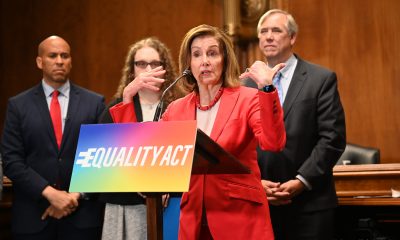
 Politics4 days ago
Victory Institute to honor Nancy Pelosi at D.C. conference
-
 Features4 days ago
Lu Corporan on designing the darkroom
-
 Palm Springs3 days ago
Here’s your Palm Springs look at the weekend: Oct 16-18, 2026
-

 a&e features3 days ago
How Orville Peck healed his inner child through ‘Street Fighter (2026)’
-
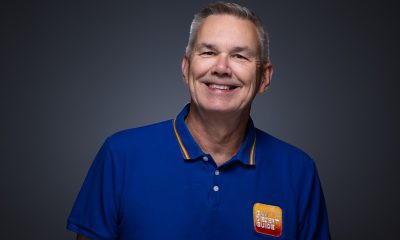 Palm Springs18 hours ago
Making waves in the desert: How Brad Fuhr and KGAY keep the Coachella Valley connected