
Europe
“I feel very secure here,” LGBTQ+ Ukrainians take refuge in Berlin
Ukrainian President Volodymyr Zelenskyy last year pledged his country would continue to fight anti-LGBTQ and anti-intersex discrimination
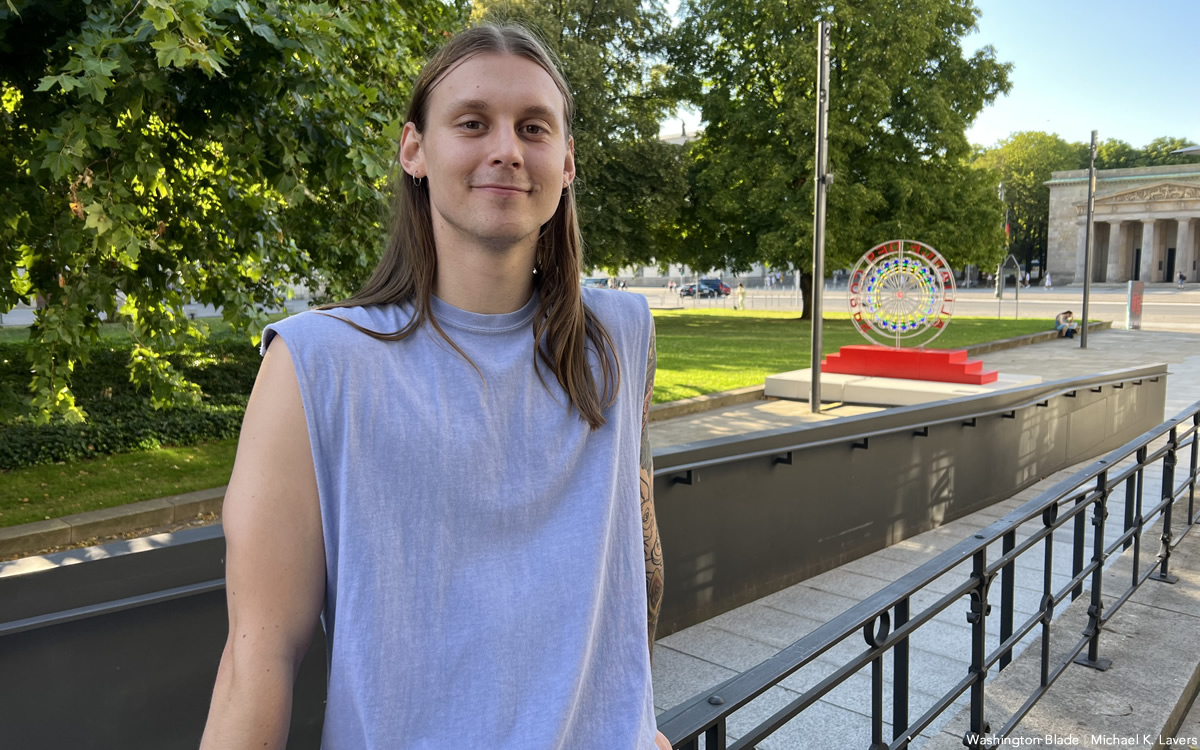
BERLIN — Dmitry Shapoval is a 24-year-old gay man from Ukraine who lives with HIV.
He was working at an IT company’s call center and studying web and UX design in Kyiv, the Ukrainian capital, in February when Russia launched its war against his country. Shapoval swam across a river and entered Poland less than a month later.
Shapoval now lives in Berlin with his cat Peach and has begun the process of resettling in Germany.
“I feel very secure here,” Shapoval told the Washington Blade on July 22 during an interview at Berlin’s Palais Populaire by Deutsche Bank on the city’s Unter den Linden boulevard.
Shapoval is one of the more than 900,000 Ukrainians who have arrived in Germany since the war began.
Ukrainians are able to enter Germany without a visa, and the German government provides those who have registered for residency a “basic income” that helps them pay for housing and other basic needs that include food. Ukrainian refugees can also receive access to German language classes, job training programs, and childcare.
Anastasiia Baraniuk and her partner, Yulia Mulyukina, were living together in Dnipro, a city on the Dnieper River in central Ukraine, when the war began.
Mulyukina, who is from Russia, was living in Moscow when she and Baraniuk began to talk online. Mulyukina traveled to Lviv in western Ukraine via Istanbul to meet Baraniuk, who is a Ukrainian citizen.
Mulyukina on July 22 told the Blade at Palais Populaire that she asked the Russian Embassy in Kyiv for help when the war began. Mulyukina said officials suggested that she “ask Ukraine what to do.”
“I was really shocked that my own country, with this idea of bringing peace, bringing quiet to Ukraine, just rejected me entirely,” she said in Russian as Shapoval translated.
Baraniuk, who also spoke with the Blade in Russian, said the Ukrainian government and a local NGO provided them with food and money.
The couple had planned to stay in Ukraine, but they decided to leave after Mulyukina “heard five explosions” while she was walking to a store. The two women’s friends gave them money to buy train tickets to Poland.
Insight, a Ukrainian LGBTQ and intersex rights organization, helped Baraniuk and Mulyukina and their cat enter Poland. They spent a week there before they arrived in Berlin on April 28.
Shapoval met them when they arrived at the train station.
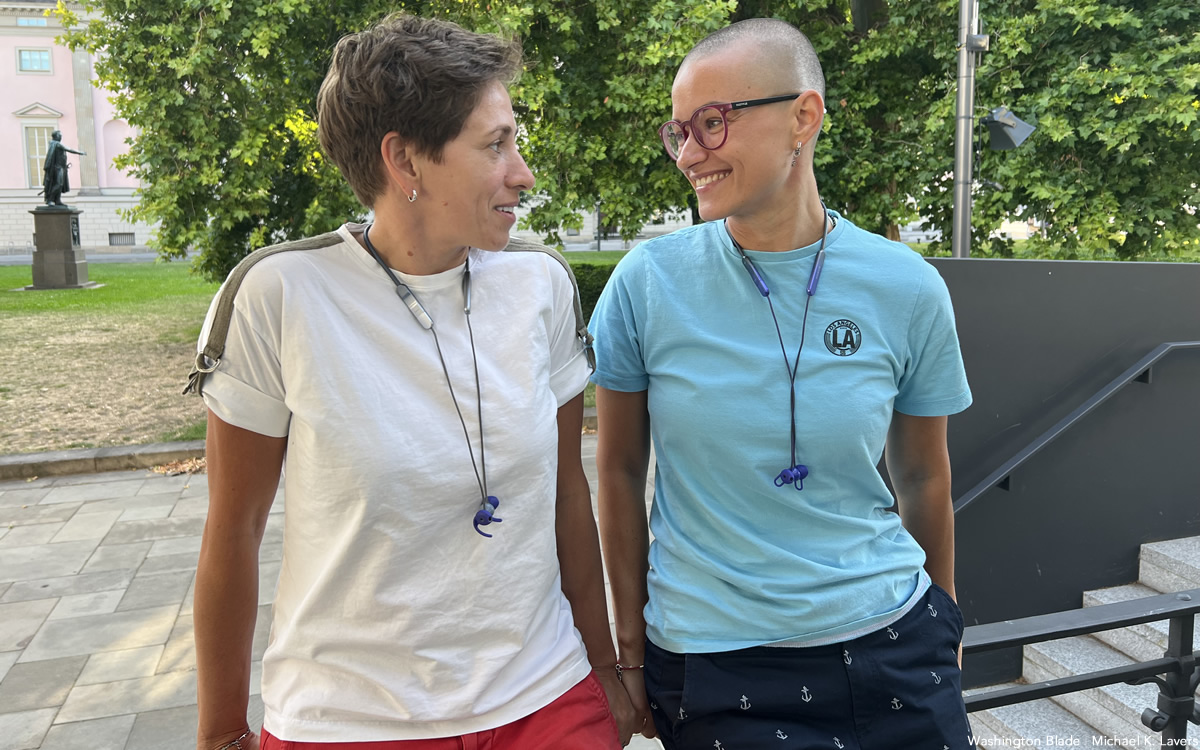
Shapoval, Baraniuk and Mulyukina are among those who attended a reception that took place at the end of a two-day meeting the Organization for Refuge, Asylum and Migration organized that took place in Berlin from July 21-22.
Activists from Ukraine, Germany, Poland, Romania, Moldova, Slovakia, the Czech Republic, the Netherlands, Italy and the U.S. attended the gathering that had a stated goal of starting “the conversation about long-term/mid-term needs and solutions for LGBTIQ Ukrainians and incite collaboration among stakeholders working with LGBTIQ Ukrainians and third-country nationals.”
“We were thrilled to bring together activists and human rights defenders from 10 countries and 20 organizations to develop medium and long-term strategies to support displaced LGBTIQ Ukrainians and third country nationals,” ORAM Executive Director Steve Roth told the Blade after the meeting. “All these organizations, including ORAM, have done an amazing job getting emergency support and services to LGBTIQ Ukrainians in need. As the war in Ukraine drags on, it’s more important than ever for organizations to coordinate efforts and plan for supporting longer term needs. This two-day roundtable in Berlin was a great step in that direction.”
ORAM has partnered with Airbnb.org and Alight (formerly known as the American Refugee Committee) to provide more than 1,000 nights of short-term housing to LGBTQ and intersex Ukrainians and other displaced people in Germany and other countries in Europe. Shapoval, Baraniuk and Mulyukina are among those who live in such apartments.
Roth noted ORAM has begun to develop “a housing collective” for LGBTQ and intersex Ukrainians in Berlin. He said ORAM rents the apartments in which the refugees can live for up to six months, “allowing them to register in Berlin, access social welfare and other services.”
“Safe and secure housing is one of the most urgent needs facing displaced LGBTIQ Ukrainians,” Roth told the Blade. “It’s an essential element in getting settled and rebuilding lives.”
Berlin Pride shows solidarity with Ukraine
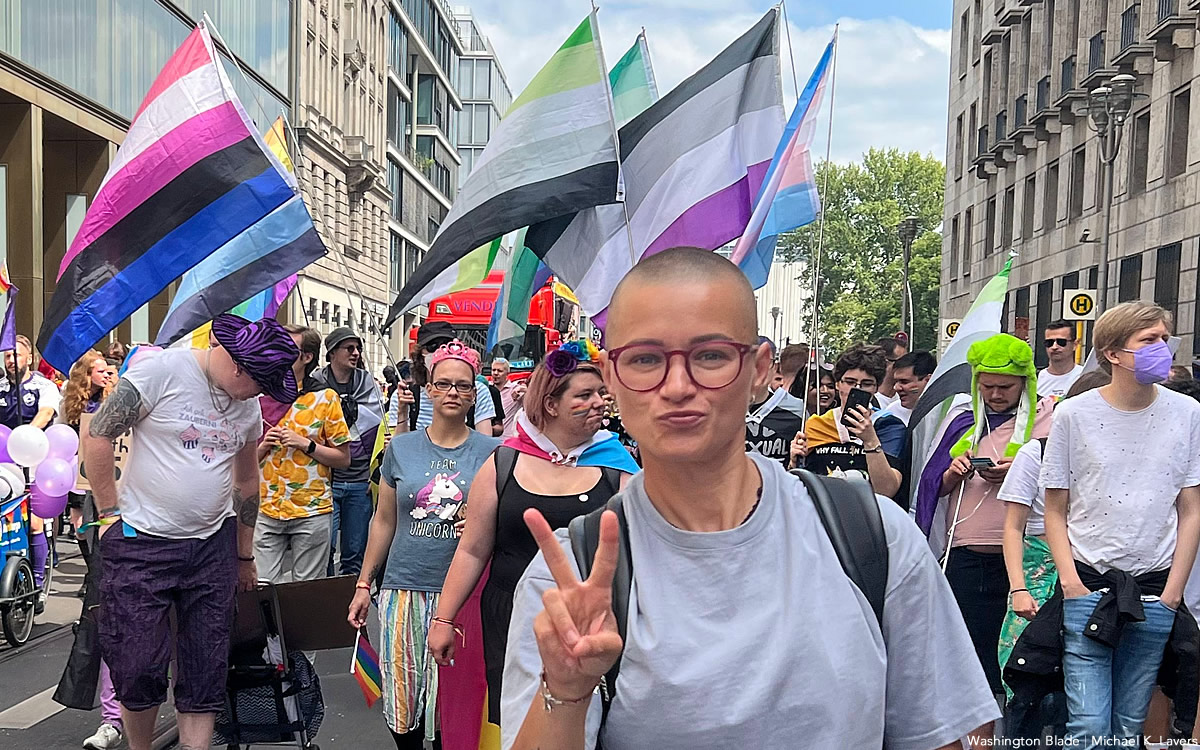
The meeting ended a day before the annual Christopher Street Day parade took place in Berlin.
Baraniuk helped carry ORAM’s banner during the parade, while Mulyukina took pictures for the organization.
‘Stop Russian aggression’
Kyiv Pride Executive Director Lenny Emson is one of the LGBTQ and intersex activists from Ukraine who participated in the ORAM meeting and in the parade.
He told the Blade before the parade began that he took several trains from Kyiv to Poland before he flew to Berlin. Emson said the trip took two days.
“I understand that it is a safe ground, but I still have those flashbacks,” Emson told the Blade as he smoked a cigarette in front of a hotel near the parade staging area. “When you were sitting in the conference room and I saw something that reminds me of an air raid siren I was getting a panic attack. It doesn’t matter if you’re in a safe place.”
Emson also took issue with parade organizers’ opposition to war.
“Unfortunately, we as the Ukrainian community here (are) very disappointed with the motto that Berlin Pride put on the main stage: No war,” said Emson. “This doesn’t reflect the feelings that we have right now.”
“We would like to actually say it loud: Stop Russian aggression,” he added. “We need action right now. We need to stop it. We need to stop Russian aggression. We need to stop it right now.”
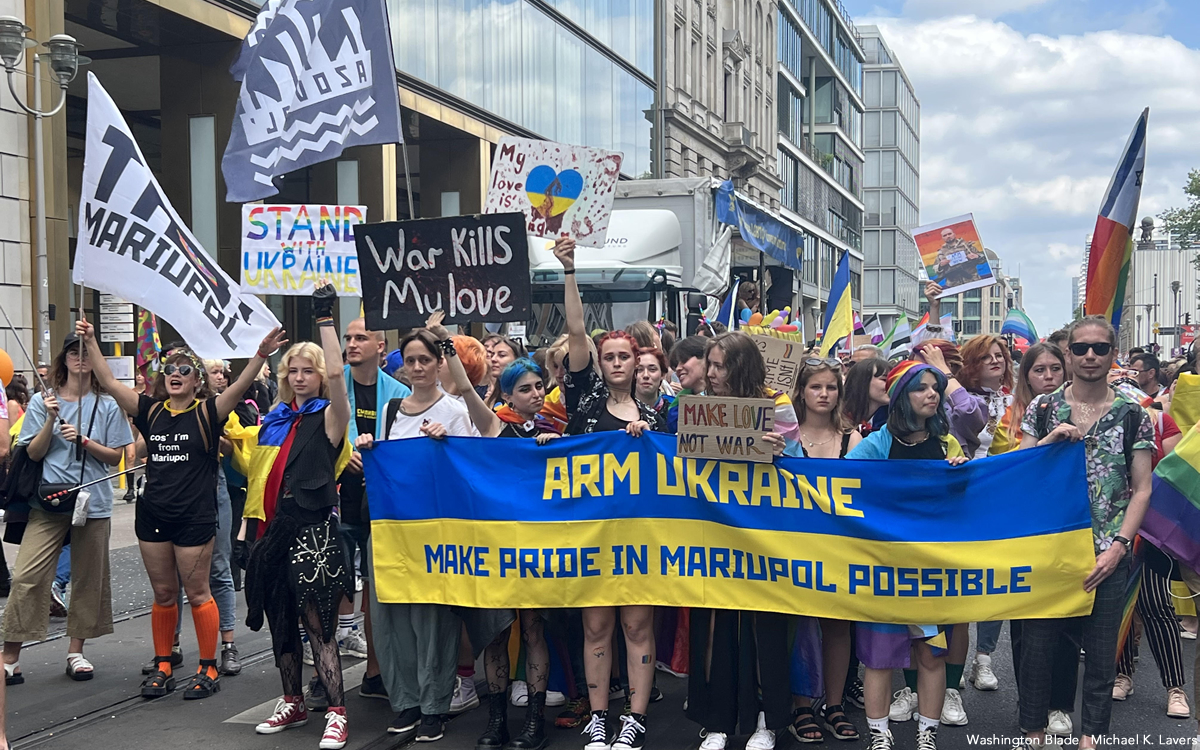
A group of marchers held a blue and yellow — the colors of Ukraine’s flag — banner that read “Arm Ukraine: Make Pride in Mariupol possible” while others simply carried the Ukrainian flag.
A man carried a homemade sign that read “Arm Ukraine: Make Pride in Kyiv, Kharkiv, Odesa, Zaporizha, Kryvyi Rih possible again.” Viktoriya, a woman from northern Ukraine who is now pursuing her Ph.D. in Berlin, held a cardboard poster that noted her homeland’s “queer soldiers are fighting for all of us.”
“I’m marching for both rights of queer people and rights of Ukrainians: The right to live and the right for love,” she said as she marched toward Potsdamer Platz in the center of Berlin.
Discrimination and violence based on sexual orientation and gender identity were commonplace in Ukraine before the war.
Ukrainian President Volodymyr Zelenskyy last year pledged his country would continue to fight anti-LGBTQ and anti-intersex discrimination after he met with President Joe Biden at the White House.
Shapoval, who is dating a man he met last October when he traveled to Berlin, told the Blade that he received “looks” in Kyiv if he wore a pink shirt.
He was wearing a pair of purple sneakers during the interview. Shapoval said he would not have been comfortable wearing them if he were still in Kyiv.
“For me it was even harder because I had misery in Ukraine because of homophobes,” he said. “Even the gay community is so toxic in Ukraine because it’s all about toxic masculinity and all of that … I also had some experiences where gays were like, ‘Oh my gosh just cut your hair and then we will get in touch with you.’”
Shapoval has begun the process of applying for German residency.
“I fell in love with the city right from the beginning,” he said. “I found friends here.”
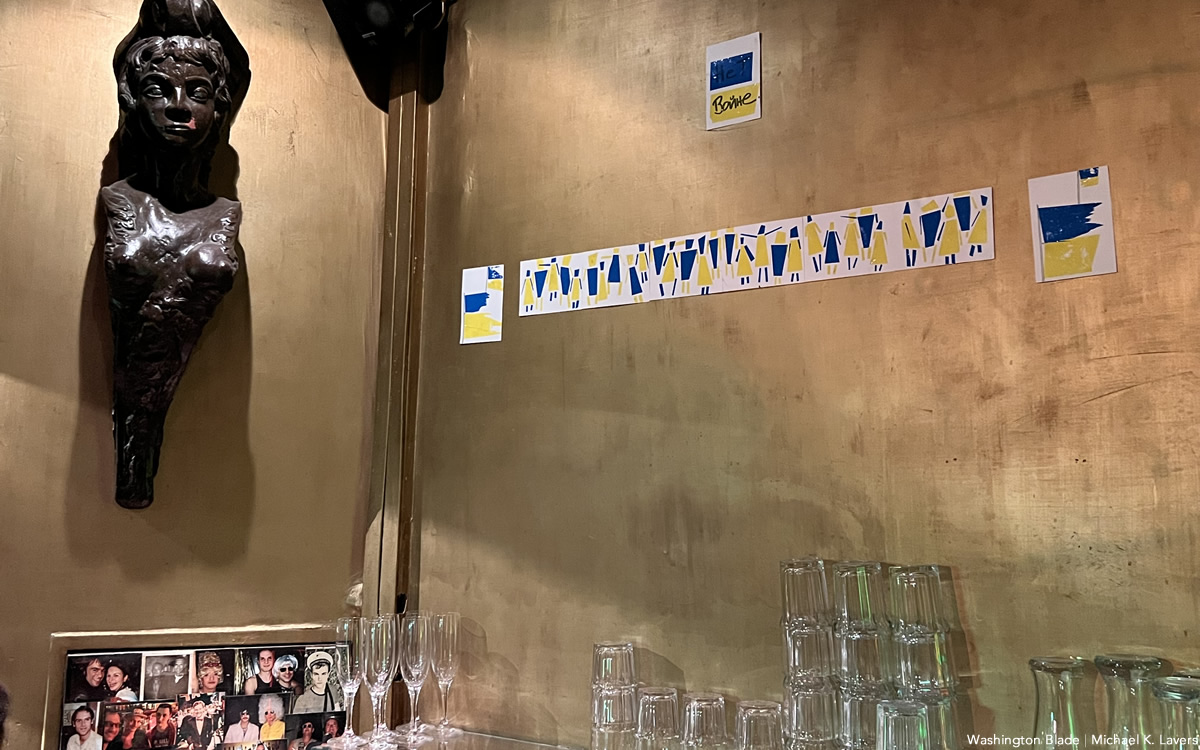

Jessica Stern, the special U.S. envoy for the promotion of LGBTQ and intersex rights, and others have noted transgender and gender non-conforming Ukrainians have not been able to leave the country because they cannot exempt themselves from military conscription. Another issue that LGBTQ and intersex Ukrainians have faced as they attempt to resettle in another country is the lack of legal recognition of their relationships.
A marriage equality petition that Kyiv Pride submitted to Zelenskky on July 12 received more than 28,000 signatures, which is higher than the threshold that requires him to consider it. Ukrainian law requires Zelenskky to respond to it within 10 days of receiving it.
Baraniuk and Mulyukina hope to resettle in the U.S. and Canada, but are unable to legally prove they are in a relationship. The U.S. has a marriage-based immigration system for bi-national couples, while the Canadian system requires them to be married or “common-law partners.”
The U.S. has approved Baraniuk’s resettlement request, but denied Mulyukina.
They said the process to legally prove they are together is prohibitively expensive.”Right now we are looking for a way to get the proof that we are a couple,” said Baraniuk. “We don’t want to stay in Berlin.”




France
Prominent French activist attacked outside Paris bar
Pierre Picavet hospitalized with internal bleeding, head injury
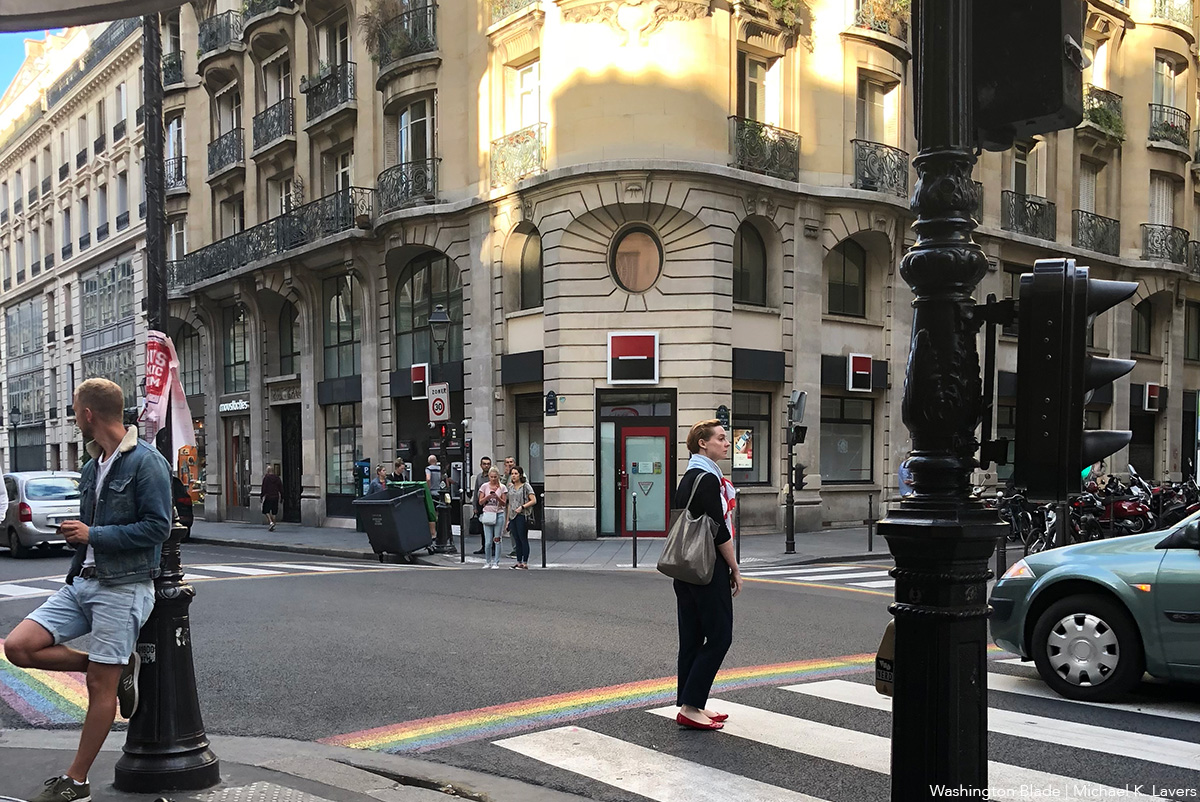
French prosecutors say a man shouted anti-gay slurs at a prominent activist before he attacked him in Paris on Saturday.
Media reports indicate Pierre Picavet, a police officer who is the president of FLAG!, a group within the French Justice and Interior Ministries that defends LGBTQ+ rights, was attacked as he left a bar in Paris’s Marais neighborhood.
The Marais since the 1980s has been center of the French capital’s LGBTQ+ community.
France 24 reported Picavet’s assailant struck him with a bottle. The attack left Picavet hospitalized with internal bleeding, a head wound, and other injuries.
“When I get better, when my wounds have healed, I will continue the fight,” Picavet told Radio France on Monday. “I am particularly shocked, but it tells me that there is still work to do.”
Paris Mayor Emmanuel Grégoire is among those who condemned the attack.
STOP Homophobia (STOP homophobie), a French group that fights against anti-LGBTQ+ violence, on its social media pages published a picture of Picavet in the hospital.
“As a long-standing partner of FLAG!, STOP Homophobia wishes to express its solidarity with Pierre Picavet, his loved ones, and the entire association,” said the group. “STOP Homophobia condemns this assault in the strongest possible terms and reiterates that anti-LGBT violence remains a reality — even in spaces where everyone should be able to move freely and live out their sexual orientation or gender identity without fear of attack.”
STOP Homophobia also praised a bystander who came to Picavet’s aid after the attack, and the first responders and law enforcement personnel who responded.
“STOP Homophobia extends its full support to Pierre, his family, his loved ones, and the entire FLAG! team, and wishes him a full recovery,” said the group.
Reports indicate the assailant, who was born in 2006, was scheduled to appear in a Paris court on Monday at 1:30 p.m. local time.
Poland
Poland begins to legally recognize same-sex marriages from other countries
‘This is an important milestone, but it should not be the final destination’

Poland has begun to recognize same-sex marriages legally performed outside the country.
TVP World, the country’s public broadcaster, reported civil registry offices began to “transcribe same-sex marriages legally” conducted outside of Poland on Aug. 22.
The EU Court of Justice in Luxembourg last November ruled in favor of a same-sex couple who challenged Poland’s refusal to recognize their German marriage. Poland’s Supreme Administrative Court in March reaffirmed the decision.
The couple, who lives in Poland, brought their case to Polish courts in 2019. The Supreme Administrative Court referred it to the EU Court of Justice.
The Polish government in May announced it will recognize same-sex marriages legally performed in other EU countries. Polish President Karol Nawrocki on July 17 vetoed bills that would have extended rights to same-sex couples.
Poland’s Constitutional Tribunal a few days later rejected the recognition of same-sex marriages legally performed in other EU countries. The Love Does Not Exclude Association, a Polish marriage equality advocacy group, in an Aug. 26 press release notes the ruling “does not prevent implementation of these new regulations” because the Constitutional Tribunal is “largely discredited” and the government considers it “to be improperly constituted.”
“This is an important milestone, but it should not be the final destination,” said Maja Heban of the Love Does Not Exclude Association. “No couple should have to cross a border to marry. Our goal is allowing loving, committed couples to marry in Poland in the first place. The law now increasingly recognizes these marriages once couples return to Poland in areas such as healthcare and social security, but significant gaps remain, mainly lack of recognition of same-sex parents which directly impacts security of their children.”
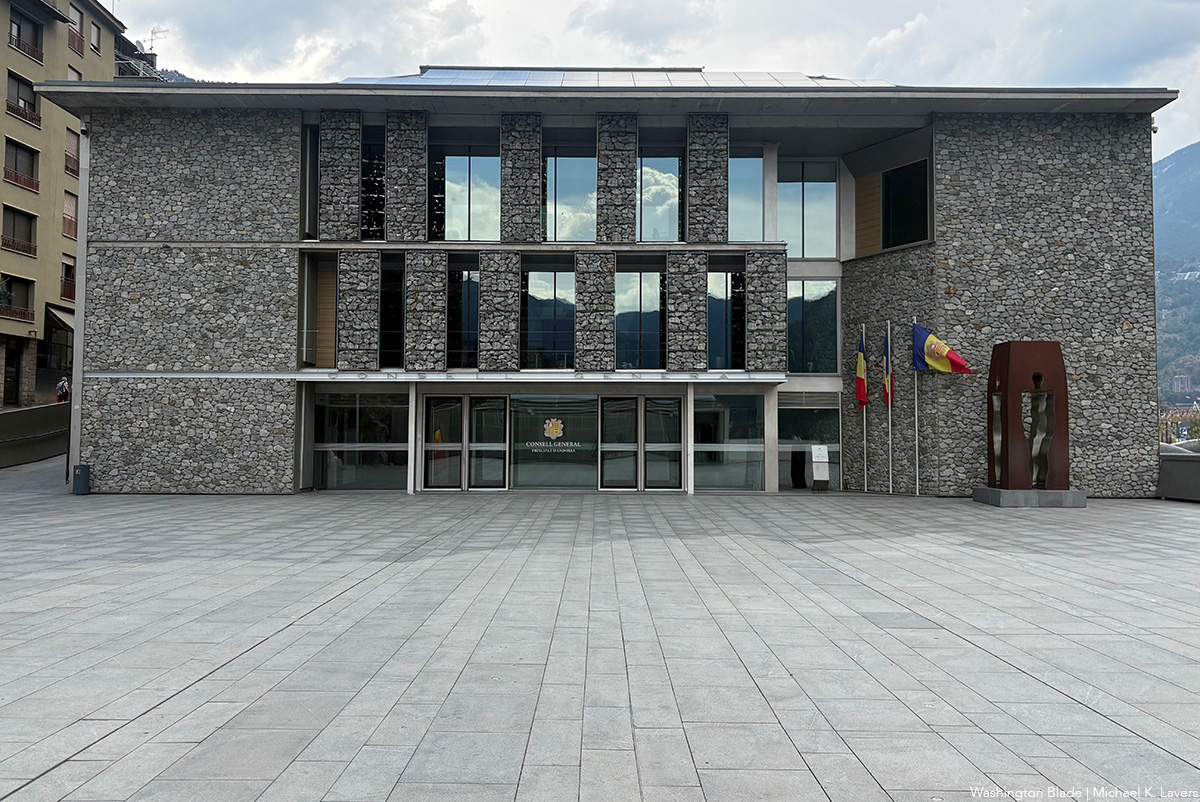
Germany, Belgium, France, Ireland, Spain, and Portugal are among the EU countries in which same-sex couples can legally marry. Andorra, whose prime minister, Xaviet Espot Zamora, is openly gay, and Switzerland are among the other European nations that have extended marriage rights to same-sex couples.
The Netherlands in 2001 became the first country in the world to extend marriage rights to same-sex couples. Activists who participated in this year’s World Pride that took place in Amsterdam earlier this summer marked this milestone.

Netherlands
Trans, nonbinary Americans find refuge in the Netherlands
DAFT visa offers fast-track to permanent residency, citizenship

Editor’s note: International News Editor Michael K. Lavers and Photo Editor Michael Key were on assignment in the Netherlands from July 28-Aug. 10.
AMSTERDAM — A transgender American couple who live in the Netherlands say President Donald Trump prompted them to leave the U.S.
Jack Reaves, who is a trans man, and his wife, Iskara McCoy, who is a trans woman of color, moved to the Netherlands from Reno, Nev., in 2024. The couple now lives outside Utrecht, a university city that is roughly 30 miles south-southeast of Amsterdam.
“We’d been keeping an eye on things during his (Trump’s) first term in 2016, which was pretty terrifying,” Reaves told the Los Angeles Blade on Aug. 24 during a WhatsApp interview with him and McCoy. “We knew that there was a lot of anti-trans legislation and just anti-trans feelings from the Republican/MAGA party at the time.”
The Biden-Harris administration took office on Jan. 20, 2021, two weeks after thousands of Trump supporters stormed the U.S. Capitol — the insurrection took place shortly after Congress began to certify the results of the 2020 presidential election that Joe Biden won.
“Joe Biden was elected, and we were like, okay, well maybe things will turn around,” said Reaves. “But it was very clear very early on in the Biden presidency that that wasn’t going to happen.”
“There weren’t any meaningful changes, and then with Trump getting ready to win the next election and MAGA really looking like they were going to continue to gain more power, we were like, well time to get out.”
Reaves and McCoy are two of the four trans and nonbinary Americans who have moved to the Netherlands with whom the Blade recently spoke. The interviews took place during World Pride, which took place in Amsterdam from July 25-Aug. 8, or in the days after the biennial event ended.
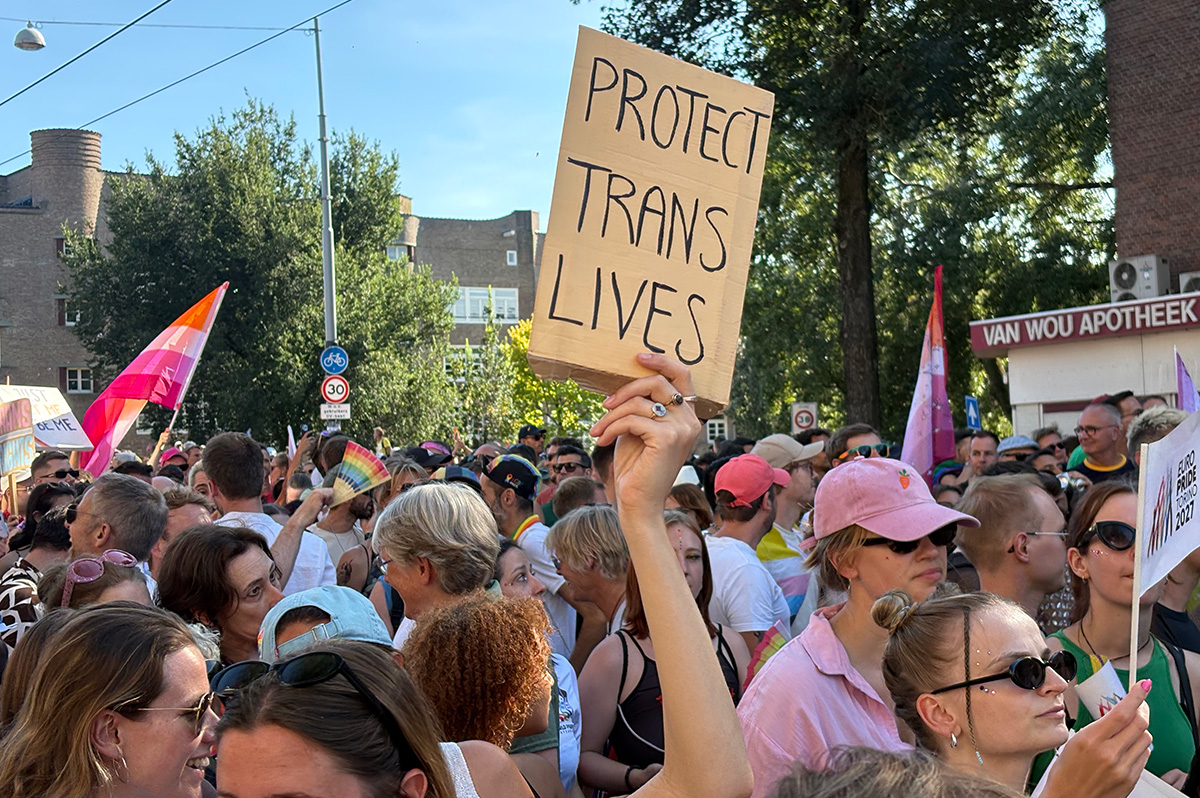
The Dutch American Friendship Treaty, or DAFT, allows American citizens to live and work in the Netherlands as self-employed entrepreneurs.
DAFT visa recipients must keep at least €4,500 ($5,244.19) in a Dutch business bank account and need to register their business with the Dutch Chamber of Commerce. DAFT visa recipients can apply for permanent residency in the Netherlands or the European Union seven years after they receive it.
Reaves and McCoy and the two other trans and nonbinary Americans with whom the Blade spoke for this story either received a DAFT visa or plan to apply for one.
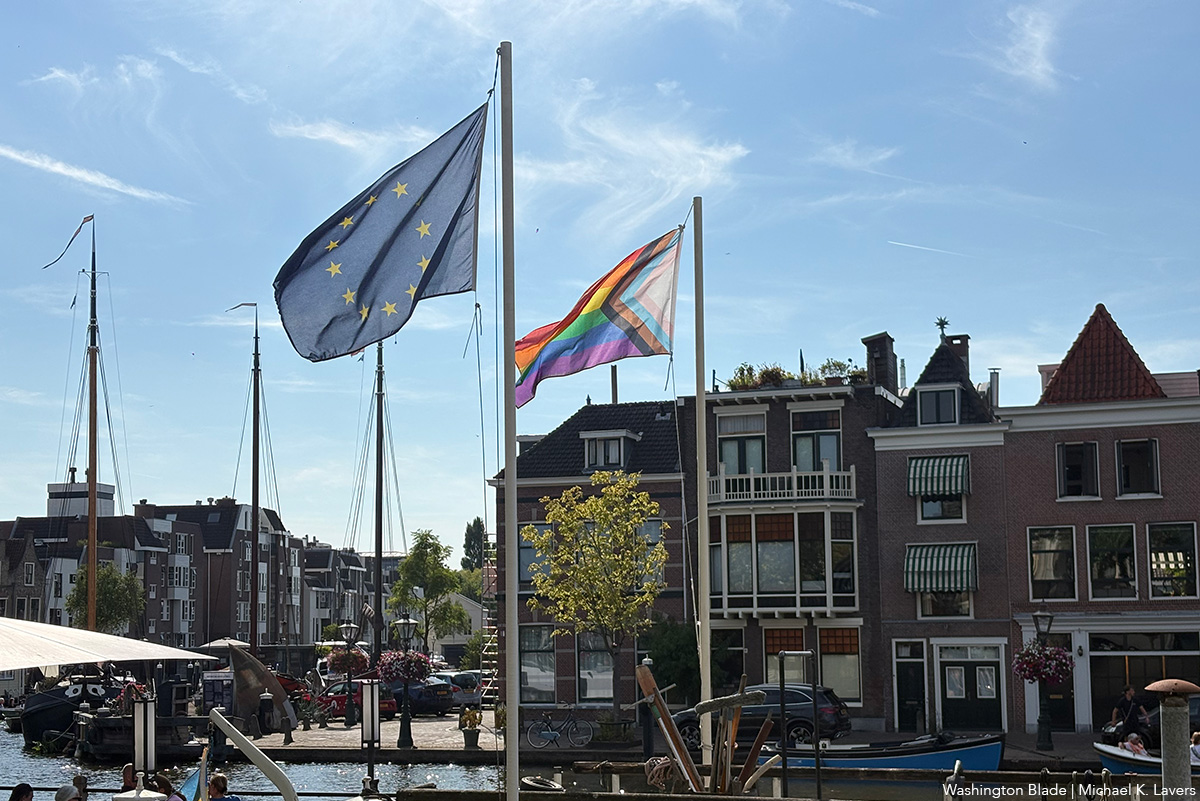
Kai, who is nonbinary, and their husband, who is a trans man, moved from New England to the Netherlands in August 2021. They now live in Haarlem, a small city that is roughly 12 miles west of Amsterdam.
Kai told the Blade on Aug. 20 during an interview from their home that friends moved to the Netherlands in 2017 after they received a DAFT visa.
“The prompt was the 2016 election for them,” said Kai.
Kai and their husband were living in a collective household in August 2020 when they “decided we wanted to have some kind of change.”
“We suspected that politics was going to get worse, even if it got better soon, that it would probably get worse again later, and that the country politically was going downhill,” they said.
Kai told the Blade a lack of promised disability payments and poor health in the U.S. were also factors.
“When I had been to visit the Netherlands to visit the friends that were living here, I found that my body was healthier, even though I was only here for one or two weeks at a time,” they said. “I was able to do more things, eat more things that I couldn’t go or eat while living in the U.S.”
The fourth American with whom the Blade spoke identifies as a “disabled transgender queer” person. He asked to remain anonymous.
He and his daughter, who is also trans, arrived in the Netherlands in July. He referred to the Holocaust and its impact in the Netherlands when the Blade interviewed him in Amsterdam on Aug. 6.
“I’m the trans parent of a trans adolescent who knows our family history, which includes genocide from the Holocaust,” he said, pointing out 85 percent of Dutch Jews died in the Holocaust. “(My daughter) said my grandparents came to New York right before the occupation, and so my daughter said from our history that targeted communities have to get out early, so this was last summer, so how will we know we need to leave and where will we go?”
“I started looking into that, and we started planning our move,” he added.
He pointed out the “murder of opposition politicians” — specifically former Minnesota House Speaker Melissa Hortman and her husband, Mark Hortman, who were shot to death inside their home in June 2025 — and “harassment and prosecution” of journalists in the U.S. — federal authorities in January arrested former CNN anchor Don Lemon less than two weeks after he entered a Minnesota church with a group of protesters who confronted its pastor who works with U.S. Immigration and Customs Enforcement — since the Trump-Vance administration took office as signs he and his daughter may need to leave the U.S.
Federal authorities charged Lemon, independent journalist Georgia Fort and two protesters with conspiracy and interfering with worshippers’ First Amendment rights during the protest.
An ICE agent on Jan. 7 shot and killed Renee Good, a 37-year-old Minneapolis woman who left behind her wife and three children. U.S. Customs and Border Protection agents on Jan. 24 shot and killed Alex Pretti, a 37-year-old nurse who worked for the U.S. Department of Veterans Affairs in Minneapolis.
Pretti and Good were American citizens.
The shootings took place after the Trump-Vance administration deployed thousands of federal immigration agents to Minnesota during “Operation Metro Surge.”
“We were thinking, depending on what happens with the midterms,” said the trans person in Amsterdam with whom the Blade spoke. “But then you’re like, you know what, every day more people are coming and we should just do this thing.”
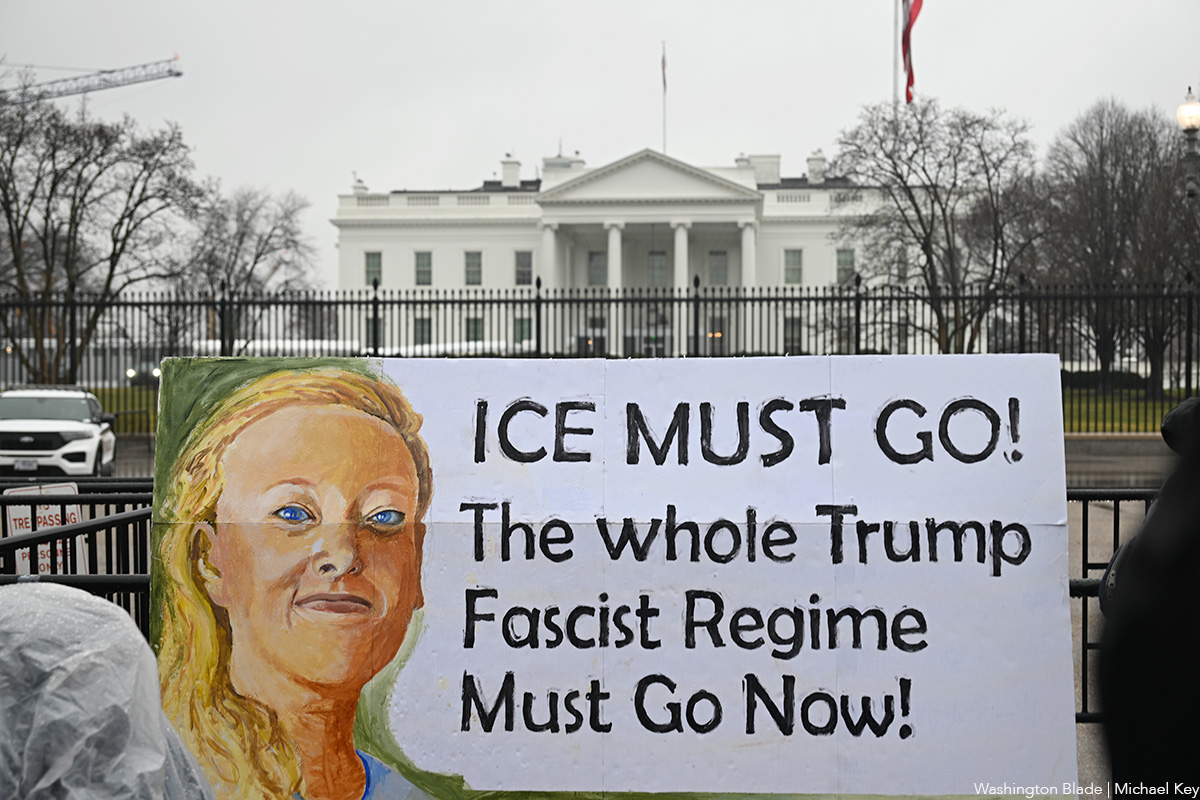
The Trump-Vance administration since it took office on Jan. 20, 2025, has implemented several anti-trans executive orders and policies.
Trump hours after his second inauguration signed the “Defending Women from Gender Ideology Extremism and Restoring Biological Truth to the Federal Government” that, among other things, declared the federal government will only recognize two genders: male and female. The directive also banned the State Department from issuing passports with “X” gender markers.
The Pentagon reinstated a ban on openly trans servicemembers. The Department of Education has rescinded agreements with school districts that were designed to protect trans students. The Trump-Vance administration’s anti-terrorism strategy specifically targets “radically pro-transgender” groups.
The U.S. Supreme Court earlier this summer upheld state laws banning athletes from school sports teams that correspond with their gender identity and block gender-affirming care for minors. The Trump-Vance administration since it took office has moved aggressively to curtail these treatments.
“On the one hand, it’s like as if people don’t recognize that that these things make it impossible to have a trans life,” said the trans person with whom the Blade spoke in Amsterdam. “But of course, that’s what Project 2025 is trying to do … make it be impossible to exist.”
McCoy said her and Reaves’s oldest child, who is also trans, has an “X” gender marker on their U.S. passport. McCoy’s grandmother with whom she was very close recently died, but her family attended her funeral virtually from the Netherlands “because we didn’t want to risk returning to the States at that point.”
Kai also noted trans and nonbinary Americans who are trying to leave the U.S., but don’t have passports and other documents with gender markers that match their gender identity.
“That’s terrifying, and it prevents you from doing things like leaving the country,” they said. “Even if it’s not a ban on leaving the country, it still prevents you from leaving the country if those things don’t match in the right way, depending on which immigrations person you get at the border.”
“On this end it wouldn’t matter as much,” added Kai. “But on the other end, it does matter and that is super frustrating and exhausting.”
Dutch ‘very into their bureaucracy’
Kai and the three other trans and nonbinary Americans with whom the Blade spoke said navigating the Dutch health care system upon their arrival in the Netherlands was one of their biggest challenges.
“They’re very into their bureaucracy and they’re very into following guidelines as if they’re laws, and they’re the only ways you do things,” said McCoy. “Once they start working for you. They work. Once you’re in the system, once you’re onboarded, once they’re caught up, then everything goes pretty smoothly.”
Reaves noted McCoy “had a little bit easier time as a trans woman who’s already passing.”
“They were just like, oh, well, it’s clear you’re a woman, so here’s your hormones, and here’s the fast path to diagnostics,” Reaves told the Blade.
Reaves, on the other hand, had been on testosterone for six years before he and McCoy moved to the Netherlands. Reaves said it took nearly a “full year of re-diagnostics before I could get back on testosterone and continue to determine care.”
“They were just like, ‘Well, you kind of look like a woman, so we’re gonna make you do the full diagnostic phase again,’” recalled Reaves.
Reaves told the Blade his doctor prescribed him the wrong type of testosterone. Health clinics that specifically treat trans and nonbinary people use what he described as “extremely outdated language,” but Reaves noted the facility’s doctor helped him get an appointment for his top surgery.
“Now that I’m fully onboarded, I think it’s actually been a little bit better than the U.S.,” he said, noting he receives testosterone blood tests at home. “The follow-ups are really easy.”
Kai also discussed the challenges navigating the Dutch health care system.
They said it would “have been a lot harder to receive care” if they had already undergone hormone replacement therapy, seen a psychiatrist, or had had surgeries. Kai told the Blade they “made the choice” to tell the clinic where they were receiving care that they were a man, as opposed to saying they are nonbinary.
“That’s not true, but I look enough like a man, and then I’m going to get the care that I need,” they said. “I’m sure it’s very different and difficult for folks, especially who are nonbinary, to say I am actually a woman, or I am actually a man, and to pretend that … and that’s still what the system says.”
“Just like with any system, if you want to get your needs met from the system, sometimes you have to meet the system where it’s at, and then once you get your needs met, then outside of the system you can be whoever you want,” Kai added.
Kai noted Dutch activists are “working to get some of those laws and some of those policies changed.” Their husband is working with one group “that is working to change things from if you don’t have a psychological diagnosis of being trans, then getting that care is going to be really hard.”
“What this group is working on is trying to get trans care to be — it’s what they use in the U.S., which is like informed consent, which is not what they use here,” said Kai. “But they’re working on putting together something to like push to governmental level to policy level to say that trans care should be informed consent, not the diagnosis.”
Gay PM: Netherlands needs to do more to defend trans people, rights
The Netherlands in 2001 became the first country in the world to extend marriage rights to same-sex couples.
The country’s nondiscrimination and hate crimes law include gender identity and expression. The Dutch government in 2021 formally apologized to trans and intersex people who were forced to become sterile in order to legally change their gender — The Gender Change Act, which was also known as the Transgender Act — was in place from 1985 until 2014.
Prime Minister Rob Jetten, who is the country’s first openly gay head of government, during a World Pride Human Rights Conference panel conceded the Netherlands needs to do more to defend trans people and their rights. Boris Dittrich, the Dutch Senate’s First Vice President and a member of Jetten’s D66 party who was previously global advocacy director for Human Rights Watch’s LGBTQ Rights Program, at the end of the panel asked about protecting intersex babies from what advocates maintain are unnecessary surgeries.
Reaves admitted he and his children are struggling to learn Dutch, but he added he and his family “appreciate” the Netherlands and “really enjoy living here.”
“I struggle in the Netherlands,” Reaves told the Blade. “I don’t speak the language
“It’s hard being away from home and your own culture and the things you grew up with,” he said. “But I’m safe here, and so that like gives it extra points.”
McCoy said their daughter has “experienced zero transphobia here so far.”
Kai told the Blade that their friends warned them that Dutch people would “call you out or they’ll stare at you or will be mean to you” if they “look nonbinary.”
“I had never had that experience,” they said.
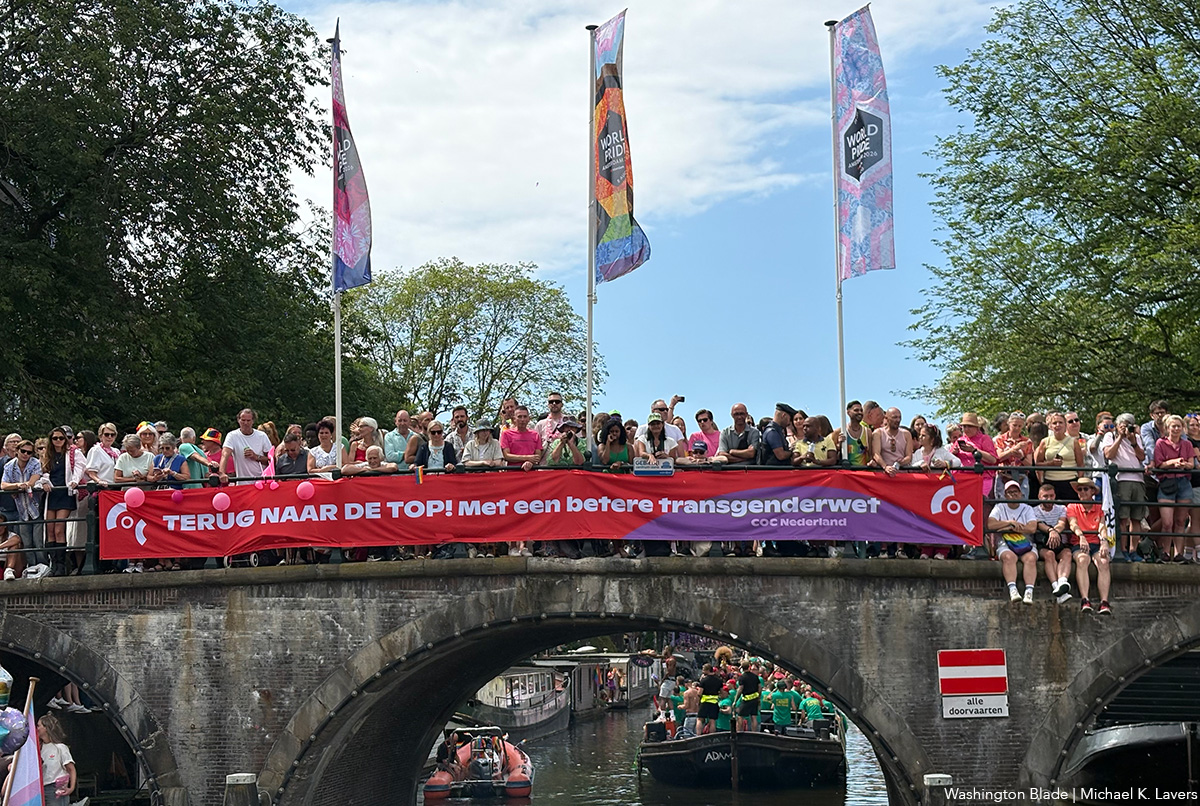
All four of the people with whom the Blade spoke said they plan to apply for their Dutch or EU citizenship once they are legally able to do so. They all expressed reservations about returning to the U.S., even once the Trump-Vance administration is no longer in office.
“I’m actually very nervous that even if things turn around in the U.S. as far as getting rid of Trump, that people are still going to be anti-trans,” said the trans person with whom the Blade spoke in Amsterdam. “The poison’s in the water.”
Reaves said the U.S. “doesn’t really feel like it’s a safe place for trans people to come to.” McCoy added she would consider visiting the U.S., but “I would not move back.”
“That’s too risky,” she said. “It can change anytime.”
“It would probably take like a decade of democratic legislative changes before I would feel safe coming back,” added Reaves.
Netherlands
Thailand’s first openly gay senator attends World Pride in Amsterdam
Blade sat down with Pornchai Witayalerdpan on Aug. 7
Editor’s note: International News Editor Michael K. Lavers and Photo Editor Michael Key were on assignment in the Netherlands from July 28-Aug. 10.
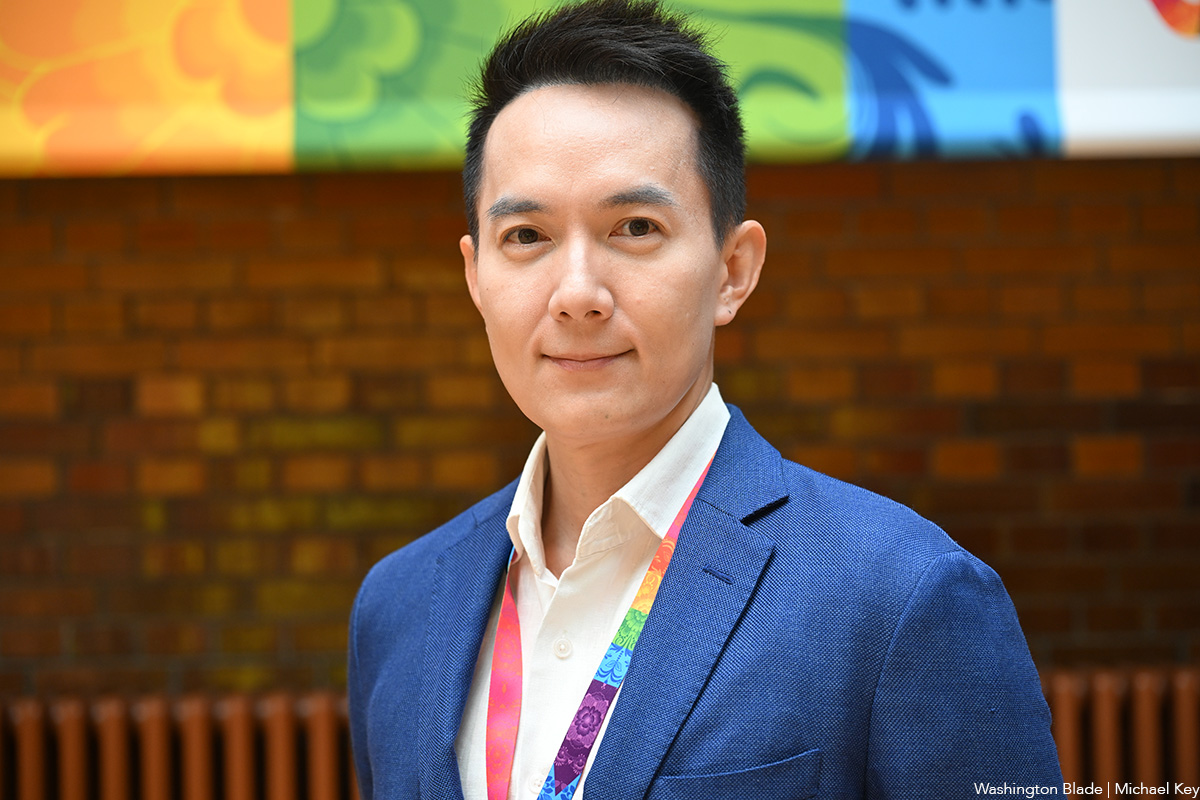
AMSTERDAM — The first openly gay man elected to the Thai Senate says the law that extended marriage rights to same-sex couples in Thailand has positively impacted his country’s global image.
“It totally changed how the world perceived Thailand,” Sen. Pornchai Witayalerdpan told the Los Angeles Blade on Aug. 7 during an interview at the World Pride Human Rights Conference in Amsterdam.
Thailand on Jan. 23, 2025, became the first country in Southeast Asia to allow same-sex couples to legally marry.
The marriage equality bill received final legislative approval in June 2024 when the Senate approved it by a 152-130 vote margin. King Maha Vajiralongkorn signed it a few months later. Then-Prime Minister Prime Minister Paetongtarn Shinawatra is among those who supported the law.
Witayalerdpan was a freelance interpreter before he took office in July 2024.
The independent senator noted Thailand’s marriage equality movement began to gain traction with a lawsuit that the Foundation for Sexual Orientation and Gender Identity Rights and Justice, a Thai advocacy group, filed.
The Constitutional Court in 2021 upheld a law that defined marriage as between a man and a woman. MP Tunyawaj Kamolwongwat of the Move Forward Party later introduced the marriage equality bill that became law.
“It was a coalition of efforts between the civil society organizations, the LGBTQ organizations, and also the Pride movement in Thailand,” Witayalerdpan told the Blade.
Taiwan in 2019 became the first country in Asia to extend marriage rights to same-sex couples.
The Nepalese Supreme Court in June issued a landmark ruling that ordered the country’s government to guarantee full marriage rights to same-sex couples.
The Japanese Supreme Court in March said it will consider six marriage equality lawsuits that have been filed in the country. The Indian Supreme Court in 2023 ruled against marriage rights for same-sex couples. South Korea is among the other Asian countries in which marriage equality efforts are gaining momentum.
Witayalerdpan said Thailand’s marriage equality law could have a direct impact in Japan, which is the only G7 country that does not legally recognize same-sex couples.
“It’s been nothing but a positive effect (in Thailand) after the same-sex marriage law (took effect),” he said.
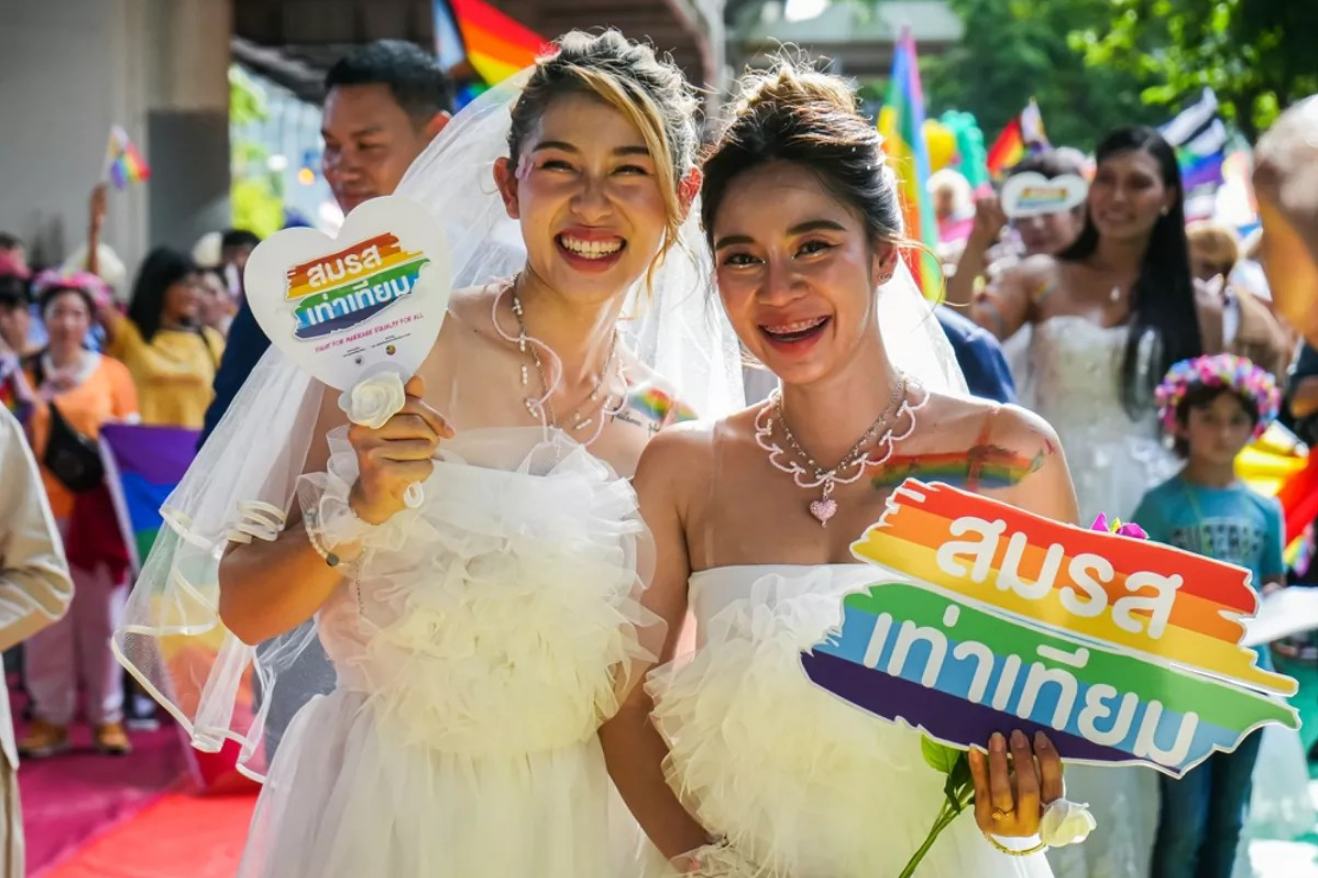
InterPride, the organization that coordinates World Pride events, has announced Bangkok and Barcelona, Spain, are the two finalists to host the biennial event in 2030. (World Pride took place in D.C. in 2025.)
Witayalerdpan told the Blade that World Pride in Bangkok would further improve Thailand’s global image. He also said his fellow lawmakers, in turn, should pass LGBTQ+ rights bills — including proposals that would allow transgender people to legally change their name and gender and enable same-sex couples to have children via surrogates from in vitro fertilization. Witayalerdpan noted the most important bill to him is one that would strengthen Thailand’s LGBTQ+-inclusive nondiscrimination law that took effect in 2015.
Impact of US funding cuts has ‘been very hard’
Witayalerdpan also offered advice to activists in the U.S. and elsewhere around the world.
“Keep on pushing forward,” he told the Blade. “I know that it’s hard for activists in Thailand as well.”
Witayalerdpan acknowledged the loss of U.S. government funding since the Trump-Vance administration took office — which has forced advocacy groups in Asia and elsewhere around the world to close — has “been very hard.” Witayalerdpan noted the global LGBTQ+ and intersex rights movement in response to these cuts has turned to the European Union, the U.K., Canada, and the Netherlands to help fill the gap.
“It’s very good that these countries are providing more funds to the activists in Asia than before because of the Trump situation,” he told the Blade. “It can increase their soft power as well.”
Witayalerdpan said American activists should “wish for a positive result in the mid-term elections.”
“Then there is some resistance,” he added.
Witayalerdpan specifically highlighted efforts to fight against the Trump-Vance administration’s efforts to restrict gender-affirming healthcare.
A federal court in Massachusetts on Aug. 15 struck down a key provision of a U.S. Department of Health and Human Service rule that would have limited access to gender-affirming care under the Affordable Care Act. Maryland and California are two of the 21 states that sued the Trump-Vance administration over the issue.
“You have to show more resistance … to show that we are still here and we will push back when we can,” said Witayalerdpan.
Russia
Russian LGBTQ+ rights group to shut down
Russian LGBT Network in April declared ‘extremist’ organization
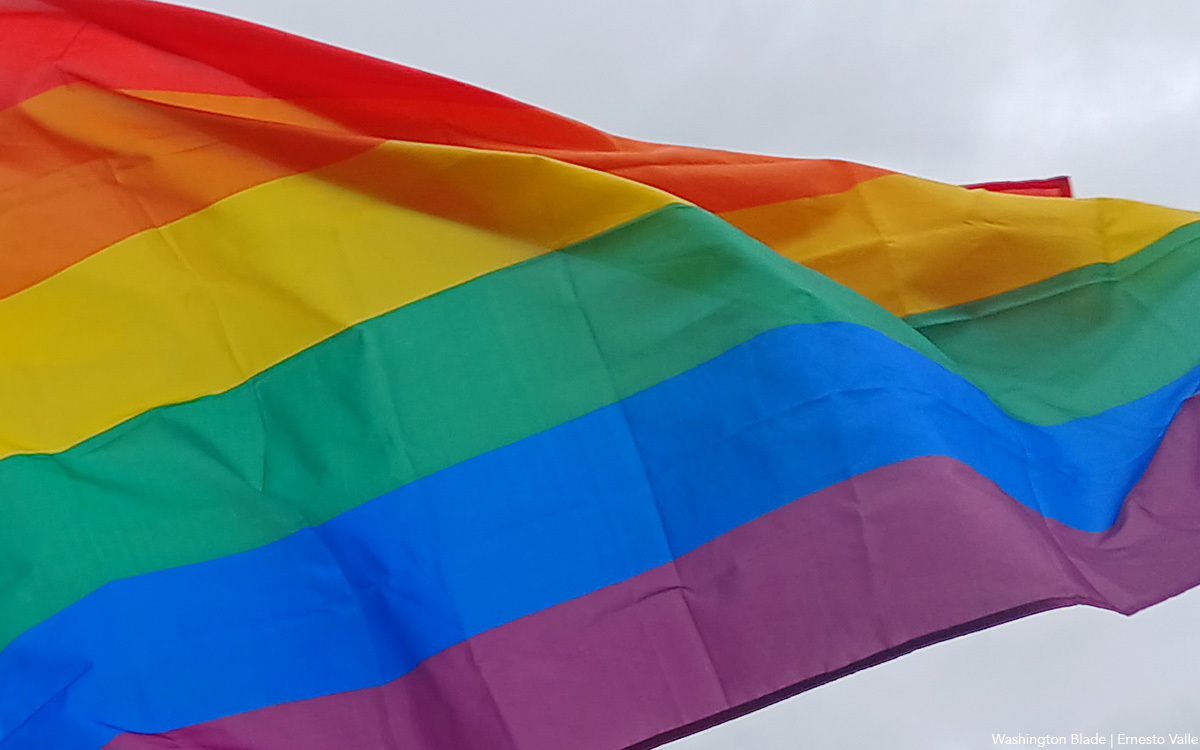
A Russian LGBTQ+ advocacy group on Monday announced it will shut down after a court declared it an “extremist” organization.
A St. Petersburg court in April in response to a Russian Justice Ministry lawsuit made the declaration against the Russian LGBT Network.
“For many years, Russian LGBT Network brought together initiatives and activists and supported queer people across the country,” said the advocacy group on its Facebook page. ” However, its ‘extremist’ status has made the previous public format of its work impossible: any connection to the organization may create additional risks for the people we seek to support and protect.”
The Russian LGBT Network formed in 2006.
The group on its Facebook page said it “made this decision” to close “after a thorough assessment of the risks.”
“Continuing our public activities could have put at risk those who took part in the organization’s work, supported it, or received assistance,” said the Russian LGBT Network. “We cannot control the repressive environment, but we can do everything possible to avoid creating additional risks for people. People’s safety comes first.”
The Kremlin over the last decade has faced global criticism over its crackdown on LGBTQ+ rights.
The Russian Supreme Court in 2023 ruled the “international LGBT movement” is an extremist organization and banned it.
Russia in January designated ILGA World, a global LGBTQ+ and intersex rights group, as an “undesirable” organization. ILGA World in response to the designation noted Russians who are found guilty of engaging with “undesirable” groups face up to six years in prison.
Human Rights Watch in May noted the Russian LGBT Network is one of nine LGBTQ+ groups that Russia this year has banned after authorities deemed them “extremist.”
“Russian LGBT Network may close; but dignity, solidarity, and people’s right to be themselves cannot be destroyed,” said the Russian LGBT Network in its statement. “Take care of yourselves.”
Netherlands
Tens of thousands take part in World Pride March
Event capped off two weeks of celebrations in Amsterdam
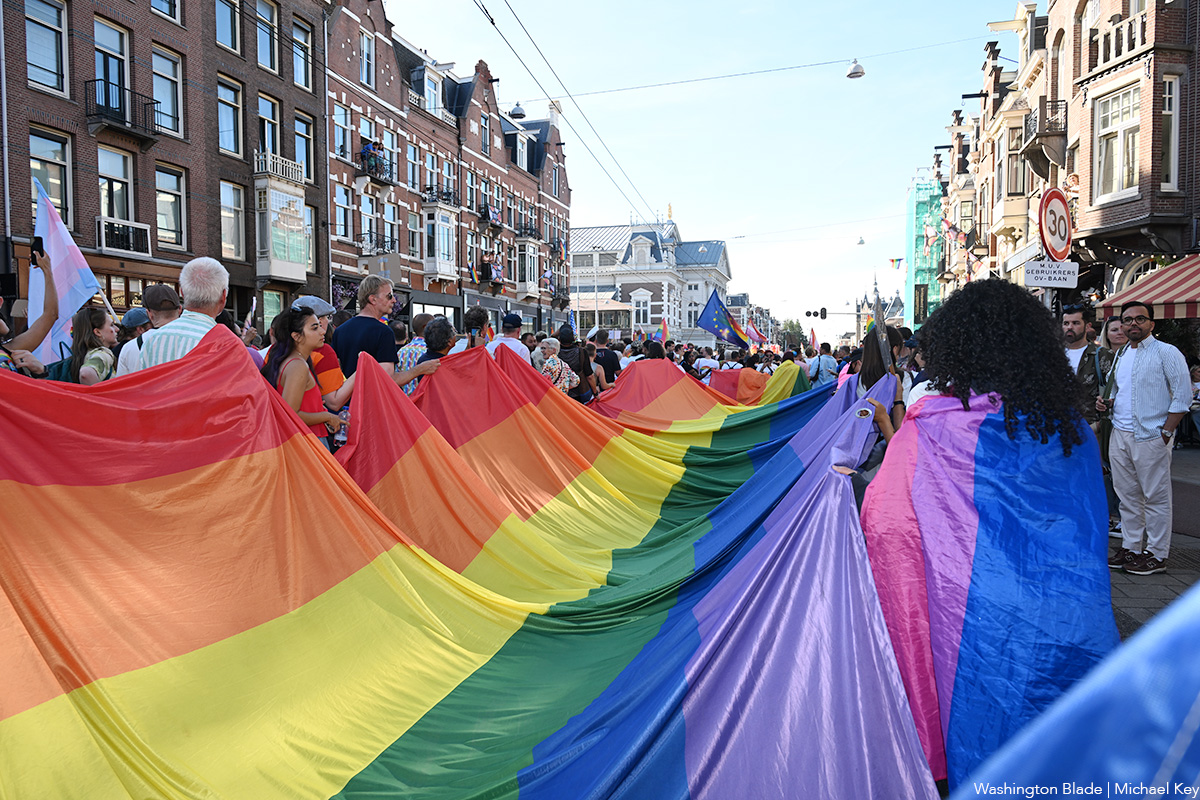
AMSTERDAM — Tens of thousands of people on Saturday participated in the World Pride March in Amsterdam.
Outright International Executive Director Maria Sjödin and Paolo Rondelli, who in 2022 became the world’s first openly gay head of state when he became Captain Regent of San Marino, are among those who participated alongside Massachusetts state Rep. Jack Lewis and Olena Shevchenko, chair of Insight, an LGBTQ+ advocacy group in Ukraine, and others.
Members of D66, the centrist Dutch political party that Prime Minister Rob Jetten heads, also marched.
Jetten in February became the Netherlands’ first openly gay prime minister. He participated in the opening of the World Pride Human Rights Conference on Aug. 5 and spoke on a panel with Rondelli, former Irish Prime Minister Leo Varadkar, and other gay and lesbian current and former heads of government.
(Washington Blade video by Michael K. Lavers)
(Washington Blade video by Michael K. Lavers)
The march took place a week after hundreds of thousands of people lined Amsterdam’s canals for the city’s annual Amsterdam Pride Canal Parade.
A terrorist attack at Berlin’s Christopher Street Day on July 25 left one person dead and more than two dozen others injured.
The incident overshadowed World Pride, which began hours earlier and ended on Saturday.
Dutch authorities increased security measures in the aftermath of the July 25 attack. No incidents were reported during World Pride.
Netherlands
Dutch PM: More needs to be done to defend trans rights
Rob Jetten on Friday was on World Pride Human Rights Conference panel
Editor’s note: International News Editor Michael K. Lavers and Photo Editor Michael Key will be on assignment in Amsterdam until Aug. 10.
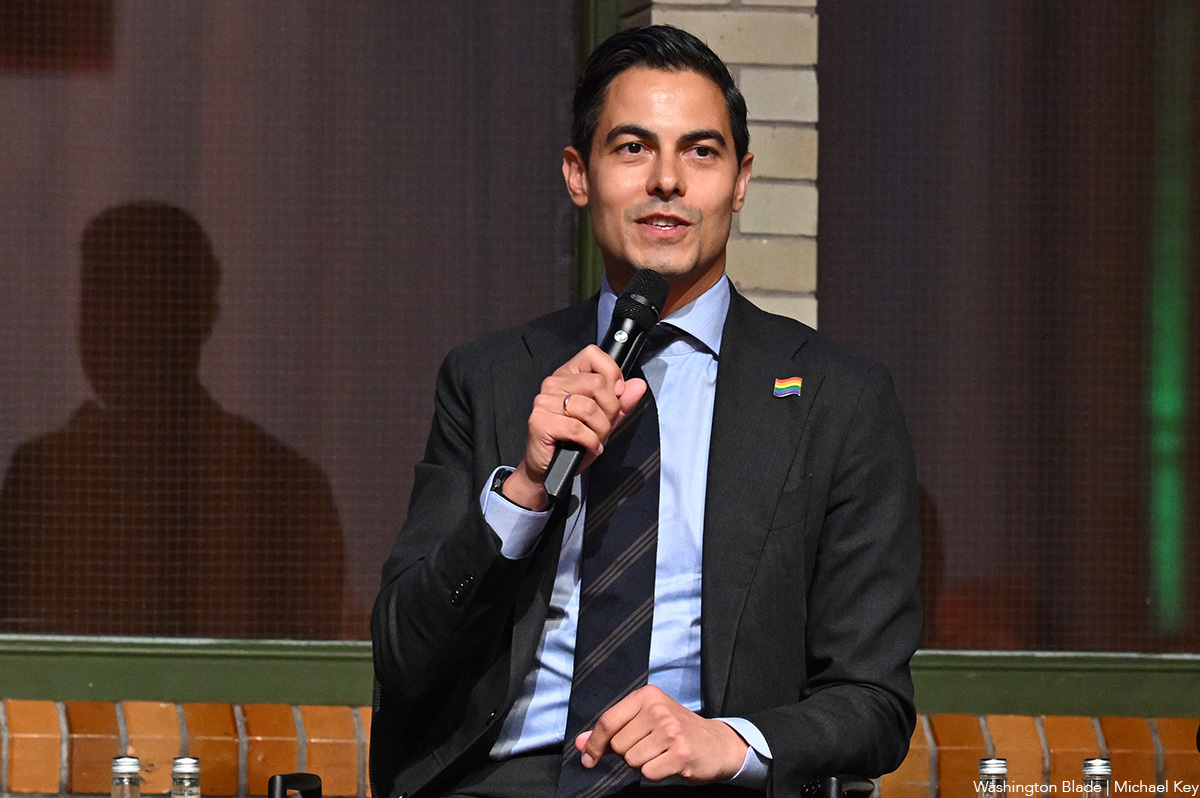
AMSTERDAM — Dutch Prime Minister Rob Jetten on Friday said more needs to be done to defend transgender people and their rights.
“Everywhere in the Western world, it’s definitely the group that’s the most vulnerable in the moment and it’s rather well-picked also by our advisories,” he said during a panel at the World Pride Human Rights Conference in Amsterdam that Ying Xin and Diego García Blum of Global LGBTQI+ Human Rights Program at the Harvard Kennedy School’s Carr-Ryan Center for Human Rights Policy moderated. “They’ve chosen the smallest group within our broader community (trans people) to attack them, to ensure that we can strip their rights and if they’ve done with that, they’ll go after the next group within our community, so we shouldn’t be naïve about what’s behind it.”
“It’s very well-funded. It’s very well-organized and we have to organize as well to fight back and to win this fight,” added Jetten. “We also need to be more open in conversations that we are having within the community and also dive into it much deeper and maybe even have more difficult and annoying conversations.”
Jetten in February became the Netherlands’ first openly gay prime minister.
He appeared on the panel alongside former Irish Prime Minister Leo Varadkar, who in 2017 became his country’s first openly gay head of government, and former San Marino Captain Regent Paolo Rondelli, who was his country’s ambassador to the U.S. from 2007-2016.
Several other current former heads of government who are gay or lesbian also participated in the panel. They include former Icelandic Prime Minister Jóhanna Sigurðardóttir, former Luxembourgish Prime Minister Xavier Bettel, and Andorran Prime Minister Xavier Espot Zamora. California Congressman Mark Takano, who chairs the Congressional Equality Caucus, and LGBTQ+ Victory Fund CEO Evan Low were among those who attended.
Jetten in his remarks said he was “very surprised” to learn that “not only in the U.S. but also in some European countries that we’ve let them decide what the gay group looked like.” The Dutch prime minister further pointed out that conservatives began “to attack the debate on toilets or starting this debate about trans people in Olympic games.”
“That is, of course, a ridiculous debate to start, but we’ve got distracted because we were so busy having this debate on Olympians, and then we actually forgot the real fight was about access to healthcare, just being yourself, being able to enlist in the army, or being able to be a young trans boy or girl in school,” said Jetten. “We got distracted by some fresh meat that was thrown into the area by some very conservative people.”
“We have to open our eyes and have very in-depth conservations within our community, and come up with a much better strategy to win this fight and to protect all our trans brothers and sisters, dolls, whatever,” he added. “Because if we don’t win this fight for trans people, we’re going to lose the bigger fight for all LGBTQ people in the world.”
Varadkar noted Ireland in 2015 passed a law that allows people to legally change their gender without surgery or other medical interventions.
He conceded there was “a liberal wind blowing across the world at the time, and it was largely uncontested.”
“It would be harder now, quite frankly, to do that legislation,” said Varadkar.

Scottish lawmakers in 2022 passed the Gender Recognition Reform Bill, which lowered the age for anyone to legally change their gender without medical intervention from 18 to 16. Then-British Prime Minister Rishi Sunak’s government later blocked the measure from taking effect.
The U.K. Supreme Court in 2025 ruled the legal definition of a woman under the country’s Equality Act is limited to “biological women.” Author J.K. Rowling is among those who praised the decision that stemmed from a case that challenged the Scottish government’s decision to include trans women in its definition of women when it sought to increase the number of women on government boards.
The Trump-Vance administration on Jan. 20, 2025, the first day it was in office, issued a sweeping executive order that, among other things, declared the federal government would only recognize two genders: male and female. The White House earlier this year in its counterterrorism strategy said it “will also prioritize the rapid identification and neutralization of violent secular political groups whose ideology is anti-American, radically pro-transgender, and anarchist.”
“We have to stay united,” said Rondelli. “The strategy was, since the beginning, was a Nazi strategy to create groups, target groups, and to create maximum distractions to avoid discussion about some sort of policies.”
“Trans people are the target at the moment,” he added. “But after them it will probably be some others, so we have to stay united.”

Boris Dittrich, the Dutch Senate’s First Vice President and a member of Jetten’s D66 party who was previously global advocacy director for Human Rights Watch’s LGBTQ Rights Program, at the end of the panel asked about protecting intersex babies from what advocates maintain are unnecessary surgeries.
Netherlands
Dutch prime minister opens World Pride Human Rights Conference
Rob Jetten is country’s first openly gay head of government
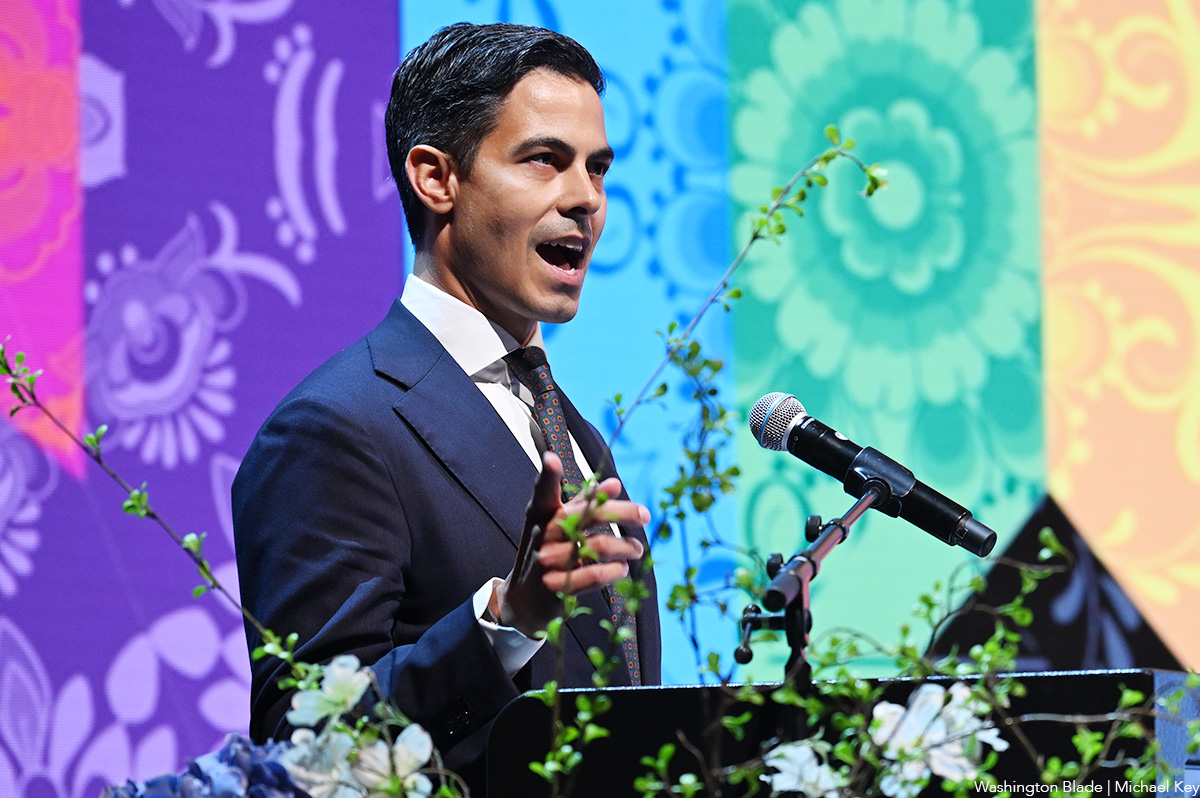
Editor’s note: International News Editor Michael K. Lavers and Photo Editor Michael Key are on assignment in Amsterdam through Aug. 10.
AMSTERDAM — Dutch Prime Minister Rob Jetten on Wednesday opened the World Pride Human Rights Conference in Amsterdam.
Jetten — who in February became the country’s first openly gay prime minister — began his remarks with an acknowledgment that the July 25 terrorist attack at Berlin’s Christopher Street Day that left one person dead and more than two dozen others injured “filled me with anger and sorrow.”
He started to speak after a group of activists began to shout at him over his government’s position on Palestine — the International Criminal Court, which is based in The Hague, has issued arrest warrants for Israeli Prime Minister Benjamin Netanyahu and Hamas leaders in connection with crimes against humanity it says they committed in the Gaza Strip and Israel after Oct. 7.
Jetten stood silently and allowed them to protest before security personnel removed them from the room.
View on Threads
Jetten in his speech acknowledged this year marks 25 years since the Netherlands became the first country to extend marriage rights to same-sex couples. He also pointed out 2025 marks Amsterdam Pride’s Canal Parade‘s 30th year.
“More and more in recent years, we’ve seen hard won progress being eroded,” conceded Jetten. “We’ve seen countries backsliding in equal rights legislation. We’ve seen homophobic hate speech becoming more overt and aggressive, and not only out in the real world, but online as well.”
Jetten pointed out “online hatred is one of the biggest threats facing the LGBTQIA+ people today.”
“All around the world … misinformation and disinformation can be spread in the blink of an eye with a single mouse click, reaching much further and much faster than NGOs, youth workers and health organizations can,” he said. “This is always how hatred takes hold. First in the shadows, outside the spotlight of society, underestimated by everyone, until, having grown into a many headed monster, it crawls out of the darkness.”
Jetten said his government this fall will launch “a social dialog on online discrimination and offering specific guidance on action to take.” This will include “training courses for municipalities and civil society organizations to help them deal with online hate speech.”
His government over the next three years will invest €7.5 million each year “in improving the safety of the queer community in our cities with an alliance of organizations committed to safety, both in the public space and in the workspace for LGBTQI+ people, and with a public information campaign to combat discrimination and disinformation.” Jetten also said the government will promote a campaign in Dutch schools that encourages students and teachers to wear purple as a way to show their support for the LGBTQ+ community.
’Equal rights are not a Western agenda’
Jetten in his speech also singled out “conservative forces” in Uganda, Senegal, and in other countries who are framing LGBTQ+ rights “developments as a neocolonial Western agenda.”
“Under the pretense of resisting so-called Western moral decadence, horrendous laws are enacted and promoted, laws that put the rights of free people under severe pressure,” he said. “But in reality, many communities in these countries have a long history of diversity and freedom, and the laws that impose the restrictions were in fact put in place by the colonial powers.”
“No matter how hard those conservative forces try to pull the wool over people’s eyes, queer communities around the world know that equal rights are not a Western agenda,” added Jetten. “They are first and foremost a human agenda.”
Amsterdam Mayor Femke Halsema and Nayyab Ali, co-chair of the Ending Violence Against Women and Girls Alliance Pakistan, are among those who also spoke on Wednesday. Lady Phyll, co-founder of UK Black Pride, and Camiel Welling, supervisor of the Amsterdam Trans Clinic, are co-hosting the conference that ends Friday.

Celebrity News
My evening with Madonna
Gay icon headlined the World Pride Music Festival in Amsterdam

Editor’s note: International News Editor Michael K. Lavers and Photo Editor Michael Key will be on assignment in the Netherlands through Aug. 10. They will be covering World Pride in Amsterdam.
AMSTERDAM — Madonna and 6,000 of her closest friends celebrated World Pride at Amsterdam’s AFAS Live concert hall early Sunday morning. I was fortunate enough to be one of them.
Madonna last Wednesday nearly broke the internet when she said on social media in Dutch that “I got somethin’ I wanna talk about,” referring to an opening line in “Danceteria,” one of the tracks on her “Confessions II” album that has received rave reviews since its July 2 release. The track has been on near constant replay on my playlist since I first heard it.
— Madonna (@Madonna) July 28, 2026
MISTR — a telehealth platform that offers free access to PrEP, Doxy PEP, STI testing, and long-term care that has organized Madonna’s Club Confessions shows in the U.S. and the U.K. — later confirmed the rampant speculation. I woke up on July 30 to an email in my inbox from MISTR and the World Pride Music Festival PR team that said I was on the press list.
Madonna was indeed going to headline the World Pride Music Festival that Jake Resnicow and Insomniac produced, and I was going to be there. OMFG!!!!
The gay icon had one more surprise in store.
The Dutch internet on Saturday once again broke over speculation that Kylie Minogue was going to appear alongside Madonna. I was getting ready to leave our hotel in Amsterdam on Saturday night when I saw a video of the two of them together.
“Madonna is now teasing Kylie Minogue on her social media … she may be one of her ‘special guests’ tonight,” I wrote in a text to Washington Blade Editor Kevin Naff at 8:46 p.m.
“Have fun! This is turning into the gayest concert ever,” he responded.
I arrived at AFAS Live shortly before 11 p.m. My press contact walked me and two other Dutch journalists into the venue’s cavernous main room known as the Black Box. We made small talk for a few minutes before I started to walk around and listen to Josh Harrison who was on the decks.
Madonna was scheduled to take the stage at 1:30 a.m., but she is known for being late — she is Madonna and she does what she wants. Hayla, a British singer, and Bebe Rexha are among those who performed ahead of Madonna. Thousands of sweaty men — including a group of Australians next to me who were eagerly awaiting Kylie’s anticipated appearance — packed the Black Box and were dancing, anticipating what was to come.

MISTR CEO Tristan Schukraft at one point came on stage and declared Madonna was indeed in the building. The moment for which we were all eagerly waiting finally came shortly before 2:30 a.m.
“Mother is here and this is gay heaven,” said Madonna when she took the stage.
Stuart Price, who produced her “Confessions on a Dance Floor” album in 2005, manned the decks during Madonna’s set.
She opened it with “I Feel So Free” from “Confessions II.” Madonna then sang “Bring Your Love” and “Danceteria” to which this reporter — and everyone else — sang along.
Madonna then teased a surprise before she began to perform “Love Sensation.” Kylie soon appeared on stage. It was nearly too much for my fellow partygoers from Australia. It was indeed the gayest concert ever!
Madonna and Kylie performed “Love Sensation” together. They then sang “Hung Up” and “Sorry” from “Confessions on a Dance Floor” to round out the set that ended shortly after 3 a.m.
Madonna and I share the same birthday — Aug. 16 — and I would like to think she and Kylie gave me an early birthday present. In all seriousness though, it was an amazing night for me and for everyone else who was fortunate enough to be there.
“On the dance floor I feel so free,” says Madonna in the opening of “I Feel So Free.”
For those few precious hours at AFAS Live I did not think about the Trump-Vance administration and the myriad ways it is destroying the U.S. I did not think about the National Guard troops deployed to D.C. I did not think about the pointless wars that continue to ravage Ukraine and other countries around the world. I simply lost myself on the dance floor and celebrated an icon who has always stood with my community.
Thank you, Madonna.
European Union
Poland’s top court rejects recognition of same-sex marriages from other EU countries
Ruling sets up potential clash with bloc

Poland’s top court this week rejected the recognition of same-sex marriages legally performed in other EU countries.
The EU Court of Justice in Luxembourg last November ruled in favor of a same-sex couple who challenged Poland’s refusal to recognize their German marriage. Poland’s Supreme Administrative Court in March reaffirmed the decision.
The couple, who lives in Poland, brought their case to Polish courts in 2019. The Supreme Administrative Court referred it to the EU Court of Justice.
The Polish government in May announced it will recognize same-sex marriages legally performed in other EU countries. Polish President Karol Nawrocki on July 17 vetoed bills that would have extended rights to same-sex couples.
The Constitutional Tribunal ruling, which it issued on July 28, was unanimous and final. It also sets up a potential clash between it and the EU Court of Justice.

Out combat vet Cait Conley fights Trump flunkie for New York’s flippable 17th Congressional District

Shooting outside gay bar in Ariz. leaves three dead

Prominent French activist attacked outside Paris bar

HRC president campaigns for Chris Pappas in NH

Fitness for beginners: The start of a new journey

Trans, nonbinary Americans find refuge in the Netherlands

‘Teenage Sex and Death’ has never been more entertaining

Here’s Your Palm Springs Weekend: Aug 28th – 20th, 2026 by LA Blade x Gay Desert Guide

Milo Yiannopoulos deported to UK

Realidad LGBTQ+ en Honduras: fuga o muerte
-
 Netherlands5 days ago
Trans, nonbinary Americans find refuge in the Netherlands
-
 Movies5 days ago
‘Teenage Sex and Death’ has never been more entertaining
-
 Palm Springs5 days ago
Here’s Your Palm Springs Weekend: Aug 28th – 20th, 2026 by LA Blade x Gay Desert Guide
-
 National4 days ago
Milo Yiannopoulos deported to UK
-
 Honduras5 days ago
Realidad LGBTQ+ en Honduras: fuga o muerte
-

 Florida5 days ago
For LGBTQ youth starting with nothing, Pride House in Florida offers help
-

 a&e features3 days ago
Are you ready for a ‘Culture Shock’ with Andy Lalwani?
-

 Features5 days ago
Building a very queer future: StartOut’s Michael Meo on LGBTQ+ entrepreneurship
-

 EMMYS3 days ago
‘Jokes with Joysauce’ brings queer AAPI comedy to the Emmys
-

 Poland2 days ago
Poland begins to legally recognize same-sex marriages from other countries