Real Estate
Could this be the new Weho? Jeff McMullen and The Rainbow Village
A Navy veteran turned real estate executive wants to transform West Hollywood with a 630-foot Rainbow Arch, thousands of homes, and what he boasts will become the world’s premier LGBTQ+ cultural destination
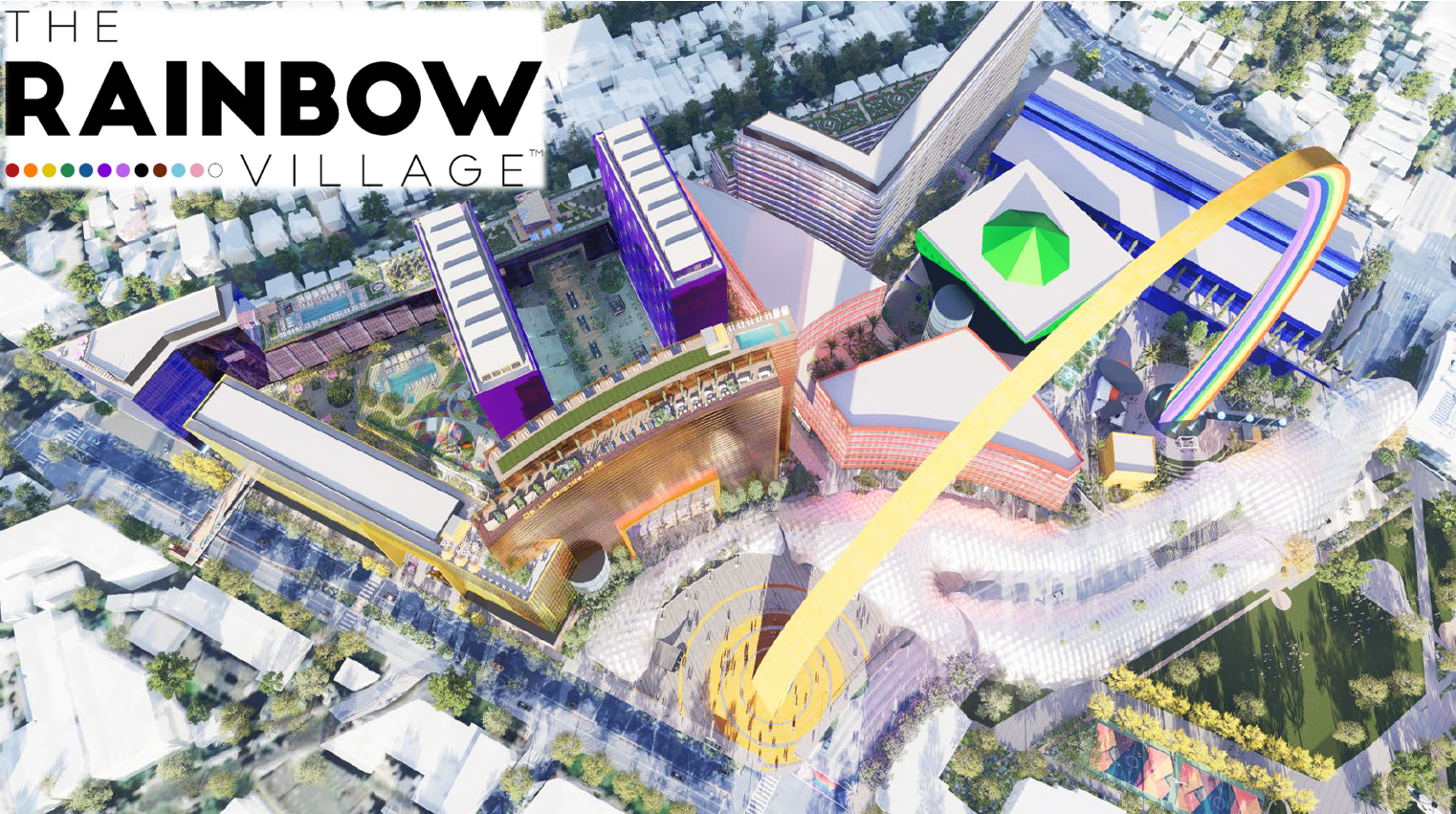
West Hollywood has never been accused of thinking small, but Jeff McMullen may have raised the bar, or perhaps… the skyline. His proposal for The Rainbow Village envisions an LGBTQ+ cultural destination strapped with housing, retail, a convention center, a museum, civic gathering spaces, and the centerpiece, a 630-foot Rainbow Arch designed to stand as a global symbol of inclusion, resilience, and queer Pride. For some folks, it’s a solid urban planning proposal. For others, it’s the kind of audacious dream that could only be imagined in WeHo.
McMullen’s journey to this moment is nearly as dynamic as the project itself. A Navy veteran, attorney, real estate executive, and proud gay man who happened to come out later in life, he speaks about The Rainbow Village with the conviction of someone who spent decades searching for a place where he truly belonged, and then decided to build one. Whether discussing civic development, LGBTQ+ history, faith, identity, or the future of queer community spaces, McMullen brings a refreshing mix of pragmatism and idealism to the table. The Blade snagged the opportunity to discuss the vision, the controversy, and why McMullen believes The Rainbow Village could become an unwavering beacon for LGBTQ+ folks worldwide.
You’re proposing a convention center, a national monument, and a complete reimagining of one of West Hollywood’s most recognizable districts. At what point did this idea turn into a plan and project?
I first conceived of what became The Rainbow Village in September 2021. At that time, I was living with my then, boyfriend in an apartment in West Hollywood. Both of us were working from home and social distancing due to the Covid-19 pandemic.
I was obsessed with The Rainbow Village. I spent every spare moment researching the site and sketching and drafting the buildings. I talked about it nonstop. Exasperated, my boyfriend finally snapped, demanding I stop talking about it and instead go out and build it. I thought to myself, “Yes, I can do that.”
Soon thereafter I used my considerable connections gained over a 20-year career in commercial real estate to recruit a very talented team of architects, developers, and investors who shared my enthusiasm for and helped shape the vision and bring The Rainbow Village to life. Among the many people who helped turn my idea of The Rainbow Village into a plan included Bryan Benso, Jeff Causey, David McCullough, Nick Sherkerjian, and my partners in Aspire – Marty Reiner and Michael Turner.
What convinced you that WeHo was ready or something this ambitious?
Interesting question. You describe The Rainbow Village as “ambitious”. Perhaps it is. I would note, however, that every component of The Rainbow Village is modeled after something that already exists. The Rainbow Arch is modeled after the Gateway Arch in St. Louis, which was built in 1968. The Rainbow Village Violet towers (the project’s multifamily housing component) are as tall as the Sierra Towers, West Hollywood’s current tallest building, built in 1965. The Rainbow Village Square (the project’s retail component) is modeled after Westfield Century City and the Grove.
Instead, you might ask, “How did I know West Hollywood was ready for The Rainbow Village?”. Charles Cohen, the owner of the Pacific Design Center (PDC), proposed developing the Los Angeles County Metropolitan Transportation Authority (LA Metro) Division 7 bus depot (Bus Depot) and adjacent Los Angeles County West Hollywood Sheriff Station (Sheriff Station) in 2013. Mr. Cohen proposed the Design Village, and Mr. Cohen and LA Metro entered into a joint development agreement for that purpose. The project was, however, ultimately defeated by the City of West Hollywood for lack of cultural relevance.
The Design Village was very informative. It demonstrated that all the stakeholders – LA Metro, LA County, LA Sheriff, Charles Cohen, even the City of West Hollywood – wanted to develop the Bus Depot and Sheriff Station. The only thing they needed was a galvanizing concept, something that would meet everyone’s requirements while speaking to the very soul of West Hollywood. Hence, The Rainbow Village.
If everything goes exactly as planned, what will someone standing in the Pacific Design Center area twenty years from now be experiencing?
Let me be clear: although my vision for The Rainbow Village imagines a fully integrated project that includes the Pacific Design Center, I do not have any control or influence over the PDC. Charles Cohen owns it.
I met with Charles Cohen in May 2022 and with Spero Plavoukos in June 2025 to present The Rainbow Village. On both occasions, however, Mr. Cohen declined to pursue the project. Accordingly, we are proceeding with a scaled-down version of The Rainbow Village that only includes the Bus Depot and Sheriff Station.
Notwithstanding, I have tremendous respect and admiration for Mr. Cohen. He has been an exceptional steward of the Pacific Design Center. In fact, under Mr. Cohen’s leadership, Cesar Pelli’s original vision for the PDC was completed with the construction of Center Red in 2012. It would be an incredible honor to work with Mr. Cohen on The Rainbow Village. Thus, it is my hope that Mr. Cohen might choose to collaborate in the future. We would welcome his participation, which would no doubt be beneficial to all concerned.
With that caveat, allow me to return to a slightly different version of your question. Twenty years from now, I hope someone standing at The Rainbow Village will experience a dynamic, universally loved, international center for LGBTQ+ culture, community, and civic life.
What’s the most controversial part of your proposal, the part that keeps community meetings interesting?
The Rainbow Arch seems to be the most controversial part of The Rainbow Village. It is intended to stand as a symbol of inclusivity, diversity, and resilience. Yes, for us in the LGBTQ+ community who adopted the six-colored rainbow flag as our banner. The Rainbow Arch includes the colors of the LGBTQ+ flag, but it also includes all seven colors of the rainbow. That was intentional. Indigo was included in the Rainbow Arch and as the color of one of the buildings to represent our heterosexual and cisgender fellows. They too are welcome at The Rainbow Village.
The height of the Rainbow Arch – 630 feet – has also raised eyebrows. It is important to understand, however, the dimensions of the Rainbow Arch. The Rainbow Arch is designed as an equilateral triangle that measures 54 feet at its base while tapering up to 17 feet at its peak. Thus, the volume of space The Rainbow Arch occupies is relatively small. Moreover, its north-south orientation means that people in the West Hollywood Hills, for example, looking down on it will only see a relatively narrow gold spire reaching into the sky. Accordingly, shadows and visual obstruction are nominal compared to, say, a 630-foot office building.
Notwithstanding, the overwhelming sentiment toward the Rainbow Arch is positive. Most people appreciate how impactful such a monument will be for West Hollywood, Los Angeles County, and the larger LGBTQ+ community.
You’ve spent a good portion of your career managing large-scale real estate portfolios and investment strategies. How does this experience prepare you to think on a civic scale?
First, let me say humbly that nothing in my professional career prepared me for The Rainbow Village. Moreover, I am not relying on my knowledge, skills, and experience alone to bring The Rainbow Village to fruition. Rather, I have sought the support of my partners and industry colleagues who have successfully executed projects of this scale.
Nevertheless, my professional experience as a real estate asset manager primarily in the multifamily industry has been very informative. What makes me exceptional as an asset manager is my ability to study a property and its context, imagine its highest and best use, create a strategy to manifest that use, and execute the strategy efficiently and effectively. I know how to create value. I simply applied those same skills when designing The Rainbow Village, only on a civic scale, as you say.
You served in the military, worked in real estate, and later came out as a gay man. In retrospect, do those experiences feel connected in ways you didn’t recognize at the time?
I grew up in rural Louisiana, where I did not feel safe being authentic. Overt and covert homophobia were as present as the humidity. I was taught that sexuality was a choice, so I chose to be straight.
I served in the United States Navy during Don’t Ask, Don’t Tell, when homosexuality was deemed conduct unbecoming and, if proven, was sufficient grounds for a dishonorable discharge. I was determined to be the best sailor I could be, and I was exceptional.
I met a wonderful woman, Carissa Phelps, while in the service, and we shared a traditional heterosexual relationship. We were in love and became engaged to marry. That commitment, however, caused me deep introspection. By that time, I had come to understand that sexuality was not a choice, and that I was gay. Moreover, while I might be able to live a lie, I could not in good conscience force my fiancée/wife to live a lie too. I broke off the engagement. After the breakup, I spent the next 18 months coming to terms with my sexuality.
In retrospect all these experiences were connected in that they lead me to self-acceptance.
You’ve spent a significant portion of your life influenced by the expectations of others. What was the most difficult part about eventually deciding to live life as your authentic self?
I was influenced by the expectations of others, but perhaps not as you might think. My father, Lawrence McMullen, was a patriotic American who volunteered for the United States Army during the height of the Vietnam War. He served honorably and returned home in one piece, or so it appeared. He suffered, however, severe post-traumatic stress disorder (PTSD) during a time when little was known about the condition and there was no treatment for it. My father used alcohol to medicate and developed debilitating alcoholism, another disease that was not well understood at the time. Thus, in the small town I grew up in, my father was generally thought of as a drunk. Moreover, it was expected I would grow up to be just like him. From an early age, therefore, I vowed I would not be like my father.
With respect to my sexuality, the most difficult part to living as my authentic self was reconciling my sexuality with what I learned in the Catholic Church. I am a spiritual person and was a Roman Catholic. The Catholic Church taught me then and continues to teach today that God hates homosexuality, and all homosexuals are condemned to hell. Thus, before I came out to anyone else, I came out to God first. Not until I felt loved and accepted by God could I live openly. After that I did not have trouble telling anyone else I was gay. I am grateful to Joel Osteen for helping me reconcile my relationship with God. Moreover, it is time the Catholic Church and all other religions acknowledge that there is nothing immoral or sinful about two consenting adults of any sexual orientation loving each other. Love is Godly. It is the hate they teach that is the sin.
Coming out later in life can often necessitate redirecting your story. What surprised you most about the person you became after having done so?
What surprised me most about the person I became after coming out was what I hope every LGBTQ+ person experiences. That is, I learned to love myself and be fearless about who I am no matter what others might think or say. Prior to coming out, I created a persona that was not me, and I hid behind that façade. Now, I stand proud in my authenticity and vulnerability. What I thought was my greatest weakness had become my greatest strength.
Now, I hope to contribute something meaningful to the LGBTQ+ liberation movement, a place of permanence of, for, and by LGBTQ+ people.
How has being a member of our LGBTQ+ community influenced the way you think about public spaces and civic identity?
I moved to West Hollywood at 40 years old. Not until then did I learn what it felt like to live in a community that saw me, understood me, and accepted me completely. It was the first time I experienced belonging. As you might imagine, it was a watershed moment.
Finally in a safe space, I reflected on the years I spent in the dark, searching for something I could not name. Searching for a home I could call my own. Looking back, I imagined how different my experience might have been had I known West Hollywood existed and that it was a place where I could find community. There would have been a light at the end of the tunnel, and I no doubt would have come here sooner. I mourned the fear, isolation, and years lost living an inauthentic life.
That reflection inspired The Rainbow Village. I wanted to create a beacon of hope that would broadcast West Hollywood’s values. A beacon whose light would be cast far and wide, and shine so brightly that even a scared, lonely little boy living in rural Louisiana would see its light and find hope in it. West Hollywood is the only place where a project like The Rainbow Village could exist and, once built can never be erased.
What do you think people outside the WeHo community misunderstand most about it?
I understand some of the grievances some outsides have with West Hollywood. West Hollywood is very expensive, especially its housing. The exorbitant cost of housing, moreover, diminishes discretionary incomes that might otherwise be spent in our cafes, restaurants, nightclubs, hotels, and local shops. Thus, excessive housing costs are a drag on our entire economy.
The evidence of this is apparent along Sunset and Santa Monica Boulevards. Our once-thriving corridors are blighted with vacant storefronts. Moreover, the high cost of housing is forcing out LGBTQ+ people, gentrifying West Hollywood, and threatening what makes West Hollywood special in the first place.
The Rainbow Village seeks to ease the housing crisis in West Hollywood by providing up to 2,300 housing units on the site in three separate structures. The Rainbow Village Violet East is a multifamily project that will offer up to 1,400 multifamily homes, with 460 homes (33%) set aside for low-income households and seniors. The Rainbow Village Violet West is a multifamily project that will offer up to 300 multifamily homes. The Rainbow Village Indigo is a condominium project that will offer up to 600 condominium homes.
You’re proposing a national monument as part of this project. What story deserves to be memorialized in our collective public memory?
The LGBTQ+ civil rights movement derives from America’s founding principles, i.e., freedom and equality for all, which are enshrined in its founding documents: the Declaration of Independence, the Constitution, and the Bill of Rights. At the time of their drafting, freedom and equality were the exclusive privileges bestowed upon wealthy, white men. Notwithstanding, the Declaration denied the realities of its day and established an aspirational goal to which America has been in pursuit ever since: true and lasting equality. Ours has been an arduous and too often a shameful journey filled with side steps and setbacks. Nevertheless, we can be proud of how far we have come while at the same time acknowledging that we still have far to go.
The Rainbow Arch and Visitor Center honors America’s founding creed and its drive to achieve it. It will memorialize the struggles and achievements of America’s diverse peoples as they hold America accountable for its promise. It will memorialize those brave Americans who have carried the torch of freedom and the moments that brought us closer ever still to a more perfect union. The Rainbow Arch will honor the American people.
The Rainbow Village’s LGBTQ+ Museum and Cultural Center will highlight the LGBTQ+ experience throughout time from antiquity to the modern age and across cultures, countries, and continents. It will highlight the places where homosexuality is still criminalized and the laws that continue to discriminate against the LGBTQ+ community. And of course, it will highlight LGBTQ+ joy, expression, and the considerable contributions LGBTQ+ people have contributed to humanity of which there are many. The LGBTQ+ Museum and Cultural Center will be a place where our proud history is honored, preserved, and lives on for perpetuity.
What’s a risk you’ve taken in life that prepared you for taking this on?
I have taken many risks in my life. I left my small hometown of Grand Isle, LA, to live in none other than Los Angeles, CA. I served honorably in the United States Navy. I was the first in my family to graduate college. I was the first to graduate law school. Instead of pursuing a legal career, I pursued a career in the multifamily industry where I could make the largest impact possible. I chose to live authentically despite the discrimination and prejudice I would no doubt face. Notwithstanding, The Rainbow Village is the biggest risk I have taken by far. Am I prepared for this risk? That remains to be seen. Ask me again at the ribbon-cutting ceremony.
When people talk about this project down the line, what do you hope they’re really talking about? What’s the message you’d like to leave for them?
The Rainbow Village is about permanence for the LGBTQ+ community. A place of our own where we can never be erased. My wish for it is to become a place whose very existence gives encouragement and hope to all LGBTQ+ people.

Real Estate
Real Estate, real talk, and real WeHo: Marco Colantonio on community, visibility, and reinvention
After stepping away from his life in hospitality to care for his father, Marco Colantonio arrived in West Hollywood, came out and began building a platform that would change the city’s conversation

Some people move to West Hollywood and find themselves. Others, like Marco Colantonio, seem to arrive already equipped with their own blueprint for the place and promptly get to work. From founding the hyperlocal media outlet, Weho Times, that would rather proudly snatch the mic than whisper in the margins to building a real estate career grounded in something far more human than square footage and cookie-scented open houses, Colantonio has always worked with intention and heart. And he does this all with a fresh-pressed suit and smile from sea to shining sea.
In our conversation, Colantonio traces a path that’s anything but ordinary. From hospitality entrepreneur to caregiver, from being outed in a cheeky headline to becoming a voice for others who deserved to be heard on their own terms. Along the way, WeHo transforms from backdrop to wingman, a place where personal truth, storytelling, and a well-timed leap of faith all meet up for vodka sodas at Micky’s happy hour. The result is a perspective shaped not just by his accomplishments and accolades but by who he has chosen to be, and the communities he’s helped make just that much more seen and a lot more livable. The house is open.
What first drew you to West Hollywood, and more importantly, what kept you there?
My journey to West Hollywood wasn’t linear—it was deeply personal. I was working in hospitality on the East Coast and eventually developed a small global restaurant company, with Denver becoming our home base. Around that time, my father moved there, and shortly after, he was diagnosed with terminal cancer. I stepped away from a high-profile career to care for him.
When my father passed, something shifted in me. I was tired of looking in the mirror every morning and pretending to be someone I wasn’t, instead of embracing my true self. That was the moment I came out—fully and honestly—and it changed the course of my life. Around that same time, I was “outed” in The Denver Post—and I say that a bit tongue-in-cheek. I was already a recognizable figure in the community, and a friend of mine happened to be the gossip columnist. The headline read something like, “Well-known restaurateur and man about town comes out of the pantry.” It was very Denver… and very of its time. But storytelling and community had always been part of who I am. I even started a gay nightlife blog with a friend called GAY5280.com—which was a lot of fun, though definitely not paying the bills.
After that chapter, I made the decision to move to West Hollywood and start over—completely. I was 40 years old, and WeHo gave me something I didn’t fully realize I was searching for: a place where I could be fully seen, supported, and safe. It was a dream—a queer, tolerant, vibrant community where you could truly begin again.
What kept me there was something even more profound. Early in my real estate career, I was managing a building on Harper Avenue when a young lesbian couple applied for an apartment. They didn’t meet the landlord’s financial criteria—on paper, they didn’t qualify. But they were both working two jobs, determined, and I asked them why this apartment—why West Hollywood?
Their answer has stayed with me forever. They said, “We just want to live in a neighborhood where we can walk down the street holding hands and feel safe—without being judged or harassed.”
I advocated for them, and the landlord approved their application. They became incredible tenants—but more importantly, that moment defined my purpose. That’s what West Hollywood meant to me—and still does.A place where anyone—any two people—can walk down the street holding hands and feel safe. That’s not just a neighborhood. That’s a promise.
And it’s one I’ve carried with me ever since—so I guess, in a way, I did get the key to the city.
Take us back to the early days of WeHo Times… What was the original vision behind it, and what space were you trying to fill in the community with its creation?
West Hollywood embraced me in a way that was transformative. I became close with a Human Services Commissioner—my dear friend, Steven Davis—who encouraged me to apply for a Board for Commission seat. I was ultimately appointed, unanimously, to the Disabilities Advisory Board by the City Council. Sitting across from each councilmember during that process, I was struck by their passion and commitment. It inspired me.
At the same time, I formed friendships with some of the most respected voices in LGBTQ journalism—Paulo Murillo, Karen Ocamb, Tom Senzee, Dana Miller, and James Mills. Their passion for truth, accountability, and community storytelling left a lasting impression on me.
When WeHo News disappeared and WeHoVille emerged as a dominant platform, I became a contributor—but I often felt there wasn’t room for diverse perspectives. West Hollywood may be small in footprint, but it has a global impact. I believed it was too important to have a single voice shaping the narrative.
So late in 2016, I launched WeHo Times. It started light—community features, nightlife, culture—but very early on, everything changed. We broke what became one of the most significant stories in the city’s history: “Sex, Politics, Meth and Death in West Hollywood.” It was the story of Gemmel Moore, who died of a methamphetamine overdose in the home of a powerful political donor.
That story changed my life. It gave a voice to someone who no longer had one and helped spark an investigation that ultimately led to justice. When Ed Buck was finally convicted, Gemmel’s mother, LaTisha Nixon, reached out to me with a message I will never forget—thanking me for listening, for believing her, and for having the courage to publish when others would not.
That remains the single most meaningful accomplishment of my life.
WeHo Times became more than a publication—it became a platform for accountability, truth, and community voice. From there, I was fortunate to see the publication evolve in extraordinary ways. I credit Paulo Murillo, who took over the fledgling platform as Editor-in-Chief and Publisher. With his talent as both a writer and photojournalist, along with his unwavering passion and commitment, he transformed WeHo Times into the #1 online source for news, culture, and entertainment in West Hollywood. I’m grateful to continue contributing today through my real estate column and to remain part of a platform that continues to inform, engage, and serve the community.
How would you describe the energy of West Hollywood during that era in contrast to today? What role did community-driven journalism play in sculpting queer identity and visibility in WeHo during this?
That era was electric! West Hollywood was nearing the end of its 20s as a city and about to enter its third decade, and many of the pioneers who fought for cityhood were still deeply engaged. Activism wasn’t just present—it was amplified. People believed their voices mattered, and they acted on it. You saw it in everything—from John D’Amico’s rise to City Council, to grassroots movements like Save Tara, to Stephanie Harker’s fight to preserve Plummer Park. These weren’t symbolic efforts—they created real change.
Community-driven journalism played a critical role in that environment. It informed, challenged, and amplified voices that might otherwise have been overlooked. It helped shape identity, visibility, and civic engagement within the LGBTQ community. There was a sense that every issue mattered—and that you could make a difference. And people did.
Do you feel some things have been lost while others have been gained regarding how LGBTQ+ narratives are shared? Then vs now?
Be careful what you wish for. We’ve gained visibility, representation, and broader acceptance—and that’s something to be grateful for. But there has also been a shift. The urban village feeling that once defined West Hollywood has, in many ways, disappeared as the city has evolved.
That said, I remain hopeful. West Hollywood is still a beacon for the LGBTQ community—especially for younger generations discovering their voice. My hope is that new voices continue to emerge, stay engaged, stay loud, and remain connected to the core values that built this city: tolerance, acceptance, hope, and community.
Growth is inevitable—but engagement is a choice. And I believe the future depends on a community that continues to care, participate, and hold leadership accountable. West Hollywood should never simply blend into Los Angeles—it should always stand apart.
WeHo has long been seen as the queer cultural hub of the West Coast. When did you first start taking notice of a shift toward Palm Springs?
I’ve been coming out to Palm Springs for about 20 years, but around seven years ago—just before the pandemic—I started to notice a real renaissance. The city was getting its swagger back. The energy was shifting. The crowd was getting younger, the social scene more dynamic, and there was a renewed focus on hospitality and experience.
Then the pandemic accelerated everything. Angelenos and WeHo residents needed an escape—a place that felt open, sun-filled, and livable just a couple of hours away. Palm Springs offered that in a way no other place could. And it hasn’t slowed down since.
To me, Palm Springs is the gayest city there is. It’s evolved into something incredibly special—a sister city to West Hollywood, but with its own rhythm, its own identity, and a lifestyle that feels both elevated and effortless.
You’ve described Palm Springs as something of a “next chapter.” In your opinion, what about this gay oasis is so appealing to the queer community today?
Everything! Palm Springs is truly a happy place. Years ago, someone said something to me at a bar on Arenas that always stayed with me: “If you ever move here, leave the baggage behind—no one wants to hear it.” And there’s truth in that. There’s a lightness here—a reset.
The city celebrates community in a very intentional way. The Pride flag flies high year-round. Modernism Week feels like a season that never ends. There are still clothing-optional resorts, a sense of freedom, and a culture that embraces individuality. Palm Springs doesn’t just welcome you—it lets you be.
Do you think Palm Springs has become LA 2.0 or is it something entirely independent in character and vibe?
Palm Springs is its own world—completely independent in character and spirit. West Hollywood is dense, urban, and immediate. Palm Springs is space, light, and ease. It’s not LA 2.0—it’s something entirely its own. And that’s exactly why people are drawn to it.
How has your background in media influenced the way you approach real estate today?
Journalism taught me that knowledge is power—and more importantly, that integrity matters.
At the end of the day, this isn’t just about transactions—it’s about impact. It’s an honor and a privilege to help people navigate one of the most meaningful decisions of their lives and guide them toward their next chapter.
What are queer buyers today looking for that might differ from previous generations?
Marriage equality changed everything. Before that, queer buyers had to navigate very real concerns around legal protections, ownership rights, and recognition—especially when purchasing property as a couple. Those uncertainties absolutely influenced how, and even if, people chose to buy. Today, that’s no longer the barrier it once was.
What I see now is a shift in mindset. Queer buyers are approaching homeownership with a level of confidence and long-term vision that simply wasn’t as accessible before. They’re building wealth, putting down roots, and making decisions as couples and families with the same sense of security as anyone else.
In a place like Palm Springs, that also translates into lifestyle. Buyers aren’t just looking for a place where they feel safe—they’re looking for a home that reflects who they are, how they live, and the community they want to be part of. It’s no longer just about protection—it’s about possibility.
You’ve witnessed both the nightlife-driven era of WeHo and the more lifestyle-oriented culture of Palm Springs. Do these two worlds intersect?
Absolutely. In many ways, they’re part of the same journey. West Hollywood has always been electric—it’s vibrant, alive, and full of energy. Palm Springs is a different kind of magic—more grounded, more effortless, but no less vibrant.
It really is a tale of two queer cities. One celebrates where you are. The other embraces where you’re going.
And understanding that journey is what allows me to guide my clients—not just to a home, but to the life they’re stepping into next.
For more info, head to MarcoHomes.com
Real Estate
Spring into your power
What every LGBTQ+ Angeleno should know about the 2026 real estate market

Let’s start with a number that should light a fire under all of us: LGBTQ+ Americans own homes at a rate of 51% — compared to 71% for their straight, cisgender counterparts. That 20-point gap isn’t just a statistic. It represents generational wealth not yet built, neighborhoods not yet claimed, and futures not yet rooted.
Spring 2026 is a moment to change that.
The Spring Market — and Why It Matters
Historically, spring is the most active real estate season of the year. Inventory rises. Buyers re-engage. Energy returns to the market. And Los Angeles, as always, operates with its own intensity.
Yes, the backdrop is complicated. Rising interest rates, an unsettled political climate, a war abroad, and oil prices rattling economic confidence —the news is loud! A lot of people are sitting on their hands, waiting for clarity that may not come on any predictable schedule.
And yet: the Los Angeles market is still moving. As of spring 2026, the LA median home price sits at $1.1 million, up 7.1% year over year, and well-priced homes are still attracting serious buyers. If that number feels out of reach — it’s the median, not the entry point. Condos, townhomes, and emerging neighborhoods offer real footholds into ownership well below that figure, and with the right programs and team behind you, the door is more open than the headline suggests. Los Angeles is one of the most insulated real estate markets in the country. The concentration of wealth, industry, and sustained demand here creates a floor that most markets simply don’t have. We’ve weathered recessions, corrections, and uncertainty before — and the market has always found its footing.
Stop Trying to Time the Market
Warren Buffett famously said: “Be fearful when others are greedy, and greedy when others are fearful.” Right now, a lot of people are fearful. Which means, for the prepared buyer, this moment deserves serious attention.
Here’s the advice I give every client, regardless of orientation, identity, income, or background: the best time to buy is when you are ready. Not when rates drop. Not when the headlines soften.
Ready means three things:
- You have your reserves — down payment, cash to close, and a cushion beyond that
- The monthly payment genuinely works for your life — not just technically on paper, but sustainably
- You’re planning to stay 3–5 years or longer — because time in the market is what builds wealth
If all three are true? You’re ready. The season is secondary. The moment is now.
For Sellers: Your Equity Is Speaking — Are You Listening?
For LGBTQ+ homeowners in LA, this market may be quietly telling you something important. The equity you’ve built could be the key to your next chapter — trading up to a larger home, relocating to a neighborhood that better reflects who you are, or leveraging that equity to purchase a second property and step into being a landlord.
That last option deserves a real conversation: being a landlord in Los Angeles is not simple. Rent control, tenant protections, and local regulations mean the numbers need to work before you commit. A good real estate advisor will walk you through the full picture honestly — the upside and the fine print.
For Buyers: You Have More Help Than You Know
First-time buyer? The path to homeownership in LA is more accessible than most people realize — it just requires the right team and the right information.
A combination of programs through NHS, Greenline, and City National Bank can stack to $85,000 in grants toward your down payment and closing costs. Many buyers never learn that these programs exist simply because no one told them.
Beyond that: buying a home is a team sport. Your real estate advisor, lender, title officer, escrow officer, and home inspector all matter. Every member plays a role in getting you across the finish line. The right agent doesn’t just find you a home — they build and quarterback that team for you, from first conversation to keys in hand.
Homeownership in Los Angeles is not impossible. It takes planning and a strategy built around where you are today. But that path exists — and it can be built for you, specifically.
See You at WeHo Pride
We’ll be at WeHo Pride this year — come find us. We’ll have a full homebuying guide, on-the-spot consultations, and zero judgment. Just real talk about what’s possible for you in this market.
This community has always known how to claim space, make noise, and show up unapologetically. It’s time to put your name on a deed.
Your most powerful act of Pride? Owning the place you call home.
By Jed Inductivo | Real Estate Advisor, Compass | JED.i Los Angeles
Real Estate
California landlords raise rents starting today by as much as 10 percent
AB-1482 rent control law caps the maximum allowable annual rent increase. However in some jurisdictions like Los Angeles rent hikes are frozen
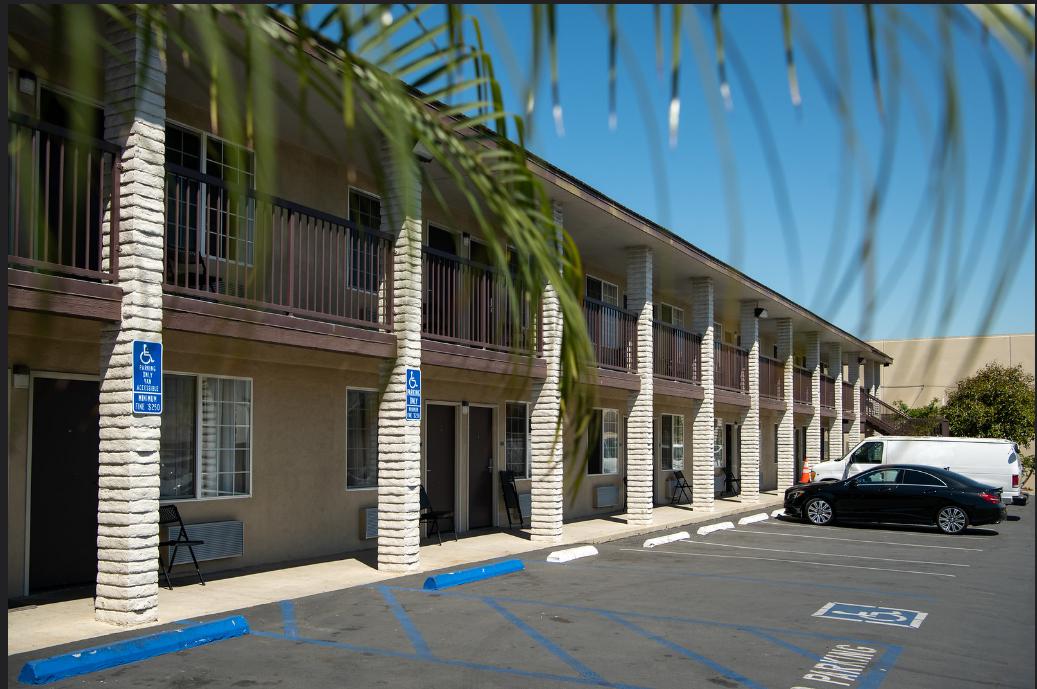
LONG BEACH – Today is the day across the state of California that landlords are able to increase rental rates by as much as ten percent. However in some jurisdictions like the City of Los Angeles rental hikes are frozen.
While the Ten percent rent increase is the maximum allowable annual increase for apartment complexes built before 2007 but there are several stipulations that could keep landlords from increasing rent by that much, if at all. For instance, the 10% increase only applies to units that are not subject to local rent control rules.
In Los Angeles, apartments built before October of 1978, which represent the majority of the city’s rental units, fall under rent control rules which allow for much smaller increases, according to the Los Angeles Times.
And at least for now, due to coronavirus pandemic regulations, those landlords can’t increase rent at all.
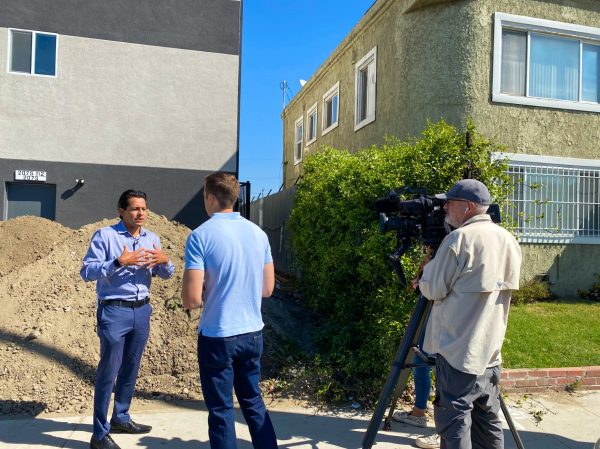
Juan Huizar, a Long Beach real estate broker and the President of the Sage Real Estate company told the Blade Monday that his firm receives a considerable number of inquiries from current renters, prospective tenants, and even landlords regarding the annual increase and the accompanying regulatory oversight.
For the second year in a row Huizar’s company website has published a guide to answering questions about rent increases especially in today’s inflationary economy:
According to the Tenant Protection Act of 2019, also known as AB 1482, landlords are allowed annual rent increases of 5% plus the percentage change in the cost of living (Consumer Price Index) per year, up to 10%.
Technically, there is no minimum amount landlords can raise the rent. Landlords are not legally required to raise the rent every year so a landlord in California may raise the rent by 0% or as low as 0.1%.
However, there are exemptions to this rent control law. Certain properties are exempt from AB 1482, and landlords have the right to raise the rent however much they please.
Which properties are exempt from rent control?
These properties are exempt from the Tenant Protection Act of 2019:
- Single-family homes and condominiums as long as they are NOT owned by a corporation, a REIT (real estate investment trust), or an LLC where one member is a corporation.
- Any duplex where the owner lives in the other unit
- Mobile homes
- School and college dormitories
- Hotels
- Commercial properties (retail stores, restaurants, etc.)
- Buildings built within the last 15 years (including accessory dwelling units)
- Rental properties provided by non-profit organizations
- Rental properties subject to pre-existing local ordinances
If a rental property falls under any of these situations, the landlord must provide a notice of exemption from AB 1482 to their tenants. Landlords with properties that are not subject to rent control laws can increase their rents as much as necessary.
However, we still urge both landlords and tenants to double-check with their local city laws as some cities, which have had rent control laws in place before AB 1482, have special restrictions.
What is the maximum a landlord in California can raise the rent?
The answer to this question is sort of complicated because it depends on the city and county you’re located in. As stated in AB1482, every rental property in California (that is not exempt from rent control) can have an annual rent increase of 5% plus the percentage change in the cost of living (Consumer Price Index) per year.
The CPI is a measure, published by the US Bureau of Labor Statistics, of the average change over time in the prices paid by urban consumers for a market basket of consumer goods and services, which is basically a measure of inflation in the economy.
The lawmakers of AB 1482 decided that the CPI percentage change should be based from April 1st of the prior year to April 1st of the current year for the region where the property is located.
What this means is that:
- there are different CPI indexes available for different cities and regions in the United States,
- and in order to calculate the maximum amount landlords can increase rent in your area (5% plus CPI),
- you must use the April CPI for your metropolitan region in California.
If you want to learn how to calculate your region’s CPI, you can read our detailed step-by-step guide here.
According to the Bureau of Labor Statistics in 2022, the nationwide CPI went up to 8.5% in March and 8.3% in April. Here are the CPI numbers for California and its four major areas:
- For the Los Angeles-Long Beach-Anaheim Area, the April 2022 CPI is 7.9%. This area includes Los Angeles County and Orange County.
- For the San Francisco-Oakland-Hayward Area, the 2022 CPI is 5.0%. This area includes Alameda County, Contra Costa County, Marin County, San Francisco County, and San Mateo County.
- For the Riverside-San Bernardino-Ontario Area, the CPI rose to 10% in March 2022. This area includes Riverside County and San Bernardino County.
- For the San Diego-Carlsbad Area, the CPI rose to 7.9% in March 2022. This area includes all of San Diego County.
- For any county or city that isn’t included in the four main areas, you’ll need to use the California State CPI which rose up to 7.4% in 2022 according to the California Department of Industrial Relations.
When you add your region’s CPI to the minimum allowable rent increase of 5% using 2022 CPI numbers, you may end up with a two-digit number. For example, if you live in Long Beach, which is Los Angeles County, you may have a number of 12.9%. However, that is not the maximum a landlord can raise the rent in Long Beach.
That’s because California’s AB-1482 rent control law caps the maximum allowable annual rent increase to only 10%. So in most cities and situations, California landlords who are not exempt from rent control can only raise the rent by a minimum of 5% and a maximum of 10% starting August 1, 2022 until July 31, 2023.
Before August 1, 2022, landlords must use the rental increase limits using the CPI numbers from April 2021, which we’ve provided in the image below.
Please also be aware that there may be rent freezes due to COVID-19 in your city. For example, there is currently a rent freeze in effect for the city of Los Angeles (not Los Angeles County) until May 2023.
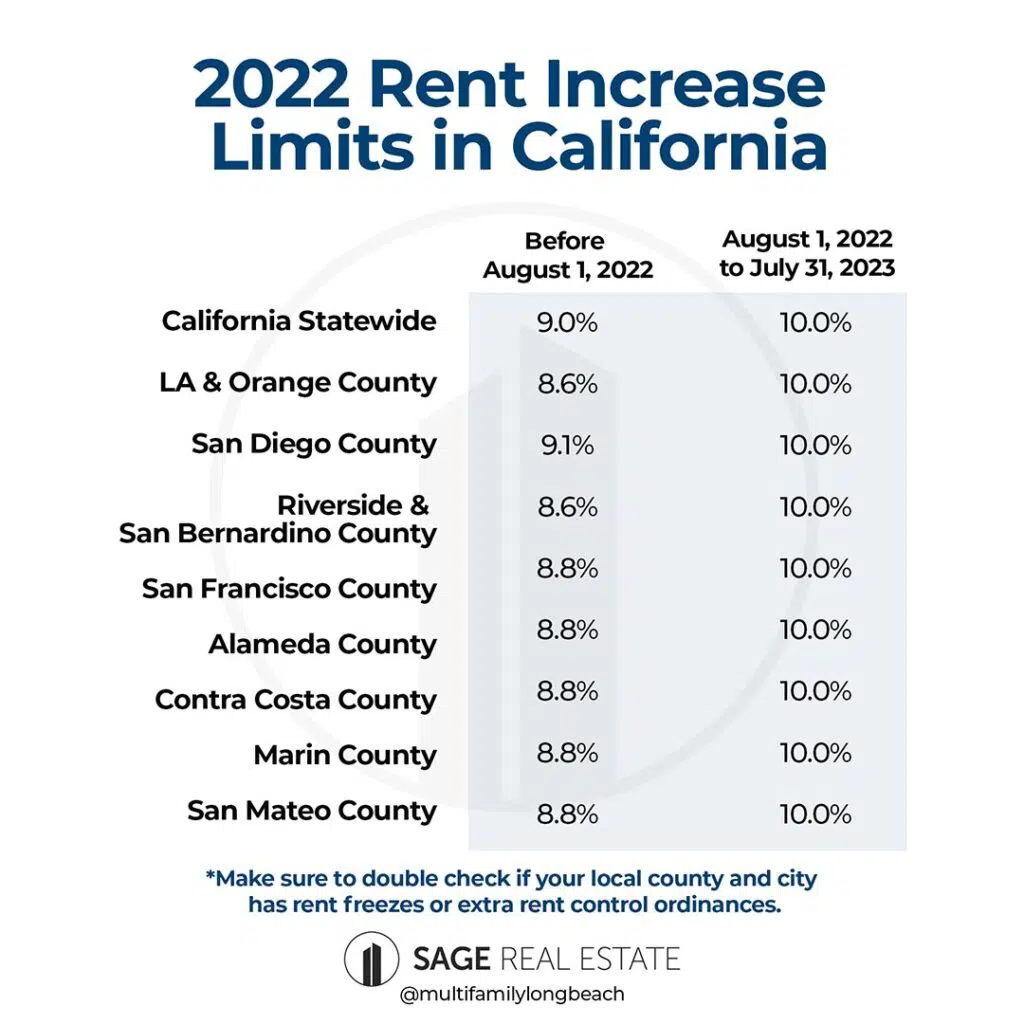
Important Note: This calculation of (5% + April CPI) applies to most situations. However certain cities in California, which have had rent control in place before 2020, may have slightly different rent control laws. So we’re also going to show you a step-by-step process on how to figure out the rent control laws in your city or county.
How to Figure Out the Specific Rent Control Laws in Your City or County
The statewide rent control law AB-1482 is really the least strict law that covers the entire state and is the minimum standard. However, many cities and counties within California have already had long-existing rent control ordinances that may be stricter than the state rent control law. There are also many California cities and counties that have decided that the state law isn’t strict enough. Therefore your city or county may be one of these areas in California with stricter rent control ordinances that overpower the state’s own rent control law.
Because of this, it is very important for you to know the specific rent control laws in your city or county. Whether you’re a landlord or tenant, knowing the specific rent control laws will help you learn whether they apply to you or not, and can help you avoid legal troubles.
Here’s the 5-Step-Process:
- Check to see if your county or city has an active rent freeze due to COVID-19.
- Check whether your county or city has extra rent control ordinances. Here’s a helpful article that covers all California cities with extra ordinances.
- Read the ordinance summary carefully so you’re aware of the legalities.
- Determine the CPI for your region. Read this article on how to find the CPI for your area.
- Contact your city or county’s housing department to confirm your information. This chart contains contact information that you’ll need.
What other resources could I use to determine how much landlords can legally raise the rent in California?
The next best resource for tenants or landlords curious about rent increase limits would be local apartment associations. Below is a list of some major apartment associations in California that you can reach out to:
- Apartment Association of Greater Los Angeles
- Apartment Association of Orange County
- California Southern Cities Apartment Association
- NorCal Rental Property Association
- East Bay Rental Housing Association
- San Diego County Apartment Association
- California Apartment Association
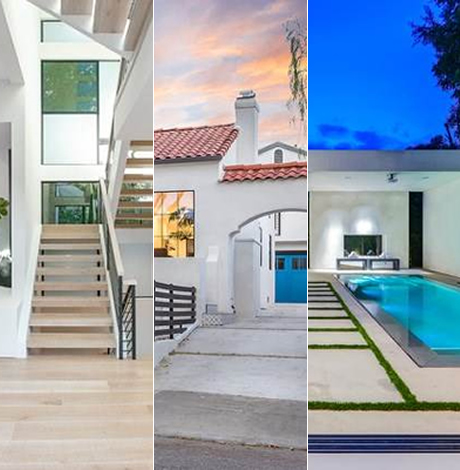
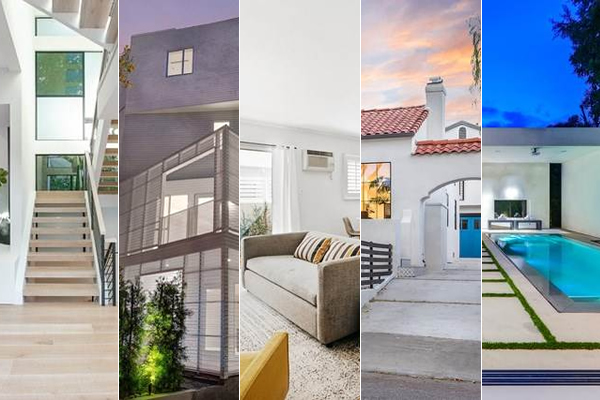
The local real estate market is booming.
According to Zillow, there are more than 400 homes for sale in West Hollywood zip codes and if you add the Los Angeles Hills (we didn’t) there are dozens more. It’s enough to make your head spin, the array of choices. If that’s what you want to call it.
Spoiler alert: You better be rich. But that’s alright. Every now and then someone hits the scratcher million status in WeHo and it’s a shopping they go. Or a rich celeb decides to quit New York and give LA a whirl. Whatever, WeHo is a luxury market.
And just like New York, the LGBT hoods are being scooped up and their characters are changing.
Here are five of our favorite local listings.
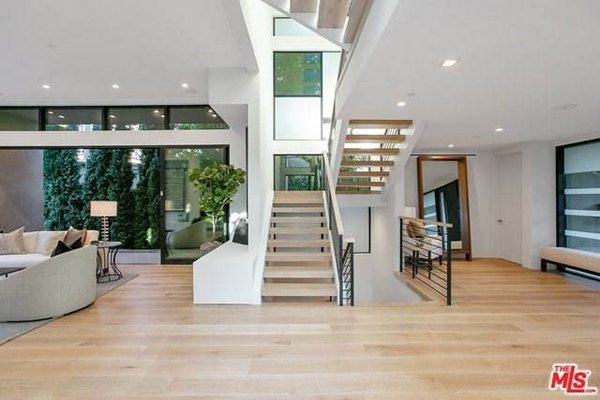
9021 Rangely, West Hollywood, CA 90048
Beds 4 | 5 Full and 1 half Baths | .11 Acres | House | Built in 2019
Asking 5,250,000
Rep: Compass Realty | Jennifer Okhovat | Cell: 310.435.7399
Raising the bar for ultimate luxury, this brand new three-level modern home is the first of its kind to go on the market in this exclusive area of West Hollywood. This premier residence features soaring-high ceilings, exquisite finishes, & stunning outdoor pool. The main level offers a grand entryway to several dining and entertaining areas, which are surrounded by Fleetwood sliding doors to create seamless transitions to an indoor/outdoor lifestyle. Kitchen is furnished w/high quality appliances manufactured by Wolf, SubZero, and Miele, & custom cabinetry curated by IKD. 3 large bedrooms including an impressive master suite w/private balcony are all located upstairs; each room has been designed w/comfort + functionality in mind. A finished basement offers a large entertaining area, wet bar, add’l bedroom, bonus room+two more baths. Do not miss this once in a lifetime opportunity to purchase a showcase home that has been created with the most discerning buyer in mind.
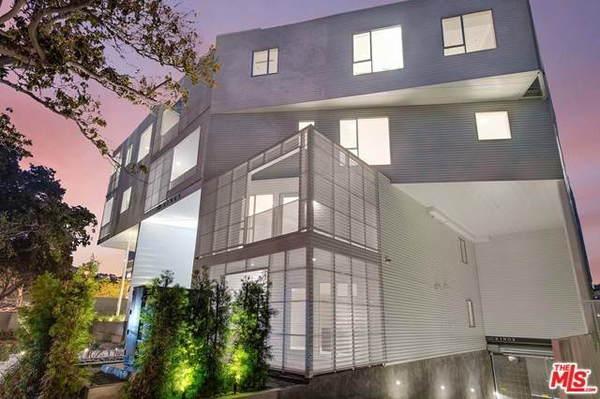 1030 N Kings Road #202, West Hollywood, CA 90069
Beds 2 | 2 Full Baths | 1056 Sq. Ft. | Condo | Built in 2018
Rep: Engel & Völkers Westlake Village | Phone: 818-889-1602
Last remaining 2nd-floor unit features innovative, sustainable architecture by award-winning Los Angeles-based firm LOHA and sophisticated interiors by MLH Design Group. This north-facing two-bedroom residence features airy, open-plan living with expansive window walls and ten-foot ceilings maximizing light, height and depth. A single patio highlights the indoor-outdoor living embraced by each unit. Chef-caliber, Bauformat kitchens boast mobile waterfall-style islands, raw wood cabinetry and Miele appliances. Exquisite master suites feature walk-in wardrobes designed by Closet Factory, and master baths with hand-selected, floor-to-ceiling marble slabs, Bauformat oak vanities and TOTO porcelain sinks.

616 N Croft Ave #PH9, West Hollywood
Beds 2 | 2 Full and 1 half Baths | Condo | 1707 sq ft | Built in 2015
Asking $1,795,000
Rep: Berkshire Hathaway HomeServices California Properties | St. James + Canter | Phone: 310.704.4248 | Lic # 00949711 / 01810156
This ultimate modern architectural penthouse showpiece boasts soaring ±17 foot high ceilings, panoramic city views, & a private outdoor rooftop w/ hot tub in the uber-prime heart of West Hollywood. This mind-blowing penthouse is in an 11-unit newer construction building designed by award winning Architect Michael Lehrer FAIA.
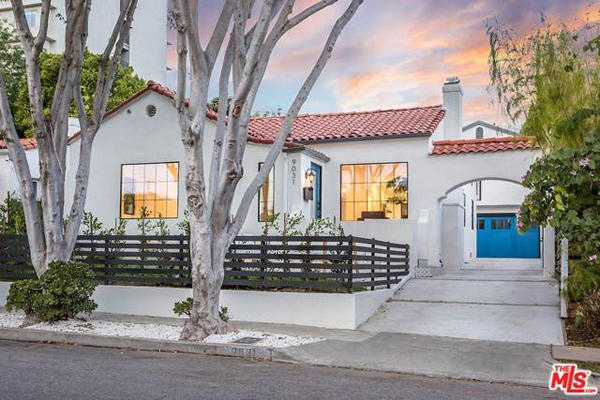 9031 Elevado Avenue West Hollywood, CA 90069
Beds 4 | 1 Full, 2 three quarter and 1 half Baths | 2,258 Sq. Ft. | House | Built in 1927
Rep: Sotheby’s International Realty | Julia Delorme | Cell: (310) 205-0305
Gorgeous Contemporary Mediterranean with detached guest home and separate address. Past the grassy front lawn, the main house features an open floor plan with French oak hardwood floors & charming French paned windows. Gourmet chef’s kitchen with custom Italian cabinetry, oversized farmhouse sink, brand-new stainless-steel appliances & matching quartz throughout the countertops, center island & separate breakfast bar. Luxurious master suite with a custom Italian walk-in closet and barn door that leads to an ensuite marble bathroom. Double doors lead to the backyard with a sleek wooden deck and porch for entertaining. 2-car garage doubles as an office space, topped with a delightful guest home, full kitchen and bath-just as stylish and comfortable as the main house. Unbeatable location in the heart of Norma Triangle in West Hollywood with a 10/10 rated school district, West Hollywood Elementary, and a stone’s throw to famed Sunset Blvd and retail & restaurant studded Santa Monica Blvd.
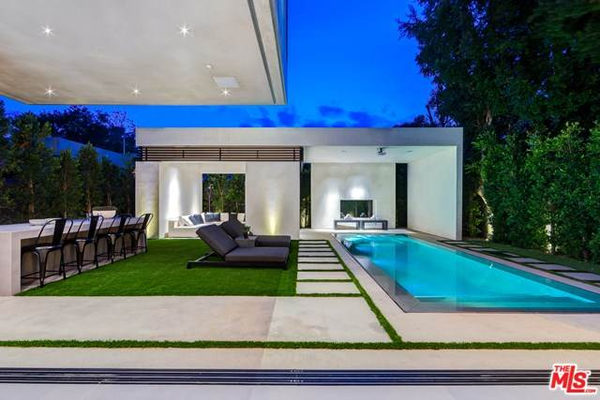
935 N La Jolla Avenue, West Hollywood, CA 90046
Beds 4 | 5 Baths | 3,932 Sq. Ft. | House | Built in 2016
Rep: Douglas Elliman | Dena Luciano | Cell: (310) 600-3848
A great 1031 exchange opportunity, this 4 bedroom / 4.5 bathroom luxe residence is leased at $22,000 per month. This property provides effortless, sophisticated living at its best. Light streams down from generous 2nd story skylights, while oversized glass doors disappear into discreet pockets, leaving the back of the house wide open to the shimmering pool and spa. Just beyond is an extra roomy, fully functional cabana complete with a sleek gas fire pit. Entertainers will delight in the high-end, open plan gourmet kitchen. Property is leased until May 2020 for $22,000 per month.
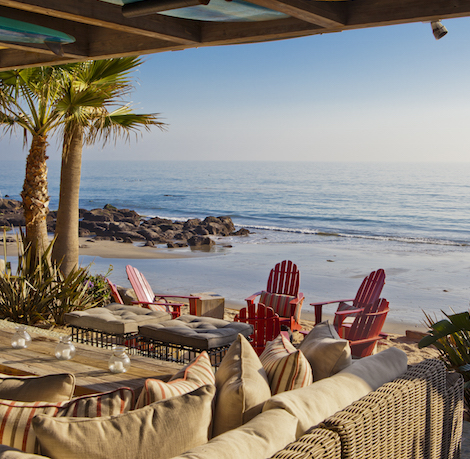
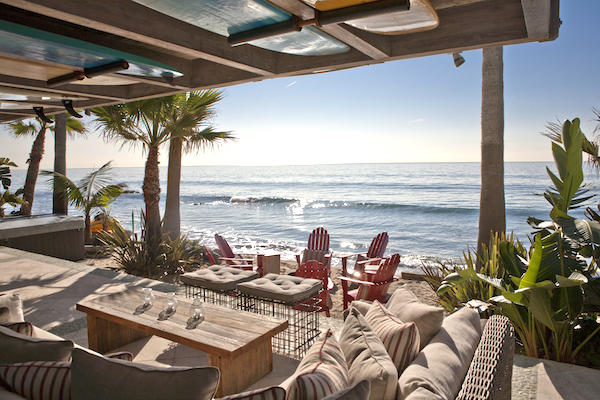
This home at 20906 Pacific Coast Highway is listed for $6,450,000. (Photo provided by private agent)
There’s a scene in “Grace and Frankie” in which Lilly Tomlin and Jane Fonda are sitting in Adirondack chairs, the surf nearly lapping at their feet as the Pacific Ocean crashes loudly then recedes Zen-like. “This is living,” says Grace to a near catatonic Frankie. “I want this house,” she says.
Who wouldn’t want to own a beachfront home in Malibu?
Long the most coveted second home community in Los Angeles, Malibu has an international reputation and culture all its own. The views, the sunsets, the meandering cliffs of the jagged coastline, the gentle breezes and the almost always perfect weather is the stuff of legend. It has inspired film, TV and literary types for years and over time has become an exclusive hideaway for some of the most famous and wealthiest people on Earth.
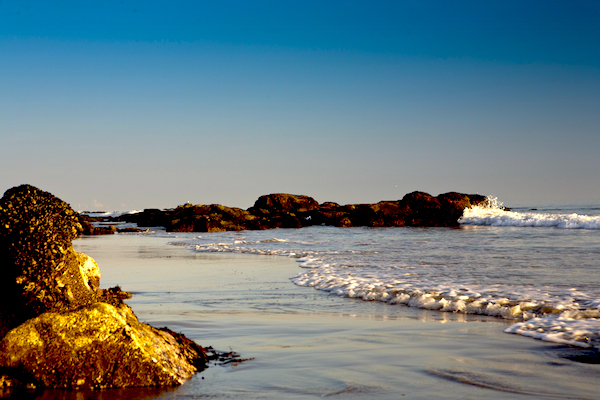
Increasingly, too, Malibu is supplanting Palm Springs as the ultimate second home community for successful gay and lesbian (and at least one notable trans woman) Angelenos.
When philanthropists Brian Pendleton and his husband Chad Goldman started looking for a second home some years ago, they chose Malibu. “While all of our friends were buying in Palm Springs, we decided to buy in Malibu,” Pendleton told the Los Angeles Blade.
But the couple didn’t buy just any property. They bought one of the best traditional coastal homes in all of Malibu.
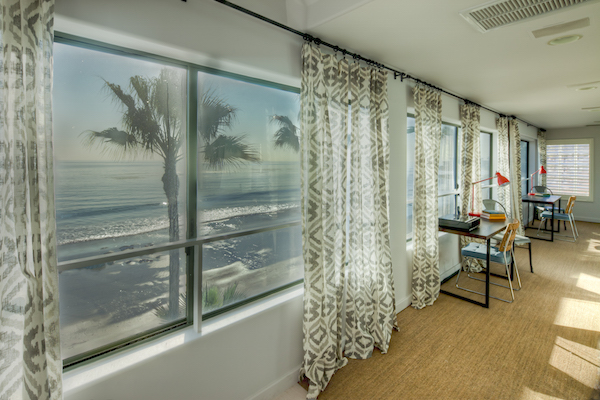
Their three-story home sits on Las Flores beach in east Malibu, offering two bedrooms, two baths, a full-size kitchen and a kitchenette on the ground floor. It was rebuilt in 2003, and is meant to be shared with friends and family, boasting a three-car garage and an additional three outdoor parking spaces — rare for Malibu.
The house is perfectly designed for entertaining, with two living rooms, two dining areas, and multiple fire-pits. “You can walk right off the beach and grab a margarita, and head to the living room,” Pendleton told the Los Angeles Blade.
Conveniently positioned on what’s known as “dog beach” (they have two fur-babies) and, unlike many of the houses up and down the beach, the house is fronted by a seawall versus pillions, so the water can’t go underneath the house as it rushes against the wall, leaving the home protected.
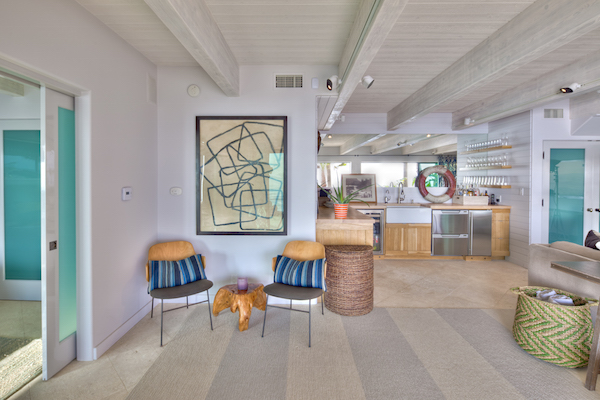
“It’s great for a second house or for someone who lives in LA. It’s so much closer than going to Santa Barbara or Palm Springs, and when you get out there it feels like you’re in a different city. It’s quiet and quaint. You can go to the movies there and park in the spot right out front of the theater doors,” Pendleton says.
“We bought it as an investment property, and Malibu was a great location. It’s closer to LA. And while interest rates are still low, we thought we’d take a look and see what buyers are interested. The home is perfect for a retired couple or small family who wants to live in Malibu. And for people looking for second home in Malibu,” Pendleton says.
“But I am not terribly motivated,” he said with a smile in his voice.
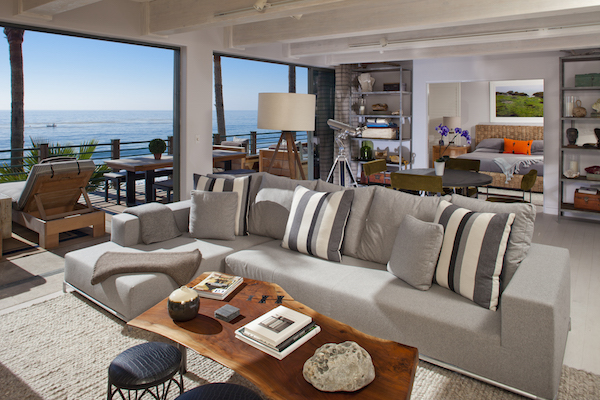
Pendleton, as founder of CauseForce, helped raise money for life-saving research and care for premier institutes around the world, raising billions of dollars for charity. In 2013, he sold his company and now volunteers his time mentoring, supporting and advising individuals and organizations. He also works to help communities gain access to academic facilities, scholarship programs and receive life saving medical support.
The “Goldman-Pendleton West Hollywood Library Mall,” for instance, in West Hollywood is a landmark facility for the community’s commitment to lifelong learning, and in the Philippines, two state-of-the-art “Pendleton-Goldman Learning Centers,” are serving local communities to help break the generational cycle of poverty in their communities. The Pendleton-Goldman PrEP clinic provides HIV education and prevention to underserved individuals in South Los Angeles. There’s even a language lab and an LGBT scholarship program the pair fund at The University of Tennessee in Knoxville, Goldman’s alma mater.
But it was this year’s #ResistMarch that put Pendleton (and Goldman) on the national map. The #ResistMarch was a resoundingly successful show of Pendleton’s team building and organizational skills.
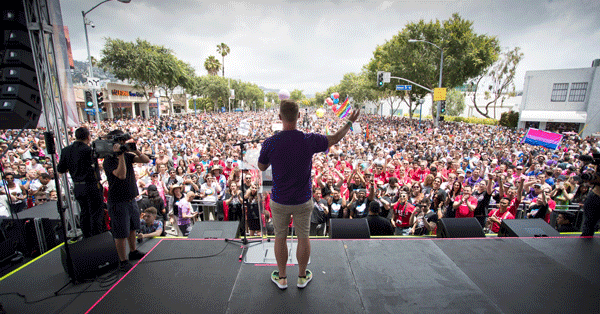
“This year, the LGBTQ community is lending our iconic rainbow flag to anyone who feels like their rights are under threat and to anyone who feels like America’s strength is its diversity,” Pendleton said. “The political climate we find ourselves in has driven us to galvanize and unite.”
Today, their attention is turned toward selling the luxe Malibu beach house, and enjoying the singular peace and tranquility of their equally amazing full-time home overlooking Runyon Canyon and downtown LA.
The couple can sit back and smile, because they have Adirondack chairs in the Hollywood Hills too.
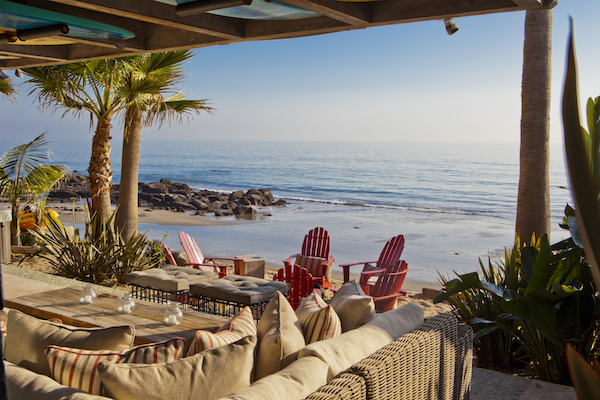
This property is being represented by Chris Cortazzo, 310-389-2472.
Real Estate
Navigating LA’s booming real estate market
3 gay professionals on opportunities, challenges for LGBT families
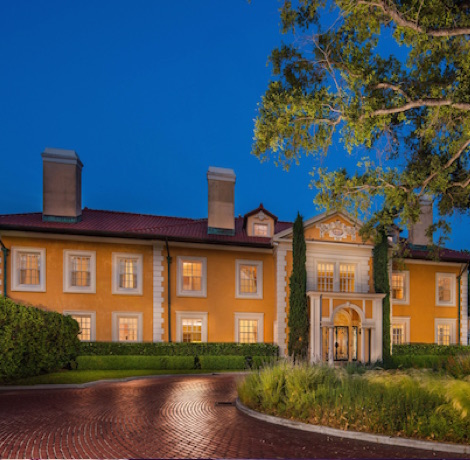
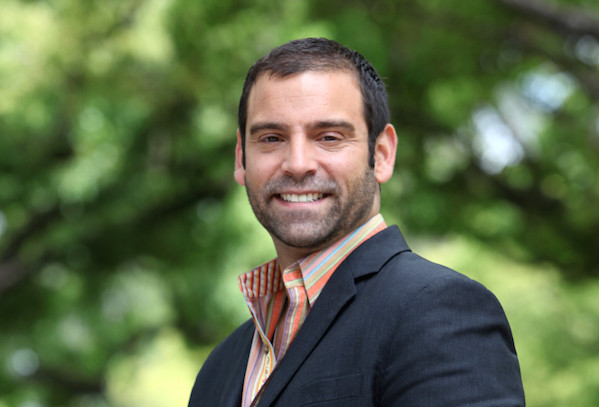
Nick Cacarnakis represents some of Los Angeles most exclusive properties from his Berkshire Hathaway offices in Beverly Hills. (Photo provided by Berkshire Hathaway)
It’s hard not to be captivated upon hearing: “Do you recall the scene in ‘Dynasty’ when Krystle and Alexis slap each other into the the lily pond?”
Oh good, you’re riveted now, too. That’s Nick Cacarnakis talking, the 43-year-old branch manager of Berkshire Hathaway Home Services on Rodeo Drive in Beverly Hills. “That house, which, of course, is every gay boy’s dream to live in that house, right? It’s listed at $28 million.”
Sigh…luxury real estate in the City of Angels, so reasonable, so within reach.
More attainable properties, from condos to three-bedroom homes, are generally the focus for the three real estate professionals interviewed for this article, all of whom happen to be gay. They buy, sell and manage real estate transactions throughout Los Angeles. One has a particular niche (West Hollywood) while the other two consider themselves generalists, the entire city their focus.
Each shared his perspective on, and experience with, the current market for LGBT clients, especially families, in search of luxury homes.
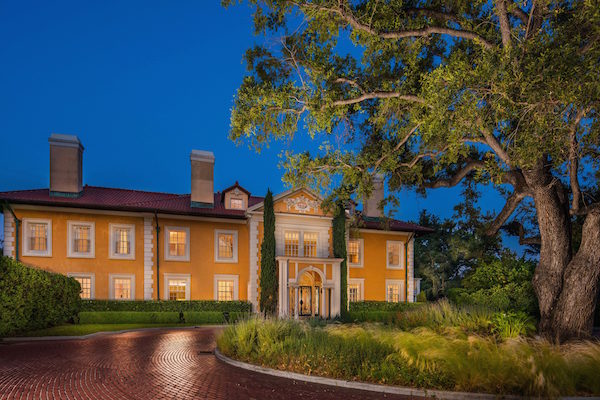
Berkshire Hathaway is offering perhaps the most iconic house in Los Angeles, the ‘Dynasty’ house. It’s surely the perfect home for any LGBT family. (Photo courtesy Berkshire Hathaway)
Defining luxury
What exactly meets such criteria? “Isn’t everything a family-size luxury property?” Cacarnakis asks. “We have a term that we use in our office: ‘Everybody’s House.’ It’s a house that will work for everybody.”
For him, that means enough bedrooms, enough bathrooms, maybe a backyard, too, a home that, “no matter what the family looks like,” can work.
In terms of price, it can be all over the map. “Half of [our listings] in the Beverly Hills office, which are $2 million and up, would fall into the category of being a luxury family home,” Cacarnakis added.
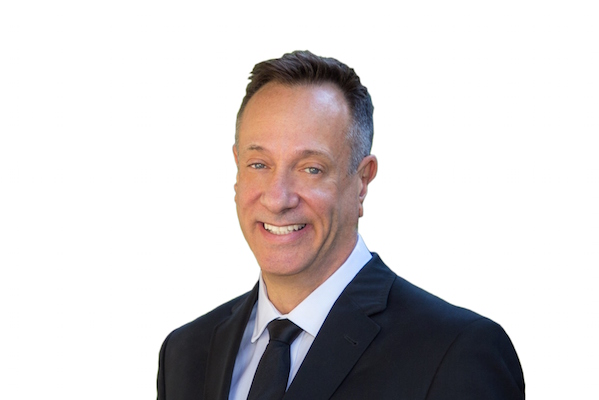
Keith Kaplan of Sotheby’s International specializes in luxury properties, primarily in West Hollywood where he has lived for many years. (Photo courtesy Keith Kaplan)
Keith Kaplan, 57, an agent with Sotheby’s expanded on that. He said, “There’s really a wide range.”
With a focus on WeHo and adjacent environs, for Kaplan that means the category of luxury family homes starts with condos, perhaps on Kings Road, let’s say, at around $750,000, all the way up to the new homes built along swanky, revamped Orlando Avenue between Santa Monica Boulevard and Melrose Avenue listing as high as $8.5 million.
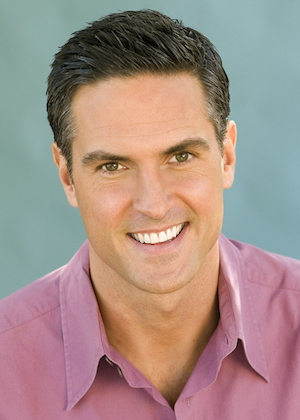
Randy Lopez represents a variety of home price points throughout Los Angeles and works at the Beverly Hills offices of Coldwell Banker. (Photo courtesy Randy Lopez)
“The word luxury brings it to a higher price point,” said Randy Lopez, 50, an agent with Coldwell Banker Beverly Hills North. “If you say ‘family-sized property,’ that’s different than ‘family-sized luxury property.’ In my mind, I’m thinking anywhere between three to five million and upwards, depending upon what their definition of luxury is.”
Maybe now is a good time to introduce the problem of sticker shock, the biggest challenge Kaplan faces when helping a client enter the market.
“I really like working with first-time buyers,” Kaplan said. “Walking them through the process, getting them to understand the value equation of owning versus renting. It’s a tremendous jump to take.”
Is there any hope for those trying to make that dramatic transition? “Although lenders have not gotten so relaxed we’re gonna be in the position we were in 2008,” Kaplan added, “they are relaxing a bit.” “Lower down payments are allowing more Millennials to enter the market, so we have more options for them.”
Kaplan added, “The first home product, or the first trade-up product, homes priced under $2.5 million, [there is] strong demand.”
Yet most readers will be familiar with the concept of competition. While all three agents said the market for high-priced homes ($2.5 million and higher) has softened, Lopez says, “In the $1 million to $10 million range, if something is well done, well-priced based on comps, and desirable, you’re still gonna have a huge demand for that property.”
All three said they still see properties sell in a single day with multiple offers all above asking. Lopez said, “Is it in a great area? Is it priced right? If there’s a value there for people, based on logic and numbers, we’re gonna see that [sell].”
The other two agents agree. “Expectations are high on all sides,” Cacarnakis said, “especially on the Westside when we’re dealing with business managers and attorneys.”
Kaplan added, “I’m seeing some crazy, crazy bidding over ask. I saw some 2-bedrooms in West Hollywood priced at $750,000…[they] went out at $825,000. That’s a tremendous overbid.” Apparently many bidders are investors who flip the property, coming in and renovating, adding premium fixtures and modern appliances, then put them back on the market. “And they’re getting top dollar.”
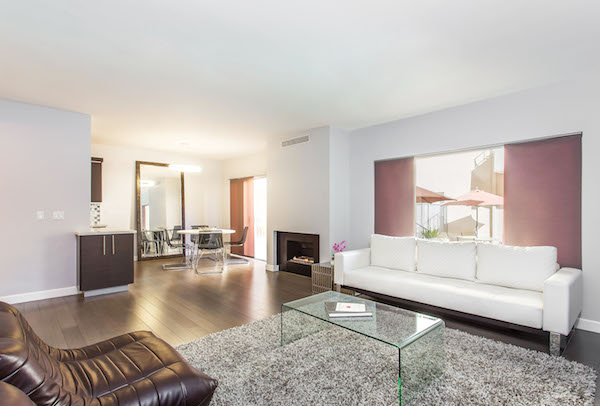
Kaplan sold this one-bedroom/one-bath condo (listed at $530,000) on Kings Road north of Santa Monica Blvd. last year. (Photo courtesy Keith Kaplan)
What’s trending?
What about trends? Managing 100 agents in Beverly Hills, Cacarnakis is able to get an aerial view of the market on a regular basis.
“Mega-mansions,” Cacarnakis said. “These mega-prices that we just haven’t seen in LA before. I had a situation where an agent wrote an offer on a listing of $22 million and they had [several] offers. That kind of money is out there.”
Another trend, perhaps obvious, is the big glass boxes replacing older homes knocked down by developers. “The style is contemporary as far as the building is concerned,” Cacarnakis said. “Lots and lots of construction going on. But I think everybody knows that.”
What about up-and-coming areas for family homes? “I think the next frontier is that area south of Melrose all the way to Fairfax,” said Kaplan. “You’re seeing a lot of rehabbing of the Old Spanish and bungalow type homes.”
Lopez’s view is, “It’s really dependent upon [budget]. Do they have unlimited resources and want to live in Beverly Park, where homes are $20 to $30 million? Or are they more on a budget and going east to Eagle Rock, Glassell Park, Mt. Washington, where you can still find a luxury home for a million dollars?”
“Up and coming?” wondered Cacarnakis. “All around that Wilshire Corridor area, and then you have all Echo Park. It’s too late for Silver Lake, that already came and went.”
Needs of LGBT families
But what do LGBT families need in their choice of home and neighborhood? Cacarnakis, a father with two teenage children, thinks “LGBT families moving into that sort of Silverlake [area]…those neighborhoods have good school districts [and] they’re very accepting.” If he had to pinpoint a section of the city that is “super LGBT friendly [and] also not incredibly insane on prices, that whole Echo Park, Silverlake area is definitely a prime area.”
Kaplan has done his homework on West Hollywood schools, even though he hasn’t had an LGBT family as a client thus far in his five years as an agent. He considers it his responsibility to know what parents will ask, though, once he does.
“We have WeHo Elementary, which is one of the best schools in the area,” Kaplan said. “Rosewood is rising quickly and then we’ve got the Center for Early Education and a number other really good private schools.”
He adds to that by waxing on West Hollywood Park and their recreation programs for kids. “I have friends that I actually meet there on Saturdays with their three boys. One plays T-ball, one plays in a basketball clinic and one swims on the swim team. It’s almost like a summer camp year-round.”
All three agents feel being gay gives them a competitive advantage over straight agents when working with LGBT clients and families.
“It’s like going to a gay doctor,” Cacarnakis said. “It’s maybe just the insight and that level of understanding. I’m gonna know…what areas we are gonna feel comfortable holding hands, and maybe what areas we’re not.”
Kaplan echoed that. “I think there is perhaps a sensitivity to, and an understanding of, the unique needs of [gay clients]. For instance, I think it’s important for a gay family to understand the community that they’re entering. Even at the school. How will they be perceived? Will it be comfortable for their children? What is faculty like?”
“There’s a compassionate psychological component to working with clients,” Lopez said. “I feel like having a common foundation with your clients…being able to hold [their] hands during the process is helpful. It provides another level of connection…as opposed to agents who are not part of the LGBT community.”
Even with this shared bond of experience in mainstream society, I wondered if these agents run into any particular challenges, or unique surprises, they might not otherwise?
“Working with LGBT clients, or not,” says Lopez, “the challenges are very much the same. Gay or straight…it’s about honoring the commitment you’re making to your Realtor.”
Cacarnakis, the married, gay dad, said, “I’m surprised at how non-different it is. We’re still just families looking for everything that everybody else is. The right schools, the right family configuration.”
For Kaplan it was “not in the process of selling, it was after the sale.” A gay couple he sold a condo to chose a contractor (“a member of the community”) to renovate the unit. Supposedly he “had the gay eye” but “the most shocking thing [was] the shoddy work and the lack of attention to detail.” Mismatched color tile on a backsplash did not bode well. “Ultimately it went to small claims court.”
I requested video links and photos of active luxury listings from all the agents featured in this story. Regarding the “Dynasty” property, Cacarnakis tells me, “Take a look at the two videos.” He pauses. “One of them is the ‘Dynasty’ mansion, which…I mean, it is a family…” residence, I think he wants to say.
“A dysfunctional family,” I joke.
“Right?” Cacarnakis says, laughing.
Palm Springs
Allure of a Palm Springs mid-century
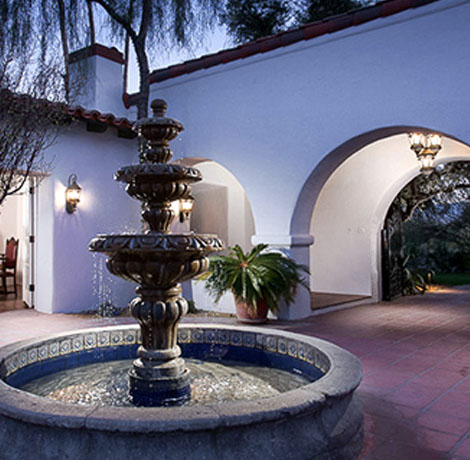
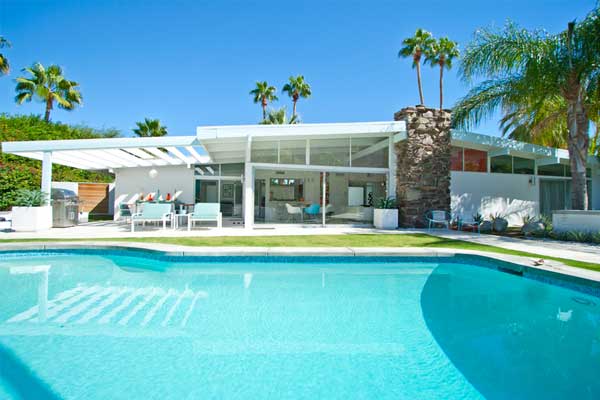
Tourists come from all over the world to gaze at the distinctive midcentury modern architecture, historical monuments, and the former homes of movie stars in Palm Springs. But what about a driving tour of places gay celebrities once lived and played? We thought we’d highlight a few.
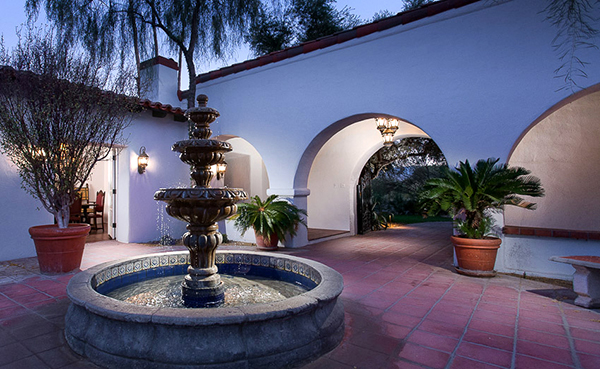
Though later known as “Mr. Palm Springs” — he served as the town’s mayor from 1948 to 1953 — hunky Charles Farrell first made a name for himself as a silent film actor. In The River (1928), Farrell became the first known American actor to appear nude on film. Though married to actress Virginia Valli from 1931 until her death in 1968, Farrell (who, with bestie Ralph Bellamy, opened The Palm Springs Racquet Club in 1934 and has a major Palm Springs street named for him) was rumored to be gay. And his Racquet Club hotel (2743 N. Indian Canyon Drive) was notorious for hosting gay parties attended by Hollywood’s elite. Farrell himself lived in a nearby compound comprising two adjacent homes, the first at 630 E. Tachevah Drive, the second around the corner at 1120 N. Via Miraleste.
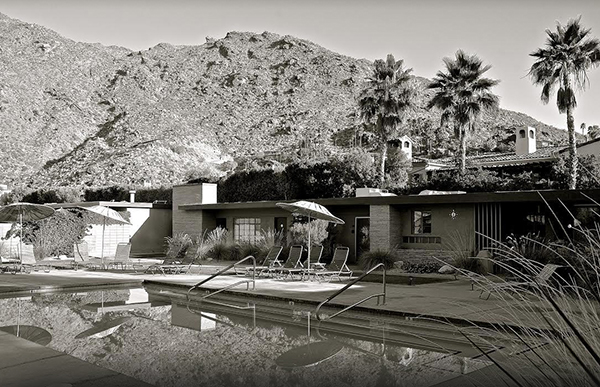
Speaking of gay parties and ground-breaking nudity, in the mid-1950s openly gay film director James Whale (who was immortalized in the 1998 film Gods and Monsters) owned the eight-unit Town & Desert Hotel in Palm Springs (now The Hideaway), located at 370 W. Arenas Road. It was here that Whale — who reportedly had a fear of water and in 1957 committed suicide by drowning himself in the backyard of his Los Angeles home — allegedly enjoyed filling the pool with naked young men, making it the area’s first known clothing-optional resort.
In his 2005 biography Tab Hunter Confidential: The Making of a Movie Star, Hollywood’s sexiest blond of the 1950s not only came out as gay but revealed that he and actor Anthony Hopkins (of Norman Bates fame) had a long-time relationship. The lovers reportedly spent weekends hiding out at the Desert Inn (123 N. Palm Canyon Drive), where Hunter would also pose shirtless poolside for fan magazines like Photoplay. The site is now a shopping center. In early 2003, Hunter bought a small, one-bedroom condo at 130 West Racquet Club Road #419, but by this time, in his early 70s, he was apparently uncomfortable with the desert heat — both the weather and the constant attention he received from men looking to hook up with the former American idol.
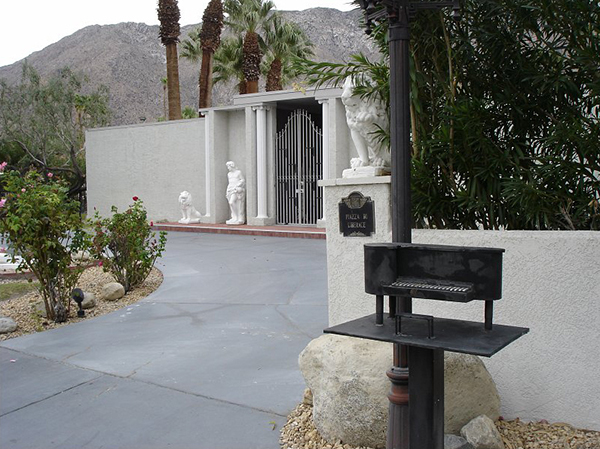
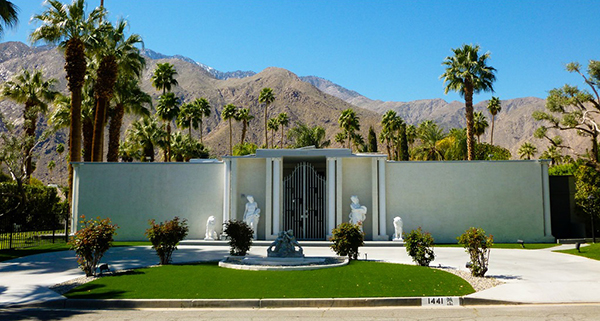
It seems neither Liberace nor Merv Griffin had similar concerns. According to Darwin Porter’s 2009 book Merv Griffin: A Life in the Closet, the famed TV host was a regular at the all-male parties thrown by his friend and former lover, Liberace. Over the decades, the musician and master showman owned four homes in Palm Springs. Piazza de Liberace (1441 N. Kaweah Road) is among the most distinctive, with its extant piano-shaped mailbox. The home depicted in the movie Behind the Candelabra is located at 501 N. Belardo Road and reportedly featured theme rooms and a master suite big enough to house a small house. In addition to partying here, Liberace reportedly passed away here in 1987.
Another closeted movie star who enjoyed desert romps with a bevy of beautiful men was Rock Hudson. His friend George Nader had a four-bedroom house in Bermuda Dunes (42520 Stardust Place). “H” gates mark the entrance to a citrus grove and side yard, according to a recent real estate listing, which lists “a huge party area” as one of the home’s benefits. Following emergency quintuple heart bypass surgery in 1981, Hudson recuperated here. What else the pair did here is anyone’s guess, but it’s assumed the house saw plenty of action.
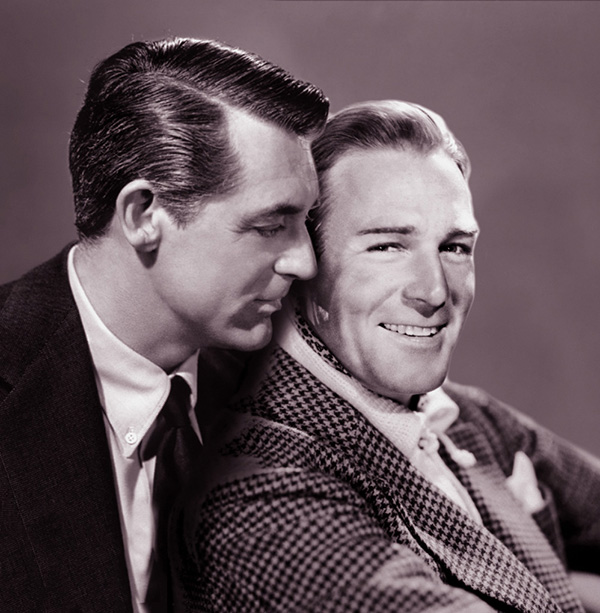
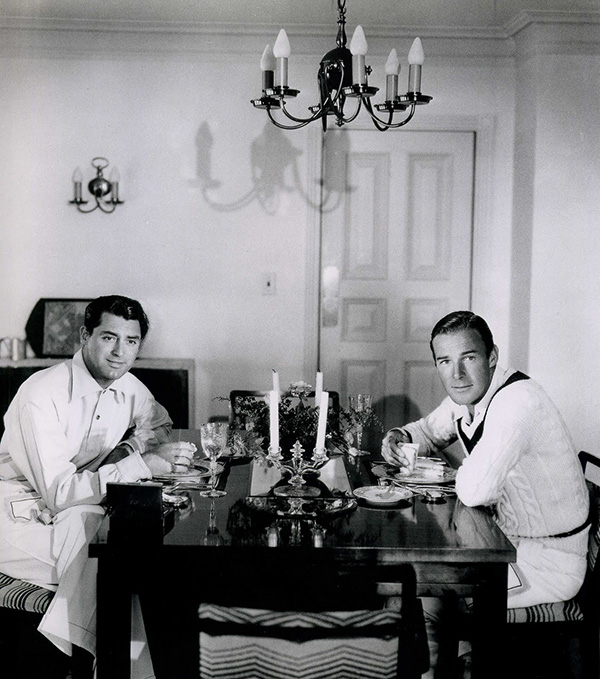
The notoriously private Cary Grant was evidently not-so-private about his affection for fellow actor Randolph Scott. After flaunting their “closeness” in a series of photographs posed in the Santa Monica beach house they shared — sharing a diving board, working out, enjoying a candlelit dinner for two (with their butler!) — it’s believed their relationship eventually relocated to the desert. Grant purchased a Palm Springs house known as Las Palomas (928 N. Avenida Palmas) in the Movie Colony neighborhood with wife number three, Betsy Drake. (Frank Sinatra and wife Ava Gardner lived nearby at 1148 E. Alejo Road, where visual remnants of the couple’s notorious knock-down-drag-outs, such as chipped countertops, are said to remain.) But rumor has it that after each of Grant’s marriages went south, he and Scott (who bought a place in nearby Indian Wells) would rekindle their relationship. Despite their other romantic partnerships (Scott was married twice, the latter union lasting from 1944 until his death in 1987) Grant and Scott’s relationship — whatever the nature of it may have been — purportedly lasted for the rest of their lives.
At the height of their fame, shamed TV evangelist Jim Bakker and his wife, Tammy Faye, owned a house on Greenbriar Lane in Palm Desert. In Palm Springs Babylon: Sizzling Stories From the Desert Playground of the Stars, author Ray Mungo writes that it was “well known within the gay community” in the 1980s that Bakker attended gay events like whipped cream wrestling at Daddy Warbucks, a long-gone gay club in Cathedral City (68891 Highway 111), and made frequent appearances at the leather hangout formerly known as C.C. Construction Company (68449 Perez Road, Cathedral City). “His indiscretions were legendary,” according to Mungo.
There are plenty of other worthwhile places to drive by: Truman Capote lived at 853 Paseo el Mirador in Palm Springs in the 1960s and ’70s, while the notoriously private Greta Garbo (a known lesbian in Hollywood circles) kept a secret hideaway at 287 W. Racquet Club Drive. And writer Moss Hart (whose homosexuality was reportedly known to just about everyone, including Kitty Carlisle, his wife of 15 years) died of a heart attack on the lawn of the home he shared with Carlisle at 467 W. Via Lola.
Gay celebrities still flock to Palm Springs. TV personality Ross Matthews and his partner, stylist Salvador Camarena, own a home here, as do Arrow star John Barrowman and his husband, Scott Gill. It was here that Barrowman, live streaming from his hot tub on Facebook, inadvertently provided the world a look at Gill’s goods when he appeared in the background, dropped his towel, and climbed in au naturel. (Gill didn’t seem to mind, and neither did the fans who viewed the video again and again.)
Here’s to hoping for more interesting tales from the Barrowman house and others.

Could this be the new Weho? Jeff McMullen and The Rainbow Village

From the bedroom to Broadway: Sterling Tull and the many faces of ‘Rocky Horror’

Judges: Our frontline troops fighting corruption, defending democracy

Her royal ‘Travesty’: Sasha Velour dishes on her new show

City Attorney candidate Marissa Roy to Children’s Hospital L.A.: ‘You still have to comply with state law’

Common Sense Isn’t Political

LGBTQ+ pioneer Rev. Troy Perry to young people: ‘Don’t be afraid’
Immunology gave HIV survivors the chance to grow old, Proposition 38 is the next step

‘WOOF’ worthy: Christopher Schellenger shares the unique challenges of playing a dog

With exquisite 4K restoration, ‘The Devils’ finally gets its due
-
 opinions5 days ago
Common Sense Isn’t Political
-
 Features3 days ago
LGBTQ+ pioneer Rev. Troy Perry to young people: ‘Don’t be afraid’
-
Commentary5 days ago
Immunology gave HIV survivors the chance to grow old, Proposition 38 is the next step
-
 Theater5 days ago
‘WOOF’ worthy: Christopher Schellenger shares the unique challenges of playing a dog
-
 Movies3 days ago
With exquisite 4K restoration, ‘The Devils’ finally gets its due
-

 Features4 days ago
Drag queens go from Send Noodz straight to the polls
-

 Brazil3 days ago
Lula defeats Flávio Bolsonaro in second round of Brazilian presidential election
-
 California1 day ago
City Attorney candidate Marissa Roy to Children’s Hospital L.A.: ‘You still have to comply with state law’
-
 Theater1 day ago
Her royal ‘Travesty’: Sasha Velour dishes on her new show
-
Commentary2 hours ago
Judges: Our frontline troops fighting corruption, defending democracy