
Reviews
“The June Jordan Experience” captures the late queer poet’s tender, revolutionary legacy
The new show, playing until Mar. 29 at the Fountain Theatre, journeys through the late queer poet’s life, radical art and activism.
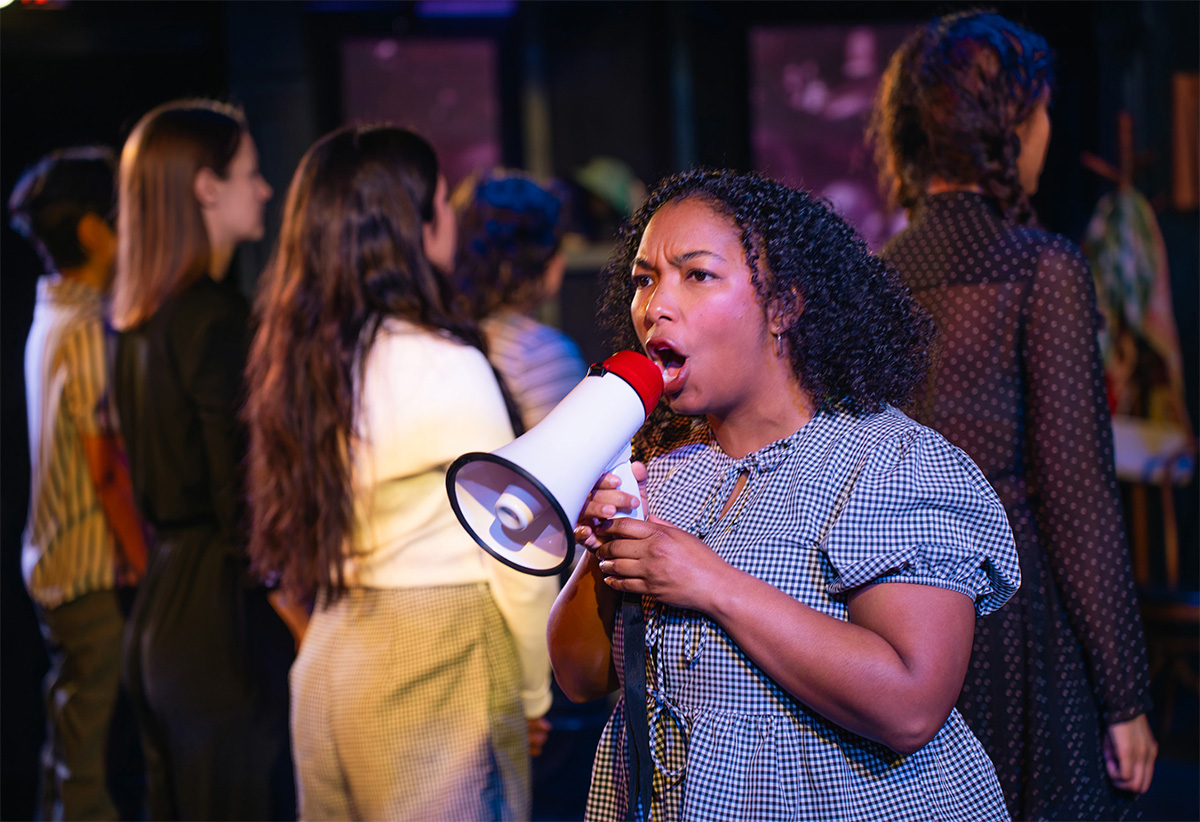
On a recent Sunday afternoon, the Fountain Theatre is nestled in quiet, minutes before a new show is to begin. Quiet jazz bounces out from the cozy cafe upstairs, and people begin to take their seats by the intimate stage inside. As the lights dim, six actors — American Covarrubias, Naseem Etemad, Kita Grayson, Mackenzie Mondag, Savannah Schoenecker, and Janet Song — begin with a powerful proclamation about the sacred act of discovering one’s own poetic voice and understanding the medium’s inherently political, participatory, and revolutionary nature.
What is stunning and clear from this very first declaration is each actor’s voice and presence: clear, loud and unwavering. Their eyes are fixed onto the crowd, flitting from person to person, demanding close attention to the production’s nearly two-hour arc that details the life and work of revered Black queer poet and activist, June Jordan.
“Poetry for the People: The June Jordan Experience” never wastes a minute. First, audience members are taken back to Jordan’s childhood in Harlem and Brooklyn, and actor Kita Grayson shapeshifts into Granville Ivanhoe Jordan — the patriarch of the family — making her body hard and rigid, her biting words twinged with Granville’s Jamaican accent. We see a young Jordan develop a penchant for poetry as a young child in the early 1940’s: a love for literature and expression blooming under the intense and even abusive watch of her father, who was her “hero and tyrant.”
We watch as each actor takes turns metamorphosing into the poet throughout the production, slipping with ease into a different part of Jordan’s life as she became a poet for the masses and a passionate educator and defender of civil rights for Black people, immigrants, Palestinian civilians, and LGBTQ+ community members. The production blends song and dance with interviews and clips of Jordan. It is refreshing to be able to see her speak: to be able to see and hear her, too, in this retrospective tribute to her life.
Throughout the show, viewers see the way Jordan’s work, alive and alchemic, traveled across mediums: not only in the defiant, romantic, and immortal texts of her poetry but also in songs, in plays, in essays, and in speeches.
Her wide-reaching impact is felt personally in this production, as her longtime partner and creative collaborator, composer Adrienne Torf, stitched together the production’s musical elements and plays the piano throughout the dynamic show. In moments, she watches the actors with steady, deferential eyes as her hands glide across the keys in gentle melodies. Love is deeply embedded in this production: Jordan’s deep devotion to creating paths of justice and humanity for others resounds throughout the show, and the love that others continue to hold for her is alive and palpable as well.
“[June] was propelled in her writing, activism and daily life to seek the possibilities for love and justice for all people,” Torf said in a recent interview. “If something was done to her or to someone she cared about, she responded with appropriate and sometimes withering anger, as would most any person with a conscience. And she cared about people in other parts of the world as much as she cared about people close to her, especially her students. June had an infectious laugh that regularly had people holding their sides as they laughed along with her. All of this comes through in her writing and the videos of her that are included in the show.”
For director and co-devisor Raymond O. Caldwell, Jordan provided him a guiding light for the development of his own activism and politically-motivated art when he was younger. “I, for so long, felt like an outsider — and then I started reading June,” Caldwell said, in an interview on KPFK. “She started teaching me what the real center of my activism was…and it’s love. Love at the center of our activism [and] art is not only art. It is personal. It is political. It is everything.”
“Poetry for the People: The June Jordan Experience” not only centers Jordan’s love and her poetic resistance — it invites the audience to take part. The actors hand out notepads and pens, and pause for a few moments throughout the show to pose writing prompts. People are encouraged to write what comes to mind, and to think about ways they can begin to seek collective and individual liberation through writing, reflecting, and community-building.
The show, experimental in its structure, is a container for possibility. It’s a timely look at how queer and marginalized people can carry June Jordan’s legacy of radical love deeply within them, as they search for tools to disrupt and dismantle the brutality that surrounds them. Jordan’s love was searing and unique in its devotion to tenderness. Her words from “Poem for Haruko” echo in my heart. “How easily you held / my hand / beside the low tide / of the world.”
“Poetry for the People: The June Jordan Experience” plays now until March 29 at the Fountain Theatre. Its next show is Monday, Feb. 16 at 8 p.m. The organization has introduced a “living ticket” model, where visitors are invited to name their own price for the show. More information can be found here.
Kristie Song is a California Local News Fellow placed with the Los Angeles Blade. The California Local News Fellowship is a state-funded initiative to support and strengthen local news reporting. Learn more about it at fellowships.journalism.berkeley.edu/cafellows.



Arts & Entertainment
Norman Lear’s “Clean Slate” struggles to find its footing
“Clean Slate” has a lot of heart, but ultimately misses the mark.

How does one even attempt to give an honest review of a new TV show executive-produced by the late Norman Lear – a pioneer in entertainment – also starring Laverne Cox, a trailblazer for trans representation? Given the current political climate towards the queer community, approaching Clean Slate should be done with kid gloves. Still, the show struggles to find its footing and generally misfires.
The show, now streaming on Prime, was originally pitched to Lear by comedian and co-star of Clean Slate, George Wallace as a Sanford & Sons reboot. Lear told him to go back to the drawing board and come back with something new. Ultimately, Wallace, together with Laverne Cox and Dan Ewen, created a show that is a throwback to the family sitcom era and to Lear’s earlier shows like All in the Family and The Jeffersons.
What’s missing here is a live audience and a stage.
The writing doesn’t seem to get that. One-liners fall flat, and preachy character orations clunk away with their heavy-handedness. Some of the actors are able to make something of a dated and unimaginative script, and some do not. Some of the jokes and situations are very stale, we’ve heard and seen them before. Though new to the scene, this show does not seem fresh, which is odd for a Lear project. We wish Clean Slate was as fast-paced and fun as the show’s trailer.
Always one to push the envelope, Lear’s projects have addressed class, racism, abortion, women’s rights and queer issues, many times way before mainstream audiences were prepared to discuss them. In Clean Slate, trans and gay issues are in the spotlight.
Laverne Cox’s Desiree returns to her small hometown in Alabama and surprises her father, Wallace’s Henry Slate, after being gone for 17 years. Not only does she surprise her father by coming back, but she also surprises him by showing uo as his daughter and not the son he knew.
Having lost her money running an art gallery in New York, she moves back in with her father to figure out her next steps. The show centers on the bond she creates with her father and the friendships she builds in small-town living, including the family that works for Henry’s car wash, her best friend Louis who is dealing with being in the closet, Louis’ mother, and the local church community.
Ultimately, she also connects with the local queer contingent. The usual themes and situations you would expect unfold. Henry must also now get used to using different pronouns with his daughter and having to put money into a pronoun jar each time he makes a mistake. He helps Desiree deal with her relationship to church and spirituality, when the local pastor shuns her new identity and she falls in love with the town’s hot guy.
Even with these storylines, the proceedings seem unimaginative and dated. At times, it seems like the show is an after-school special and not a progressive comedy. Henry and almost all of the small town embrace Desiree’s new identity with vigor and understanding which – although optimistic and hopeful – seems improbable in small town living in the South. The whole affair just comes across as saccharin in its sweetness.
Wallace as Henry Slate is charming and a great choice to help lead this story. He handles many of the cheezy lines with sincerity that makes it almost work. He is a gentle giant as a character, and quickly becomes lovable, even with his many missteps of grappling with the queer community. He loves his child unconditionally and would do anything for her, which is very believable from the get-go. D.K. Uzoukwu as the closeted Louis plays his role with sincerity and is a very welcome fresh face to big-time TV.
He plays the balance of presentational comedy and character honesty very well. Jay Wilkison as Mack – the town’s bad boy turned loving single father – really handles the material deftly and adds some much-needed craft to make the script and situations seem plausible. He’s also not hard on the eyes. Stealing practically every scene she is in is TV veteran Telma Hopkins, most known for her role in Family Matters, as Louis’ mom. She understands the nuance of sitcoms, single-camera closeups, and just the right amount of presentational acting to make it work. She is a delight to watch. We just want to hang out with her and gossip on the porch.
We know Laverne Cox is a talented actor. She made history as the first trans actor to be nominated for a Primetime Emmy for her role in Orange Is the New Black. Oddly and we feel guilty by even writing it, but she misses the mark the most in Clean Slate.
She doesn’t seem to understand the material and comedic moments are overdone. Her emotional moments just don’t ring true. She seems to be overacting which, along with a weak script, doesn’t anchor the show properly. But, she is a consummate actor. What was it? The direction? The writing? Her performance just doesn’t cut it.
Here’s the thing.
All that being said, the show does have a lot of heart. But it seems lost, trying to find its footing, as to what it wants to be. A sitcom? A dra-medy? It does not succeed in any of those genres, but as a queer person watching the show, it is touching just because of its existence.
A comedy show led by trans and queer storylines is so much needed right now and just knowing this show is part of the Lear legacy, makes it that much more important.
Should we blindly support queer content just because it is out there? No.
Should we support the efforts and mission of a show? Yes.
And we also love the fact that this is a show the whole family can watch and discuss, which holds a lot of weight. There is a lot to explore if the show gets a season 2 and we do hope it is renewed so it has a chance to find its footing with stronger direction and writing.
Clean Slate season 1 is now streaming on Amazon Prime.

Japanese Supreme Court to consider marriage equality

LA Blade’s Best of LA 2026 winners announced!

New IOC policy bans trans women from Olympics

LA Metro should approve the San Vicente-Fairfax route for the K Line Northern Extension without delay

Who gets to vote? The SAVE Act and what it means for LGBTQ Americans
LA Metro should approve the San Vicente-Fairfax route for the K Line Northern Extension without delay

The harms of our leaders do not erase our movements and voices
Who gets to vote? The SAVE Act and what it means for LGBTQ Americans

‘It’s Dorothy’ traces lasting influence of a cultural icon
LA Blade’s Best of LA 2026 winners announced!
-
 Commentary2 days ago
LA Metro should approve the San Vicente-Fairfax route for the K Line Northern Extension without delay
-
 Commentary4 days ago
The harms of our leaders do not erase our movements and voices
-
 COMMENTARY3 days ago
Who gets to vote? The SAVE Act and what it means for LGBTQ Americans
-
 Movies4 days ago
‘It’s Dorothy’ traces lasting influence of a cultural icon
-
 Arts & Entertainment17 hours ago
LA Blade’s Best of LA 2026 winners announced!
-
 Sports1 day ago
New IOC policy bans trans women from Olympics
-
 Japan4 hours ago
Japanese Supreme Court to consider marriage equality