
Michigan
Michigan library defunded after refusing to censor LGBTQ books
A community voted to close its library rather than have it remain open with books some consider to be “indoctrinating” children
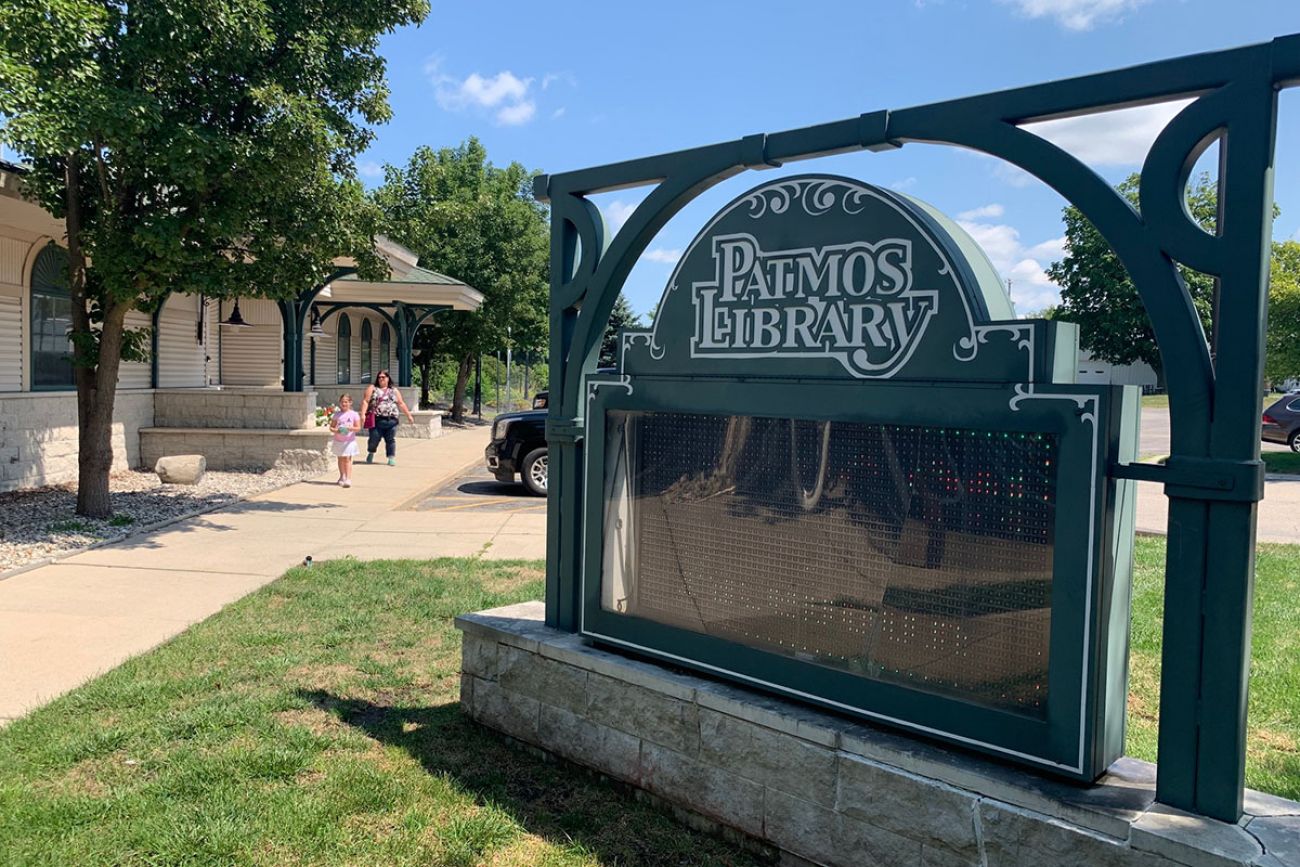

By Ron French | JAMESTOWN TOWNSHIP, Mi. – What started as a fight over an LGBTQ-themed graphic novel may end with the closure of a west Michigan public library.
Voters in Jamestown Township, a politically conservative community in Ottawa County, rejected renewal Tuesday of a millage that would support the Patmos Library. That vote guts the library’s operating budget in 2023 — 84 percent of the library’s $245,000 budget comes from property taxes collected through a millage.
Without a millage, the library is likely to run out of money sometime late next year, said Larry Walton, library board president.
“I wasn’t expecting anything like this,” Walton told Bridge Michigan Tuesday. “The library is the center of the community. For individuals to be short sighted to close that down over opposing LGBTQ is very disappointing.”
There have been protests at other Michigan public libraries and at school board meetings about books with LGBTQ themes. But Tuesday may be the first time a community voted, in effect, to close its library rather than have it remain open with books some consider to be “indoctrinating” children.
Continue reading at Bridge Michigan: (LINK)
*********************
Ryan Wieber, President of the Michigan Library Association, released a statement Friday regarding the situation at Patmos Library:
The Michigan Library Association stands in solidarity with the Patmos Library Board of Trustees on the decision to retain a small collection of LGBTQIA+ materials on their library shelves. We are equally disheartened to learn that continued funding for the library was defeated on the August primary ballot because the library would not remove these materials.
We recognize that individuals have the right and responsibility to make decisions about what materials are suitable for themselves and their own families. We also stand united with the majority of the Patmos Library Board, and with librarians across the nation in upholding our Constitutional protections. The freedom to read is guaranteed by the Constitution. No one has the right to make rules restricting what other people read or to make decisions for other families. Freedom only exists when individuals can make their own choices. When a book is banned by those who want to censor voices they don’t agree with, our democracy itself is threatened.
Of utmost importance to any public library is curating collections that allow every citizen, young and old alike, to see themselves in the books and resources their library provides, and choosing a broad range of subject matter that reflects diverse experiences. It is important to emphasize that the presence of any reading materials in a library collection does not imply endorsement of the ideas expressed in those materials. The library is simply doing its job to provide a wide variety of views and expressions—if the library “endorses” anything, it is citizens’ right to access a broad selection of age-appropriate materials. This is a core tenant of librarianship – to provide for the interests of all, and to do so without bias.
Of the 50 library millages across Michigan that were on the August primary ballot, five were voted down, but only one was voted down due to extremist rhetoric and opposition concerning the small collection of materials with LGBTQIA+ themes on the shelves of the Patmos Library.
And we all know that there are extreme consequences to be addressed for those that voted “NO”.
How will the community fare, when and if, the library closes its doors because its funding was not approved? Economically? Socially? Educationally? The Patmos Library serves many purposes – simultaneously a community center, voting precinct, history center, a place to read, gather, socialize, study and learn – a beautiful cultural institution in the heart of Hudsonville. The day will come when there is no access to WiFi. No access to employment assistance. No access to books, materials and eContent. No access to veteran’s benefits. No access to storytime. No access to afterschool, weekend and evening programs. No access to lifelong learning opportunities. NO ACCESS at all because the Patmos Library will shut and lock their doors and will no longer serve the needs of anyone, including those that voted no.
It is the responsibility of libraries throughout Michigan and our Nation to guarantee and facilitate access to all expressions of knowledge and intellectual activity, including those that some individuals in our society may consider to be unconventional, unpopular, or unacceptable. We stand with you as you uphold the first amendment rights that are enshrined in the Constitution by serving the entire population, including those who see value in material that others may find objectionable.
The Michigan Library Association will help Patmos Library in any way they deem needed to address this challenge.
There is a GoFundMe campaign established by local Jamestown resident, Jesse Dillman, who is raising funds to sustain library operations. As of Friday, August 5, 2022 the campaign had raised $12,571 of its $245,000 goal.
The link to the GoFundMe is here: (LINK)
**********************
The preceding excerpt was previously published by Bridge Michigan and is republished by permission. Photograph of Patmos Library sign by Ron French for Bridge Michigan republished by permission.
Bridge Michigan is a non-profit supported by readers like you. Membership at Bridge isn’t like a traditional newspaper subscription. It’s a community.
Every gift makes a difference, but monthly or annual recurring donations build long-term sustainability, helping us grow and prepare for the future. Join Bridge today with a credit card or, if you prefer, through PayPal. Thank you!


Congress
Jeremy Moss looks to bring LGBTQ+ advocacy from Lansing to Capitol Hill
Congressional candidate would represent Detroit suburbs if elected
With fall comes swapping out T-shirts for sweaters, raking leaves and, of course, elections. The summer’s primaries have narrowed the playing field in a slew of races, but the big ones — the actual races for seats in federal and local elections — are still to come.
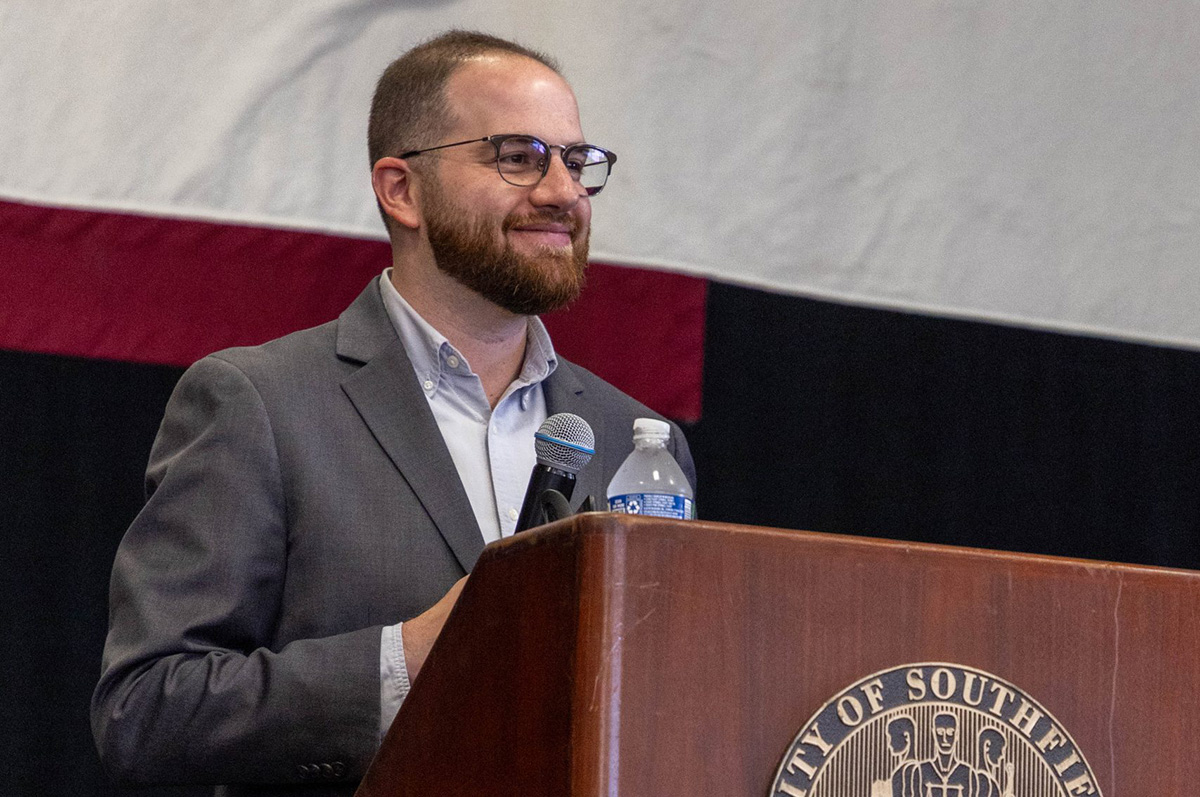
Jeremy Moss is one of those people running for a congressional seat in Michigan. Despite his young age, Moss has quickly learned the ropes of politics in the state, already serving terms in the Great Lakes State’s House of Representatives and Senate.
Moss sat down with the Los Angeles Blade to discuss his history in Michigan politics, his experience as an openly LGBTQ+ legislator and his vision for a better America as he looks toward Congress.
He currently represents Michigan’s 7th Senate District, but now he is setting his sights beyond Lansing toward Capitol Hill to represent Michigan’s 11th Congressional District, which includes Detroit’s northern suburbs.
Moss earned his bachelor’s degree in journalism from Michigan State University, where just a few years later he made history as the first openly gay person elected to the Michigan Senate and the first to serve as its president pro tempore.
His political experience stretches across multiple offices.
Moss worked in the offices of Southfield Mayor Brenda Lawrence, who also served in the U.S. House of Representatives, and State Rep. Paul Condino.
Moss, at age 25, was elected to the Southfield City Council in 2011, becoming the youngest member elected in the body’s history. He then switched over to the state legislature, representing Michigan’s 35th House of Representatives District in the Michigan House of Representatives from 2014-2018, becoming the second openly gay member elected to the Michigan legislature.
He then moved from Michigan’s House to its Senate in 2018, elected to represent the 11th Michigan Senate District and becoming the Assistant Democratic Leader. Moss started his second term in the Michigan Senate in 2023, this time representing District 7.
He currently has a long list of priorities listed on his campaign website, many of which have become standard for Democrats running across the country, with a particular focus on minimizing — and cleaning up — issues that the Republican-controlled federal government has created under President Donald Trump.
Those goals include lowering healthcare costs, tackling the cost of living crisis, holding U.S. Immigration and Customs Enforcement accountable and fixing the broken immigration system, restoring national voting rights, protecting rights — with a particular focus on abortion access and LGBTQ+ rights — combating corruption in politics, preventing gun violence and strengthening gun safety, empowering Michigan workers, and preserving the environment.
Why Moss is running for Congress
When asked why he wants to run for Congress, Moss pointed to his lengthy resume in state leadership, with a clear voice arguing that if he can do it in Lansing, he can get it done in Washington.
“I’ve served 12 years in the legislature and have ascended into leadership as president pro tem of the Senate,” Moss explained to the Blade. “We flipped our state legislative chamber to a Democratic majority for the first time in 40 years in 2022, and we passed some big, generational-changing, consequential Democratic wins that had languished for a generation, but had improved people’s lives in our state.
“We’ve passed the first gun safety laws in a generation that are saving lives. We protected the right to vote amidst attacks from Donald Trump and other conspiracies. We pushed forward and finally put LGBTQ rights in our state civil rights law. We provided free school meals and lunches for all public school children in the state of Michigan.
“The problems from Washington, D.C., aren’t getting less severe over time,” he continued. “They’re getting more severe. So this district unexpectedly opened up due to a series of retirements and it was just a great opportunity for me to continue to advocate for big change that we’ve already achieved here in the state legislature.”
“I’m a product of this district. I grew up here. I’ve represented a bulk of the district already in the state legislature, and I knew that I was going to earn grassroots support to be able to wage this campaign. We sought it out, we earned it, including some premier endorsements from Gov. (Gretchen) Whitmer, among many others, and were highly successful in the primary because we were in tune to the needs of this district.”
Moss has been endorsed by a slew of Democratic leaders and organizations, including, as he pointed out, by Whitmer.
Other endorsements include former Gov. Jim Blanchard, Secretary of State Jocelyn Benson, Attorney General Dana Nessel, the Equality PAC, the Human Rights Campaign, the Unity Fund, and the LGBTQ+ Victory Fund.
His political identity and the Democratic Party
Moss described himself as being “on the liberal end of the spectrum,” but argued that the Democratic Party’s internal divisions should not be the central focus.
“I’m certainly on the liberal end of the spectrum, but I don’t even think it necessarily has to be this progressive versus establishment fight that we’ve seen play out,” Moss said when asked about various elements of in-party disagreements. “It has to be between action and, and inaction, fighters versus folders.”
He said that distinction between action and inaction is central to how he would approach Washington.
“At this moment, I think we need to demonstrate that we are ready to take on Donald Trump and MAGA chaos with boldness and effectiveness. I’ve been saying all along our campaign trail, we can no longer be the party that shows up to the knife fight carrying a pie chart, and so I think we have to be showing that we have spine and we have punch, and we’re really ready to be tough fighters for, for Michiganders and the American people.”
“We can’t walk on eggshells anymore. We can’t pull our punches,” he added. “We can’t fear that we’re offending someone, you know, one way or another with how we act. People are expecting a bold party to take on MAGA, and I think that’s exactly what the Democratic Party needs.”
Becoming an LGBTQ+ legislator
Moss also reminisced with the Blade about his first run for elected office — at a time when Michigan had no openly LGBTQ+ members serving in the state legislature — and how that experience became deeply connected to his identity and his approach to LGBTQ+ politics.
In 2014, Michigan was in the pre-marriage equality era, and the state had no openly LGBTQ+ members serving in the legislature.
“12 years ago in 2014 — this was pre-marriage, the pre-marriage equality era — we had zero people from our community serving in the legislature, and still they were talking about us.
“The big topic then in Michigan was whether or not to expand our civil rights law to include LGBTQ protections, so that people from our community would no longer face discrimination in housing and employment. And they were talking about us regardless of whether or not we were at the table.”
Moss eventually helped lead the effort to expand Michigan’s civil rights protections to include LGBTQ+ people, a measure that passed with bipartisan support.
He said his experience as an openly gay lawmaker allowed him to make the case for LGBTQ+ protections in terms that extended beyond LGBTQ+ issues.
“One thing I definitely aligned with Gov. Whitmer at the time was making the case that discrimination was not only morally wrong, but it was bad for business,” he said. “By not having these protections for our LGBTQ neighbors and family members and friends and community members, we were actually holding back our economy. We were essentially allowing people to be kicked out of Michigan as consumers and workers, because of who they are and how they identified.”
That led to various efforts — including committee hearings and meetings with advocates, businesses and the public — that helped make Michigan what the Movement Advancement Project deems the 16th most LGBTQ+-friendly state, solidly above other states due to its robust LGBTQ+-related legislation.
“I wanted to meet everybody where they were, including those who may have not been involved with or engaged with the LGBTQ community as legislators, but understood that we couldn’t sustain the economic impact of discriminating against our community,” Moss said. “And as I’ve said all along, discrimination is bad for business. That’s something I think helped broaden the vote and earn some bipartisan support for it.”
Representation and LGBTQ+ youth
For Moss, the importance of LGBTQ+ representation also comes from his own experience growing up.
“I think about when I was younger, when I was 18 years old. It was in 2004, and, you know, there are certain things that really shaped me in that time … Michigan had a ballot proposal that passed to have the strictest language banning marriage equality in our state constitution. We didn’t even allow civil unions in that language in our constitution to exist, and there were scandal-plagued LGBTQ politicians.”
“It was the same year that Jim McGreevey was forced to resign as he came out,” he said. “So it really was a signal to me that, you know, you don’t have a future. Not just you don’t have a future in politics; you might not even have a future. Period, and it was pretty defining for me.”
Despite those fears, Moss continued to pursue public office.
“And you can’t be what you can’t see, and so to be able to break the barriers at the state level and at this congressional level, I think is a signal to anybody who is struggling with wondering where their place is?”
“I think that visibility is incredibly important, and it’s something that I needed when I was much younger, and it’s something that I’ve been honored to be able to provide for the, for the next generation of emerging leaders.”
His LGBTQ+ priorities in Congress
When asked what LGBTQ+ issues he would prioritize in Congress, Moss emphasized the importance of growing the number of LGBTQ+ lawmakers while also expanding federal nondiscrimination protections.
“To have a caucus in the legislature has made all the difference because you can, you know, run these issues across the field. You can have somebody take on marriage. You can have somebody take on trans rights. You can have somebody take on LGBTQ youth. You can have somebody take on discrimination protections.”
He sees much of the work he wants to get done on Capitol Hill as a direct follow-up to his work in Lansing — most importantly, the passage of the Equality Act. The legislation has been debated in some form for more than 50 years at the federal level, with the goal of protecting LGBTQ+ people from discrimination under federal law.
“I think the Equality Act is incredibly important. That’s kind of the, the counterpart to what we’ve done in the state legislature, ensuring discrimination protections for the LGBTQ community,” he said.
“I think housing and, and workplace discrimination is, is everything, you know, to protect our community so that they can have a safe place to call home and earn a living … That’s incredibly important across the board. And I would really want to take a leading role in telling the story of how we were able to do it in Michigan after 50 years since this act was first written — and finally finished the job federally to ensure their federal protections in, in, in, in employment and housing.”
LGBTQ+ political organizations and Congress
Moss said the LGBTQ+ political organizations that have supported his political career from its early stages have helped him along the way.
“Obviously, I’ve been affiliated with Victory Fund since I first ran for office, and they were early endorsers, but Equality PAC, which is the political arm of the LGBTQ caucus in Congress, has been an incredible part of my support system. From day one they helped me out.
“I’ve been getting to know a lot of the members of Congress who are LGBTQ, really over the last year of this campaign. So I’m eager to join them. I’m eager to be one of the players on the field here to be able to advocate and advance our issues.”
Voting rights
Voting rights are another major focus for Moss, an issue he said dates back to his experience during the 2004 campaign over marriage equality.
“Something I’m very passionate about is voting rights, and it really does go back to that 2004 campaign where it was very evident that elections can determine your future.
“Elections can determine what rights you do have and don’t have, and so I’ve been very laser focused on increasing access to the ballot box, making sure our democracy remains whole and accessible.”
He explained how Trump’s recent attacks on voting legitimacy and mail-in voting have only made his desire to help that much stronger.
“We went through a real trial of that in 2020 with, with Michigan’s presidential election, with Donald Trump and Rudy Giuliani — as he jetted into Michigan and tried to overturn our valid and accurate election results. We were kind of the spotlight of the nation in that stop this deal movement that led to Jan. 6.”
That, according to Moss, spurred direct action on his end.
“I took the helm as chair of the Senate Elections Committee, and we wrote the law to implement pieces of that ballot proposal, including drafting the law that implemented nine days of early voting here in Michigan, increased access to absentee ballot. We further secured our canvassing and certifications so that nobody could jet in with an alternative slate of electors and send them to Congress on Jan. 6.”
“So I’ve been on the front lines in Michigan on defending our election systems and strengthening protections for both voters to access the ballot box and protections against those who want to overturn our election results.”
Those issues are still present today, he explained.
“He’s pushing for suppressive tactics like the Save Act. The Supreme Court has eroded the federal Voting Rights Act,” Moss said. “I want to really get into Congress as an election expert, we have a Michigan story to tell. I wrote a lot of that story, and, and I think the most urgent thing that we could pass is the John Lewis Voting Rights Act to make sure that there’s no pocket of discrimination anywhere in our country, and that people have the ability to exercise their constitutionally guaranteed right to vote.”
What he would do differently in Washington
Moss also shared that he believes Democrats should communicate differently in Washington, with an emphasis on getting things done.
“Yeah, again, we’ve, we’ve seen politics evolve in this Trump era, and I think that Democrats need to communicate differently.
“He talks so brazenly, and how proud he is that he’s renamed the Gulf of Mexico or Lake Ontario. I put that in the stupid category.
“He’s also done things in the harmful category that he boasts about, like cutting Medicaid and cutting SNAP. And of course, he’s doing things in the dangerous category, but proud of it, like trying to overturn our elections or suppressing the vote.
“What we’re doing is both popular and good for people, whether it’s growing our economy from the middle class outward, whether it’s lowering costs, whether it’s making healthcare more affordable, whether it’s strengthening the core functions of our democracy, we have to be talking about it with the same gusto and confidence that MAGA talks about their agenda.
“I think this is a party that needs more spine and more punch, and really meet this moment because I think that’s what people are looking for, and that’s really what I think a new generation will bring into this next Congress.”
Michigan
Progressives score victory as El-Sayed wins Mich. Senate primary
Democratic newcomer will face Rogers in November
Michigan held its primary on Tuesday, allowing the two major political parties to select their nominees to go head-to-head for the state’s U.S. Senate seat.
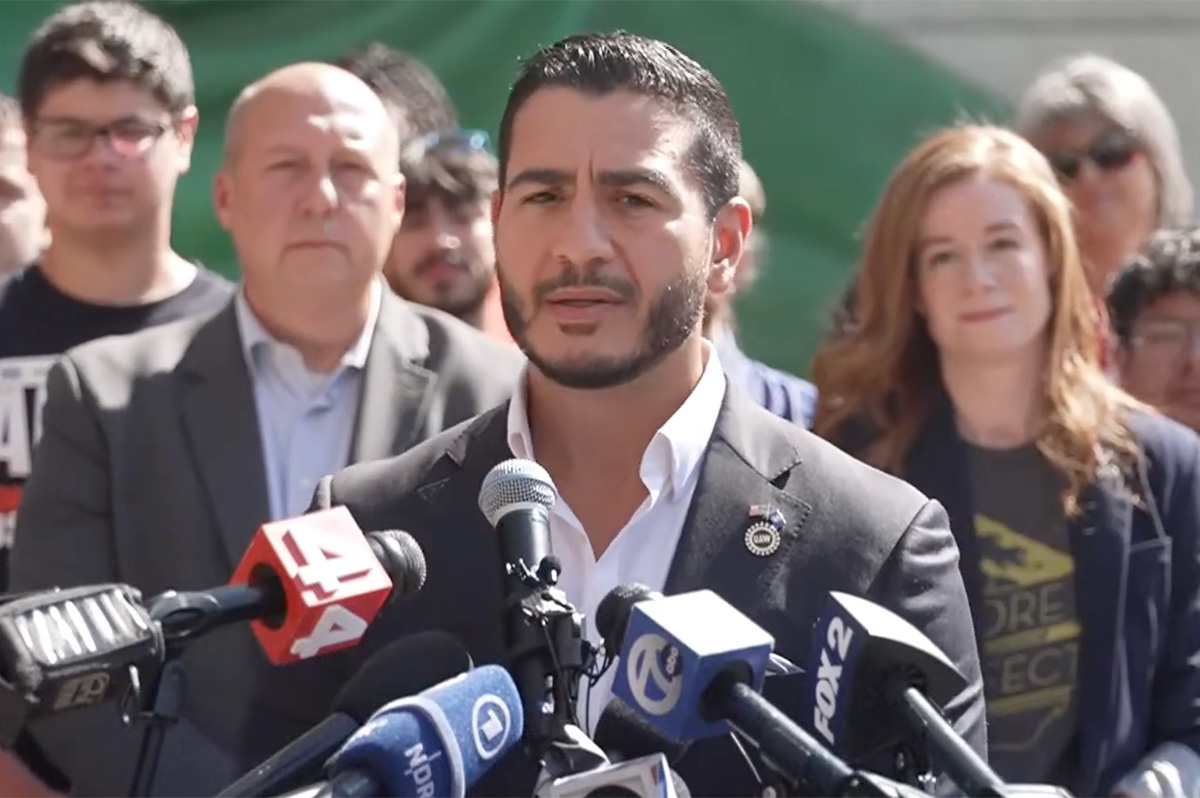
NBC News called the Democratic race early, giving the victory to physician Abdul El-Sayed over incumbent U.S. Rep. Haley Stevens (D-Mich.) in an extremely close primary. El-Sayed won 48.5 percent of the primary vote, with Stevens trailing by just one percentage point at 47.5 percent.
Both candidates have campagined on supporting the LGBTQ+ community through different avenues— for El-Sayed he focused on his past promoting HIV and PrEP funding and research. Stevens focused on her legislative history working to support transgender rights in the state.
This is a major win for progressive Democrats, who have been bearing the brunt of political attacks from President Donald Trump, the Republican Party, and centrist Democrats.
El-Sayed, a former health director in Detroit, ran his campaign largely on making life in the Great Lakes State more affordable amid rising costs. His policies include promoting “Medicare for All,” pushing health policy that targets the regressive efforts of the Trump-Vance administration that rolls back funding for both Women and LGBTQ+ people, minimizing the growing amount of money in politics, and he was very vocal in his criticism of Stevens for supporting aid to Israel. He was endorsed by two major progressives — U.S. Sen. Bernie Sanders (I-Vt.) and U.S. Rep. Alexandria Ocasio Cortez (D-N.Y.).
Stevens, the four-term congresswoman, is much closer to establishment Democrats on policy than El-Sayed.
During her time in the federal government, she has consistently supported the Equality Act, which would add sexual orientation and gender identity as protected classes under the Civil Rights Act of 1964. She has also emphasized supporting local manufacturing and lowering housing costs in the state.
She was named to Advocates for Trans Equality’s 118th Congressional Champions list for her pro-trans policies and was endorsed by establishment heavy hitters Michigan Gov. Gretchen Whitmer and Senate Minority Leader Chuck Schumer (D-N.Y.).
The contentious race boiled down not only to Michigan affairs but also extended to international conflicts — namely Palestine. (South Africa has filed a case in the International Court of Justice in The Hague that accuses Israel of committing genocide in the Gaza Strip after Oct. 7.) This primary also acted as one of the first major races that pushed back against AIPAC, a lobbying group that works to promote pro-Israel candidates in U.S. elections. The group has been involved in domestic politics since 1954.
AIPAC devoted a massive amount of money to this race.
The Associated Press reported that the pro-Israel lobbying group spent more than $30 million on ads against El-Sayed because of his vocal denunciation of Israel and his continued criticism of its policies towards Palestine.
Michigan has a large Muslim and Arab American population, which could, in part, explain how El-Sayed was able to win.
The Republican side was far less competitive. Former U.S. Rep. Mike Rogers (R-Mich.) ran unopposed and clinched the GOP nomination. He has consistently held anti-LGBTQ+ positions, going as far as voting multiple times for a federal constitutional amendment to ban same-sex marriage, voting against repealing the military’s “Don’t Ask, Don’t Tell” policy, and supporting efforts to directly target the attempted expansion of Title IX protections to include trans people.
El-Sayed will face off against Rogers in November for Michigan’s Senate seat — one that could have lasting impacts not only on the state’s politics but also on the Republicans’ narrow Senate majority and Trump’s political agenda.
Michigan
Governor & Michigan lawmakers recognize June as Pride month
House lawmakers passed a resolution Wednesday recognizing June 2024 as Pride month and acknowledging the push for equality for LGBTQ+ people
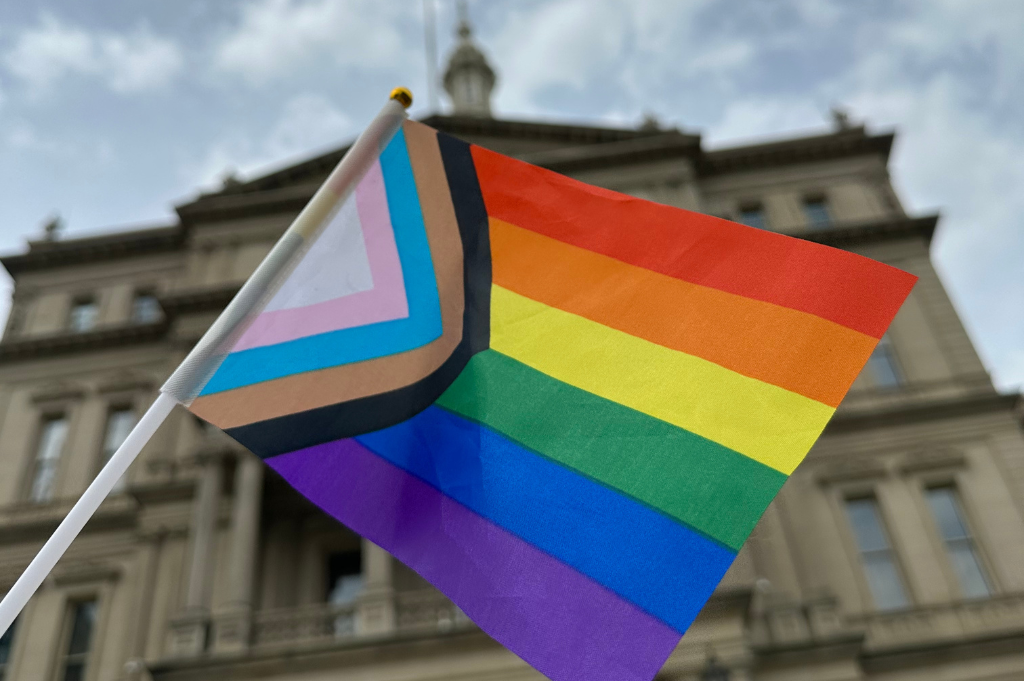

By Lucy Valeski | LANSING, Mich. – It’s Pride month in Michigan, an annual recognition of the LGBTQ+ community marked by parades and celebrations in every corner of the state.
In Lansing, House lawmakers passed a resolution Wednesday recognizing June 2024 as Pride month and acknowledging the push for equality for LGBTQ+ people in Michigan, past and present.
The LGBTQ+ community has celebrated Pride month since June 1970, the one-year anniversary of the Stonewall riots in New York. The month was first recognized in the United States in 1999 by President Bill Clinton. The Michigan legislature did not formally recognize Pride month until 2021.
“Resolutions like this aren’t policy, obviously,” state Rep. Laurie Pohutsky (D-Livonia) told the Advance. “But it’s important that we do everything we can to make sure that folks in Michigan, and particularly our LGBTQ residents, know that they’re welcome and that they have a government that recognizes them and appreciates them and respects them.”
Pohutsky, a member of the House LGBTQ+ Caucus, sponsored the resolution. She said the resolution is especially important this year, as GOP lawmakers previously blocked the recognition of Pride month.
In 2022, the then-GOP-controlled Senate blocked a vote on a resolution recognizing Pride month. Republican lawmakers wanted to add language reflecting that not every Michigander “agrees with the lifestyle of the LGBT community.” The resolution passed the previous year in 2021, but not in 2019 or 2020.
“There was such a long time where we couldn’t even get the bare minimum of a Pride resolution passed,” Pohutsky said.
Gov. Gretchen Whitmer also formally recognized the Pride month with a proclamation on June 1. Whitmer was the first governor to march at the Motor City Pride parade and fly a Pride flag on a state building in 2019.
“Michigan will always be a place where everyone has the freedom to be who they are and love who they love,” Whitmer said in a release. “Our work is not done, but every year, we make progress to move Michigan forward. Let’s keep getting it done.”
LGBTQ+ legislation in Michigan
During this session, Michigan’s Democratic-controlled Legislature has passed several bills aimed at protecting the LGBTQ+ community in the state. Whitmer, a Democrat, signed legislation expanded Michigan’s anti-discrimination law to include LGBTQ+ people last year and banned conversion therapy for minors.
These bills had languished in the Legislature for years when it was led by Republicans.
Lawmakers are also working on a bill that would ban gay and trans panic defenses. The defense excuses crimes, like assault, of an LGBTQ+ person because it lets the perpetrator blame their identity.
But Pohutsky said it is important to think about how any bill will impact the LGBTQ+ community. Laws relating to legal name changes or reproductive rights can affect queer Michiganders in unique ways, she said.
“I think one of the really wonderful things that has happened as a positive consequence of us electing more LGBTQ leaders is that we are more apt to recognize how policies impact the community, and that’s been really important,” Pohutsky said.
******************************************************************************************

Lucy Valeski is a States Newsroom fellow for the Michigan Advance. She is currently a student at the University of Missouri, where she studies journalism and political science. She previously covered local government for the Columbia Missourian, statewide news for Missouri Business Alert and technology policy for MLex in Brussels.
******************************************************************************************
The preceding story was previously published by the Michigan Advance and is republished with permission.
Corporate media aren’t cutting it. The Michigan Advance is a nonprofit outlet featuring hard-hitting reporting on politics and policy and the best progressive commentary in the state.
We’re part of States Newsroom, the nation’s largest state-focused nonprofit news organization.
Michigan
Michigan State University investigating alleged hate crime
MSU’s interim vice president and chief safety officer notes that the incident occurred during the school’s LBGTQ Pride Month

EAST LANSING, Mich. – Michigan State University Police and Public Safety officials confirmed that a group of seven suspects assaulted two victims on Monday, April 15, 2024, at the MSU Main Library, potentially selecting the victims because of the perpetrators sexual orientation bias.
According to MSU police, a warning was issued to all MSU students, faculty and staff on Monday, and the suspects were identified on Tuesday. None of the suspects are affiliated with MSU. The investigation into this incident is ongoing.
Once the investigation is completed, it will be submitted to the Ingham County Prosecutor’s Office with a request for charges against the suspects.
MSU Vice President and Spokesperson Emily Guerrant said two MSU students were followed into the library by seven non-MSU students who appeared to be of high school age, the Lansing State Journal reports. The suspects continued to follow the two MSU students to the third-floor study area. A video posted to an anonymous messaging board shows a physical altercation ensued.
Fox 47 News in Lansing reported that a student at MSU and a member of a group dedicated to advocating for transgender and non-binary students told the station: “I was shocked and appalled to see that happened on this campus,” said Lyra who asked that only her first name was used.
MSU’s Gender and Sexuality Campus Center is offering online and in-person support for students following the incident.
“It is important to recognize that crimes are never the fault of a victim,” the school wrote in a statement. “Anyone who believes they have been discriminated against or harassed is encouraged to report the incident(s) to the MSU Office of Institutional Equity.”
Doug Monette, MSU’s interim vice president and chief safety officer, and Vennie Gore, the senior vice president for the school’s student life and engagement department, addressed students and faculty in a separate statement on Tuesday, according to NBC News. The statement notes that the incident occurred during the school’s LBGTQ Pride Month and that it was also based on the students’ “racial identities” in addition to their sexualities.
Michigan
Michigan Democrats spar over LGBTQ+ inclusive hate crime law
Michigan could soon become the latest state to pass an LGBTQ-inclusive hate crime law but lawmakers disagree on just what kind of law to pass

By Rob Salerno | LANSING, Mich. – Michigan could soon become the latest state to pass an LGBTQ-inclusive hate crime law, but the state’s Democratic lawmakers disagree on just what kind of law they should pass.
Currently, Michigan’s Ethnic Intimidation Act only offers limited protections to victims of crime motivated by their “race, color, religion, gender, or national origin.” Bills proposed by Democratic lawmakers expand the list to include “actual or perceived race, color, religion, gender, sexual orientation, gender identity or expression, ethnicity, physical or mental disability, age, national origin, or association or affiliation with any such individuals.”
Democratic Governor Gretchen Whitmer and Attorney-General Dana Nessel have both advocated for a hate crime law, but house and senate Democrats have each passed different hate crimes packages, and Nessel has blasted both as being too weak.
Under the house proposal that passed last year (HB 4474), a first offence would be punishable with a $2000 fine, up to 2 years in prison, or both. Penalties double for a second offense, and if a gun or other dangerous weapons is involved, the maximum penalty is 6 years in prison and a fine of $7500.
But that proposal stalled when it reached the senate, after far-right news outlets and Fox News reported misinformation that the bill only protected LGBTQ people and would make misgendering a trans person a crime. Bill sponsor Rep. Noah Arbit was also made the subject of a recall effort, which ultimately failed.
Arbit submitted a new version of the bill (HB 5288) that added sections clarifying that misgendering a person, “intentionally or unintentionally” is not a hate crime, although the latest version (HB 5400) of the bill omits this language.
That bill has since stalled in a house committee, in part because the Democrats lost their house majority last November, when two Democratic representatives resigned after being elected mayors. The Democrats regained their house majority last night by winning two special elections.
Meanwhile, the senate passed a different package of hate crime bills sponsored by Sen. Sylvia Santana (SB 600) in March that include much lighter sentences, as well as a clause ensuring that misgendering a person is not a hate crime.
Under the senate bill, if the first offense is only a threat, it would be a misdemeanor punishable by 1 year in prison and up to $1,000 fine. A subsequent offense or first violent hate crime, including stalking, would be a felony that attracts double the punishment.
Multiple calls and emails from The Blade to both Rep. Arbit and Sen. Santana requesting comment on the bills for this story went unanswered.
The Attorney-General’s office sent a statement to The Blade supporting stronger hate crime legislation.
“As a career prosecutor, [Nessel] has seen firsthand how the state’s weak Ethnic Intimidation Act (not updated since the late 1980’s) does not allow for meaningful law enforcement and court intervention before threats become violent and deadly, nor does it consider significant bases for bias. It is our hope that the legislature will pass robust, much-needed updates to this statute,” the statement says.
But Nessel, who has herself been the victim of racially motivated threats, has also blasted all of the bills presented by Democrats as not going far enough.
“Two years is nothing … Why not just give them a parking ticket?” Nessel told Bridge Michigan.
Nessel blames a bizarre alliance far-right and far-left forces that have doomed tougher laws.
“You have this confluence of forces on the far right … this insistence that the First Amendment protects this language, or that the Second Amendment protects the ability to possess firearms under almost any and all circumstances,” Nessel said. “But then you also have the far left that argues basically no one should go to jail or prison for any offense ever.”
The legislature did manage to pass an “institutional desecration” law last year that penalizes hate-motivated vandalism to churches, schools, museums, and community centers, and is LGBT-inclusive.
According to data from the U.S. Department of Justice, reported hate crime incidents have been skyrocketing, with attacks motivated by sexual orientation surging by 70% from 2020 to 2022, the last year for which data is available.
Twenty-two states, DC, Puerto Rico, and the US Virgin Islands have passed LGBTQ-inclusive hate crime laws. Another 11 states have hate crime laws that include protections for “sexual orientation” but not “gender identity.”
Michigan Democrats have advanced several key LGBTQ rights priorities since they took unified control of the legislature in 2023. A long-stalled comprehensive anti-discrimination law was passed last year, as did a conversion therapy ban. Last month the legislature updated family law to make surrogacy easier for all couples, including same-sex couples.
A bill to ban the “gay panic” defense has passed the state house and is due for a senate committee hearing April 17.
******************************************************************************************
Rob Salerno is a writer and journalist based in Los Angeles, California, and Toronto, Canada.
Michigan
Michigan venue: No same-sex marriages, formal complaint filed
The business owned by Mitch and Kelli VanOverloop said they were “discussing things further with their lawyer”

HUDSONVILLE, Mich. – A wedding venue in a West Michigan farming community has sparked a formal complaint to the Michigan Department of Civil Rights and the Michigan Attorney General’s Office over its policies on same-sex weddings.
The Old Wooden Barn wedding venue in Hudsonville, Mich. states its marriage policy clearly online:
“Because God has ordained marriage and defined it as the covenant relationship between a man, a woman and Himself, the Old Wooden Barn will only recognize marriages between a biological man and a biological woman. Further, the staff of the Old Wooden Barn shall only participate in and host weddings between a man and a woman. We thank you for respecting our Christian family values.”
According to a local media outlet, the Holland Sentinel, the Surfus Foundation, an LGBTQ+ foundation based in Grand Rapids filed a formal complaint with the Michigan Department of Civil Rights and the Michigan Attorney General’s Office last month.
The Sentinel reported that the foundation feels the policy “is a clear violation” of the Elliot-Larsen Civil Rights Act Expansion of 2023 and the Michigan Supreme Court’s decision in Rouch World vs. the Michigan Department of Civil Rights.
In a letter to both parties, signed by Chris Surfus, the foundation requests “enforcement of laws against this and similar businesses across the state of Michigan that choose to create policies that discriminate against the LGBTIQ+ community.”
The Elliott-Larsen Civil Rights Act was created to eliminate discrimination in employment, housing, public service and the use of public accommodations. In 2023, the law was amended to add sexual orientation, gender identity and gender expression as protected classes.
The business owned by Mitch and Kelli VanOverloop told The Sentinel they were “discussing things further with their lawyer.”
Michigan
Anti-LGBTQ+ Michigan salon owner faces discrimination charges
Studio 8 and Geiger could have state licensing certifications revoked based on violation of Michigan’s Elliott-Larsen Civil Rights Act

By Lily Guiney | LANSING, Mich. – The Michigan Department of Civil Rights (MDCR) has issued a charge of discrimination against Studio 8 Hair Lab, the Traverse City salon that drew national attention in July for anti-trans online posts made by its owner, Christine Geiger.
Geiger declared in an initial Facebook post in July that her salon would deny service to transgender and nonbinary people and said that she was protected by “free speech.”
“If a human identifies as anything other than a man/woman please seek services at a local pet groomer,” Geiger wrote in the post. “You are not welcome at this salon.”

The charge reasoned that Michigan law “makes it is unlawful for Studio 8 to print, circulate, post, mail, or otherwise cause to be published” a statement which indicates that the “full and equal enjoyment” of goods or services will be refused because of sex, or that an individual’s patronage is “objectionable, unwelcome, unacceptable, or undesirable” for the same reason.
In a Wednesday morning press conference, MDCR Director John Johnson said that Geiger’s post, and subsequent doubling down on her stances, were in violation of Michigan’s Elliott-Larsen Civil Rights Act (ELCRA).
“This is not a complicated case,” Johnson said. “It is not a case that relies on complex legal concepts or that requires expensive or convoluted arguments to explain. Christine Geiger has responsibilities under law as the owner of a business offering services to the public in the state of Michigan.”
The Advance called Geiger for comment at the salon, but the voicemail was full.
MDCR officials said that the charge is one of unlawful advertisement, not free speech. According to the charge, even though Geiger didn’t physically remove someone from her salon based on their gender identity, the posts she made still negatively impacted LGBTQ+ members of the community.
“As a direct and proximate result of Respondent’s unlawful discrimination, Claimants L.M., H.S. and M.H. have suffered the loss of full and equal enjoyment of a public accommodation due to Respondent’s published statements,” the charge read.
MDCR Director of Enforcement Marcellina Trevino said that the department’s investigative process was followed to determine whether there was cause for a charge of discrimination, including trying to facilitate a conciliatory meeting with Geiger.
“Our staff attorney attempted to set up a meeting with [Geiger] to address the issues in the complaint and to go over the sufficient evidence that we found,” Trevino said. “To our dismay, the respondent refused to participate in conciliation, and therefore our staff attorney drafted a charge which was filed this morning with the Michigan Office of Administrative Hearings and Rules.”
Geiger filed her own lawsuit on Oct. 25 against the city of Traverse City and the three individuals who submitted complaints to the MDCR, citing her business’s right to “use its talents and the expressive platform they have to celebrate and promote God’s design for male and female.”
While MDCR officials were unable to comment on Geiger’s ongoing lawsuit, Trevino said that the three complainants, two of whom are nonbinary, are protected from certain forms of retaliation under ELCRA.
“Under the Elliott Larsen Civil Rights Act, there are protections against retaliation for participating in a protected activity, such as filing an unlawful discrimination complaint with our department,” Trevino said.
The next step for the Studio 8 case will be awaiting a hearing before an administrative law judge. The MDCR’s charge requests that Geiger pay the claimants for emotional distress and “mental anguish” her posts caused. If decided after a hearing, Studio 8 and Geiger could have state licensing certifications revoked based on violation of ELCRA.
MDCR Director of Legal Affairs Bryant Osikowicz said that the charge shouldn’t be misconstrued as an issue of religion or freedom of speech.
“I will just say that free speech is not absolute,” Osikowicz said. “The classic example from law school is you can’t yell fire in a crowded theater, that type of thing, and we were very specific in this charge. This is not a free speech case. This is a discriminatory advertisement case.”
******************************************************************************************

Lily is a contributor to the Michigan Advance and a former reporting intern. Her coverage areas included state government and politics, including abortion rights and gun violence prevention issues.
*************************************************************************************
The preceding story was previously published by the Michigan Advance and is republished with permission.
Corporate media aren’t cutting it. The Michigan Advance is a nonprofit outlet featuring hard-hitting reporting on politics and policy and the best progressive commentary in the state.
Related:
Michigan
Federal lawsuit: Hamtramck’s Pride flag ban is unconstitutional
When the council voted to ban Pride flags in June, conservative Muslims clashed with LGBTQ+ residents with some shouting homophobic slurs
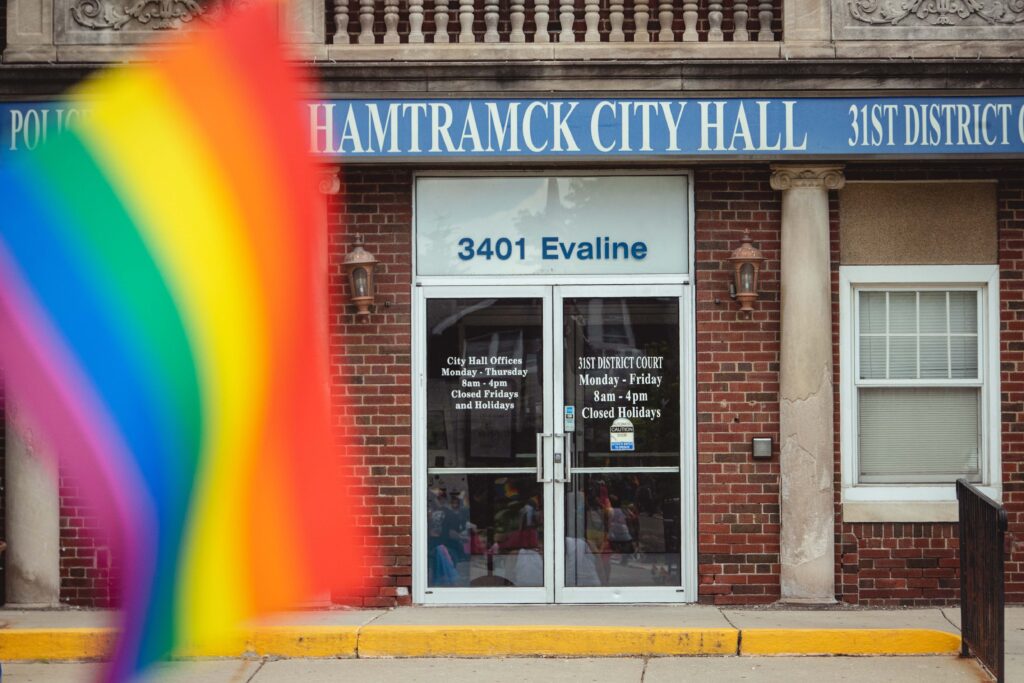
By Steve Neavling | HAMTRAMCK, Mich. – A federal lawsuit filed Monday alleges the city of Hamtramck’s Pride flag ban violates free speech rights and numerous other state and federal laws.
The lawsuit in the U.S. District Court in Detroit was filed on behalf of former Hamtramck Human Relations Commission members Russ Gordon and Cathy Stackpoole. The Hamtramck residents were fired from the commission in July, a month after the all-Muslim city council unanimously approved a flag “neutrality” ordinance in July.
Although the ban also prohibits religious, ethnic, racial, and political flags, the impetus was the LGBTQ+ Pride flag, which many local Muslims complained was an affront to their religion.
The lawsuit, filed by attorney Marc M. Susselman, argues the ban violates the First Amendment right to free speech and the equal protection clause of the 14th Amendment.
“It is unconstitutional for government to select what speech will be permitted, and what speech will be prohibited, based on the content or viewpoint of the message conveyed by the speech,” the lawsuit states.
Susselman argues that the ban is not neutral because it allows the display of the Prisoners of War flag and other countries’ flags.
The lawsuit seeks to overturn the flag ban and reinstate Gordon and Stackpoole.
In an act of defiance, Gordon and Stackpoole displayed a Pride flag on public property on Joseph Campau Avenue on July 9. Police removed the flag after a councilman complained.
Two days later, the city council unanimously approved a resolution removing Gordon and Stackpoole from the Human Relations Commission.
The lawsuit argues that Gordon and Stackpoole did nothing wrong when they displayed the Pride flag.

“In so doing, Gordon was not violating the law,” the lawsuit states. “An unconstitutional Resolution is itself a violation of law, and a citizen who violates an unconstitutional, and therefore unlawful, Resolution cannot be violating the law. Rather, the Councilmen who voted in favor of the unconstitutional Resolution violated the law by violating the Constitution.”
Since the ban, dozens of Pride flags on private property have been vandalized, and residents in the diverse city say they feel alienated and maligned by conservative Muslims who view homosexuality as a sin and peddle false narratives about children being indoctrinated in schools.
More than half of Hamtramck’s residents are believed to be Muslim. In January 2022, Hamtramck became the first city in the U.S. to have an all-Muslim City Council. The mayor, Amer Ghalib, is also Muslim.
Tensions between conservative Muslims and progressive began to simmer in the summer of 2021, when then-Mayor Karen Majewski broke a 3-3 City Council tie to fly a Pride flag outside of City Hall.
A backlash ensued as conservative Muslims began to complain, saying the flag was an affront to their religion. Ghalib, a health care worker and Muslim immigrant from Yemen, made the flag a campaign issue and handily defeated Majewski, a four-term mayor, in November 2021.
When the council voted to ban Pride flags in June, conservative Muslims clashed with LGBTQ+ residents and their allies, with some shouting homophobic slurs. Since then local Muslims have joined forces with conservative Republicans, pledging to create an alliance to oppose LGBTQ+ rights. The coalition is propelled by crackpot ideas that public schools are “grooming” and indoctrinating impressionable children.
This story first ran in the Detroit Metro Times. Follow them: Google News | NewsBreak | Reddit | Instagram | Facebook | Twitter
******************************************************************************************

Steve Neavling is an award-winning investigative journalist with the Detroit Metro Times. He operated Motor City Muckraker, an online news site devoted to exposing abuses of power and holding public officials accountable.
Neavling also hosted Muckraker Report on 910AM from September 2017 to July 2018. Before launching Motor City Muckraker, Neavling was a five-year veteran of the Detroit Free Press, covering Detroit’s city hall.
*************************************************************************************
The preceding story was published by the Michigan Advance and is republished with permission.
Corporate media aren’t cutting it. The Michigan Advance is a nonprofit outlet featuring hard-hitting reporting on politics and policy and the best progressive commentary in the state.
Michigan
School board orders LGBTQ+ mural removed from health clinic
“We reluctantly were willing to accept to ensure the children continue to have access to medical and behavioral health care”

GRANT, Mich. – The battle over a controversial LGBTQ+ affirming mural painted on the wall at the Child and Adolescent Health Center at Grant Middle School climaxed Monday after the Grant Public Schools Board of Education voted to renew the healthcare provider’s contract with the stipulation the mural is removed.
The Muskegon Chronicle reported that Superintendent Brett Zuver said the new contract stipulates that Family Health Care, the provider that operates the Child and Adolescent Health Center, must remove the mural, which was painted by a student who won an art contest, by the end of October.
In a statement Monday, Family Health Care spokesperson Alan Neushwander said the mural highlighted diversity and inclusion, values that are important to the health care provider.
“While it is disappointing that the mural must be removed by the end of October, it’s a compromise we reluctantly were willing to accept to ensure the children of the Grant community continue to have access to medical and behavioral health care,” Neushwander said in the statement, which can be viewed in full here.
Some parents of teenagers in this Western Michigan small town about an hour North of Grand Rapids were extremely angry over the LGBTQ+ affirming mural.
During a school board meeting last year, the anger spilled over into heated arguments with some in the audience saying the transgender flag, a video game character and other symbols painted in the mural were ‘Satanic.’ Prior to the board meeting social media threads on posts critical of the mural had become the mainstay of community discussions around Grant.
The student artist from Grant High School, Evelyn Gonzales, who was responsible for creating the mural maintains the artwork is intended to be inclusive. “I put my art up there to make people feel welcome,” she told WZZM 13, the ABC News affiliate in Grand Rapids in October of 2022.
Gonzales explaining her thinking and creative process did little to calm the enraged parents WZZM 13 reported as after she made her remarks and fled in tears one stood up and angrily said “I feel like she did a really good job finding excuses to defend the things she put on,” said Katelyn Thompson. “None of us are that stupid.”
As for the transgender flag, one parent implied it’s a sickness.
“When adults pretend things that are like real life, it’s a mental illness,” says Danielle Beight. “We need counselors, we need medication that’s going to help bipolar disorder, fix their brains.”
With another saying it is discriminatory against Christian beliefs.
“We and our administration should embrace that and get all of this hate material out of our schools, because it is hate material,” says Nate Thompson.
While some parents called for the mural to be removed or altered, WZZM reported that Grant Public Schools handbook includes a nondiscriminatory policy, saying in part, “any form of discrimination or harassment can be devastating to an individuals academic progress, social relationship and/or personal sense of self-worth.”
Michigan
Michigan: 22nd state to ban conversion therapy for LGBTQ+ youth
The ban is part of several LGBTQ+ rights measures considered this term after Democrats have the majority in both chambers
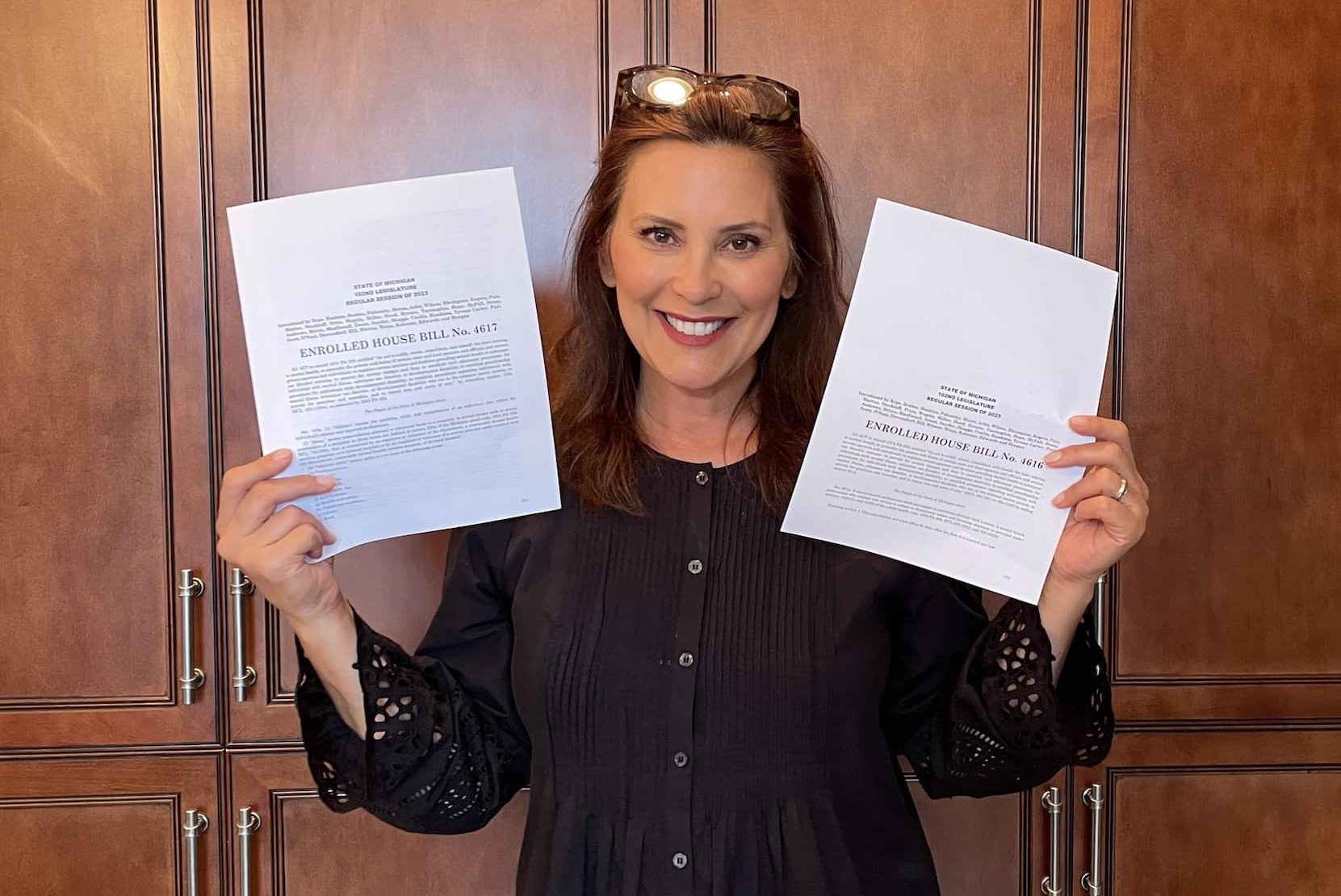
By Anna Liz Nichols | LANSING, Mich. – A ban on conversion therapy for minors was signed into law in Michigan Wednesday in the latest development of the new Democratic-led state Legislature’s push for LGBTQ+ rights in Michigan.
Gov. Gretchen Whitmer said in a news release Wednesday that as the mother of a gay daughter, she is grateful to have the opportunity to make the state a more welcoming place to live for everyone’s children.
“Today, we are banning the horrific practice of conversion therapy in Michigan and ensuring this is a state where you can be who you are,” Whitmer said. “Let’s continue working together to ensure anyone can ‘make it’ in Michigan, expand fundamental freedoms, and fight back against any and all forms of discrimination.”
The legislation, HB 4616 and HB 4617, effectively bars mental health professionals from seeking to alter a minor’s sexual orientation or gender identity, or risk facing disciplinary action that could result in the loss of their professional licenses.
The legislation does not prohibit the practice of gender-affirming care or support during exploration of gender or sexuality or counseling to prevent unsafe relationship practices.
There is no evidence that conversion therapy works, but there is evidence that shows it is dangerous to children, bill sponsor Rep. Felicia Brabec (D-Pittsfield Twp.), who is also a clinical psychologist, said in the news release from the governor’s office and in her testimony on the House floor in June.
“I am acutely aware that kids need to be free to express themselves without the fear or threat of damaging pseudo-psychology like conversion therapy. With the support of several mental health organizations throughout our state and nation, I can confidently say that this law will help to ensure that therapists like myself continue to do no harm in our practices, while protecting the LGBTQ youth in our state,” Brabec said.
Proponents of banning conversion therapy say legislation like what’s being implemented in Michigan prevents suicide.
When Whitmer signed an executive order in 2021 banning the use of state and federal funds being used for conversion therapy on minors, the Trevor Project, a non-profit group working to create a safer environment for LGBTQ+ kids, applauded the action. The Trevor Project added at the time that a 2020 report by the Williams Institute at UCLA School of Law found that lesbian, gay and bisexual youth who experienced conversion therapy were more than twice as likely to report multiple suicide attempts in the last year than their peers who hadn’t been in conversion therapy.
Erin Knott, executive director of Equality Michigan, which works to reach out and advocate for LGBTQ+ Michiganders, said, “today is a good day” because the ban is a win for Michigan against the “torture” of conversion therapy.
‘The practice is inherently discriminatory, they are cruel, inhumane and degrading treatments that, depending on the severity, physical or mental pain, the suffering inflicted on a victim oftentimes amounts to torture,” Knott said. “This is just one step in terms of mitigating torture and trauma to our kids as well as letting them know or giving them a signal that they are loved and supported and valued as they are, there’s no need to attempt to change them for who they are or how they identify.”
The ban is part of several LGBTQ+ rights measures considered this term after Democrats have the majority in both chambers in the state legislature for the first time in nearly 40 years. The state’s 1976 civil rights laws got an update in March when Whitmer signed into law legislation to extend protections against discrimination on the basis of gender identity and sexual orientation.
Currently, expansions to the state’s hate crime laws, which would add protections for abuses suffered by individuals because of their sexual orientation or gender identity are making their way through the Legislature.
The legislation signed Wednesday creates penalties for licensed mental health professionals, but doesn’t address unlicensed professionals who perform conversion therapy, including religious leaders providing conversion therapy with no mental health care licensure.
Related:
However, Brenden Bell, care manager at Affirmations LGBTQ+ Community Center in Ferndale said in his experience, both being in religious ex-gay support groups in the past and in working with individuals at Affirmations, many conversion therapy efforts by religious organizations are led by licensed mental health professionals. So while the legislation may not have the teeth some advocates may hope for, Bell said the legislation does work towards cultural acceptance of the queer community in Michigan.
“I’m just feeling a sense of relief that at least from a cultural perspective we’re starting to recognize and take seriously how harmful this is to people. … We have a lot more work to do in terms of queer rights…but I feel like this is an important step and I feel relieved that this is something we can all finally agree is unequivocally bad and abusive,” Bell said.
But the ban is not supported unequivocally, as all Republican representatives in the House voted against the bills and all but one Republican senator rejected them in the Senate.
Rep. Nancy De Boer (R-Holland), along with several of her Republican colleagues gave similar no vote explanations, saying the bills limit conversations mental health care providers can have with patients and interfere with family conversations.
“I voted to put families over vague mandates and radical political agendas,” De Boer said. “Parents in consultation with qualified medical professionals are better qualified to make important decisions regarding their child’s development, not politicians in Lansing.”
Knott said conversion therapy can actually drive a wedge between kids and their parents, dismantling trust.
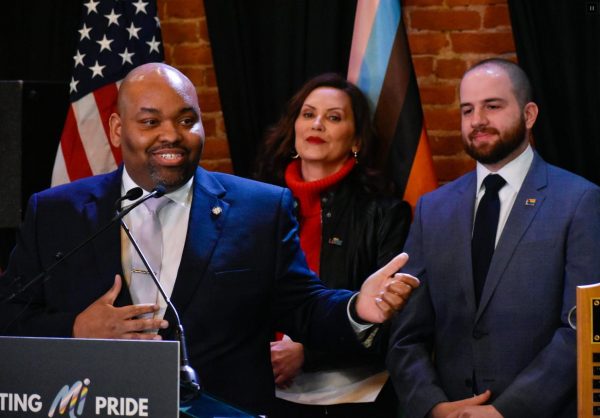
“Conversion therapy is based on this myth that being LGBTQ+ is caused by bad parenting or childhood abuse,” Knott said. “For the kids that are subjected to conversion therapy, the biggest issue that they experience is shame, self-harm and suicide and no child deserves that kind of trauma. They do not deserve to be a trauma survivor when they’re just a kid.”
Bill sponsor Rep. Jason Hoskins (D-Southfield), said the LGBTQ+ community has endured enough under obstacles to acceptance like conversion therapy.
“Today marks a significant step forward as we bid farewell to a harmful and deceitful practice that has inflicted considerable harm upon the LGBTQ+ community since its inception,” Hoskins said in the news release. “With this legislation, we are creating a safer environment for Michigan’s children. It is a powerful message of love, hope, and acceptance, paving the way for brighter days ahead.”
*****************************************************************************************

Anna Liz Nichols covers government and statewide issues, including criminal justice, environmental issues, education and domestic and sexual violence. Anna is a former state government reporter for The Associated Press and most recently was a reporter for the Detroit News. Anna is a graduate of Michigan State University.
*****************************************************************************************
The preceding article was previously published by the Michigan Advance and is republished by permission.
Corporate media aren’t cutting it. The Michigan Advance is a nonprofit outlet featuring hard-hitting reporting on politics and policy and the best progressive commentary in the state.

Step into the ‘Crush House’ with JJ Aussie and Josh Moore

Jeremy Moss looks to bring LGBTQ+ advocacy from Lansing to Capitol Hill

‘There are resources available’: Justin Todd talks LGBTQ addiction treatment and recovery

More than 150 people detained outside Istanbul courthouse

Advocate, Out parent company adds Trump supporter to board, prompting outrage

Indonesia’s top Muslim clerical body proposes criminalizing LGBTQ+ people, advocacy

Fashion icon Bob Mackie dead at 87

The 78th Annual Emmy Awards recapped

L.A. DJs Heidi Lawden and FLABBERGAST call for resistance in ‘Children of the Revolution’

Grand marshals announced for 2026 Greater Palm Springs Pride
-
 India3 days ago
Indonesia’s top Muslim clerical body proposes criminalizing LGBTQ+ people, advocacy
-
 Celebrity News4 days ago
Fashion icon Bob Mackie dead at 87
-
 EMMYS3 days ago
The 78th Annual Emmy Awards recapped
-
 Music & Concerts3 days ago
L.A. DJs Heidi Lawden and FLABBERGAST call for resistance in ‘Children of the Revolution’
-
California3 days ago
Grand marshals announced for 2026 Greater Palm Springs Pride
-

 Turkey4 days ago
Dozens detained after Turkish authorities raid LGBTQ groups, businesses
-

 Hungary4 days ago
New Hungarian government to scrap anti-LGBTQ+ adoption law
-

 a&e features5 days ago
Cameron Esposito will make you laugh (and cry) on ‘King of Drag’ season 2
-

 Books4 days ago
Dolly Parton biography puts her hardships into context
-
 National3 days ago
Advocate, Out parent company adds Trump supporter to board, prompting outrage