
National
Trump to honor Charlie Kirk with Medal of Freedom
Anti-LGBTQ political activist assassinated in Utah on Wednesday

At a Sept. 11 remembrance ceremony at the Pentagon on Thursday, President Donald Trump announced that he will award right-wing political activist Charlie Kirk the Presidential Medal of Freedom.
Kirk was assassinated less than 24 hours earlier at Utah Valley University while speaking on conservative talking points to a crowd.
The 31-year-old conservative commentator is best known for founding Turning Point USA, a nonprofit that sought to build a robust conservative youth movement. He earned notoriety for his unwavering loyalty to Trump, his advocacy of expansive Second Amendment rights, and his opposition to LGBTQ rights. Conservatives and far-right supporters have quickly elevated Kirk to martyr status since his death.
“Before we begin, let me express the horror and grief so many Americans feel at the heinous assassination of Charlie Kirk,” Trump said. “Charlie was a giant of his generation, a champion of liberty, and an inspiration to millions and millions of people.”
As of now, there is no indication when the award ceremony will take place, although Trump said “I can only guarantee you one thing, that we will have a very big crowd.”
Many credit Kirk with helping Trump return to the White House in 2024 by mobilizing young voters — particularly young men — on behalf of the twice-impeached president.
Kirk’s stance against LGBTQ rights was a central part of his political brand.
A staunch opponent of Obergefell v. Hodges, the landmark Supreme Court ruling requiring states to recognize same-sex marriage, Kirk often used incendiary rhetoric, at times calling for the erosion of LGBTQ rights altogether.
As host of “The Charlie Kirk Show” on the Salem Radio Network, he frequently denounced transgender participation in sports, referring to trans people and their supporters as “sick.” He also suggested they should be “taken care of like how things in the 1950s and 60s” were — an allusion many critics interpreted as a reference to lobotomies, shock therapy, and forced institutionalization.
Kirk often framed his views through the lens of “Christian values.”
On his YouTube channel, he invoked biblical passages, at one point citing Leviticus 20:13 to claim that the Bible’s call for the stoning of gay men reflected “God’s perfect law.”
The Washington Blade contacted several LGBTQ advocacy organizations for comment on Trump’s decision to posthumously honor Kirk, a man widely criticized for his hostility toward the LGBTQ community. Many focused instead on condemning the violence that ended his life.
“Political violence is unacceptable and has no place in this country,” said Kelley Robinson, president of the Human Rights Campaign, in an emailed statement. “We cannot ever accept this epidemic of gun violence as normal. We cannot keep living like this.”
Kristen Browde, president of the Florida LGBTQ+ Democratic Caucus, which has 21 chapters across the state, making it one of the largest LGBTQ caucuses in the nation, echoed those sentiments while pointing to the consequences of Kirk’s rhetoric.
“Political violence, for any reason, is wrong. Gun violence, for any reason, is wrong. Spending your life, inciting violence, demonizing political opponents? Attacking those who are different? Every bit as wrong. And when violence follows such actions? One can’t be shocked. All you can do is recommit yourself to fight against it.”
According to videos — and witnesses at Utah Valley University, Kirk was shot seconds after beginning to answer a question about how many”transgender” people were responsible for “mass shootings,” where he answered “too many.”
As of Thursday evening, Kirk’s killer remained at large. The FBI has identified a person of interest in its investigation and is offering a $100,000 reward for information leading to an arrest.



New York
NYC lawmakers seek to repeal bathhouse ban
Current policy enacted in 1980s in response to AIDS crisis
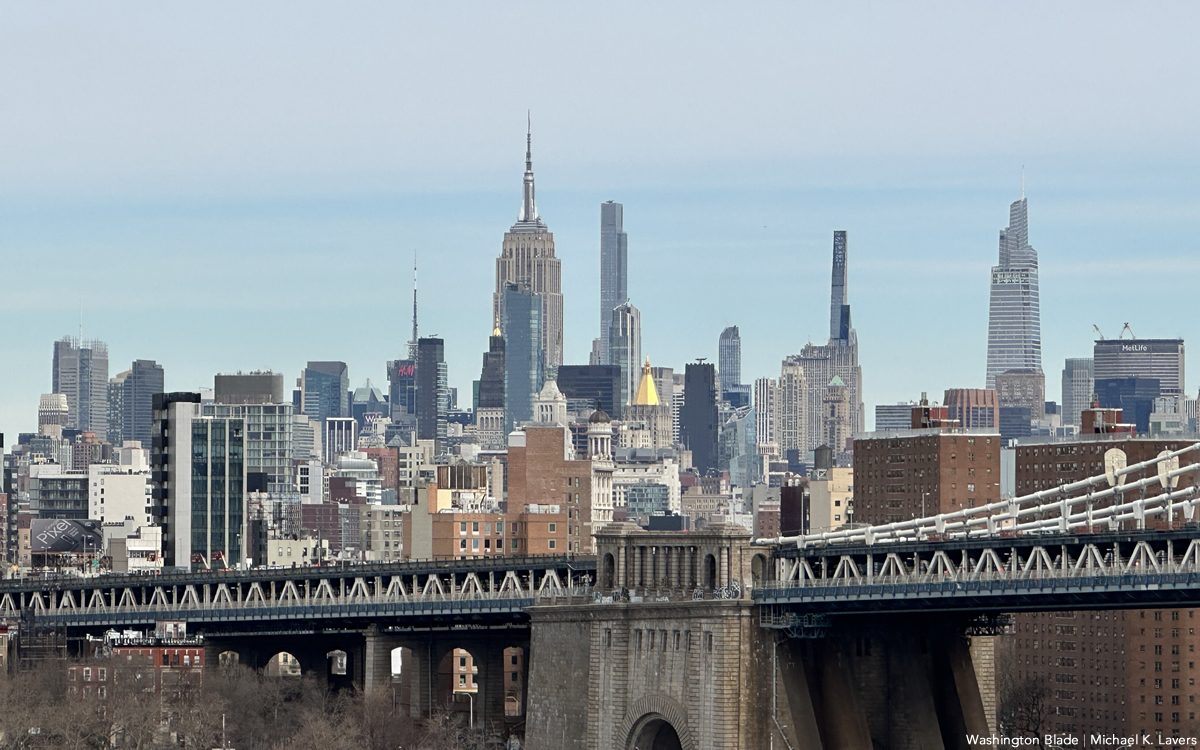
New York City lawmakers are pushing to repeal a decades-old prohibition on adult bathhouses, arguing the regulation was created during the height of the AIDS crisis and no longer reflects modern science or public health practices.
Erik Bottcher, the openly gay New York state senator who represents the 47th District that includes the Upper West Side, Chelsea, Hell’s Kitchen and portions of the West Village in Manhattan, is leading the charge to remove the decades-old ban. (Openly gay state Assemblymember Tony Simone has sponsored the repeal bill in the New York State Assembly.) Bottcher sat down with the Los Angeles Blade to discuss why he is advocating for more bathhouses in New York City.
“This is simply about ensuring that our public health policy is in line with today’s science,” he told the Blade. “The prohibition on adult bathhouses was put into place in 1985 at the height of the the AIDS epidemic, when there was very little information, very little treatment options, few treatment options, and great deal of fear. Science has changed. Treatment has changed, and the laws need to change too.”
The proposed legislation would direct the New York State Department of Health to repeal the 1985 regulation and establish a new framework for regulating bathhouses.
“Municipalities around the country and all around the world allow for adult bathhouses. There’s no reason why New York City alone needs to maintain this outdated prohibition. Our bill orders the New York State Department of Health to strike the 1985 regulation and replace it with a regulated public health framework that’s grounded in science.”
Under the proposal, bathhouses would operate as licensed and regulated facilities subject to health and safety standards. Backers of the proposal say that framework could also give public health officials greater access to people who may otherwise be difficult to reach through traditional health care settings.
“What the Department of Health would do is work with public health experts and advocates to develop a regulatory framework that allows licensed regulated facilities to operate under clear health and safety standards — and under this — it would allow public health agencies to have greater opportunities to provide STI and HIV prevention resources, connect people to testing and treatment, conduct instructions, and address legitimate health concerns.”
Supporters of the repeal also argue banning bathhouses does not eliminate the sexual activity that takes place in them or elsewhere. Instead, they say, it pushes those activities into the shadows, where public health officials have fewer opportunities to provide life-saving services that include STI and HIV testing.
“This is also about a safer alternative than pushing activity into unregulated settings where there’s little opportunity for public health engagement because these activities are happening, but they’re happening in the shadows,” Bottcher continued. “We know that the best public health policy is to establish clear public safe public health guidelines that allow for public health intervention.”
Demetre Daskalakis, a physician and longtime HIV prevention advocate who has worked to create sexual healthcare opportunities in bathhouses, also worked with Bottcher on the proposal.
Daskalakis was a high level Centers for Disease Control and Prevention employee until 2025, when he left federal health landscape after the Trump-Vance administration ousted then-CDC Director Susan Monarez. There he worked as director of the National Center for Immunization and Respiratory Diseases and was director of the Division of HIV Prevention at the National Center for HIV/AIDS, Viral Hepatitis, STD, and TB Prevention.
Daskalakis explained his experience has shown him the potential for these spaces to become points of contact for people who do not regularly access traditional health care.
“I’ve seen what happens when you push sex into the underground,” he said. “From my perspective, this is a great opportunity to be able to reach people who really will not come to normal clinical care and won’t go to normal routine places for testing or screening.”
“As a public health person, I look at it as a great opportunity,” added Daskalakis. “If there’s like regulation of those venues, and if there’s like a prevention plan that sort of sprouts in those places with really solid public health and clinical partners, I think it’s a great opportunity for public health good.”
Daskalakis said a regulated bathhouse could offer more than HIV and STI testing, potentially creating spaces where people could access prevention medications and other health services.
“The bottom line is if there is a good relationship between the government and the venues, we can develop spaces in the venues to actually deliver services,” he said. “It’s not just infectious disease services — I mean yes, you can do HIV testing, STI testing. You can provide doxypep and pre-exposure prophylaxis for people who are HIV negative and at risk for HIV.
“As an example, at Callen-Lorde Community Health Center (in New York City), where I’m the chief medical officer, we developed a prevention pack in a very low threshold way. We gave people enough doxypep and prep to get through Pride. You can also have Narcan and other things to reduce the risk of overdose.”
Daskalakis said that approach reflects what public health should be striving for: meeting the community where they are.
“If you have this sort of relationship with the government that’s not antagonistic, and the government, as New York is one to do, provides some regulatory oversight to these venues, I think what you’re going to have is a place that supports LGBTQ culture — which also which does include sexuality, and also creates a platform to be able to do like very solid prevention work.”
The public health landscape surrounding HIV has changed dramatically since the bathhouse regulation was adopted, Daskalakis said, pointing to advances in treatment and prevention.
“The bottom line is that HIV treatment and prevention have really converged. If you are someone living with HIV and you’re on HIV medicines and your viral load is undetectable, you don’t transmit HIV. That’s called undetectable is equal to untransmittable, or U = U. People who are on prep also have very low risk of acquiring HIV, and so you know the world is very different,” he said.
“Back in the 80s, when there was no way to impact transmission of HIV because we didn’t have effective ways to prevent it — or didn’t know very much about it at that point. It’s a very different world where we know a lot about HIV and have a lot of tools to be able to prevent transmission. Same with STIs,” added Daskalakis. “If you create a holistic strategy for prevention that is sex positive and aligned to these venues, you’re going to prevent HIV and STIs. Period.”
For supporters of the legislation, that public health argument is central to the effort to repeal the ban. Bottcher also sees the proposal as a way to restore LGBTQ+ community spaces at a time when many queer venues have disappeared and social interaction increasingly takes place online.
“In this era of social isolation created by social media and streaming services, people are desperate for third spaces,” Bottcher said. “Places for people to come together in person, to be together in person. That’s what this would help provide.”
Daskalakis echoed Bottcher’s point that bathhouses could transform from underground, tabooed spaces into venues that combine sexual health services with broader LGBTQ+ culture.
“When you make them illegal, they become seedy and dark. When you make them something that is allowed, they actually then become sites that may have sex on premises but also support other sorts of cultural things, and in a universe where people are trying to make LGBT folks seem invisible, creating a safe space for them is exactly what we need right now.”
That community-space argument is also tied to health disparities, Bottcher said, arguing that greater access to health education and prevention services could help people who are less likely to seek care through traditional medical settings.
“Creating opportunities for in-person public health education, prevention, treatment that will help improve health outcomes when you push people into less safe settings without any opportunities for education, prevention tools, or treatment. That’s when we see these disparities, these health disparities grow. So it’s very important that we be laser focused on opportunities to address these disparities and reduce them.”
He continued, explaining the proposed change is ultimately about updating public health policy as medical science evolves, just as other practices are updated when new information comes out.
“This is a matter of an outdated public health regulation and the government has a responsibility to continually revisit its public health regulation and ensure that they’re in line with modern day science,” Bottcher said. “Science and healthcare are continually evolving, and the HIV/AIDS prevention and treatment landscape has changed tremendously in the last few years. Our public health regulations need to keep pace with science.”
For LGBTQ+ New Yorkers who lived through the AIDS crisis, however, changing the policy could carry a different meaning.
Bottcher says the experiences of those who lived through the epidemic — one that killed nearly 300,000 gay men since the 1980s — should inform how any new system is implemented, rather than being dismissed.
“These are in order to help prevent the spread of HIV and AIDS and other STIs,” Bottcher said. “We have to bring people engaging in these activities out of the shadows and into safe settings that provide the opportunity for public health entities to engage with education, treatment, prevention — that’s what this would do.”
Daskalakis said those concerns should be approached through what he described as trauma-informed care.
“My response is that of trauma-informed care,” Daskalakis said. “We have totally been through it, but we need to sort of move past the trauma and realize that the science has changed. I’s not it’s not the ’80s anymore, but we definitely need to look at those folks who have gone through the experience (of the HIV/AIDS crisis) to make sure that what we’re building, from a public health perspective, are effective programs.”
“There’s a great opportunity to learn from folks with experience rather than to alienate them,” he added.
Bottcher also pointed out this policy revision and effort to bring regulations in line with modern science is not only happening in New York. Multiple other cities across the U.S. have moved away from bathhouse prohibitions.
“Minneapolis just passed their ordinance in June,” he said. “San Francisco, despite the fact that they repealed their prohibition some years ago, they are still working to change the policy … However, around the country, even in red states, they have bathhouses … and they haven’t presented a detriment to public health in any way.”
The proposed change could also revive a part of New York’s LGBTQ+ cultural history, Bottcher said.
“Bathhouses were a big part of gay culture for decades. We all know the legendary stories of Bette Midler and Barry Manilow performing at the Continental Baths. I envision a resurgence of bathhouse culture that includes things like live music, arts, and entertainment. So it’s exciting to think about.”
And if that resurgence happens, Bottcher already has a dream performer in mind to be the first to take the stage.
“Oh, that’s such a good question … Cher.”
Daskalakis picked a similarly essential female singer of gay culture that he’d like to see in the bathhouses of today.
“I feel like my list could be so long, but I think that would be a great place for Madonna.”
The debate over New York’s bathhouse regulation ultimately reflects a broader question about how public health policy should respond as science, medicine, and LGBTQ+ communities change.
For Bottcher, regulation, rather than prohibition, would give health officials more opportunities to provide prevention and treatment while allowing LGBTQ+ people to gather openly.
For Daskalakis, the central lesson from his extensive healthcare work in bathhouses is that pushing sexual activity underground will make public health outreach more difficult — the opposite of what the government and healthcare providers should be doing.
“The opportunity to create safe spaces means that we’ll have more opportunities to reach people, not just for public health, but for so many other things … The strategy of banning things that are natural really doesn’t tend to help you very much. It ends up creating misalignment between the community and policymakers.”
Illinois
Chicago’s LGBTQ+ youth: Why their zip code still matters
South and West side residents face longer commutes to access affirming services
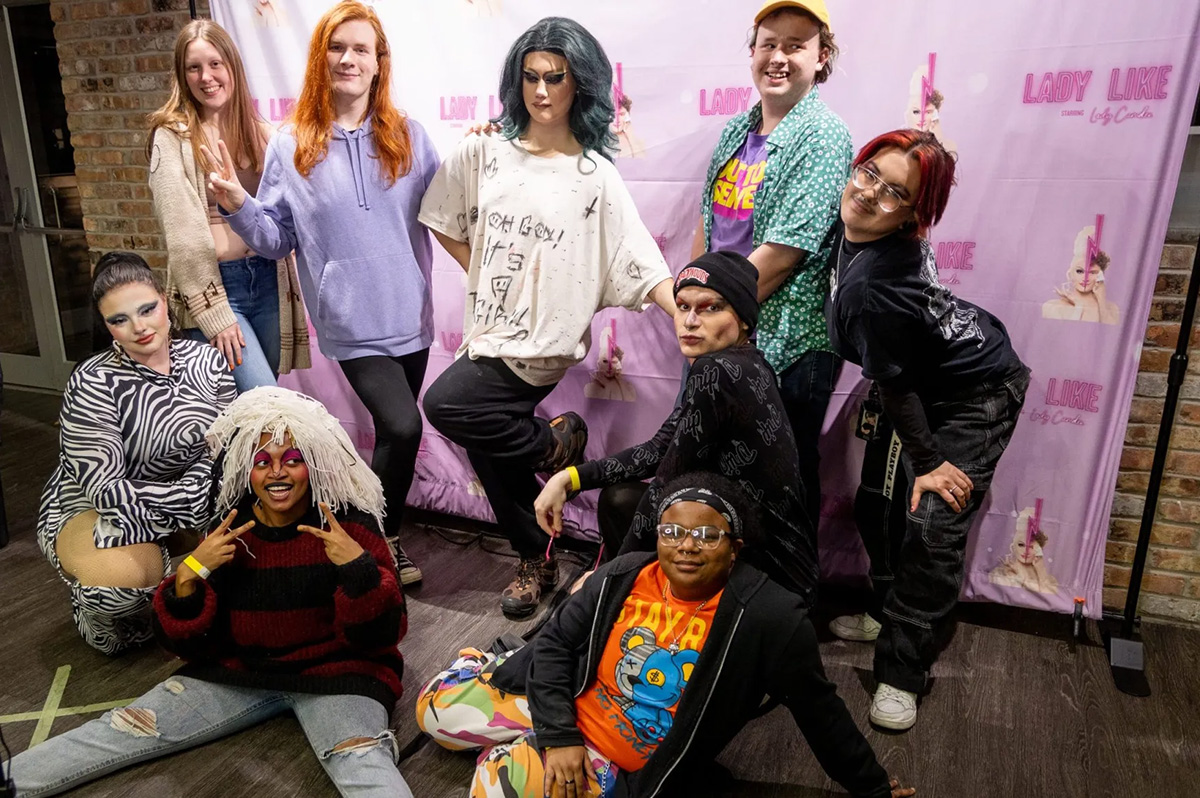
On Chicago’s West Side, the ballroom scene doubles as a lifeline for LGBTQ+ youth.
Every week, teens are drawn into TaskForce Prevention & Community Services for its popular Vogue School. Once there, they then have access to a variety of resources like housing support, a food pantry, fresh produce, and mental health services.
For many, it’s the only affirming environment in their neighborhood.
“We’re located here in Austin, and there isn’t really any other LGBTQ+ youth program like us on the West Side,” said Reyna Ortiz, program director at the nonprofit. “It’s special because young people don’t have to go Downtown or to the North side to feel like they belong here.”
Ortiz’s perspective underscores a long-standing reality that access to LGBTQ+ youth resources often depends on your zip code.
The city’s largest LGBTQ+ institutions have a prominence on the North Side, which is home to LGBTQ+ enclaves like Northalsted and Andersonville. This can leave queer youth on the South and West sides having to face longer commutes and other barriers when trying to access affirming services.
And when queer youth don’t have these kinds of resources nearby, it can create gaps that shape their health, education and economic futures. But North Side-based institutions—as well as smaller LGBTQ+ orgs on the South and West sides and some citywide organizations—are working to fill these gaps.
Two of Chicago’s largest LGBTQ+ organizations, the Center on Halsted and Howard Brown Health’s Broadway Youth Center, are both situated on the North Side.
At Center on Halsted, 3656 N. Halsted St., youth and family programming spans drop-in spaces, leadership and mentoring opportunities and support groups for LGBTQ+ youth. statewide LGBTQ+ hotline provides additional access for young people beyond its Lakeview base.
CEO Joli Robinson said the Center has been intentional about expanding youth programming beyond the North Side through partnerships with other LGBTQ+ organizations and by introducing programs to its South Side location, the Center on Cottage Grove, 6323 S. Cottage Grove Ave.
“A week or so ago, we started our first drop-in space at the Center on Cottage Grove, which has been a priority for us over the past year and a half that I’ve been with the organization,” Robinson said. “We also partner with organizations like Chicago House and Life is Work, … and work to strengthen relationships with the GSAs in schools and PFLAG organizations that exist on the South and West sides.”
These kinds of collaborations are crucial to reaching LGBTQ+ youth in all neighborhoods of Chicago, Robinson said.
“These are organizations that they may already have a strong relationship with, and by deepening our partnerships with them, we’re leveraging the expertise of people who are in these neighborhoods to make sure we’re working in collaboration,” Robinson said.
The Broadway Youth Center, 1023 W. Irving Park Road, serves LGBTQ+ youth ages 12 to 24, particularly those experiencing homelessness or housing instability. It provides integrated medical and mental health care, sexual and reproductive health services, case management and mental wellness support.
The Broadway Youth Center’s drop-in space also offers meals, clothing, showers and other essentials, while cultural programming like art and dance provides additional affirming outets.
Both organizations state their programs are open to youth citywide and emphasize outreach through hotlines, housing services and broader support networks.
Still, their physical bases on the North Side mean that young people in other parts of the city often face barriers to access them.
“And we don’t want transportation to be a barrier for individuals,” Robinson said. “We don’t want location to be a barrier for individuals to participate in some of our programming, so it really is incumbent upon us to be very strategic and think creatively about how we engage the full city.”
TaskForce is among the organizations working to fill these gaps.
Based in Austin on the West Side, the nonprofit offers youth services that are culturally specific, including housing support, food access, and sexual health testing.
Equally as important is TaskForce’s Vogue School, which uses voguing and ballroom culture to strengthen community and encourage self expression.
“Ballroom is important because it’s the one place where they can showcase their talents, where they can showcase who they are without any type of restrictions, without any type of judgment,” Ortiz said. “Ballroom and vogue are how our kids see themselves celebrated. It’s culture, it’s community, and it’s also leadership development.”
Ortiz said TaskForce also provides a steady presence in a neighborhood where resources are limited.
“We are consistent, we are here, we are present and we are open,” Ortiz said.
TaskForce is also home to PrEP 4 Teens, a citywide program focused on HIV prevention and sexual health among youth. While it’s open to teens across Chicago, staff said they are especially focused on reaching those on the South and West Sides who often face the steepest barriers to access.
“We’re looking to collaborate more with agencies, both in the south and west side of Chicago,” said program lead David Gauna. “We know those are the young people who need us most.”
That focus reflects the larger imbalance in the city.
“It’s about equitable access,” said Jim Pickett, one of the program’s organizers. “And so there’s a real lack of equity throughout Chicago, and we could certainly have a much more equitable distribution of opportunities.”
PrEP4Teens was shaped by youth themselves, Gauna added.
“Young people created this,” Gauna said. “They decided the colors, the imagery, the language. They said, ‘We don’t want this to be medical. We want this to be something fun. We want this to be engaging.’”
That youth-driven design is what makes it resonate, said Skai Underwood, who also runs PrEP4Teens.
“We try to meet youth where they are, and culture is part of that,” Underwood said.
Schools can also play a part in filling these gaps on the South and West sides.
“I think that there’s a great opportunity for schools to be like the glue that brings everything together,” said Julio Flores, program director for the Alliance, which promotes school safety for LGBTQ+ youth through advocacy, education, youth programming and research.
For some students, he said, school-based GSAs are the only affirming space they have.
“A GSA can be the only affirming space a young person has,” Flores said.
And those spaces can change a student’s trajectory, he added.
“When young people can lead a GSA, they’re not just building community, they’re building the skills they’ll use in college, in jobs and in life,” Flores said.
The gaps in geography don’t just shape whether young queer people can find community. They also shape whether they’re set up to succeed.
At TaskForce, Ortiz said success often begins with visibility. Young people who first came in for the Vogue School or drop-in services have gone on to train as medical assistants and phlebotomists.
“Some of our youth that frequent the Vogue School start to volunteer. Then we hire and train them, and now they’re building careers,” Ortiz said.
For youth involved with PrEP 4 Teens, growth is just as tangible.
Gauna said teens were engaged in a program that empowered them to build the look, feel and voice of a PrEP awareness campaign. By the end of the cohort, youth who had once been too shy to speak were leading workshops, presenting artwork and giving speeches.
“They started off super shy… and by the end they were showcasing what this program had done for them — not just to take charge of their sexual health, but to feel a lot more confident in themselves,” Gauna said.
Pickett tied those individual transformations back to the bigger picture.
“So many queer young people of color don’t necessarily have many safe spaces throughout the day in their lives,” he said. “Providing these opportunities to engage with other young people and develop their skills and have fun and be fully who they are is so empowering. It sets them up for success.”
Robinson of Center on Halsted said the link between geography and opportunity often comes down to whether young people have their most immediate needs met close to home. Without food, shelter or a safe place to connect, long-term success could remain out of reach.
“For people to really have the safety and security they need to think about economic development or to be provided with a stronger footing and foundation to focus on maybe college or career, they need to have some of their most basic needs met,” Robinson said.
This article was originally published by the Windy City Times and is part of a national initiative exploring how geography, policy, and local conditions influence access to opportunity. Find more stories at economicopportunitylab.com/
Pennsylvania
Philadelphia gayborhood preservation battle raises questions about displacement
Opponents of historic designations worry about new burdens on property owners
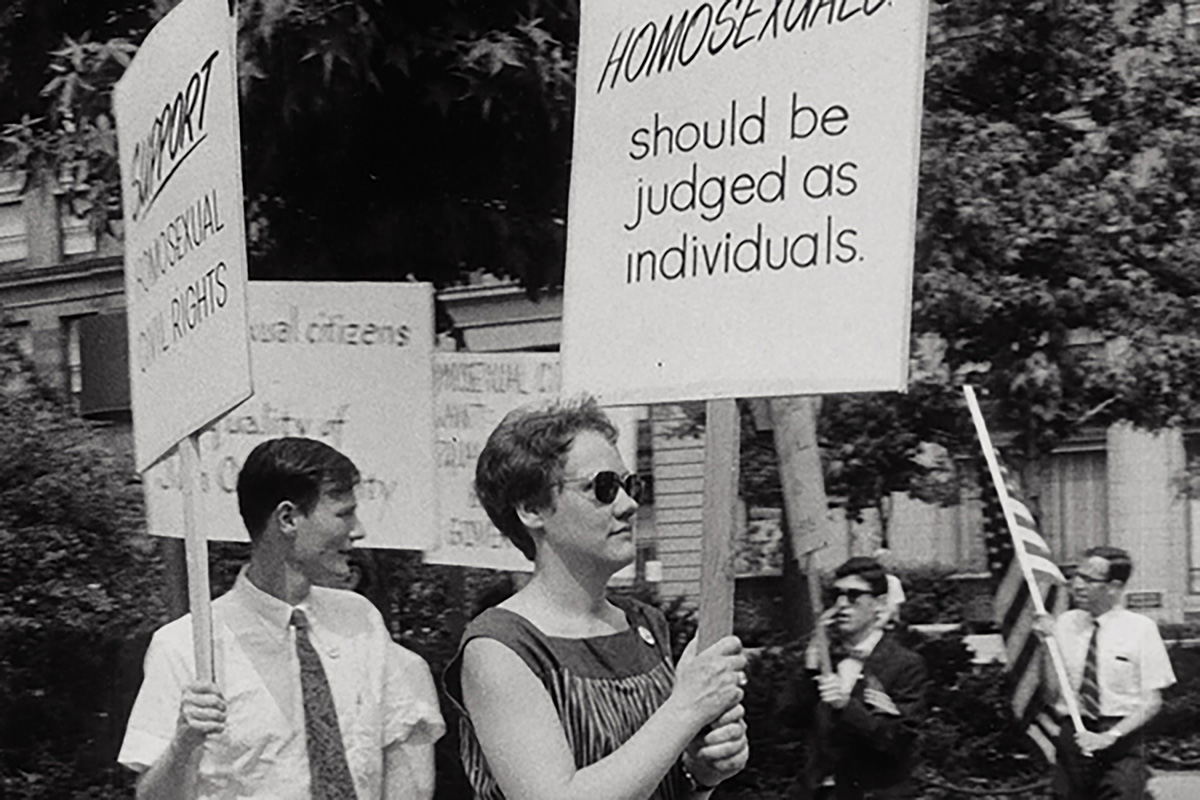
Philadelphia’s Washington Square West neighborhood — which is home to the city’s Gayborhood — was awarded a historic designation in 2024. While many LGBTQ+ Philadelphians were excited by news of preserving approximately 1,500 residences, religious spaces and business properties spanning the 26 included blocks, the designation was not celebrated by all.
Advocates, including the Washington Square West Civic Association and various LGBTQ+ residents, partly framed the designation as long-overdue recognition for the area’s LGBTQ+ culture and Black history — but opponents argued it would impose costly restrictions on property owners and limit new development. A group of property owners — which also includes LGBTQ+ people — took the city to court over the designation and successfully overturned the decision.
The judge cited a lack of substantial evidence as a leading cause for his decision despite the Philadelphia Historic Commission’s nearly 1,500-page nomination packet. Attorney Dan Auerbach, representing the residents who opposed the designation, told WHYY that the documents submitted didn’t explain why many of the properties hold historic significance. Just 173 properties were described as historically significant, he argued. However, 773 of 1,509 properties included in the boundary — more than half of the neighborhood’s properties — are already listed in the National Register of Historic Places.
In March, the judge’s ruling was vacated after an appeal — effectively forcing the process to start over. The historic designation stands in the meantime. The Preservation Alliance for Greater Philadelphia is now drafting its own brief — due May 18 — to support the city’s position, which the organization’s executive director Paul Steinke believes will elaborate on the merit of the designation as a supplement to the city’s arguments.
Scholars have found that Philadelphia’s local historic designation offers a more protective effect on buildings facing possible demolition than the national register. Because zoning and construction is overseen by local laws and leaders, local designations play a stronger role in preservation. But that doesn’t mean buildings with the designation are guaranteed to be preserved.
The outcome of this lawsuit could affect a major re-development project that would benefit the LGBTQ+ community but has been met with mixed feelings. William Way LGBT Community Center (WWCC), which is currently housed in a pre-Civil War era building that would be harder to demolish under the designation, is set to be leveled (along with a famous LGBTQ+ mural on its facade) to build a more accessible space for gatherings and queer-centered low-income housing units.
Steinke underlined that it’s possible for the project to move forward as-is. Historic designations do not prevent every demolition. There are standards in place that allow for demolition, which WWCC would need to meet for the project to be approved.
WWCC leaders would need to appear before the historical commission to seek a demolition permit before applying to the city, but that obstacle would be removed if the historic designation is overturned.
Historic designation is mostly used to preserve the character of buildings through recommendations about how owners can restore or maintain exterior facades. Steinke hopes WWCC will adjust its plans to maintain all or some of the most important historic elements of its current home (the facade, historic marble and wooden staircases, entryways and ballroom) rather than demolishing it all outright. He hasn’t lost hope, but he admits he hasn’t convinced anyone at WWCC to change the current plans.
It’s a project that seems to place competing interests in tension. There’s a need for housing — especially income-specific, LGBTQ+ centered projects — in that neighborhood. This, as Steinke hopes, could be pursued without demolishing much-loved cultural landmarks — but WWCC has emphasized that the price tag for pursuing its goals this way makes preservation out of reach.
The Washington Square West litigation is one of three active lawsuits pending against historic districts in Philadelphia. Six newer proposals are also currently in various stages of the nomination process — but if approved, they too could be contested and overturned.
A 2002 attempt to designate Spruce Hill was unsuccessful due to resident opposition that may have been fueled by politics. It was the third attempt to nominate the neighborhood. A case study published in 2023 by a University of Pennsylvania student about the matter found that the opponents feared increased maintenance costs, the loss of personal freedom and gentrification.
“Ironically, in the two decades since that campaign, Spruce Hill has become one of the most gentrified — and threatened — neighborhoods in the city of Philadelphia,” the study notes.
Residents also feared displacement. The case study underlines that residents who are displaced by gentrification tend to move to neighborhoods with lower property values, less access to resources, and fewer opportunities for upward economic mobility.
Following historic designation, the number of college-educated households in a community tends to increase while the poverty rate drops in contrast to its adjacent neighborhoods, which do not receive the designation. These and other factors contributing to economic mobility are visible on maps created by the Opportunity Atlas, a project of Harvard University which presents information collected by the census in an effort to tangibly discuss economic mobility in localities across the United States. It shows the same patterns in many of Philadelphia’s historic districts.
But the Washington Square West neighborhood outperformed the surrounding blocks even before the historic designation took effect — highlighting that the designations themselves may not always be the cause of disparities.
“It’s true that in most cases, historic districts aren’t the most affordable neighborhoods in any city — no matter where you go,” Steinke said. “That’s not the fault of the historic district.”
Historic districts tend to protect properties and neighborhoods that are historically, architecturally, or culturally significant — properties that already tend to be expensive.
For example, Steinke underlined that Rittenhouse Square was expensive before it was officially designated as historic — and some neighborhoods, like Graduate Hospital, have become pricey without the designation.
Historic preservation may actually promote some protective factors that act as a buffer against gentrification and rising rents, contradicting the most common fears. For instance, the designation makes it harder for developers to tear down smaller, older, more affordable homes or significant community hubs that sit on desirable land in order to build newer, larger, high-cost housing units in their place.
Many LGBTQ+ locals opposed the redevelopment of the Gayborhood’s former 12th Street Gym — which held cultural significance and a meaningful mural of queer activist Gloria Casarez. It was removed alongside a neighboring building of note for its connection to Black history. A luxury high-rise apartment complex now takes its place.
Residents of a working-class neighborhood in Durham, N.C. hoped they would stave off developers and prevent or slow gentrification by pursuing historic designation in 2016.
Steinke explained that this has happened in Philadelphia too.
The Parkside neighborhood, which is situated near the Please Touch Museum, has been a historic district for 15 years, Steinke explained. It was a low to moderate income, majority minority neighborhood when it was designated in 2009 and it still is today, he said. The same is true for West Diamond Street in North Philly, which was designated historic in the 1980s. It was a low to moderate income neighborhood then and has remained one today.
“Real estate prices are a factor of so many other things — proximity to work, public safety, access to schools, access to shopping and other amenities, transportation,” Steinke said. “That’s really what determines property values and neighborhood value.”
Those are also factors that have strong correlations with upward economic mobility.
Despite a poverty rate that is lower than it has been in decades, Opportunity Insights ranks Philadelphia as last among large metro areas for upward economic mobility — with some children experiencing even worse economic outcomes than their parents. It’s a problem Mayor Cherelle Parker has addressed with new initiatives she hopes will support young people who hope to break free from cycles of poverty.
The supplemental programs that offer economic support to historic homeowners in Durham might have helped its anti-gentrification efforts succeed.
Steinke said it’s true that some preservation-oriented maintenance costs may be higher upfront, but many of those options also last longer and could even cost less than cheaper fixes that must be repeated over time.
“One real weakness in Philadelphia is that there is no publicly available funding to help homeowners maintain their historic homes, and that’s something that we have talked about with city officials, with city council, with the mayor’s office,” he added. “There really needs to be a fund that homeowners can apply to if their property is designated historic — especially for low to moderate income homeowners.”
Although there isn’t a city fund or initiative to help offset maintenance costs for historic homeowners in Philadelphia, a few state and federal tax incentives could be helpful to some historically-designated property owners — including landlords and developers who might not otherwise pursue preservation.
“Not many property owners or homeowners have a lot of expertise about what’s best for a historic building to maintain its value and its appearance,” Steinke said. “So when historic districts are in place, you actually have access to experts who know the best practices and can share them with you and help you find solutions to the problems you’re trying to solve.”
The Preservation Alliance for Greater Philadelphia collaborated with the Washington Square West Civic Association to publish a manual that will be released in late spring or early summer. It will provide information about historic practices for windows, doorways, carpentry, masonry and roofs pertaining to the area’s buildings.
There’s been an increase in low-income households in Philadelphia’s historic districts and top earners are moving in at a slower rate than in neighborhoods in the rest of the city.
Racial diversity is shifting in there, too. Although these districts tend to have whiter populations, a report published by the Preservation Alliance shows that non-white homeownership in Philly’s historic districts has increased significantly since 2010. The number of non-white homeowners and Black and Hispanic residents is on the rise in these districts, even as diversity has slowed in other neighborhoods.
“We think [this report] shows that historic designation is not an obstacle to housing production or population growth,” Steinke said.
Steinke argues that the buildings in Washington Square West have economic value not only to those who own or utilize the buildings but to the city as a whole. They’re an economic engine — creating jobs and drawing tourists. Almost 6% of Philadelphia’s jobs are in historic districts, including nearly 10% of small business jobs, 13% of new jobs, and almost 17% of creative jobs.
The 250th anniversary of the United States will bring visitors hoping to immerse themselves in Philadelphia’s history. Visit Philly estimates the events could contribute up to $2.5 billion to the city’s economy.
Some funding is making its way to historic districts in preparation for the events by way of grants for programming and beautification projects. But that doesn’t make them an accessible place to do business.
Historic districts aren’t necessarily start-up friendly. Commercial rent tends to be higher there too — a frequent complaint among LGBTQ+ business owners who want to open brick-and-mortar locations in the Gayborhood but are priced out.
(This article was originally published by the Philadelphia Gay News and is part of a national initiative exploring how geography, policy, and local conditions influence access to opportunity. Find more stories at economicopportunitylab.com.)
National
Remembering Barbara ‘Boo’ Price, a pioneering force in women’s music
Key organizer behind Michigan Womyn’s Music Festival
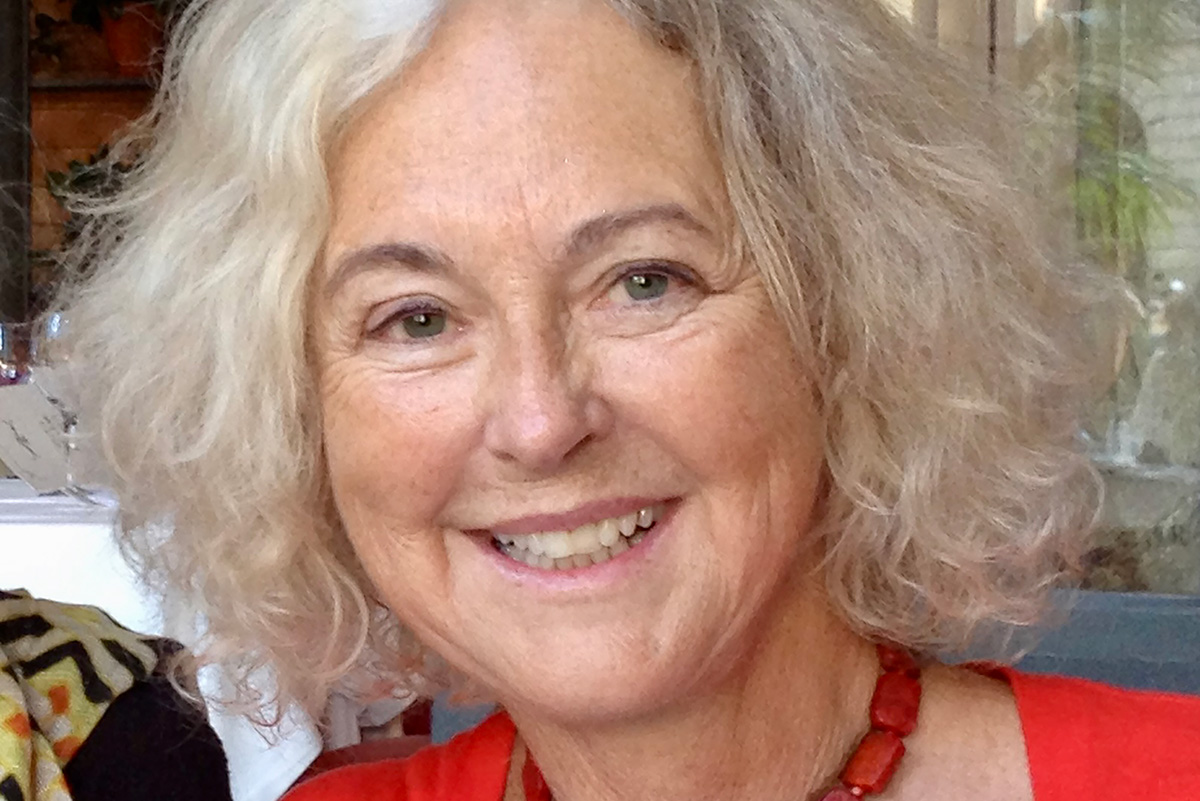
Barbara (“Boo”) Easter Price, a pioneering figure in the women’s music movement, died Tuesday, Aug. 4 in Oakland, Calif. Price produced some of the earliest women’s music concerts as a new lesbian-feminist culture was taking shape, and was a driving force behind the Michigan Womyn’s Music Festival which ran from 1976 to 2015 – a flagship event in the movement, and the largest women’s music festival in North America. Price was 82.
“Her vision from the very beginning was how complex and how wide the whole phenomenon of women’s music could be, and how far we could carry it beyond the multi-purpose rooms and church basements into Town Hall and the Palace of Fine Arts and major media,” says singer-songwriter Margie Adam, for whom Price served as manager, agent, producer and attorney from 1975 to 1984, and, for part of that time, her romantic partner.
“I think when she heard Cris Williamson, Vicki Randle and me sing at the Embassy Theater in 1974, she grasped that this thing we were just beginning to call women’s music could actually be a soundtrack for the women’s liberation movement – that it could be an activator and a healing, empowering tool.”
Arguably, nowhere was that emerging culture of music, feminism and community more fully realized than at the Michigan Womyn’s Music Festival.
At its peak, 8,000 women, predominantly lesbians, came from around the world to gather for a week in August. Camping, music, dance performances, workshops and the requisite tofu and beans were just a few of the innumerable offerings in this rite of passage for a generation of lesbians in a time when there were few safe and free environments available.
Alicia Davis of Michigan remembers the festival foremost for its sense of community. “The feeling of not having to make myself smaller to fit into the world, but rather the feeling that I could be happy, loud and share my opinions and feel valued, even when there were disagreements among people,” she says. “There was a shared respect that I didn’t feel outside of the festival walls. The festival shaped what I thought women could do in the world, the entire camp was made by women: electricians, plumbers, cooks, carpenters, singers, artists of every stripe… “
The sense of shared experience followed women long after they left “the land.”
In the 1980s, drivers across the U.S. would exchange knowing glances when passing a car with the familiar “See you in August!” bumper sticker. It was the original IYKYK.
The Festival was also an important showcase for emerging and established musicians, including Holly Near, Meg Christian, Tracy Chapman, Indigo Girls and Ani DiFranco. The list of alumni is vast and stretches across genres from classical to Afro-centric percussion. To name just a few: Casselberry-DuPree, Phranc, Heather Bishop, Ubaka Hill, big band Deuce, flutist Kay Gardner, Edwina Lee Tyler, Lynn Breedlove-fronted punk band Tribe 8, pianist Mary Watkins, and Cultural Heritage Choir founder Linda Tillery who remembers Boo as the big sister she never had.
“I could go to her with anything, and she would listen and give counsel. She was always supportive of me and usually right,” the singer and arranger says.
And while Michigan wasn’t the only festival in the country, it inspired people like marriage equality activist and comedian Robin Tyler who attended Michigan because of Price, and went on to produce her own West Coast music and comedy festivals, as well as the main stage for three Marches on Washington.
“My last memory of Boo was not about Boo Price, the producer or the magician that could create everything,” says Tyler who was also Price’s lover for a time. “It was how lucky I was to have had her in my life at all, and that we were able to love each other and share. She was one of the most influential people of my life.”
Price’s talents were evident across the festival’s sprawling operation which relocated several times over its 40-year existence. In 1982, together with one of the original founders, Lisa Vogel, Price purchased the land that would become the festival’s permanent 650-acre home near Hart, Michigan; in 1983, she became a co-owner and co-producer, a role she held until the two parted ways in 1994.
From 1976–1994, Price was involved in many aspects of the Michigan Womyn’s Music Festival. But her prowess as producer was perhaps most visible at the Night Stage. Her contemporaries have vivid memories of an opening ceremony with an aerialist swinging on a trapeze from an oak tree, while jazz artist Rhiannon performed on vocals.
“Sometimes it started with a parade or a procession and percussion, and sometimes there were stilt walkers – and so there was always this production about you as you were coming to Night Stage,” remembers Sändra Washington, who performed with her twin sister Sharon as the Washington Sisters. As a performer, Washington recalled the wall of energy rushing at her from the audience.
“It was her desire to create a thing, a space, an event that was really magnificent – and that showed in everything she did, whether or not she was organizing a tour, or she was organizing a party, or events at the [Montclair] club,” says Washington. “Boo really specialized in creating a whole vibe around the event, the space, the production, so that you felt something special when you came into a space that Boo had created.”
“There was never a space that felt as positive, overwhelming, and energetic as the crowd at Michigan.”
Kathryn A. Willmore, co-founder of feminist journal Sojourner, remembers how Michigan grew into something bigger than anticipated – and how instrumental Price was in elevating the rudimentary systems needed to support it. One year, Willmore brought copies of Sojourner to the festival, hoping to connect with other people publishing women’s papers. “But there was no system for communicating any of that really. So I just tacked a note on a tree of that location, and there were about 30 of us that came together.”
Price, Willmore says, helped put systems in place, articulate a vision, and bring in people who could then carry it forward.
“Boo really empowered so many women in so many dimensions. I think that is one of the overarching themes of her life, and certainly in music production… and her confidence was infectious. So people who had never done something grew into becoming experts. I think that she inspired and empowered.”
Willmore first met Price in 1961 at Mt. Holyoke just after the women arrived for the start of college. “There were all these girls in this half-empty dorm in the middle of a hurricane, and Boo started going around to everyone’s room to introduce herself. Then she got to my room… and that was the beginning of this lifelong friendship.”
The importance of what Price created cannot be overstated, nor the reach and durability of the connections formed in the space she helped build.
Just last month, a French woman found this writer on Instagram 40 years after the Festival and claimed I invited her into my tent. We have been corresponding since this improbable reconnection (though the question of who did the inviting is under dispute):
Emmanuelle Gachet, now a writer and professor at Université de Nantes, reflects on her experience:
“In 1986, I step onto an island populated by six thousand women. I come from France, from a rural area, and I am twenty years old. Never before have I felt such a powerful energy. Here, lesbianism is the norm. I don’t have to justify my place. For the first time, I am not a minority. At the time, I am broke. The community welcomes me with sisterhood. I take part in artistic and political workshops, without always realizing their significance. I discover music without male voices. Women playing, singing, improvising, taking the stage. A stage of their own. Music becomes a common language, a way of recognizing one another, of celebrating who we are and what we can create together… I leave with the feeling that I am leaving a world that may never exist again… “
Price’s influence extended beyond the festival arena. The MSU Libraries document the breadth of her production work, including the Women on Wheels Tour in 1976; a celebration for the opening of Judy Chicago’s The Dinner Party in 1979; concert closing the ERA Campaign at Constitution Hall with Margie Adam and Sweet Honey in the Rock; and, decades later, the 2008 San Francisco City Hall memorial for lesbian rights pioneer Del Martin. She also established Women in Production in 1976, which hired and trained primarily lesbian technicians and production staff.
Price co-founded Pleiades Records with Margie Adam in 1975, producing and promoting Adam’s first four albums. She had an eye for the entire presentation – from press kits and photography to album covers – and for how the emerging women’s music movement projected itself to the world. Price produced a 50-city tour promoting Adam’s first album, culminating at the historic National Women’s Conference in Houston in 1977, where Adam performed “We Shall Go Forth!” as 10,000 women joined in three-part harmony.
“When Boo and I began to work together, both of us were convinced that we should have that phrase, ‘Women’s music by women about women for everyone.’ And that was not a point of view that was agreed upon by everybody in women’s music,” Adam says. “We had wiggle room in there, and we had controversy, and we had continuums.” Ultimately, Price wanted the music “to get out as far as it can go.”
Barbara Easter Price was born on Oct. 8, 1943 in Lafayette, Ind. She received a bachelor’s degree in political science from Mount Holyoke College in 1965, and Juris Doctor from UC Davis in 1976.
She brought her legal background, organizational skills and business acumen to everything she touched – including the justice system, most notably through her work on child custody cases, a focus that grew out of her own experience.
In 1978 she co-authored a law review article on lesbian custody proceedings and how attorneys could best prepare, at a time when lesbians were viewed unfavorably by the courts and “Sexual Orientation Disturbances” remained a psychiatric diagnosis.
“People forget what it was like,” says attorney Diane Gelon, who first met Price in 1977 at the women’s conference in Houston. “The lesbian mother would not have even had what we would look at now as normal access to that child because the fear was that the kids would be gay or lesbian, or there would be some amount of gender confusion, or they would suffer some kind of psychological harm… These are the myths that Boo wrote about and tried to address.”
Earlier in her career, she also worked at the White House for the Food for Peace Program, where she helped organize a Latin American tour for First Lady Lady Bird Johnson. She also worked with the President’s Commission on Civil Disorders. Price later became active in Bay Area Lesbians in Law, the Lesbian Rights Project, Lyon-Martin Clinic, the National Lesbian Feminist Organization, National Organization for Women, the National Women’s Political Caucus, and Women and the Law.
Whether through politics, advocacy or music, much of Price’s work was centered around creating spaces for women.
Following her tenure with the Michigan Womyn’s Music Festival and a brief hiatus, Price couldn’t help but create another gathering place. She had been regularly driving past an old building, originally established as a social and literary club in 1928. It still had its projection room, stage and lightboard. She knew she had to have it.
“She just was always producing, even when she had stopped,” says Sharon J. Washington.
Price purchased the building in 1996 and, after a thorough renovation, opened the Montclair Women’s Cultural Arts Club, which became home to the Montclair Women’s Big Band, which she co-founded with trumpeter Ellen Seeling in 1998. Over the next two decades, the predominantly lesbian space became a vital gathering hub, hosting more than 2,000 events – high-toned parties, workshops, theater, dance, concerts, and more.
“Her Valentine’s Day dances were extraordinary,” says Sändra Washington, who remembers four-course plated meals and, like many of Price’s friends, volunteered at the club.
When the club closed in 2015, luminaries of women’s music came together for farewell performances, and the San Francisco Bay Times chronicled the extraordinary range of what had taken place there: more than 500 birthday celebrations, 150 concerts (“which we can attest were fabulous,” the paper wrote), countless workshops, arts and cultural events.
“Whatever Boo had built, whether it was the club or her home – that was our second home,” says Sändra Washington.
“Buying that club was in some ways a transgressive action, but at the same time, it was saying we belong here,” says Margie Adam. “We belong everywhere. Women’s music belongs everywhere, and that was her vision from the moment that I met her.”
“I think of Boo as someone who inspired and empowered women everywhere,” says Kathryn Willmore. “She herself was a fearless explorer, and she instilled that spirit into so many other women who would never imagine themselves doing the things that they did. And it wasn’t just in music.”
Willmore remembers Price’s first foray into scuba diving. “She was a good swimmer, but there she was, completely underwater with this mask on, not being able to see much in front of her. So she just kept her eyes on the fins of the guide in front of her.”
She woke up the next morning and said, “Let’s do that again.”
“And she just fell in love with it, became an expert diver, and then inspired so many other women – including me,” says Willmore, who would never have imagined venturing into the sea’s depths had it not been for Price.
Price soon convinced others to join her, and organized trips over the years to explore earth’s bounteous ocean offerings – women traveling the world from the Caribbean to the Solomon Islands and sharing in the joy that Price found amid the coral reefs of Indonesia.
Price is survived by her son, Andrés Garcia Price; daughter-in-law, Katie Garcia; granddaughter, Tallulah Katherine Garcia; nieces Melissa Price and her husband, Donal, and Cynthia Price Czabala and her husband, Tom; and an expansive community of chosen family, friends, and beneficiaries of her generous and unstoppable spirit.
“Many of you know that Boo’s health had been in decline for some time,” Kathryn Willmore, Sharon J. Washington, and Margie Adam wrote in announcing their friend’s passing. “Over this past weekend, she had a serious heart attack and was being cared for in the hospital, with her son Andrés and family with her much of the time. Yesterday afternoon, she noticed a partially open door in her room and asked the nurse if that was the exit, because she was ready to leave. A few hours later, she did just that – moving on to another realm, but never out of our hearts.”
National
HRC condemns DoE removal of LGBTQ+ bullying data from federal survey
Organization cites rise in homophobic, transphobic policies, worse mental health outcomes
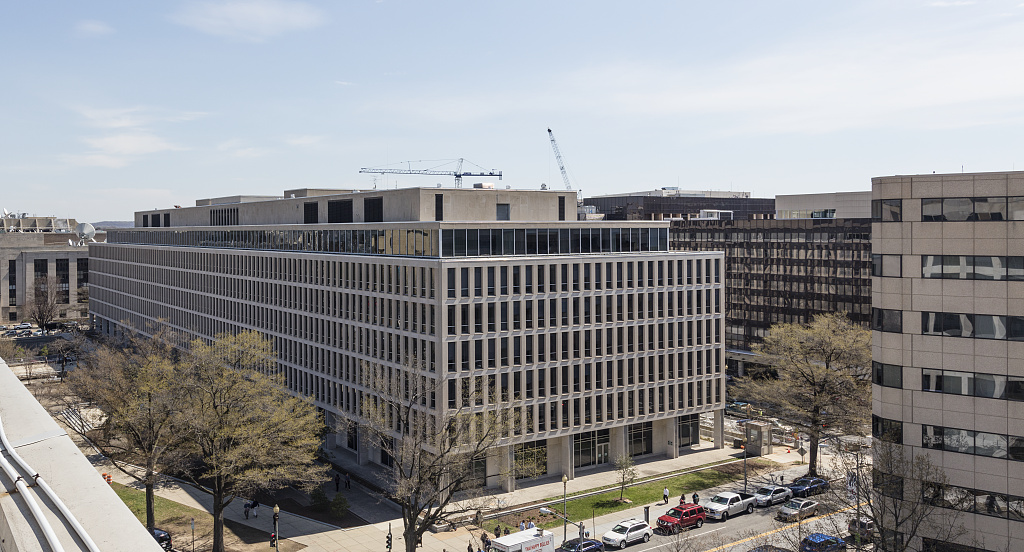
The Human Rights Campaign is slamming the White House — and the Department of Education — following their removal of some LGBTQ+ bullying data from federal data collection.
The Civil Rights Data Collection is a mandated survey of all public school districts that collects figures on a wide variety of statistics about students — including demographics that include race, ethnicity, sex, disability status, and English learner status; course-level enrollment data, such as how many students are enrolled in advanced placement or honors classes; and school climate information, such as rates of bullying, harassment, suspensions, and expulsions.
That data collection has been ongoing since 1968 — nearly six decades — but now has a major change in what questions are being asked, or not asked, that advocates are largely attributing to the Trump-Vance administration’s culture war fight on LGBTQ+ children in the country.
Changes to the 2025-2026 survey questions — approved by the Office of Budget and Management in July — eliminated a space for schools to report how many students identify as nonbinary, how often those students are victims of harassment and bullying, and whether school districts have policies prohibiting gender identity-based incidents.
K-12 Dive, a publication that focuses its reporting on news related to K-12 education, first published a list of these data collection changes from 2024-2025 to 2025-2026.
These questions, as well as others that included LGBTQ+ student topics on treatment in schools, were added to the CRDC under the Biden-Harris administration. By including these questions, policymakers hoped this would lead to increased investigations into discrimination complaints, initiate compliance reviews, and provide policy guidance to districts, according to Education Department documents.
The CRDC also eliminated the mention of “gender identity” from the definition of rape and sexual assault. The prior collection of data (before the Trump-Vance administration changed it) defined rape as something that could be done to “all students, regardless of sex, or sexual orientation, or gender identity.” Now, the new data collection questions say, “All students, regardless of sex, or sexual orientation can be victims of rape,” removing “gender identity” from the new definition.
By removing and changing definitions, this could have a real-world impact on some of the school’s most vulnerable students. According to CRDC data from 2021-2022, more than 1,800 school districts reported enrolling one or more nonbinary students.
Additional data also shows that the changes to data collection is harming public school students. U.S. Sen. Bernie Sanders (I-Vt.), the ranking member of the Senate Health, Education, Labor, and Pensions Committee released a report in April finding that the Trump-Vance administration’s efforts to all but close the Department of Education Office for Civil Rights has left students facing discrimination and harassment throughout the country without the federal recourse they are entitled to under federal law.
The Williams Institute, a think tank that collects data and conducts research on issues related to sexual orientation and gender identity, has data indicating the true number of nonbinary and transgender children is much higher — they estimate that for children ages 13 to 17, nearly 724,000 identify as nonbinary or trans.
This is in line with a slew of policies pushed by the Trump-Vance administration since their federal takeover. Within his first day in office, President Donald Trump signed Executive Order 14168, titled “Defending Women from Gender Ideology Extremism and Restoring Biological Truth to the Federal Government.” This directive attempts to make the federal definition of gender unchangeable, determined by sex assigned at birth alone.
Within his first month of his second term, Trump issued Executive Order 14187, titled “Protecting Children from Chemical and Surgical Mutilation.” The order directs federal agencies to restrict gender-affirming medical care — including puberty blockers, hormone therapy, and surgeries — for individuals under the age of 19.
He also pushed multiple anti-trans executive orders, including Executive Order 14201, “Keeping Men Out of Women’s Sports,” and Executive Order 14183, “Prioritizing Military Excellence and Readiness,” targeting trans athletes and military members, respectively.
These policies have a real-world impact on trans people.
The Trevor Project, a nonprofit dedicated to crisis and suicide prevention for LGBTQ+ people under 25, reported that, for the seventh year in a row, LGBTQ+ youth are at higher risk for suicide as a result of mistreatment and stigmatization.
Trevor Project data showed that nearly 60 percent of LGBTQ+ young people ages 13-17 said they were bullied in the past year, and that 36 percent of LGBTQ+ youth seriously considered suicide in the last year. The data shows a bigger discrepancy for trans youth, with that number hovering around 40 percent considering suicide.
HRC President Kelley Robinson issued a statement following the approval of the new data collection questions that leaves LGBTQ+ students’ bullying statistics under — if not completely unreported.
“If there was even a shadow of a doubt, this latest move by the Trump administration makes it abundantly clear they do not care about the safety of LGBTQ+ students, and trans students in particular,” Robinson said. “These are adults who should be protecting our kids. And instead, they are making sure bullying and harassment are not tracked. If they are not tracked, bullying and harassment cannot be prevented or stopped — which is exactly what the Trump administration wants. Parents deserve to know their kids are safe at school, and every single young person deserves dignity and safety at school. Anything less is plain evil.”
HRC has a “Welcoming Schools” initiative that they say is the “most comprehensive” bias-based bullying prevention program in the nation. The program includes LGBTQ+ and gender-inclusive resources for schools, help navigating special education and disability resources for LGBTQ+-identifying students, and other tools to help schools become more inclusive.
This program has been in effect for nearly two decades and, according to HRC, reaches nearly 750,000 students.
The Washington Blade reached out to both the Department of Education and Office of Management and Budget for comment but did not receive a response by publication time.
National
HRC files class action over federal ban on gender-affirming care coverage
Lawsuit filed Monday challenges White House effort to restrict care
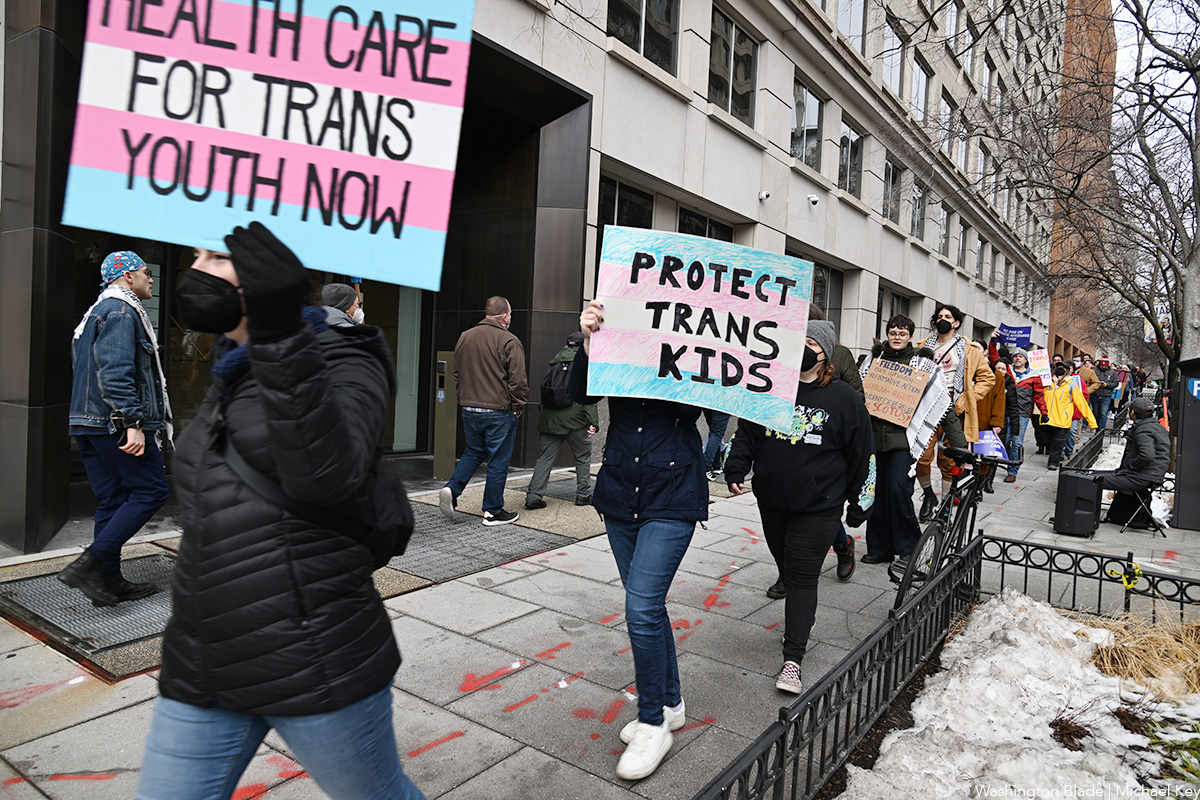
The Human Rights Campaign Foundation, the nonprofit sister organization to the largest LGBTQ+ human rights lobbying and advocacy organization in the U.S., along with law firms Correia & Puth and Cohen Milstein Sellers & Toll, filed a class action lawsuit against the government as it attempts to restrict gender-affirming healthcare for federal employees.
The suit, filed on Monday, alleges that the Office of Personnel Management, run by Trump appointee Scott Kupor, is discriminating against LGBTQ+ federal employees (and their families and retired employees) by prohibiting health insurance coverage for gender-affirming care under the Federal Employees Health Benefits and Postal Service Health Benefits plans. There are five plaintiffs named in the complaint, but it extends to others who have those healthcare plans.
The document asserts that OPM’s prohibition on coverage for “gender transition” care in the FEHB and PSHB programs violates Title VII, the federal law that prohibits discrimination based on sex, race, color, religion, or national origin.
The policy, which was implemented on Jan. 1 following the 2025 issuing of Program Carrier Letter, mandated that insurance providers in these programs deny any coverage for gender-affirming care. In February, HRC filed a federal complaint with OPM over the change in healthcare policy, which was ultimately passed to the Equal Employment Opportunity Commission for review. That complaint is now an officially filed class action lawsuit in the U.S. District Court for the District of Columbia.
Research from the Williams Institute at UCLA Law, a think tank that collects data and conducts research on issues related to sexual orientation and gender identity, indicates that this policy denying gender-affirming care will impact healthcare access for at least 39,400 current and former federal employees and their dependents.
Human Rights Campaign President Kelley Robinson released a statement following the lawsuit’s filing.
“Our message to the Trump administration is simple: we’ll see you in court,” said Robinson. “Healthcare access should never be weaponized to advance discrimination — and the denial of coverage for critical healthcare based simply on who you are blatantly violates the rights of all of us.”
Gender-affirming care has been under constant attack by the Trump-Vance administration since its return to the White House, despite the practice being considered as extensively evidence-based but also supported by nearly every major medical organization. This type of care is provided to all people—not just transgender people—and includes things such as social affirmation, including using correct names and pronouns and wearing clothing that matches a person’s gender identity; mental health support, such as counseling to reduce depression and anxiety; and, in some cases, medical interventions such as reversible puberty blockers or hormone therapy when deemed medically appropriate.
“Federal employees have been through the wringer with the Trump administration,” said Cathy Harris, partner at Correia & Puth. “We draw the line at blatant discrimination to deny healthcare to our nation’s dedicated civil servants.”
“This odious policy is the latest example of the Trump administration’s obsession with targeting transgender people, using shameful and cruel tactics to threaten their employment, their health, and the well-being of themselves and their families,” Robinson added. “OPM’s actions will not go unchallenged, and we’ll continue to fight so that federal employees and their families receive the dignity they deserve.”
This is not the first time the White House has directly attacked gender-affirming care.
In January 2025, the administration issued Executive Order 14187, titled “Protecting Children from Chemical and Surgical Mutilation.” The order directs federal agencies to restrict gender-affirming medical care — including puberty blockers, hormone therapy, and surgeries — for individuals under the age of 19.
For more information on how to get involved with the lawsuit, visit hrc.org.
Michigan
Progressives score victory as El-Sayed wins Mich. Senate primary
Democratic newcomer will face Rogers in November
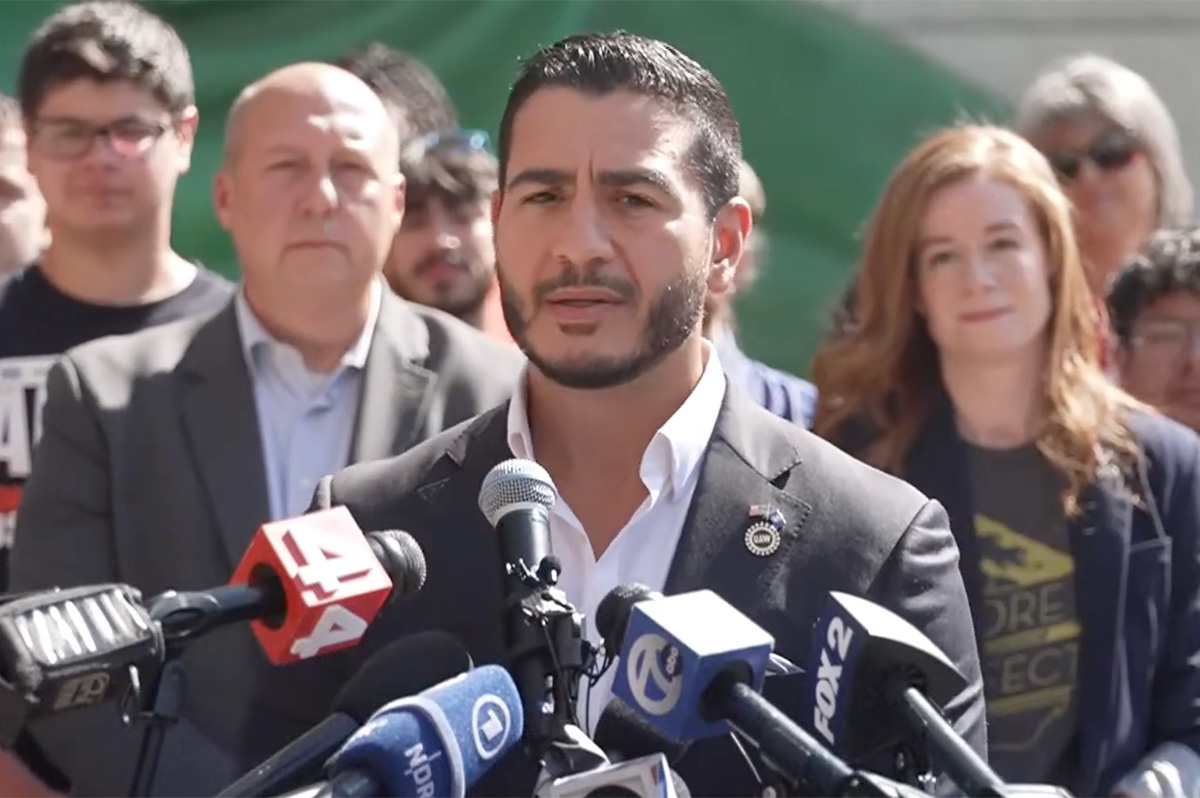
Michigan held its primary on Tuesday, allowing the two major political parties to select their nominees to go head-to-head for the state’s U.S. Senate seat.
NBC News called the Democratic race early, giving the victory to physician Abdul El-Sayed over incumbent U.S. Rep. Haley Stevens (D-Mich.) in an extremely close primary. El-Sayed won 48.5 percent of the primary vote, with Stevens trailing by just one percentage point at 47.5 percent.
Both candidates have campagined on supporting the LGBTQ+ community through different avenues— for El-Sayed he focused on his past promoting HIV and PrEP funding and research. Stevens focused on her legislative history working to support transgender rights in the state.
This is a major win for progressive Democrats, who have been bearing the brunt of political attacks from President Donald Trump, the Republican Party, and centrist Democrats.
El-Sayed, a former health director in Detroit, ran his campaign largely on making life in the Great Lakes State more affordable amid rising costs. His policies include promoting “Medicare for All,” pushing health policy that targets the regressive efforts of the Trump-Vance administration that rolls back funding for both Women and LGBTQ+ people, minimizing the growing amount of money in politics, and he was very vocal in his criticism of Stevens for supporting aid to Israel. He was endorsed by two major progressives — U.S. Sen. Bernie Sanders (I-Vt.) and U.S. Rep. Alexandria Ocasio Cortez (D-N.Y.).
Stevens, the four-term congresswoman, is much closer to establishment Democrats on policy than El-Sayed.
During her time in the federal government, she has consistently supported the Equality Act, which would add sexual orientation and gender identity as protected classes under the Civil Rights Act of 1964. She has also emphasized supporting local manufacturing and lowering housing costs in the state.
She was named to Advocates for Trans Equality’s 118th Congressional Champions list for her pro-trans policies and was endorsed by establishment heavy hitters Michigan Gov. Gretchen Whitmer and Senate Minority Leader Chuck Schumer (D-N.Y.).
The contentious race boiled down not only to Michigan affairs but also extended to international conflicts — namely Palestine. (South Africa has filed a case in the International Court of Justice in The Hague that accuses Israel of committing genocide in the Gaza Strip after Oct. 7.) This primary also acted as one of the first major races that pushed back against AIPAC, a lobbying group that works to promote pro-Israel candidates in U.S. elections. The group has been involved in domestic politics since 1954.
AIPAC devoted a massive amount of money to this race.
The Associated Press reported that the pro-Israel lobbying group spent more than $30 million on ads against El-Sayed because of his vocal denunciation of Israel and his continued criticism of its policies towards Palestine.
Michigan has a large Muslim and Arab American population, which could, in part, explain how El-Sayed was able to win.
The Republican side was far less competitive. Former U.S. Rep. Mike Rogers (R-Mich.) ran unopposed and clinched the GOP nomination. He has consistently held anti-LGBTQ+ positions, going as far as voting multiple times for a federal constitutional amendment to ban same-sex marriage, voting against repealing the military’s “Don’t Ask, Don’t Tell” policy, and supporting efforts to directly target the attempted expansion of Title IX protections to include trans people.
El-Sayed will face off against Rogers in November for Michigan’s Senate seat — one that could have lasting impacts not only on the state’s politics but also on the Republicans’ narrow Senate majority and Trump’s political agenda.
National
White House orders warning signs at Smithsonian over gender identity exhibits
Administration criticizes National Museum of American History
The Trump administration will install temporary warning signs outside the Smithsonian’s National Museum of American History after releasing a report accusing the museum of promoting what it calls “radical” gender ideology and other politically biased content.
According to the Executive Order, “For purposes of policy formulation under EO 14253, this review of the National Museum of American History concludes that NMAH, by the intention and at the direction of current Museum and Smithsonian leadership, has become subject to institutional capture by a radical, activist ideology that is fundamentally opposed to telling the noble, honest story of the great country we know and love.”
Executive Order 14253 refers to what the White House has deemed the “Restoring Truth and Sanity to American History” order. Therefore, the Trump administration has said it will take all available steps to ensure that the issues in the report are addressed and rectified.
Without specifying, the White House has stated that warnings will be posted along NMAH to alert visitors to sections of the museum it has deemed are in violation according to the report.
“The Secretary of the Interior, acting through the Director of the National Park Service (NPS) and in coordination with the Assistant to the President for Domestic Policy, shall install temporary signage along the NPS-maintained sidewalks and walkways used by the public to access the Museum, informing visitors of the findings of the Report and of the policy set forth in section 1 of this order,” the Executive Order states.
The warnings were raised in a 162-page report issued by the Domestic Policy Council. The report detailed ways in which the National Museum of American History (NMAH) has “poorly” portrayed American history and insufficiently highlighted the founding story during America 250th celebrations.
The report outlined key findings of the NMAH. One of these findings was the Center for Restorative History within the museum, which has stated its purpose is to “encourage systemic change” by highlighting diverse groups. However, the report states that it highlights every group of Americans except for straight and white Americans.
The Domestic Policy Council accused the museum of engaging in “transgender activism.” According to the report, examples include referring to “biological men” as women or girls, displaying what it describes as sexually suggestive content, and incorporating discussions of gender fluidity, gender identity, and gender nonconformity into the museum’s educational curriculum, “Becoming US.”
The report also criticizes the curriculum for using the term “transgender” when discussing gender-nonconforming people and encouraging individuals to ask a person’s pronouns when meeting them. It further objects to exhibits stating that “transgender, nonbinary, and cisgender female athletes” continue to struggle for and demand equality.
It also condemns what it refers to as explicit content in an exhibition, “Girlhood (It’s Complicated)”, such as chest binders, questioning gender testing in women’s sports, and referring to biological females as “people inhabiting female bodies.”
Additionally, the report accuses the museum of no longer participating in flag-celebrating ceremonies because it was “too busy” preparing for June Pride and WorldPride events. It states, “As Director Hartig explained in a June 2024 presentation, all her attention was focused on flying the Smithsonian Pride Alliance’s ‘intersexual pride flag during June’ in 2023 and 2024.”
On July 9, the American Historical Association issued a statement rejecting the report’s findings.
In regard to the report, it states, “Its anonymous authors overlook a central lesson of the nation’s founding: the United States was forged by finding common purpose amid intense divisions, conflicts, and disagreements.” They argue that only “honest history” can tell the true history of the nation.
House Republicans led a subcommittee hearing that questioned Smithsonian Director Hartig extensively. A main focus of the questions was on the exhibits related to gender identity and whether they were appropriate. In the hearing, Rep. Nancy Mace asked: “When was your gender revealed to you, Dr. Hartig?”
In response to questioning, Hartig stated that the institution is nonpartisan and does not push a specific agenda.
Hartig published a two-page statement ahead of her hearing outlining her thoughts on the situation. In the report, she states that the institution is always open to criticism and will continue to look for ways to improve, but she sees the report as misleading.
“I can attest that the report does not fairly characterize the full body of work at this museum. I am familiar with the depth and breadth of our collections, exhibits, and programming. And while I recognize there is always room for improvement, I also know the beauty, inspiration, and expertise that exists in our museum,” Hartig wrote.
Democrats created their own 16-page report as a rebuttal to the Domestic Policy Council’s report. It argued that the attacks by the current Trump administration are another example of its attempt to rewrite history. Additionally, the report states that no policy changes were included in the Executive Order, as that is beyond the President’s role. “The Report recommends nothing. That is no accident. To recommend an action, the Report would need to identify who is legally empowered to take it, and its own opening chapter concedes the President’s only power is to ‘urge’,” House Democrats wrote.
It is still unclear when the temporary warnings will be installed or what form they will take beyond the requirements outlined in the executive order.
National
Trump ends direct HIV prevention funding to community groups
Advocates say transfer of funds to states may disrupt local programs
A decision by the U.S. Office of Management and Budget (OMB) at the request of the Trump administration to discontinue direct federal funding of community-based organizations and clinics that provide HIV prevention services has raised concern among community health advocates, including LGBTQ advocates.
News surfaced earlier this month that the OMB informed the U.S. Centers for Disease Control and Prevention that it would not renew $46 million in funding for 96 community-based organizations that provide HIV testing, referrals to medical care, and arrangements for obtaining pre-exposure HIV prevention medication known as PrEP that has been shown to be 99 percent effective in preventing HIV infection.
Under the new policy arranged by OMB, the funds will be redirected to the states to be allocated to state and local health departments. The policy calls for states to encourage but not require their respective state and local health departments to allocate some of those funds for community-based organizations. Under the new policy, the funding is scheduled to last until May of 2027, before a renewal decision is made.
Some political observers have speculated that the decision to end direct federal funding to community-based organizations could be motivated by the Trump administration’s hostility to diversity, equity, and inclusion or DEI programs and organizations that promote those programs, with the belief that some of the groups receiving the federal HIV prevention funds are promoting DEI.
Carl Schmid, executive director of the D.C.-based HIV+ Hepatitis Policy Institute, is among the leaders of many AIDS advocacy organizations expressing strong opposition to the OMB action. Schmid said that in places like D.C. and some states, local officials will be willing to redirect the federal funds to local community-based organizations.
A list of the 96 community-based organizations across the country that are currently receiving the federal AIDS funds includes the D.C.-based Whitman-Walker Health, which has a long history of healthcare support for the LGBTQ community, and La Clinica del Pueblo, which reaches out to the Latino community.
Schmid said Whitman-Walker and La Clinica del Pueblo have longstanding good relationships with the local D.C. government.
“But other states and jurisdictions don’t have that relationship with the community-based organizations,” Schmid said. “It depends on the state,” he said, adding, “Not all states send their money to the communities that really need it most. And not all states are fast in getting money to the community-based organizations.”
Spokespersons for Whitman-Walker and La Clinica del Pueblo couldn’t immediately be reached for comment on whether they think the Trump administration’s latest action related to funding will adversely impact their respective organizations.
Schmid said under the current federal grant program slated to be discontinued, which has been in effect for at least five years, HIV-related health organizations receiving the federal grant funds were eligible for an existing federal policy enabling them to purchase HIV-related medication, including the PrEP prevention medication, at a significant discount from pharmaceutical companies. With the ending of the direct federal HIV funds to community-based organizations, Schmid said it was unclear whether problems may surface in obtaining drug discounts.
“They could still qualify as a sub-grantee from a state,” Schmid said. “But what if they don’t get that grant again? They would not be able to qualify to obtain the drugs” at the discounted price, he said.
Among the organizations expressing strong concern over the decision to discontinue the direct HIV prevention funding to community-based organizations has been the Federal AIDS Policy Institute and its subgroup called the HIV Prevention Action Coalition.
In a July 22 letter bearing the names of 71 community-based organizations from throughout the country sent to U.S. Department of Health and Human Services Secretary Robert F. Kennedy Jr. and Centers for Disease Control and Prevention Acting Director Jay Bhattacharya, the group called for the Trump administration to “reconsider” ending the current funding policy.
“Ending this program without a clear plan for what comes next would dismantle prevention infrastructure that has taken more than three decades of federal investment to build and do so just as that long record of measurable returns is accelerating,” the letter states.
It says the initiative by President Trump in his first term as president to end the HIV epidemic and reduce new HIV infections by 90 percent by 2030 was moving ahead by the funding program for community-based organizations that the administration now wants to end.
“Discontinuing this program would also cost far more than it saves,” the letter says. “Every HIV transmission prevented avoids an estimated lifetime treatment cost of roughly half a million dollars per person to the healthcare system – costs that fall heavily on taxpayer-funded programs, including Medicaid, Medicare, and the Ryan White HIV/AIDS program,” the letter continues.
“The choice before the administration is straightforward: a modest, targeted investment in prevention now, or far greater public expense for treatment later,” the letter concludes.
Spokespersons for the OMB and the Department of Health and Human Services, which oversees the CDC, have not immediately responded to news media requests for comment on the opposition to the funding change policy.
National
At Alliance Defending Freedom’s summit, church and state are one
House Speaker Mike Johnson (R-La.) among speakers

Uncloseted Media published this article on July 23.
By SPENCER MACNAUGHTON | Earlier this month, hundreds of people filled a conference room in San Diego. These included Speaker of the House Mike Johnson, Assistant Secretary of Health Admiral Brian Christine, OpenAI executive Dean Ball, and the attorneys general of West Virginia and Idaho.
They all came together for Alliance Defending Freedom’s 2026 Summit. The Christian legal group, also a Southern Poverty Law Center-designated anti-LGBTQ+ hate group, described the event as a “gathering of leaders from many different spheres, including law, public policy, media, business, education, and Christian leadership.”
Johnson — who has said that “homosexual relationships are inherently unnatural and … society cannot give its stamp of approval to such a dangerous lifestyle” — was a featured speaker.
In his speech, he seemed unconcerned with the separation of church and state: “It is so encouraging to Kelly and I to be among friends and fellow warriors for this cause and people who understand that God is not done with America yet. … ADF’s on the very tip of the spear, front line, defending those very truths and keeping the door open for the spread of the Gospel. This is our moment. I’m telling you, I believe the next season … is going to be the greatest season of this ministry since its inception.”
That ministry is one that has espoused aggressively anti-LGBTQ+ views since its inception in the early 1990s. It was co-founded by a group of evangelical men, including Alan Sears, who co-authored a book called “The Homosexual Agenda: Exposing the Principal Threat to Religious Freedom Today.” Since then, ADF has opposed gay marriage and supported bans on gay sex and on gender-affirming care for minors.
After helping overturn Roe v. Wade, ADF lawyers have led key victories at the Supreme Court. In 303 Creative v. Elenis, SCOTUS ruled that a website designer could refuse service to gay weddings. And this year they convinced the Court to overturn Colorado’s ban on conversion therapy and to uphold state laws in West Virginia and Idaho that ban trans girls from playing on girls’ sports teams.
At the summit, ADF President Kristen Waggoner, who has promoted conversion therapists and consistently misgenders trans people, interviewed these states’ attorneys general.
“The lawyers who were defending women’s sports were among the best I’ve ever seen in my entire life,” West Virginia Attorney General JB McCuskey told Waggoner.
Similar to Johnson, Trump’s Assistant Secretary of Health Christine showed his commitment to governing based on conservative Christianity. He gave a Bible-thumping speech against gender transition and trans healthcare, saying that it “contradicts … the deeper moral order that is woven into creation itself. For Genesis 1:27 informs us that God created man in his own image. … Male and female” He also said the “complementary relationship between man and woman is divine” and advocated for youth with gender dysphoria to receive care from a pastor.
All of these remarks from politicians made me think of the interview I published earlier this week with Pete Hegseth’s pastor, Doug Wilson. He wants a Christian theocracy in America and told me that: both the perpetrator and the victim should be disciplined in some cases of marital rape; that transgender people are “sad;” that execution is justifiable for certain homosexual acts; and that gay sex should be illegal.
The ADF Summit is glossy and polished. And while its messaging may be less explicit than Pastor Wilson’s, the track record of the organizations shows they have the exact same desires. They’re just deeply strategic in what they say and when and how they say it.
I believe the political power players who attended this year’s summit know this. They know they are endorsing an organization whose members have essentially called for the illegalization of most — if not all ‚ forms of queer behavior and presentation.
In the last few years, these perspectives have become increasingly embedded in the highest rooms of the federal government and they have been effective in stripping away LGBTQ+ rights. Wilson, who just installed a full-time pastor in Washington to lead services, says there are 10 to 20 government officials who align with his church’s ideology.
It is vital for Americans to keep their eyes wide open to the ultimate goal of groups like ADF: to create a United States that leaves LGBTQ+ people without rights and that pushes us back in the closet.

Dolly Parton dies at 80

Get ‘Gritty In Pink’ this Thursday, August 27

Monument to LGBTQ+ Canadians officially unveiled

When home becomes a journey: migration, memory, and the African diaspora

Celebrating 40 years of ‘Being Alive’

Not all trans people are the same

Queer team brings girl power to fully baked ‘The Wrong Girls’

Trump-Vance administration’s LGBTQ+ brain drain: what you need to know

Log Cabin Republicans remove transgender rights from mission

Here’s Your Palm Springs Weekend: Aug 21 – 23, 2026 by LA Blade x Gay Desert Guide
-
 Opinions4 days ago
Not all trans people are the same
-
 Movies4 days ago
Queer team brings girl power to fully baked ‘The Wrong Girls’
-
 White House5 days ago
Trump-Vance administration’s LGBTQ+ brain drain: what you need to know
-
 Politics4 days ago
Log Cabin Republicans remove transgender rights from mission
-
 Palm Springs4 days ago
Here’s Your Palm Springs Weekend: Aug 21 – 23, 2026 by LA Blade x Gay Desert Guide
-
 Features1 day ago
Celebrating 40 years of ‘Being Alive’
-
 a&e features4 days ago
Singer Tiffany returns to pop life with new cookbook
-

 Autos1 day ago
Two awesome, affordable rides
-

 Features1 day ago
REACH LA: Where community, culture, and liberation kiki
-
 India1 day ago
Proposed Indian foreign funding law overhaul could further pressure LGBTQ+ groups