
National
Meet the gay couple at the center of Masterpiece Cakeshop case
Religious freedoms and same-sex marriage: “we were turned away because we’re a gay couple”
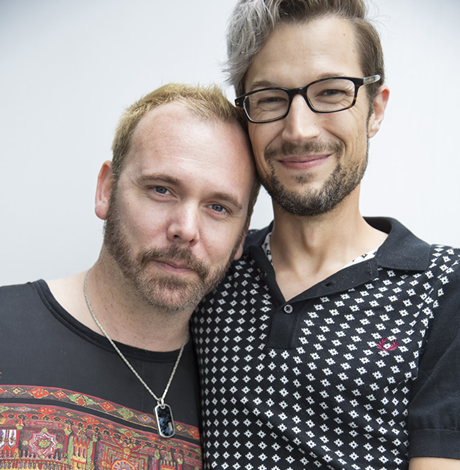
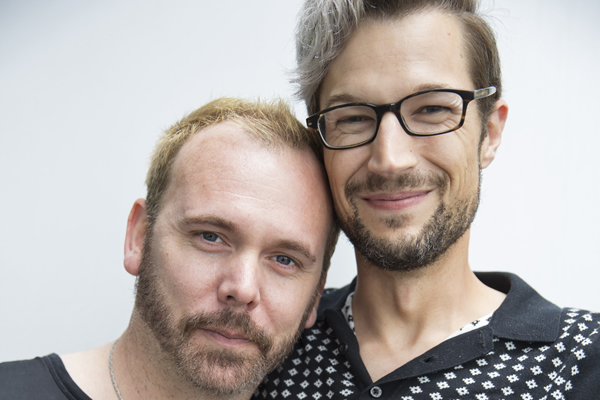
Charlie Craig and David Mullins are at the center of the Masterpiece Cakeshop case. (Photo courtesy of the ACLU)
Charlie Craig and David Mullins didn’t expect to be the new face of the LGBT rights movement, but that responsibility will be thrust upon them in a matter of weeks as the U.S. Supreme Court hears their case over being denied a wedding cake in Colorado at Masterpiece Cakeshop.
The two are key figures in the case challenging Colorado’s non-discrimination law, which bars discrimination in public accommodations on the basis of sexual orientation. Jack Phillips, the owner of Masterpiece Cakeshop, refused to make a wedding cake for the Denver-based couple on the basis that it would violate his religious beliefs as a Christian.
In an exclusive interview with the Washington Blade, Craig, 37, and Mullins, 33, said they’ve been anticipating the oral arguments in the case — set for Dec. 5 — with intense emotions.
Mullins said he’s been filled with “trepidation and excitement” since the Supreme Court agreed to hear the lawsuit in June.
“I will definitely say I don’t think anyone in the country is prepared to hear that a case they are party to is going to be argued before the Supreme Court,” Mullins said. “That was definitely a hard thing for us to wrap our minds around.”
The day of oral arguments for the court on Dec. 5 is actually the anniversary for the first date of the couple seven years ago. (Recognizing the occasion, Craig said “maybe it’s good luck.”)
Craig said the two met through a mutual best friend and were friends for a good year before dating. At a time when same-sex marriage was legal in limited places and not in their home state of Colorado, the two nonetheless decided to marry.
Although many couples arrange dramatic engagement proposals, Mullins said the couple had a “cute story” that wasn’t very dramatic.
“In all reality, we were just lying on the couch together one Sunday morning,” Mullins said. “I think it was Charlie who turned me. He was like, ‘You know. I really would marry you.’ And I thought about it and I was like, ‘I would marry you, too.’ And we sort of sat there for a minute and we were like, ‘So should we get married? And we decided to get married.’ It was a very natural, casual moment, which was really kind of how our relationship was.”
Craig added he later discovered Mullins had been socking away money to buy wedding rings. (The two have a pair of three-diamond rings. Craig’s is made of white gold, but Mullins’s is comprised of cobalt because he’s allergic to silver and gold.)
Because same-sex marriage wasn’t yet legal in Colorado, the couple decided to marry in Provincetown, Mass. The Bay State, first in the country with marriage equality, legalized same-sex marriage as a result of a court order by the Massachusetts Supreme Court in 2003.
The two planned to have 30 friends and family members fly up to Massachusetts for the ceremony, and have a hometown reception in Colorado. But then there was the matter of the wedding cake.
Craig said the host for the Denver reception party used Masterpiece Cakeshop for earlier clients and recommended the bakery based on its service and close proximity.
“We looked up the website and were like, yeah, OK, they look like something that we would want,” Craig said.
On the fateful day, July 19, 2012, Mullins and Craig proceeded to Masterpiece Cakeshop and brought along Craig’s mother. Because she doesn’t live in Denver and was in town for a conference that day, the wedding cake purchase would be her only opportunity to take part in the planning.
Mullins said the three went in “really excited” and Craig came in with a binder of ideas, but “it all went wrong immediately” after they sat down with Phillips.
“He immediately asked us who the cake was for and we said it was for us, and he told us he would not make a cake for a same-sex wedding,” Mullins said. “And what followed was a horrible pregnant pause. We were just mortified and embarrassed and quickly we just got up and we left.”
When the couple entered the parking lot, Mullins said they became emotional and broke down in tears — a moment they said was all the more “painful and profoundly embarrassing” because Craig’s mother was present.
The couple said they had no idea Phillips sought to operate his business consistent with this Christian beliefs, nor that he had a policy of refusing wedding cakes to same-sex couples.
Craig and Mullins quickly found relief from the LGBT community and supporters after a Facebook post, which quickly went viral worldwide in a couple days.
As a result of the Facebook post, a friend informed the couple that Phillips’ actions were a violation of state law in Colorado — something Mullins said the couple wasn’t aware of previously.
“We actually were unaware that there was a law in Colorado against what happened,” Mullins said. “It actually took a relative of Charlie’s looking something up and connecting us the next day to actually tell us there was an anti-discrimination statute in Colorado that covered public accommodations discrimination.”
Another Colorado shop, Lora’s Donuts & Bakery Shop, offered to provide the wedding cake the couple ultimately used for their celebration. The cake had rainbow layering to represent solidarity with the LGBT community.
But there still was the matter of the discrimination. Mullins said the couple spoke with the LGBT legal group Lambda Legal about their rights under state law, then the American Civil Liberties Union — which represents them in the case — helped them further and filed a complaint on their behalf in 2013.
“Eventually, someone at the ACLU found us and we spoke to them, and we decided to move forward with the complaint,” Mullins said. “They sort of helped us file the paperwork a little bit, and then after that and much discussion on their part, they decided to take up the case.”
Prior to the complaint, the couple hadn’t had significant experience in LGBT advocacy. Craig, an alumnus of University of Wyoming in Laramie, said 15 years ago he was a board member of a student LGBT group that sought to raise awareness for the Matthew Shepard Foundation and HIV testing, and Mullins said he couldn’t recall any instance of prior LGBT work.
“This was kind of my awakening,” Mullins said.
James Esseks, director of the ACLU Lesbian Gay Bisexual Transgender & HIV Project, said by filing a complaint, the couple took the lead in the fight to ensure equal rights for LGBT people.
“No one should ever have to experience the kind of pain and humiliation that Charlie and Dave were put through,” Esseks said. “They’ve shown real courage to stand up for the rights of all of us and we’re proud to stand with them as they take this fight to the Supreme Court. We all deserve the freedom to go out in public without being turned away because of who we are.”
At the state level, the couple had success many times over. In December 2013, an administrative judge ruled the bakery had illegally discriminated against the couple — a decision affirmed by the Colorado Civil Rights Commission.
Masterpiece Cakeshop wasn’t penalized with monetary damages, but required to take remedial measures to comply with the law, institute comprehensive staff training and issue quarterly compliance reports for two years on these corrections in addition to documenting all patrons denied service at the bakery.
Mullins said the litigation “is not about whether or not there’s somewhere else we could get a cake” when asked why the couple is insistent Masterpiece Cakeshop be required to serve wedding cakes to same-sex couples.
“Our case is about basic access to public accommodations,” Mullins added. “We were not turned away from Masterpiece Cakeshop because of any design we asked for, we were turned away because we’re a gay couple, and we pursued this because we didn’t want another couple to go through what we had gone through.”
Mullins said if Masterpiece Cakeshop followed state law “we would have received the same service that any other person would have received, we would have been treated with respect.”
As litigation proceeded, Craig said the couple discovered Masterpiece Cakeshop turned away four or five same-sex couples before them. Although court documents say Phillips had offered the couple any ready-made product in the store in lieu of a wedding cake, Craig said one of these couples had sought cupcakes and were denied service.
In 2015, a three-judge panel on the Colorado Court of Appeals affirmed the decision of the commission. Later, the Colorado Supreme Court refused to hear the case upon appeal from Masterpiece Cakeshop.
That seemed like the end of the road for Masterpiece Cakeshop, But in a last ditch effort, the bakery, represented by the anti-LGBT legal firm Alliance Defending Freedom, petitioned the U.S. Supreme Court for review, citing issues of freedom of religion and expression.
To the surprise of just about everyone, the U.S. Supreme Court agreed to accept the petition in June. (The petition had remained pending before the Supreme Court for some time and was taken up shortly after confirmation to the bench of U.S. Associate Justice Neil Gorsuch.)
Why did the Supreme Court agree to take up the case? After consistent rulings at the state level in favor of the couple, could justices have in mind overturning those decisions in favor of allowing anti-LGBT discrimination?
The answer, Mullins said, is completely in the minds of the Supreme Court justices and no one else — at least until justices render their decision in the case.
“Obviously there have been numerous public accommodations cases that have happened in numerous states, and in my wholly un-legal opinion, I think that maybe the reason they took our case was because there was no disagreement over the facts of how anything went down,” Mullins said. “It’s also possible that they just felt it was time to take up one and ours was the one that was on their desk when they made that decision.”
Mullins and Craig — with Craig’s mother in tow — plan to travel to D.C. to witness the oral arguments firsthand at the Supreme Court on Dec. 5. Mullins expressed excitement about seeing “Ruth Bader Ginsburg’s neckpiece” while hearing the case.
The couple has a busy schedule planned for the time they’re in D.C., which includes three speeches at different rallies. That’s consistent with the nearly 150 media interviews in which the couple has participated, ranging from the LGBT press to the New York Times.
“I think it’s important for people to see us just for the fact of we’re standing up for ourselves,” Craig said. “We experienced discrimination and experienced what it means to follow it through this far.”
During the arguments, the ACLU will represent the couple, another attorney will represent the Colorado Civil Rights Commission in defense of the non-discrimination and Alliance Defending Freedom will make Masterpiece Cakeshop’s arguments.
But another lawyer from the U.S. Justice Department under U.S. Attorney General Jeff Sessions may also take part: U.S. Solicitor General Noel Francisco. Francisco sought time to speak before the Supreme Court after the Justice Department filed a friend-of-the-court brief in favor of Masterpiece Cakeshop.
Mullins said the participation of the Trump administration in the litigation is “definitely notable,” but ultimately the Supreme Court will be making the decision in the case.
“In the end, the Supreme Court is nine justices and nine votes and they will make their decisions, and so, in the end, the buck stops with them,” Mullins said.
Contrary to the experiences of many plaintiffs in LGBT rights cases, Mullins said the couple hasn’t faced significant backlash since the Supreme Court agreed to hear the case.
“If anything, I feel like it made the story larger and it helped reach some people and changed some minds, of people who weren’t as aware of the story beforehand,” Mullins said.
The Supreme Court ruling in the Masterpiece Cakeshop will likely be issued next year and could be a milestone for the LGBT rights movement.
Craig, however, said the impact is difficult to determine because the ruling could affect just Colorado law or similar statutes nationwide.
“In the smallest sense they can validate what Colorado has already said, that he violated anti-discrimination laws here, and that would set a precedent for Colorado,” Craig said. “It could also set a precedent for the other 20 states that have the same public accommodations laws, or it could be as big as they’re sending a message to the whole nation that discriminating against gay people is wrong.”
In the event of a loss before the Supreme Court, Mullins said the decision would have deleterious consequences not just for LGBT people, but other marginalized groups.
“If the Supreme Court found that a business owner could refuse to serve someone based on their strongly held religious beliefs, could a hotel owner refuse to rent a room to an interracial couple because his faith believed the races were not meant to mix, or could a business owner refuse to hire a single mother because his faith believed that mothers should be married?” Mullins said. “A loss at the Supreme Court could open the door to many forms of discrimination that have long been considered wrong in our society, and not just ones that involve LGBT people.”
Win or lose, Craig said the lawsuit will be worth the effort because it means not just standing up for the thousands of people who’ve told the couple about their own discrimination stories as the litigation proceeded.
“I feel like of course we’re standing up for ourselves, but the important thing is and what the Supreme Court decision is going to decide, is we’re standing up for these thousands of other people who are discriminated against all the time, and that’s really what keeps us going,” Craig said.






National
988 restores crisis services for LGBTQ+ youth
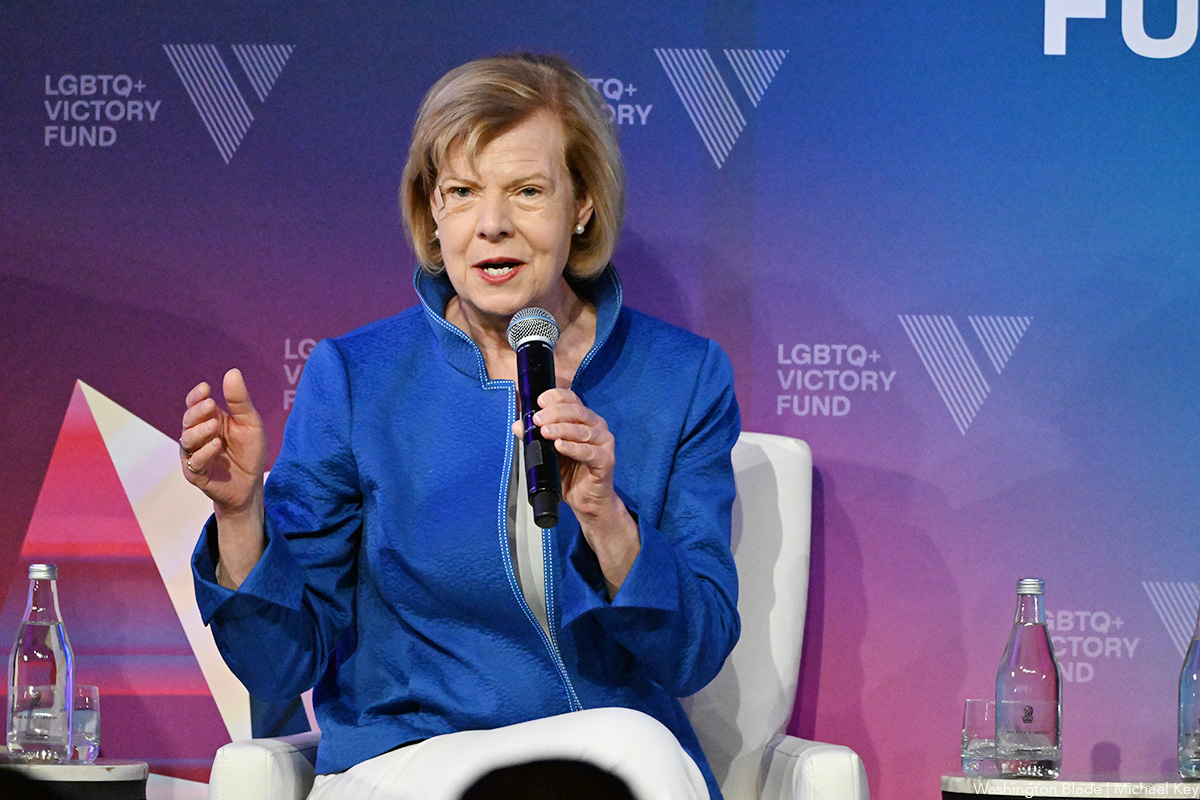
The lifesaving 988 call-in number to help people experiencing mental health crises or suicidal thoughts has once again restored its specialized services for LGBTQ+ youth.
The lifeline, which used to have the option to “press 3” to be directly sent to specialized services for LGBTQ+ youth facing mental health crises or suicidal thoughts, was returned on Wednesday following an over-year-long battle with the Trump-Vance administration, which removed the service in May 2025.
The Press 3 option rolled out as a pilot program in 2022 through a government contract with the Trevor Project, a suicide prevention and crisis intervention organization for LGBTQ+ people.
Then, in June 2025, the federal government announced that the lifeline would be eliminated within a month. By July 2025, 988 Lifeline’s “Press 3” services were terminated.
Openly gay U.S. Sen. Tammy Baldwin (D-Wis.) helped lead Congress in reversing the removal of the lifesaving resource from American phones. As a member of the Senatw Labor-HHS Appropriations Subcommittee, she started the process of securing $535 million for 988 — a $15 million increase — as well as dedicated funding for LGBTQ+ youth specialized services.
Then, in September 2025, Baldwin, along with U.S. Sen. Lisa Murkowski (R-Alaska), introduced bipartisan legislation in the Senate, the 988 LGBTQ+ Youth Access Act, to codify the 988 Lifeline’s specialized services for LGBTQ+ young people.
At the same time, U.S. Rep Raja Krishnamoorthi (D-Ill.) introduced the legislation in the House of Representatives alongside U.S. Reps. Michael Lawler (R-N.Y.) Sharice Davids (D-Kan.) Brian Fitzpatrick (R-Pa.) and Seth Moulton (D-Mass.)
The Senate passed Baldwin’s bipartisan funding bill in January 2026, funding the Department of Health and Human Services with explicit language mandating the return of 988’s LGBTQ+ youth specialized services.
In February 2026, Congress passed legislation mandating that the previously eliminated “Press 3” specialized services be restored and funded with $33,100,000 — but it was unclear if the Press 3 option would still be allowed under current executive orders, namely Executive Order 14168, or “Defending Women From Gender Ideology Extremism and Restoring Biological Truth to the Federal Government.”
Despite the securing of federal funding for the Press 3 resource, the battle to get the 988 LGBTQ+ Youth Access Act through Congress is ongoing — and would provide codafied protection from this removal ever happening again.
According to data on the Trevor Project’s website, LGBTQ+ young people are more than four times as likely to attempt suicide than their peers.
Baldwin’s office touts the immense help the lifeline provides to LGBTQ+ people in their moments of greatest need. The press release on the reinstatement of Press 3 highlighted the continued demand for the service:
“The volume of calls, texts, and chats 15 percent higher than a year earlier and nearly 50 percent higher than two years ago. Since the lifeline launched, it has received over 27 million contacts, including over 18 million calls, 4 million texts, and 3 million chats.”
Advocates for LGBTQ+ rights and mental health awareness have agreed with the increasing numbers and hailed the return as a win for everyone.
“Suicide and mental health struggles touch every community across our state, and that’s why creating the 988 crisis lifeline to make sure help is there for everyone is one of my proudest accomplishments,” said Baldwin said in a statement. “But, last year, the Trump administration decided to make these real struggles a political football and ripped away the specialized line that helped LGBTQ children. This was a deliberate choice. The Trump administration chose to put children’s lives on the line to score some political points.”
“I’ve fought tooth and nail to restore this lifesaving resource. When I realized the Trump administration was not going to do it on their own, I wrote it into federal law to require them to restore the Press 3 option,” the Wisconsin senator said. “This lifesaving resource never should have gone away in the first place, but I am glad the lifesaving support Press 3 provides is once again there for people who need it.”
“I’m proud that we secured the funding to restore this lifesaving LGBTQ+ crisis line and successfully pressured the Trump administration to bring the program back,” Krishnamoorthi said. “When an LGBTQ+ young person reaches out for help in a moment of crisis, they deserve to reach a counselor trained to understand and support them. This program should never have been taken away, and now we need to make sure it stays available for every young person who needs it. I’m grateful to the Trevor Project, NAMI Chicago, Equality Illinois, the American Foundation for Suicide Prevention, and all the advocates and young people who worked alongside us to bring these services back.”
Jaymes Black, CEO of The Trevor Project who works with the SAMHSA, in their press three operations celebrated the return of the resource.
“We are grateful to see that the 988 Suicide & Crisis Lifeline’s ‘Press 3’ specialized services for LGBTQ+ youth have been restored. Resuming this national resource will be critical in addressing the public health crisis of suicide among LGBTQ+ young people, and supporting the estimated more than 1.8 million LGBTQ+ youth who seriously consider attempting suicide in the U.S. each year,” Black said via a statement. “We are thankful for the large coalition of bipartisan lawmakers, mental health advocates, allies, and supporters who fought tirelessly for this restoration. We will monitor the launch and usage of these important services to ensure all LGBTQ+ youth are supported with clinically best standards.”
If you or someone you know needs mental health resources and support, please call, text, or chat with the 988 Suicide & Crisis Lifeline or visit 988lifeline.org for 24/7 access to free and confidential services. Trans Lifeline, designed for transgender or gender-nonconforming people, can be reached at (877) 565-8860. The lifeline also provides resources to help with other crises, such as domestic violence situations. The Trevor Project Lifeline, for LGBTQ+ youth (ages 24 and younger), can be reached at (866) 488-7386. Users can also access chat services at TheTrevorProject.org/Help or text START to 678678.
U.S. Federal Courts
Renee Good’s family files two federal lawsuits
ICE officer killed lesbian mother of three in Minneapolis in January

The family of lesbian woman who a U.S. Immigration and Customs Enforcement killed in Minneapolis in January have filed two federal lawsuits.
The Associated Press notes Renee Good’s partner, Becca Good, and her brother, Brent Ganger, in the lawsuits accuse the Trump-Vance administration and ICE officer Jonathan Ross of “unjustified and excessive use of force.”
Renee Good was a 37-year-old mother of three.
Ross on Jan. 7 shot and killed her in Minneapolis.
The shooting took place during the Trump-Vance administration’s so-called Operation Metro Surge that targeted Somalis and other immigrant groups in Minneapolis. U.S. Customs and Border Protection agents on Jan. 24 shot and killed Alex Pretti, a 37-year-old nurse who worked for the U.S. Department of Veterans Affairs, in Minneapolis.
Both shooting sparked outrage across the U.S. and around the world.
“Every morning, she is my first thought. I think about how the kids are growing up without their mama, and how I will grow old without the love of my life. I think about how we should have had 40 more years together. But I also think about what she would have wanted after all of this,” said Becca Good in a statement the Human Rights Campaign released after she and her partner’s family announced the lawsuits.
“As we have tried to navigate our own massive loss, I am also devastated by how many other lives have been destroyed in this darkest of times. So many other families are dealing with the loss of their loved ones; to everyone who has had to witness it — the pain of this moment extends far beyond our family,” added Becca Good. “What happened to us should never happen to any family. No child should grow up without a parent because of it. No one should lose their sister or their daughter. No one should have to live without their soulmate. Accountability — real accountability — is the only way to make sure that no other family has to go through what we have.”
HRC President Kelley Robinson in her own statement said the Good family “is one of our own — and today, the Human Rights Campaign joins them in demanding justice.”
“It has been eight months and 24 days since Renee was shot and killed by an ICE agent, and the United States government has failed to take responsibility for its actions,” said Robinson. “Her partner, Becca, and brother Brent, have made the brave and bold decision to hold the government accountable, and we stand with them. Like every person murdered by ICE, Renee should be alive today. The Goods were robbed of what every American family deserves: to be together.”
National
HRC report: LGBTQ+ students face ‘far greater challenges’ in non-supportive states
Survey finds anti-LGBTQ+ school harassment, bullying highest in 17 states
The Human Rights Campaign Foundation, the educational arm of the national LGBTQ+ advocacy organization Human Rights Campaign, has released a report showing LGBTQ+ public school students are more likely to face bullying, harassment, and “other barriers” in states that have less overall supportive LGBTQ+ laws and policies.
The report is based on the HRC Foundation’s National Educator Survey of School Climate and Bullying, which was released on Sept. 17.
“The report finds that harassment, bullying, and other barriers to LGBTQ+ inclusion are more prevalent in states with limiting policies, where educators report widespread restrictions on LGBTQ+ resources, visible expressions of support, and assistance for transgender students,” a statement released by HRC says.
“As just one example,” the statement adds, “while 59 percent of educators in states with limiting policies report restrictions on supporting their transgender students, just 6 percent to 8 percent of educators in states with supportive policies report the same, underscoring the impact of these policies on school climate, student well-being, and the stakes of the upcoming midterm elections for LGBTQ+ youth and inclusive classrooms.”
The report says the survey consisted of responses by 826 educators in 42 states who worked as teachers, principals, counselors, administrators, and others who worked in support services. All worked at schools with students from pre-kindergarten to 12th grade, most being public schools and a smaller number being charter schools, the report says.
It says the survey was conducted between April 15 and May 21, 2026, and included a survey questionnaire with about 55 questions covering a wide range of LGBTQ+ related school issues.
According to the report, its classification of LGBTQ+ supportive and non-LGBTQ+ supportive states is based on a detailed analysis of the LGBTQ+ related laws and policies of all 50 states, D.C., and U.S. territories conducted by the Movement Advancement Project, or MAP, which describes itself as an “independent, nonprofit thinktank.”
The report includes a chart consisting of 51 boxes representing the 50 states and D.C., with 32 plus D.C. colored as blue and said to have overall LGBTQ+ supportive policies. The 17 boxes colored in red are said to have overall non-LGBTQ+ supportive policies and laws, Each of the boxes has the initial of a state or D.C. printed inside it.
In addition to D.C., the chart shows Maryland, Virginia, New York, California, and Massachusetts as among the supportive states. Florida, Texas, West Virginia, and Ohio are among the states shown to be non-LGBTQ+ supportive.
The HRC statement includes these “key” findings from the survey:
- In states with restrictive LGBTQ+ inclusion policies, 59 percent of educators report restrictions on supporting transgender students, compared to just 6-8 percent of educators in states with supportive LGBTQ+ inclusion policies.
- In states with restrictive policies, nearly 50 percent of educators reported restrictions on LGBTQ+ books or resources, compared to just 7 percent of educators in states with supportive policies.
- Roughly 32 percent of educators in states with restrictive policies reported anti-LGBTQ+ harassment was a moderate or serious problem, compared with 11 percent of educators in states with supportive LGBTQ+ inclusion policies.
- In states with restrictive LGBTQ+ inclusion policies, 29 percent of educators were very worried about anti-LGBTQ+ harassment, compared to 15 percent in states with supportive LGBTQ+ inclusion policies.
- In states with restrictive LGBTQ+ inclusion policies, 36 percent of educators witnessed anti-LGBTQ+ student bullying, compared to 27 percent in states with supportive LGBTQ+ inclusion policies.
- In states with supportive LGBTQ+ inclusion policies, 75 percent of educators reported no restrictions on LGBTQ+-supportive displays, highlighting a substantially more supportive school environment than in states with restrictive policies.
- Educators in states with restrictive LGBTQ+ inclusion policies also reported significant harassment of students based on appearance (57 percent), race or ethnicity (43 percent), sexual orientation (42 percent), and gender identity or expression (39 percent). (No direct comparison figure from supportive-policy states is provided in the data above.)
“Every young person deserves to feel safe and supportive at school, but this report makes clear that fore too many LGBTQ+ students, especially transgender youth, are being failed by policies designed to exclude them,” said HRC President Kelley Robinson in the HRC statement.
“We know that when students feel seen, supported, and affirmed, they are more likely too thrive, but when schools become places of exclusion or hostility, young people pay the price through lower engagement, missed opportunities to learn, and poorer mental and physical health,” Robinson said.
The HRC statement notes that the survey findings come at a time when a growing number of states have passed laws targeting LGBTQ+ students and the school officials and teachers who support them. It says that for the first time, the survey found that “educators themselves are also experiencing anti-LGBTQ+ harassment, highlighting the growing impact of these policies on school staff as well as students.”
The full survey findings and report can be accessed here:
National
Education Department rolls back protections for LGBTQ+ students under Title IX
The DoE policy rescinds Biden-era protections
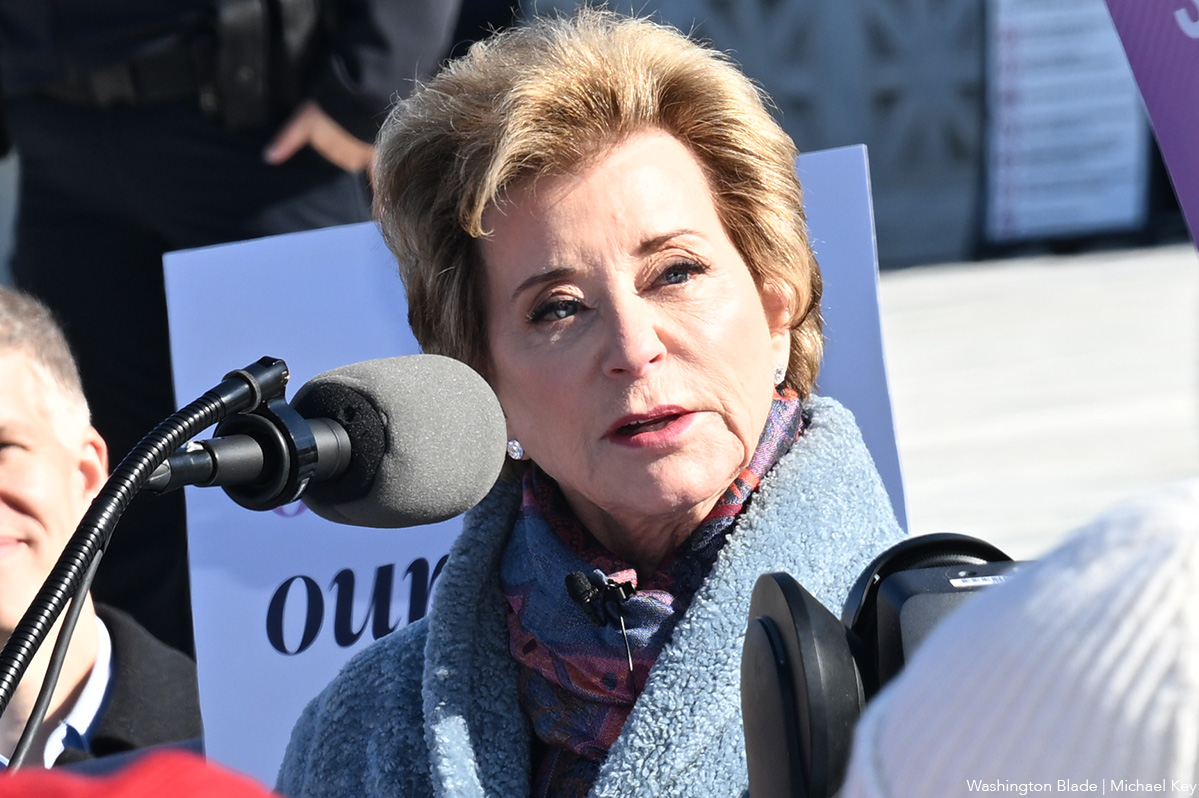
The Department of Education rolled back a Biden-era Title IX interpretation on Monday that secured sex-based discrimination protections for students on the basis of sexual orientation and gender identity.
Title IX was established in 1972 as landmark civil rights law. It prohibits sex-based discrimination in any school or any other education program that receives funding from the federal government.
Education Secretary Linda McMahon spoke about the revision of the policy, claiming the decision would explicitly help “women and girls.”
“Thanks to today’s action, the published Title IX regulations faithfully reflect court orders and congressional intent — reducing confusion for parents, students, and educational institutions. We will continue to relentlessly champion equal opportunity for all Americans and hold accountable any school or college that violates the rights, privacy, or athletic opportunities of our women and girls,” McMahon said via press release.
Prior to her work under the Trump-Vance administration, McMahon was a World Wrestling Federation/World Wrestling Entertainment executive before resigning to pursue a career in politics. She was appointed to the Connecticut State Board of Education by then-Gov. Jodi Rell in January 2009, but resigned from her role shortly afterward to run what ultimately became two failed campaigns for Connecticut’s U.S. Senate seat in 2010 and 2012.
A “fact sheet” provided by the Department of Education also called the inclusive sexual assault and gender identity protections expanded under the Biden-Harris unlawful, saying, “This change is necessary to provide clarity in the Code of Federal Regulations so that institutions, administrations, students, and families can see the rules that are actually in force and to help eliminate public confusion about the Biden administration’s unlawful attempt to stretch Title IX’s legal protections to cover ‘sexual orientation’ and ‘gender identity.’”
This is not the first time this policy has faced judicial hurdles. While Biden was still in office, the plan was struck down in multiple courts in Republican states.
Opponents of the move say it will harm transgender athletes and weaken protections for sexual assault victims.
“Sexual harassment and assault continue to be pervasive in schools and, to the fullest extent possible, we should be working to enforce the laws that protect student survivors of sexual violence. Yet, Education Secretary Linda McMahon and the Trump administration have decided to ignore what survivors need, instead weaponizing Title IX to attack trans students,” said Shiwali Patel, senior director of education justice at the National Women’s Law Center.
This is a return to a first Trump term policy after Biden issued an executive order to attempt to curb discrimination for all — especially those with different sexual orientations and gender identities — that had been given a pass during Trump’s first term. Much of Title IX’s policy has a narrow vision of what sex protections look like that often and enthusiastically leave gender-diverse and non-heterosexual people out.
In March 2021, President Joe Biden signed Executive Order 14021, “Guaranteeing an Educational Environment Free From Discrimination on the Basis of Sex, Including Sexual Orientation or Gender Identity,” to attempt to undo some of the flagrantly anti-LGBTQ+ policy the Trump-Pence administration had set forth relating to Title IX protections for LGBTQ+ students and sexual assault survivors.
The secretary focused this “win” for the administration as one more step toward restricting transgender students from competing in women’s sports, but the 2020 rule, completed under former Education Secretary Betsy DeVos, didn’t explicitly ban trans students from participating on sports teams consistent with their gender identity. It did limit the types of sexual harassment and assault complaints that schools had to investigate and required live hearings so male students could respond to accusations.
McMahon didn’t discuss those aspects in her statement or in requests for comment. The 2020 rule drew praise from conservatives and intense opposition from advocates who said it downplayed sexual abuse and left victims unprotected.
In a statement, U.S. Rep. Tim Walberg (R-Mich.), who chairs the House Education Committee, said, “Returning to the 2020 regulations restores longstanding protections for women and girls that the Biden-Harris administration attempted to dismantle and realigns Title IX policy with court precedents.”
LGBTQ+ activists have called this decision a direct attack on LGBTQ+ safety — particularly for trans students who continue to face a barrage of legislative, executive, and judicial attacks in recent years from the Trump-Vance administration.
Kelley Robinson, president of the Human Rights Campaign, the largest LGBTQ+ advocacy group in the world, released a statement following the DoE’s announcement.
“Title IX is, quite simply, about protecting students and ensuring that they are safe from abuse, harassment, and discrimination while they pursue their education. But Donald Trump and his cronies aren’t interested in any of that,” Robinson said. “Donald Trump’s Department of Education has completely lost sight of that mission. Instead of enforcing protections for students, they’re rescinding them. They don’t care if sexual harassment and assault go unaddressed. And they’re happy to strip funding away from school districts and states that are actually trying to keep students safe.
“We know who will be hurt: women, girls, and others who are vulnerable to sexual harassment, assault and abuse — including LGBTQ+ students. The fact that they’re dropping this rule into place abruptly, without a comment period, denying families, educators, loved ones, and the students themselves a say in how they should be treated, shows how little they care about the safety of our students.
“This is a monstrous injustice, and it drives home how essential it is that we take action at the polls this November to start bringing some accountability to an administration that has turned its back on the very students Title IX was written to protect,” she added.
The Los Angeles Blade reached out to the DoE for comment and questions on whether Title IX protections still included LGBTQ+ students, but did not receive an answer.
Netherlands
Dutch prime minister visits Stonewall Inn
Rob Jetten is the Netherlands’ first openly gay prime minister
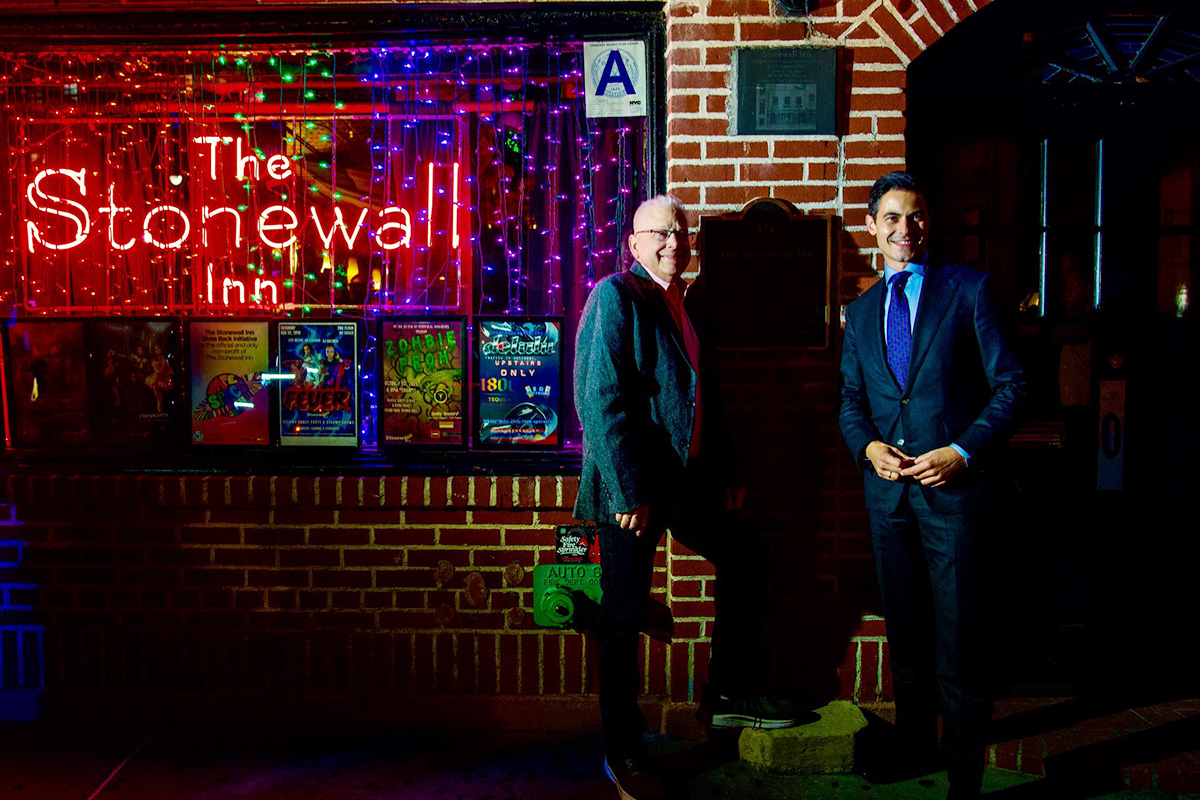
Dutch Prime Minister Rob Jetten on Monday visited the Stonewall Inn in New York.
“The Stonewall Inn is not just a gay bar in New York, but the place where in 1969 riots took place as a reaction to years of discrimination and police violence,” wrote Jetten on X. “This is seen as the starting point of the global LGBTIQ+ emancipation and activism. Nowadays, the bar is a national monument, dedicated to the LGBTIQ+ rights movement.”
“For me, it is impressive and moving to be here tonight. And also fitting, because the defense of human rights is an important part of our foreign policy,” he added. “The Netherlands stands alongside the Stonewall Inn community when it comes to everyone’s right to live openly, safely, and with pride, no matter who you are or who you love.”
De Stonewall Inn is niet zomaar een gay bar in New York, maar de plaats waar in 1969 rellen plaatsvonden als reactie op jarenlange discriminatie en geweld van de politie. Dit wordt gezien als startpunt van de wereldwijde lhbtiq+-emancipatie en activisme. Tegenwoordig is de bar… pic.twitter.com/hJmFYjF91Z
— Rob Jetten (@MinPres) September 23, 2026
Jetten in February became the Netherlands’s first openly gay prime minister.
He opened last month’s World Pride Human Rights Conference in Amsterdam. Jetten also participated in a panel with former Irish Prime Minister Leo Varadkar, former San Marino Captain Regent Paolo Rondelli, and other current and former heads of government who are gay or lesbian.
Jetten is scheduled to speak to the U.N. General Assembly on Thursday.
(Editor’s note: Jetten visited New York’s LGBT Community Center with New York City Mayor Zohran Mamdani before he left the city.)
National
For lesbian victims of domestic violence, competent care is scare
Heteronormative assumptions, funding cuts contribute to lack of resources for survivors

Uncloseted Media published this story on Sept. 22.
By EMMA PAIDRA | Claire, a 25-year-old Los Angeles resident, distinctly remembers the night she and her ex-girlfriend broke up.
“She was strangling me in a CVS parking lot,” Claire recalls, adding how she was gasping for air as bystanders looked on. “I made eye contact with one man who just kept walking, and we were right behind a car that was trying to reverse out of a parking spot. No one got out of the car. They didn’t honk; they didn’t do anything.”
Claire, who asked to use a pseudonym due to safety concerns regarding her ex, says she managed to fight her way out of her then-girlfriend’s grasp. It was at this moment in 2024 she realized things had reached a breaking point.
While research on intimate-partner violence has traditionally focused on opposite-sex couples, two recent reports found that queer women, like Claire, are not immune to this type of abuse. An international research review published last year in the Journal of Media Critiques found “IPV rates in same-sex relationships are comparable to or exceed those in heterosexual relationships,” with up to 46 percent of lesbians encountering such abuse, compared to 36 percent of straight women. A separate review published earlier this year found that nearly 27 percent of lesbians surveyed had experienced IPV.
Despite the prevalence of IPV in lesbian relationships, heteronormative and outdated assumptions have left many queer women feeling like they have nowhere to turn for competent services and support, according to experts, advocates and victims interviewed by Uncloseted Media.
“Queer folks are joining the conversation to say, ‘This is happening in our communities, too, and we need the same resources and support services that straight women are offered,’” Tori Stranges, a professor of women’s studies at the University of British Columbia, told Uncloseted Media.
A frequently overlooked problem
Stranges says the false notion that only men are domestic abusers can result in violent same-sex relationships not being taken seriously.
“People assume that violence is perpetrated by men against women,” she says, adding that this “has left queer people out of the conversation.”
“If it was a man that was doing all these things, and people heard and saw it, I’m sure I would have been taken seriously,” says Claire. “People saw a 5-foot-7 woman who didn’t look that strong — and above all, she was a woman. Men, especially, don’t really see that as a threat. So they’re like, ‘If I’m not threatened, then I’m sure it’s not a big deal.’”
Outdated assumptions about IPV can even result in victims themselves overlooking their abuse.
“When it comes to abuse in heterosexual relationships, there are national campaigns, there are resources that you can access,” Stranges says. “There are people coming into the school systems to talk about relationship violence. We don’t have similar recognition and the same conversations about queer people.”
Claire says the violence she was subjected to was paired with moments of intense affection, which made it harder for her to recognize the abuse.
“We would get into a fight, and she would physically abuse me, and then apologize. She was actually also very gentle with me sometimes,” Claire recalls. “That kind of cycle can be really addicting. I would always wait for the good parts.”
The role of mental illness
K.P., a 47-year-old lesbian living in Maine, was with her abusive ex-girlfriend for five years before ending the relationship in 2023. During their time together, K.P. says her ex, who struggled with panic disorders, ADHD and depression, experienced a decline in her mental health, which contributed to more frequent outbursts of rage. When it comes to the link between rage and violence, one 2022 meta-analysis found that “anger was a significantly stronger correlate of IPV perpetration for women than men.”
K.P., who was working from home at the time and felt like she had no escape, says her ex’s verbal abuse spiraled into physical violence.
“I was on the couch with my laptop, trying to work, and she was just being belligerent,” recalls K.P., who asked to be identified by only her initials because of safety concerns. “I tuned her out, but when she realized I wasn’t giving her the attention that she expected, she went to the kitchen, grabbed two knives and started coming at me.”
K.P. ran outside, trying to get away. Her ex ran after her and then chased her back inside to avoid being seen by neighbors.
Once inside, her partner hid her phone. K.P. used this brief window to message a co-worker on her laptop, asking him to call the police.
“I was confused and afraid,” K.P. told Uncloseted Media. “I’d never been chased with a knife before, let alone by someone who I cared about.”
Research shows LGBTQ people have higher rates of mental health conditions than their non-LGBTQ+ peers. A study published last year in JAMA Network Open found sexual and gender minorities had “significantly higher odds of at least four of 10 commonly diagnosed mental health conditions,” including post-traumatic stress disorder and bipolar disorder.
IPV may also contribute to negative mental health effects, with research finding that victims experience an increase in depression, anxiety and PTSD and a reduction in life satisfaction.
“After we broke up, I was messed up,” K.P. says. “It took me a good six or eight months to feel like I could breathe again.”
Trapped in a ‘double closet’
In addition to mental health, the stigma of being queer may affect a victim’s response to being in an abusive relationship. When Claire first came out to her family, she says they kicked her out of their home until she returned to the proverbial closet. They eventually accepted her sexuality, but Claire says the residual shame she carried afterwards led her to avoid the added stigma she feared she’d experience if she admitted to being in an abusive relationship.
“All of that combined made me feel so trapped. I just thought, ‘Oh my god, I’m being judged from every single angle,’” she says. “There was just nowhere to go.”
Letícia Yuki de Araujo Furukawa, a clinical psychologist specializing in supporting survivors of IPV, says this kind of thinking is not uncommon among queer women in abusive relationships.
“Sometimes lesbian women who are experiencing IPV relationships start to isolate themselves, to prevent themselves from the shame and judgment they think they are going to suffer,” she says.
Furukawa says this impulse is rooted in the layers of stigma queer women face.
“It comes down to two things that make it like a double closet: We have the closet of being a lesbian, and you have the other one that comes from being in a violent relationship.”
According to Furukawa, having a supportive family can decrease the risk of entering an abusive relationship. Unfortunately, strained familial relationships are common among queer people: A 2022 study in the Journal of Marriage and Family found that 32 percent of gay and lesbian adult children — compared to 22 percent of their heterosexual counterparts — were estranged from their fathers.
Because of the shame Claire faced from her family when she came out, she was reluctant to admit there was a problem in her relationship when her mother and sister expressed concern. She worried that if her family knew her lesbian relationship was abusive, they would stop accepting her queer identity.
“My mom and sister would say to me during the relationship that they thought my ex looked evil, and that I changed so much. I used to be such a bubbly girl, and my personality made a complete 180,” she remembers. “In my head, I was like, ‘I can’t admit that it’s true.’”
‘Gaps in, policy, care, and services’
When queer women have the courage to report IPV, some don’t receive the response they’re hoping for. When police arrived at K.P.’s home following the knife-wielding incident, she says they opened a case file and wrote an incident report but said there was nothing else they could do because her ex had fled the scene.
“It was a little frustrating that since my ex-girlfriend drove away, the police couldn’t do anything,” K.P. explains.
Laura Elizabeth, an assistant professor of criminal justice at Virginia Union University who researches IPV, says there may have been additional steps police could have taken to support K.P., including connecting her with resources for domestic-violence survivors.
“It is vital that [police] make the proper referrals, and that it not just be limited to handing the victim a brochure,” she says. “There needs to be an active discussion with victims about what their options are in terms of who they can reach out to, who can offer what services.”
Kimberley Jackson, an associate professor at the Arthur Labatt Family School of Nursing at Western University, says lack of research on same-sex domestic violence also impacts the support services available to lesbian victims.
“The intersection of IPV and the LGBTQ community is really not well understood,” Jackson told Uncloseted Media. “What we can tell you based on really limited evidence, is that there are huge gaps in policy, care and services. And with respect to shelters, we haven’t really moved the needle very far.”
One area in which shelters may be failing lesbian victims has to do with both the perpetrator and the victim being able to access the same shelter.
“This issue is further compounded in rural areas, where there’s likely only one shelter,” Jackson says. “There’s a chance they won’t be able to turn someone away, even if they’re the perpetrator.”
Jackson says queer victims of domestic violence who aren’t open about their sexuality may face additional obstacles.
“With respect to anonymity, in a lot of rural places, you’re going to know people in the community,” she says. “There are issues with accessing help if you’re worried about outing yourself.”
Calls for change
Experts and victims say LGBTQ+ training for shelter workers and law enforcement, as well as funding for research, could help prevent same-sex IPV and address the damage done by such abuse.
But under the Trump-Vance administration, these funding resources are slipping away. In March of last year, the administration canceled at least 68 grants, totaling nearly $40 million, that were focused on LGBTQ+ health. A second round of cuts followed two months later, during which $800 million worth of grants dedicated to researching LGBTQ+ health were terminated.
Rebecca Hobbs, co-executive director of Through These Doors, a domestic violence resource and advocacy center in Portland, Maine, says LGBTQ+ training materials are essential to ensuring shelters can support lesbian victims.
“LGBTQ people will not come to us unless they see themselves reflected in our materials,” Hobbs says. “We want our advocates to be well versed in understanding the additional barriers and challenges that LGBTQ people might experience.”
Advocates say police departments could also benefit from LGBTQ+-awareness training.
The state of California and a number of large cities — including Atlanta, Chicago, Los Angeles, Houston, New Orleans, New York, Philadelphia, and D.C. — have implemented some form of LGBTQ+-sensitivity training.
But Greg Miraglia, founder and CEO of Out to Protect, a national organization supporting LGBTQ+ police officers and equipping all officers to serve queer people, says these programs are the exception, not the rule.
“Most other states do not require any type of LGBT awareness training,” Miraglia, a retired police officer who is based in California., told Uncloseted Media “There are over 18,000 law enforcement agencies out there, and I don’t think we’ve scratched the surface.”
“The problem comes about when law enforcement goes into a domestic violence incident with a same-sex couple without any training, carrying a lot of stereotypes that are common,” Miraglia adds. “They’re not picking up the fact that this is a couple that’s involved in an intimate relationship, and therefore domestic violence laws in that state apply.”
Claire says she wishes someone had intervened when her ex abused in the CVS parking lot and on her college campus. “The police had the biggest missed opportunity to intervene, as well as campus security,” she says. “A lot of our fights were in public, and she would get very loud. I made a promise to myself that if I ever saw anything like that in public, I would say something, because that’s all I needed at the time.”
National
Long-time DignityUSA executive director announces retirement
Marianne Duddy-Burke has been with LGBTQ+ Catholic group for decades
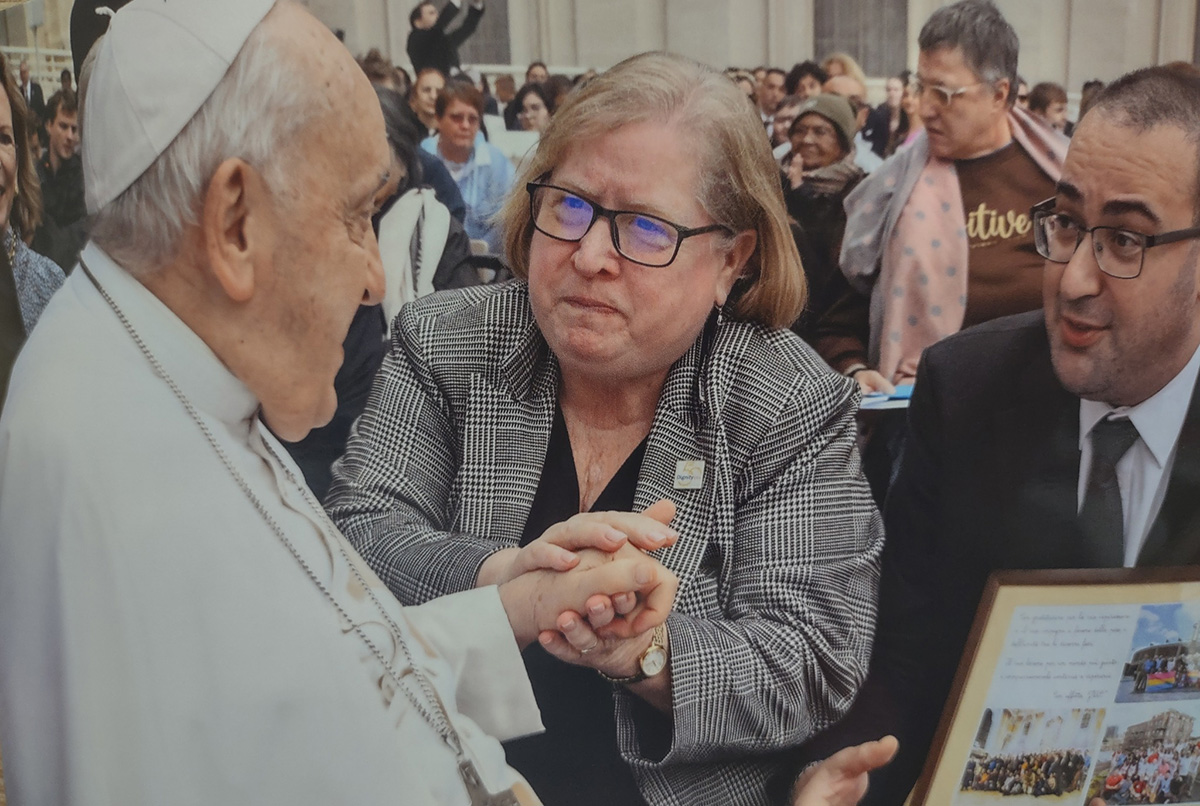
The executive director of the world’s oldest LGBTQ+ Catholic organization has announced she will retire once her successor has been chosen.
Marianne Duddy-Burke has been with DignityUSA for more than four decades. She has been the group’s executive director since 2007.
DignityUSA announced Duddy-Burke’s retirement on Sept. 17.
Duddy-Burke during her tenure has urged the Vatican to do more to welcome LGBTQ+ Catholics. She has also, among other things, championed marriage equality and advised the State Department on LGBTQ+-specific issues. (The Trump-Vance administration’s decision to freeze nearly all U.S. foreign aid shortly after it took office in January 2025 has had a devastating impact on the global LGBTQ+ and intersex rights movement and efforts to fight HIV/AIDS around the world. A report that Outright International released earlier this month notes 90 percent of LGBTQ+ and intersex rights groups around the world have lost funding since 2025.)
Duddy-Burke met with Pope Francis in 2023.
She traveled to Rome in 2025 for the papal conclave to choose the Argentine-born pope’s successor. Pope Leo XIV, who was born in Chicago, succeeded Francis.
DignityUSA in the press release that announced Duddy-Burke’s retirement notes she expressed “particular appreciation to people who spoke honestly about the reality of being a queer Catholic or family member.”
“I have been inspired every day by your stories and have done my best to lift them up,” said Duddy-Burke. “It is your lives, your faith, your struggles, your hopes that I have strived to reflect in my work, and doing this has been a great honor.”
DignityUSA President Meli Barber praised Duddy-Burke.
“It is almost impossible to sum up the scope and depth of Marianne’s achievements and contributions to DignityUSA over her more than four decades of service,” said Barber. “Under her wisdom and leadership, DignityUSA has only grown in stature as an advocate for LGBTQIA+ Catholics and as a visionary thought leader for LGBTQIA+ ministry and spirituality.
“Marianne has been more than an extremely able executive director,” added Barber. “Her care for and ministry to chapters, her deep personal relationships with countless Dignity members, her connections to LGBTQIA+ Catholics around the world, the relationships she has built with other progressive Catholic organizations, her skill as a public representative, the respect with which she is universally regarded, and her tireless devotion to service all leave an indelible mark. It is not an exaggeration to say that she has shaped not only Dignity but a generation of LGBTQIA+ Catholics.”
Barber said DignityUSA will “soon begin a search for a new executive director.” Barber added Duddy-Burke “will assist with the transition.”
Congress
Jeremy Moss looks to bring LGBTQ+ advocacy from Lansing to Capitol Hill
Congressional candidate would represent Detroit suburbs if elected
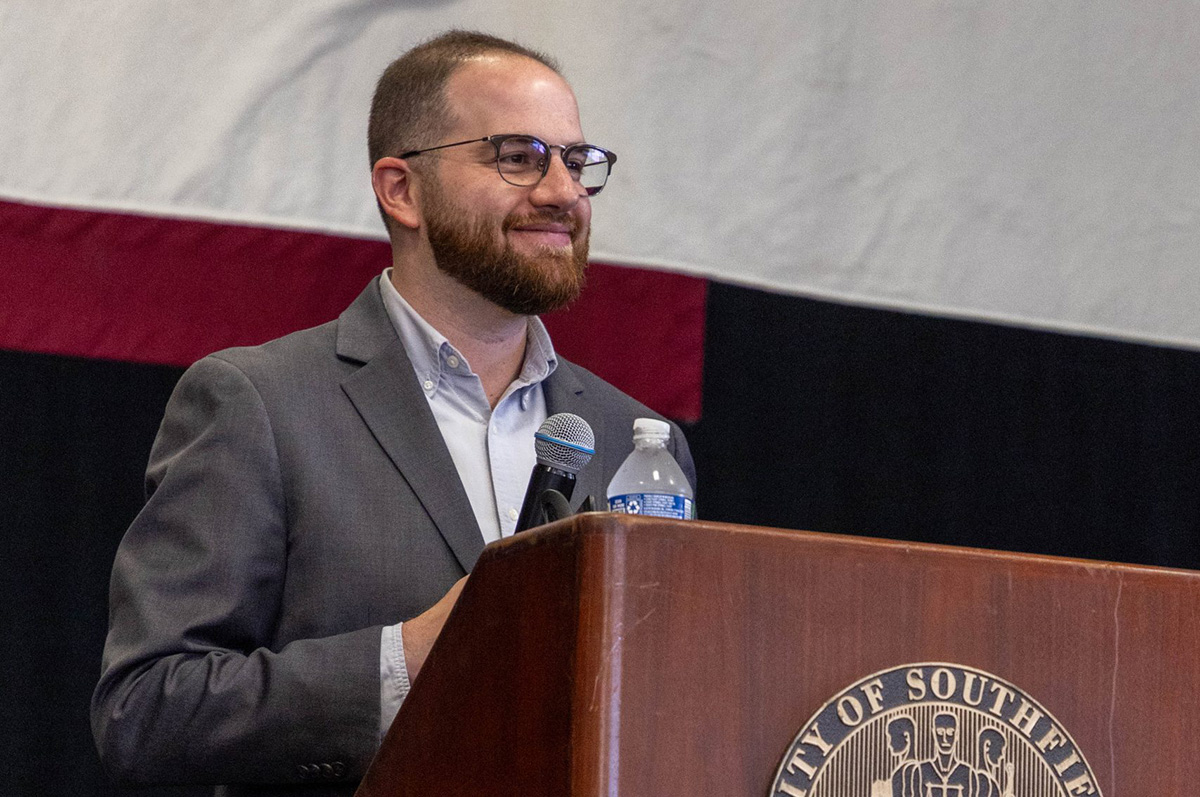
With fall comes swapping out T-shirts for sweaters, raking leaves and, of course, elections. The summer’s primaries have narrowed the playing field in a slew of races, but the big ones — the actual races for seats in federal and local elections — are still to come.
Jeremy Moss is one of those people running for a congressional seat in Michigan. Despite his young age, Moss has quickly learned the ropes of politics in the state, already serving terms in the Great Lakes State’s House of Representatives and Senate.
Moss sat down with the Los Angeles Blade to discuss his history in Michigan politics, his experience as an openly LGBTQ+ legislator and his vision for a better America as he looks toward Congress.
He currently represents Michigan’s 7th Senate District, but now he is setting his sights beyond Lansing toward Capitol Hill to represent Michigan’s 11th Congressional District, which includes Detroit’s northern suburbs.
Moss earned his bachelor’s degree in journalism from Michigan State University, where just a few years later he made history as the first openly gay person elected to the Michigan Senate and the first to serve as its president pro tempore.
His political experience stretches across multiple offices.
Moss worked in the offices of Southfield Mayor Brenda Lawrence, who also served in the U.S. House of Representatives, and State Rep. Paul Condino.
Moss, at age 25, was elected to the Southfield City Council in 2011, becoming the youngest member elected in the body’s history. He then switched over to the state legislature, representing Michigan’s 35th House of Representatives District in the Michigan House of Representatives from 2014-2018, becoming the second openly gay member elected to the Michigan legislature.
He then moved from Michigan’s House to its Senate in 2018, elected to represent the 11th Michigan Senate District and becoming the Assistant Democratic Leader. Moss started his second term in the Michigan Senate in 2023, this time representing District 7.
He currently has a long list of priorities listed on his campaign website, many of which have become standard for Democrats running across the country, with a particular focus on minimizing — and cleaning up — issues that the Republican-controlled federal government has created under President Donald Trump.
Those goals include lowering healthcare costs, tackling the cost of living crisis, holding U.S. Immigration and Customs Enforcement accountable and fixing the broken immigration system, restoring national voting rights, protecting rights — with a particular focus on abortion access and LGBTQ+ rights — combating corruption in politics, preventing gun violence and strengthening gun safety, empowering Michigan workers, and preserving the environment.
Why Moss is running for Congress
When asked why he wants to run for Congress, Moss pointed to his lengthy resume in state leadership, with a clear voice arguing that if he can do it in Lansing, he can get it done in Washington.
“I’ve served 12 years in the legislature and have ascended into leadership as president pro tem of the Senate,” Moss explained to the Blade. “We flipped our state legislative chamber to a Democratic majority for the first time in 40 years in 2022, and we passed some big, generational-changing, consequential Democratic wins that had languished for a generation, but had improved people’s lives in our state.
“We’ve passed the first gun safety laws in a generation that are saving lives. We protected the right to vote amidst attacks from Donald Trump and other conspiracies. We pushed forward and finally put LGBTQ rights in our state civil rights law. We provided free school meals and lunches for all public school children in the state of Michigan.
“The problems from Washington, D.C., aren’t getting less severe over time,” he continued. “They’re getting more severe. So this district unexpectedly opened up due to a series of retirements and it was just a great opportunity for me to continue to advocate for big change that we’ve already achieved here in the state legislature.”
“I’m a product of this district. I grew up here. I’ve represented a bulk of the district already in the state legislature, and I knew that I was going to earn grassroots support to be able to wage this campaign. We sought it out, we earned it, including some premier endorsements from Gov. (Gretchen) Whitmer, among many others, and were highly successful in the primary because we were in tune to the needs of this district.”
Moss has been endorsed by a slew of Democratic leaders and organizations, including, as he pointed out, by Whitmer.
Other endorsements include former Gov. Jim Blanchard, Secretary of State Jocelyn Benson, Attorney General Dana Nessel, the Equality PAC, the Human Rights Campaign, the Unity Fund, and the LGBTQ+ Victory Fund.
His political identity and the Democratic Party
Moss described himself as being “on the liberal end of the spectrum,” but argued that the Democratic Party’s internal divisions should not be the central focus.
“I’m certainly on the liberal end of the spectrum, but I don’t even think it necessarily has to be this progressive versus establishment fight that we’ve seen play out,” Moss said when asked about various elements of in-party disagreements. “It has to be between action and, and inaction, fighters versus folders.”
He said that distinction between action and inaction is central to how he would approach Washington.
“At this moment, I think we need to demonstrate that we are ready to take on Donald Trump and MAGA chaos with boldness and effectiveness. I’ve been saying all along our campaign trail, we can no longer be the party that shows up to the knife fight carrying a pie chart, and so I think we have to be showing that we have spine and we have punch, and we’re really ready to be tough fighters for, for Michiganders and the American people.”
“We can’t walk on eggshells anymore. We can’t pull our punches,” he added. “We can’t fear that we’re offending someone, you know, one way or another with how we act. People are expecting a bold party to take on MAGA, and I think that’s exactly what the Democratic Party needs.”
Becoming an LGBTQ+ legislator
Moss also reminisced with the Blade about his first run for elected office — at a time when Michigan had no openly LGBTQ+ members serving in the state legislature — and how that experience became deeply connected to his identity and his approach to LGBTQ+ politics.
In 2014, Michigan was in the pre-marriage equality era, and the state had no openly LGBTQ+ members serving in the legislature.
“12 years ago in 2014 — this was pre-marriage, the pre-marriage equality era — we had zero people from our community serving in the legislature, and still they were talking about us.
“The big topic then in Michigan was whether or not to expand our civil rights law to include LGBTQ protections, so that people from our community would no longer face discrimination in housing and employment. And they were talking about us regardless of whether or not we were at the table.”
Moss eventually helped lead the effort to expand Michigan’s civil rights protections to include LGBTQ+ people, a measure that passed with bipartisan support.
He said his experience as an openly gay lawmaker allowed him to make the case for LGBTQ+ protections in terms that extended beyond LGBTQ+ issues.
“One thing I definitely aligned with Gov. Whitmer at the time was making the case that discrimination was not only morally wrong, but it was bad for business,” he said. “By not having these protections for our LGBTQ neighbors and family members and friends and community members, we were actually holding back our economy. We were essentially allowing people to be kicked out of Michigan as consumers and workers, because of who they are and how they identified.”
That led to various efforts — including committee hearings and meetings with advocates, businesses and the public — that helped make Michigan what the Movement Advancement Project deems the 16th most LGBTQ+-friendly state, solidly above other states due to its robust LGBTQ+-related legislation.
“I wanted to meet everybody where they were, including those who may have not been involved with or engaged with the LGBTQ community as legislators, but understood that we couldn’t sustain the economic impact of discriminating against our community,” Moss said. “And as I’ve said all along, discrimination is bad for business. That’s something I think helped broaden the vote and earn some bipartisan support for it.”
Representation and LGBTQ+ youth
For Moss, the importance of LGBTQ+ representation also comes from his own experience growing up.
“I think about when I was younger, when I was 18 years old. It was in 2004, and, you know, there are certain things that really shaped me in that time … Michigan had a ballot proposal that passed to have the strictest language banning marriage equality in our state constitution. We didn’t even allow civil unions in that language in our constitution to exist, and there were scandal-plagued LGBTQ politicians.”
“It was the same year that Jim McGreevey was forced to resign as he came out,” he said. “So it really was a signal to me that, you know, you don’t have a future. Not just you don’t have a future in politics; you might not even have a future. Period, and it was pretty defining for me.”
Despite those fears, Moss continued to pursue public office.
“And you can’t be what you can’t see, and so to be able to break the barriers at the state level and at this congressional level, I think is a signal to anybody who is struggling with wondering where their place is?”
“I think that visibility is incredibly important, and it’s something that I needed when I was much younger, and it’s something that I’ve been honored to be able to provide for the, for the next generation of emerging leaders.”
His LGBTQ+ priorities in Congress
When asked what LGBTQ+ issues he would prioritize in Congress, Moss emphasized the importance of growing the number of LGBTQ+ lawmakers while also expanding federal nondiscrimination protections.
“To have a caucus in the legislature has made all the difference because you can, you know, run these issues across the field. You can have somebody take on marriage. You can have somebody take on trans rights. You can have somebody take on LGBTQ youth. You can have somebody take on discrimination protections.”
He sees much of the work he wants to get done on Capitol Hill as a direct follow-up to his work in Lansing — most importantly, the passage of the Equality Act. The legislation has been debated in some form for more than 50 years at the federal level, with the goal of protecting LGBTQ+ people from discrimination under federal law.
“I think the Equality Act is incredibly important. That’s kind of the, the counterpart to what we’ve done in the state legislature, ensuring discrimination protections for the LGBTQ community,” he said.
“I think housing and, and workplace discrimination is, is everything, you know, to protect our community so that they can have a safe place to call home and earn a living … That’s incredibly important across the board. And I would really want to take a leading role in telling the story of how we were able to do it in Michigan after 50 years since this act was first written — and finally finished the job federally to ensure their federal protections in, in, in, in employment and housing.”
LGBTQ+ political organizations and Congress
Moss said the LGBTQ+ political organizations that have supported his political career from its early stages have helped him along the way.
“Obviously, I’ve been affiliated with Victory Fund since I first ran for office, and they were early endorsers, but Equality PAC, which is the political arm of the LGBTQ caucus in Congress, has been an incredible part of my support system. From day one they helped me out.
“I’ve been getting to know a lot of the members of Congress who are LGBTQ, really over the last year of this campaign. So I’m eager to join them. I’m eager to be one of the players on the field here to be able to advocate and advance our issues.”
Voting rights
Voting rights are another major focus for Moss, an issue he said dates back to his experience during the 2004 campaign over marriage equality.
“Something I’m very passionate about is voting rights, and it really does go back to that 2004 campaign where it was very evident that elections can determine your future.
“Elections can determine what rights you do have and don’t have, and so I’ve been very laser focused on increasing access to the ballot box, making sure our democracy remains whole and accessible.”
He explained how Trump’s recent attacks on voting legitimacy and mail-in voting have only made his desire to help that much stronger.
“We went through a real trial of that in 2020 with, with Michigan’s presidential election, with Donald Trump and Rudy Giuliani — as he jetted into Michigan and tried to overturn our valid and accurate election results. We were kind of the spotlight of the nation in that stop this deal movement that led to Jan. 6.”
That, according to Moss, spurred direct action on his end.
“I took the helm as chair of the Senate Elections Committee, and we wrote the law to implement pieces of that ballot proposal, including drafting the law that implemented nine days of early voting here in Michigan, increased access to absentee ballot. We further secured our canvassing and certifications so that nobody could jet in with an alternative slate of electors and send them to Congress on Jan. 6.”
“So I’ve been on the front lines in Michigan on defending our election systems and strengthening protections for both voters to access the ballot box and protections against those who want to overturn our election results.”
Those issues are still present today, he explained.
“He’s pushing for suppressive tactics like the Save Act. The Supreme Court has eroded the federal Voting Rights Act,” Moss said. “I want to really get into Congress as an election expert, we have a Michigan story to tell. I wrote a lot of that story, and, and I think the most urgent thing that we could pass is the John Lewis Voting Rights Act to make sure that there’s no pocket of discrimination anywhere in our country, and that people have the ability to exercise their constitutionally guaranteed right to vote.”
What he would do differently in Washington
Moss also shared that he believes Democrats should communicate differently in Washington, with an emphasis on getting things done.
“Yeah, again, we’ve, we’ve seen politics evolve in this Trump era, and I think that Democrats need to communicate differently.
“He talks so brazenly, and how proud he is that he’s renamed the Gulf of Mexico or Lake Ontario. I put that in the stupid category.
“He’s also done things in the harmful category that he boasts about, like cutting Medicaid and cutting SNAP. And of course, he’s doing things in the dangerous category, but proud of it, like trying to overturn our elections or suppressing the vote.
“What we’re doing is both popular and good for people, whether it’s growing our economy from the middle class outward, whether it’s lowering costs, whether it’s making healthcare more affordable, whether it’s strengthening the core functions of our democracy, we have to be talking about it with the same gusto and confidence that MAGA talks about their agenda.
“I think this is a party that needs more spine and more punch, and really meet this moment because I think that’s what people are looking for, and that’s really what I think a new generation will bring into this next Congress.”
National
Advocate, Out parent company adds Trump supporter to board, prompting outrage
Online backlash against EqualPride grows
(UPDATE: Since this story was posted, EqualPride announced that Jay Katari has resigned from the board as of Tuesday afternoon. “I have decided to step down from the Board of Directors of equalpride,” Katari said in a statement shared by EqualPride CEO Mark Berryhill. “My intention was simply to volunteer my time and experience to support the incredible team and the important work they do for the LGBTQ+ community.”)
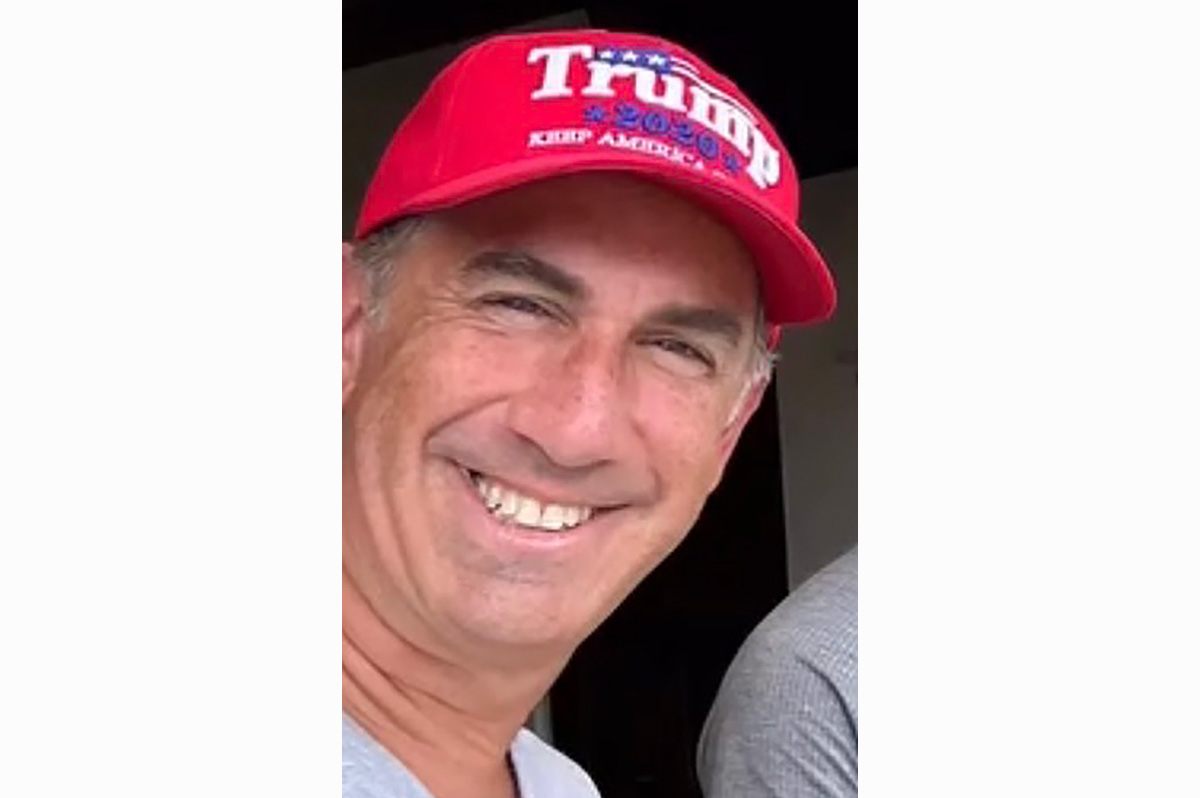
EqualPride, a prominent LGBTQ+ media company that owns the Advocate and Out magazines, has added a Trump supporter to its board of directors.
Jay Katari, an entrepreneur and investor who now serves as EqualPride’s “Strategic Advisor, Growth & Innovation,” also sits on its official leadership team.
EqualPride’s website describes his role as “focused on helping the company expand its reach, strengthen its commercial partnerships, and develop new sources of recurring revenue.”
This change in leadership has caused an outcry of concern from LGBTQ+ media consumers, people working at the outlets published under EqualPride, and LGBTQ+ advocates who seem unsure of how a Trump supporter will fare on the board of one of the most important LGBTQ+ media organizations in the country.
The story was first reported by Kevin Ortega-Rojas, a freelance writer and podcaster who specializes in covering social issues. His resume includes a number of connections to the world of LGBTQ+ media — particularly under EqualPride — including being a former rapid response reporter for GLAAD and host of “The Advocate Weekly,” a queer news podcast produced by The Advocate magazine.
Earlier this year, EqualPride laid off staff across its existing publications, including senior editors and writers. That move, followed by the addition of a Trump supporter to its board, has created concern among LGBTQ+ consumers.
According to his Instagram, Katari is married to a woman and still has posts showing him wearing Trump MAGA-branded merchandise. He also follows members of the Trump family, including President Donald Trump, his sons Donald Trump Jr. and Eric Trump, Lara Trump, and his daughter Ivanka Trump. He also follows an account with the username donaldtrump.hq titled “Donald Trump Fans.”
This apparent endorsement of Trump and MAGA politics, which includes restricting the rights of transgender people as well as rolling back protections for LGBTQ+ people more broadly, seems to be in direct conflict with EqualPride’s mission statement.
“Our mission is to provide content of inspiration, hope, community, equality and love through our platforms that reach a vast majority of the American LGBTQ+ audience every month and increasingly women and people of color,” a statement on EqualPride’s website from 2023 said. “We are a diverse community of storytellers, innovators, and influencers who believe in giving a voice to all people!”
The Los Angeles Blade reached out to Christopher Wiggins, the politics and news editor at EqualPride, but was directed to the already publicly available joint statement made by editors of the largest publications represented by EqualPride.
In the Instagram post, the editorial teams of The Advocate, Out, Them, PRIDE.com, Out Traveler and Plus all co-signed the statement, assuring readers that Katari being on the board has not — so far — impacted any of their reporting and implying EqualPride needs to expand on what Katari’s role will be for the organization.
“Our editors became aware of concerning reports this morning that Jay Katari — one of the board members of our parent company, equalpride — may have espoused beliefs that are antithetical to the mission of our brands, per a new article from journalist Kevin Ortega-Rojas.
“The editorial teams only recently learned of Katari’s expanding role and had no information about his background or past political statements prior to this week.
“Please know that Katari’s position has not influenced our reporting.
“In an initial meeting today, we urged management to provide further clarification about Katarı and hıs role at equalpride, and are awaiting information.
As queer and trans journalists, we are committed to independent reporting that serves the LGBTQ+ community — and to getting answers on this critical matter.”
Nearly 200 comments were made online under a joint post made by multiple EqualPride publication accounts, including Them, The Advocate, and Out.
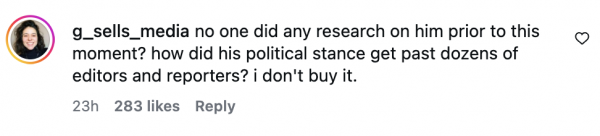
Gisselle Palomera, a Future of Queer Media fellow for The Advocate and former local news reporter at the Blade, commented under the post, questioning how much leadership actually knew about Katari.
“No one did any research on him prior to this moment? How did his political stance get past dozens of editors and reporters? I don’t buy it,” they said in the now most liked Instagram comment under the announcement, with 283 likes.
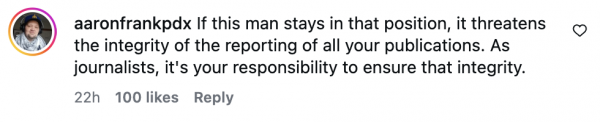
Another Instagram user, Aaron Frank Duncanson, who goes by the username aaronfrankpdx, pointed out how the situation looks and expressed fears for the future if Katari stays on the board.
“If this man stays in that position, it threatens the integrity of the reporting of all your publications,” Duncanson wrote. “As journalists, it’s your responsibility to ensure that integrity.”
The Blade reached out to Katari, and to Tony Morrison of Morrison Media Group— who is working with EqualPride, according to Wiggins— but did not hear back in time for publication.
EqualPride CEO Mark Berryhill issued a statement after Katari resigned.
“I want to clarify Jay Katari’s involvement with equalpride, which was limited to business growth, revenues and the company’s long-term sustainability,” said Berryhill. “Under our investment agreements, our lead investor group held the right to appoint two board members without separate votes or approval by the CEO or management. Jay joined the board through that process. Going forward, the investor group has provided me with the right to appoint future board members.”
Berryhill then noted Katari’s decision to resign and referred to his statement.
“Our focus now is on strengthening our brands, and continuing to support the stories of our LGBTQ community,” added Berryhill.
National
Multi-billion-dollar 9/11 Victim Compensation Fund to continue until 2090
Eligibility for same-sex partner survivors remains unclear

As part of its commemoration of the 25th anniversary of the 9/11 terrorist attacks, the September 11th Victim Compensation Fund, a federally operated program, released information during the past week showing it has awarded more than $18 billion to over 77,000 9/11 victims and their families since 2011.
Officials with what’s now referred to as the VCF point out that it was created to provide compensation to individuals or to a court-approved personal representative of a deceased individual who were present at one of the three sites where the hijacked jetliners crashed.
Among those supported under the program are thousands of rescue workers, clean-up crews, and residents living near the World Trade Center Twin Towers destruction site who became ill, many of whom later died, by being exposed to the toxic fumes created by the fire and falling debris.
“Twenty-five years since that day, the September 11th Victim Compensation Fund has served tens of thousands of victims and their families, and we continue to receive over 750 new claims each month — a clear indication of the ongoing importance of our mission,” said Allison Turkel, VCF’s leader, who holds the title of Special Master.
In a Sept. 2 briefing for the news media in advance of the 9/11 anniversary commemoration, Turkel pointed out that the VCF operation was upgraded and expanded by separate laws passed by Congress in 2011 and 2019, with the 2019 law signed by President Trump providing full funding to “pay all eligible claims and extended the filing deadline to Oct. 1, 2090.”
LGBTQ advocacy organizations in New York and nationwide have reported that during the time shortly after the 9/11 attacks same-sex surviving partners of 9/11 victims learned they were ineligible for compensation benefits because their same-sex relationships were not legally recognized.
Nicole Nava, a VCF spokesperson, told the Washington Blade she would inquire into whether same-sex couple surviving partners were being supported under the VCF program in more recent years.
She said under long established VCF procedures, all applicants for benefit claims regarding a deceased person, whether same-sex or opposite sex, must be appointed as a Personal Representative of the deceased person by a state court. For D.C. residents, the probate division of the D.C. Superior Court appoints a Personal Representative.
“Claims for deceased victims (regardless of the cause of death) may be submitted only by the Personal Representative,” a statement on the VCF website says. “Each state has laws that define the process for appointment of the Personal Representative and the specific authority granted to that Personal Representative,” it says.
The Washington Blade couldn’t immediately determine the criteria for being approved as a Personal Representative by the D.C. Superior Court and various state courts, including whether a same-sex survivor partner would be eligible for such an appointment.
A spokesperson for the District of Columbia LGBTQ+ Bar Association, which includes many local attorneys who specialize in a wide range of specialized legal issues, couldn’t immediately be reached to find out if one or more of their members might be able to determine the same-sex partner eligibility for Personal Representative status.
In her news media briefing, VCF Special Master Turkel said detailed information about how best to file a claim for 9/11 victim compensation is available on the VCF website.
“Twenty-five years since the events of September 11th , 2001, we know it has become increasingly challenging for claimants to find documents needed to prove their presence at an eligible location, which is one of the key requirements to be eligible for compensation,” she said.
She was referring to the requirement that 9/11 surviving victims seeking a claim for support for injuries or illnesses related to the 9/11 attacks must prove they were present at the World Trade Center site, the Pentagon site, or the Shanksville, Pa. site where the hijacked jetliners crashed. Those requirements are separate from the less clearly defined criteria for same-sex couple victim survivor eligibility.
“Our team is committed to ensuring no claimant feels lost or overwhelmed when submitting a claim,” Turkel said at the briefing. “We have a great helpline with real live people who can answer or refer any questions that come in,” she added. “They engage in over 4,000 calls a month on average. We encourage folks to call 1-855-1555 with any questions.”
The VCF website, wh

988 restores crisis services for LGBTQ+ youth

Renee Good’s family files two federal lawsuits

House Democrats urge White House to confront Turkish government over anti-LGBTQ+ crackdown

Victory Fund board investigates former staffers’ allegations against CEO Evan Low

10 explosions of queer history not to miss at this year’s Circa Festival

We asked WeHo City Council candidates your most pressing questions

Governor Newsom signs 6 pro-LGBTQ bills, vetoes 1

Lesbian Bar Project co-founder: purity politics could destroy our remaining spaces

Education Department rolls back protections for LGBTQ+ students under Title IX

HRC report: LGBTQ+ students face ‘far greater challenges’ in non-supportive states
-
 West Hollywood2 days ago
We asked WeHo City Council candidates your most pressing questions
-
 California4 days ago
Governor Newsom signs 6 pro-LGBTQ bills, vetoes 1
-
 Bars & Parties4 days ago
Lesbian Bar Project co-founder: purity politics could destroy our remaining spaces
-
 National5 days ago
Education Department rolls back protections for LGBTQ+ students under Title IX
-
 National4 days ago
HRC report: LGBTQ+ students face ‘far greater challenges’ in non-supportive states
-

 AIDS and HIV4 days ago
Science takes the runway: HIV Unwrapped at NYFW
-
 Brazil4 days ago
529 openly LGBTQ+ candidates running in Brazilian election
-

 Serbia3 days ago
Ana Brnabić becomes world’s first openly lesbian head of state
-

 Travel3 days ago
‘(Out) On the Road’ revels and reveals the joys of queer travel
-
 Features2 days ago
The survivors we don’t talk about: October is Domestic Violence Awareness Month