
Europe
Turkish police violently break up Pride March at a university in Ankara
Footage on Twitter showed the police responding to students with pepper powder balls and excessive use of force
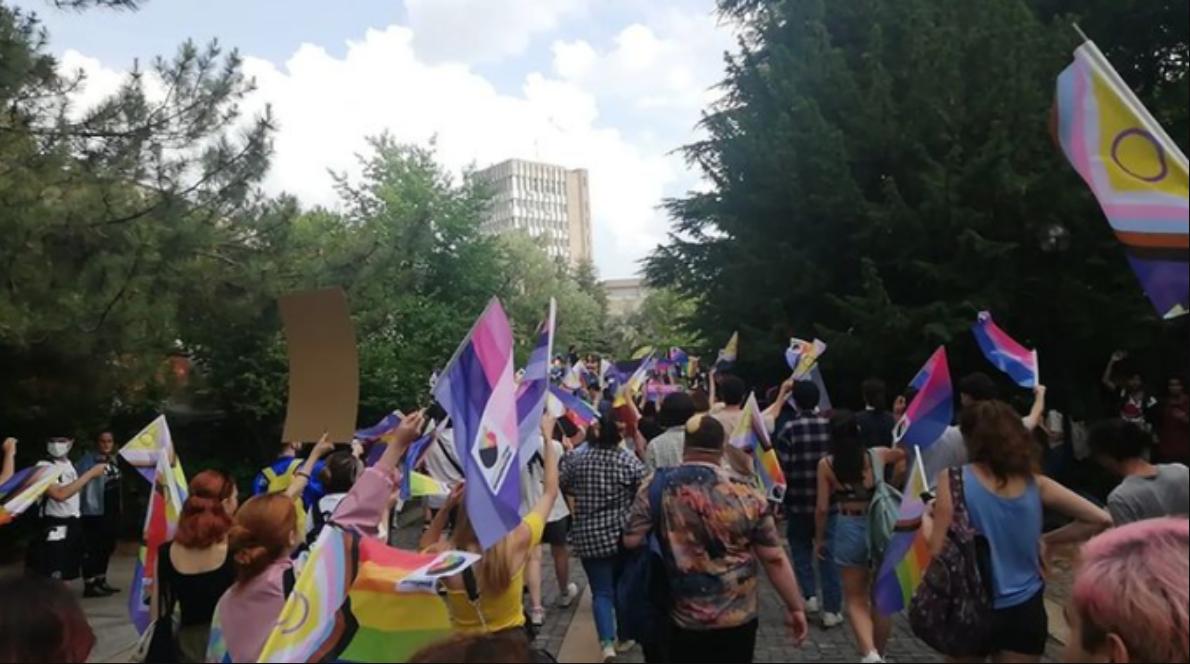
ANKARA, Turkey – Turkish Police officers carrying clear-plastic riot shields, wielding batons and deploying pepper powder balls as well as tear gas violently broke up a Pride Parade organized by Middle East Technical University students on campus Friday.
The annual LGBTQ+ Pride event, marking its 10th year, was condemned by the university’s officials who had sent an email to all students earlier in the week, declaring the campus-based Pride march on 10 June ‘categorically banned’, and threatened participants with police intervention.
The email also noted that university has a “peaceful, productive, and creative academic environment, and that its reputation is being threatened by their students demonstrating in a nonviolent manner during Pride Month.”
Prominent Human rights group Amnesty International said in a press release that; “On 10 May 2019, the last time METU’s students and academic staff attempted to hold a peaceful Pride March in the campus, they were met with excessive police force, forbidden from marching and charged with “participating in an unlawful assembly” and “refusing to disperse despite being warned”. At least 21 students and staff were detained and 19 among them were prosecuted in a trial that ended with their acquittal in October 2021.”
In Friday’s march, multiple videos emerged on Twitter that showed Turkish police officers attacking the participants and detaining dozens as they broke up the event.
Amnesty International’s Nils Muižnieks, the organisation’s director of its Regional Office for Europe issued a statement condemning the actions of the police;
“The footage showing the police responding to students participating in the peaceful Pride Parade on the METU campus with pepper powder balls and excessive use of force is quite disturbing; especially considering that this is a repetition of the violence we witnessed here three years ago.”
“Today is a dark day when the university administration has called the police to disperse students who are marching only for their rights to dignity and equality. Anyone detained by the police must be released immediately and unconditionally.”
Police intervention into the 10th METU Pride is going on. At least one student is seen being detained by the police during the intervention.
— Amnesty Turkey (@aforgutu) June 10, 2022
No one should be detained due to exercising the right to peaceful assembly. All students under detention must be released immediately. pic.twitter.com/TWdscTAWsK
One student told to have been pushed against the ground, had their hair torn and beaten by the police when recording the intervention.
— Amnesty Turkey (@aforgutu) June 10, 2022
METU academicians are talking to the police to get them release the students who have been detained. #OnuncuODTÜOnurYürüyüşü pic.twitter.com/akiJjXKTPh
İşkenceyle gözaltından!
— Kaos GL (@KaosGL) June 10, 2022
Polise biber gazı ve plastik mermi sıkmak yetmedi! Öğrencileri ODTÜ kampüsünden işkenceyle gözaltına alıyor! #OnuncuODTÜOnurYürüyüşü#Hatırla pic.twitter.com/WfCV0WaSSt






United Kingdom
Grindr settles UK lawsuit over claims it shared users’ personal information
Plaintiffs allege gay hookup company disclosed HIV status to third parties

Grindr has agreed to pay £26 million ($35.24 million) to settle a lawsuit in the UK over allegations it shared users’ HIV status and other personal information with third parties.
The BBC on Monday reported a lawsuit was filed in the High Court of England and Wales in 2024. A class action lawsuit with more than 11,000 plaintiffs was later filed in the U.S.
Grindr in a U.S. Security and Exchange Commission filing notes the California-headquartered company as part of the settlement it reached on Sept. 2 will pay £13.0 million ($17.62 million) “to the counterparties” by Dec. 31, 2026, and another £13.0 million ($17.62 million) by March 31, 2027.
“As previously disclosed, in April 2025, Grindr Inc. and Grindr LLC, its indirect and wholly-owned operating subsidiary (collectively, ‘Grindr’), were served with proceedings in the High Court of England and Wales, which proceedings were originally issued in April 2024, brought on behalf of UK Grindr users from a period up to early 2020 alleging violations of UK privacy laws,” reads the U.S. Security and Exchange Commission filing.
“On Sept. 2, 2026, Grindr resolved the above-described UK group action related to historical data practices before 2020, when Grindr was owned and controlled by the Chinese conglomerate Kunlun,” it continues. “The settlement includes no findings or admission of liability. While Grindr disputes the allegations, it recognizes and acknowledges the distress and loss of trust expressed by some of its UK users regarding that pre-2020 period.”
The filing further notes Grindr in 2020 “was sold to new owners and appointed new management” and in 2022 became a publicly listed company on the New York Stock Exchange.
“Since 2020 Grindr has overhauled its privacy program with a keen focus on the unique needs of its community,” reads the filing. “Grindr is and remains a safe space for users, committed to transparency, user control, and responsible data practices.”
A Grindr spokesperson in the UK on Tuesday referred the Los Angeles Blade to the filing for comment on the settlement.
Iceland
Iceland implements gender-neutral blood donor rules
New regulations took effect Sept. 1, allow more LGBTQ+ people to donate

New rules that will allow more gay and bisexual men to donate blood in Iceland took effect on Sept. 1.
The Iceland Review, an English-language magazine, notes the new regulations the country’s Health Ministry approved are gender-neutral. Some restrictions, however, remain in place for potential donors, regardless of their sexual orientation or gender identity.
“Specific sexual activity can be linked to higher risk of bloodborne infections, therefore thorough screening is very important in regards to blood donor eligibility,” states the Icelandic Blood Bank on its website.
Potential donors are asked these two questions:
• In the past four months, have you had sex with a new partner?
• In the past four months, have you engaged in what is considered sexual relation of higher risk?
The Icelandic Blood Bank defines “sexual relation of higher risk” as:
• Sexual relation where a condom is not used and relationship duration is less than 4 months.
• Sexual relation outside of pre-existing long-term relationship, where a condom is not used.
• Sexual relation with many individuals (more than one) with/without a condom.
• Sexual relation, where a condom is not used, with an individual whose behavior falls under sexual relation of higher risk.
• Sexual relation where a condom is not used, with an individual that injects narcotics. If more than four months have passed since the last injection, donation is permitted.
• Sexual relation, with/without the use of condom, in exchange for payment.
• Anal sex with/without a condom with a new partner.
• Sexual relation where chemicals are used to enhance sexual experience (chemsex).
• Sexual relation with/without the use of a condom, with an individual diagnosed with HIV, HTLV, Hepatitis B or C, or syphilis.
• Sexual relation with an individual using viral medication (PrEP or PEP) for HIV.
“If yes, evaluation for possible deferral from blood donation needs to be done,” says the Icelandic Blood Bank.
A person with HIV, Human T-lymphotropic virus-1, hepatitis B or C, or syphilis cannot donate blood. A person who has taken PrEP or PEP in the previous four months is also unable to become a donor.
“If more than four months have passed since the medication was taken, viral screening can be done,” says the Icelandic Blood Bank. “If results are negative, blood donation is permitted. Deferral period is longer if administrated intravenously.”
Any potential donor who had “sexual relation with an individual using viral medication (PrEP or PEP) for HIV” must wait four months since their “last sexual relation” before they can give blood.
Anyone who has “ever, even just once, shared a needle/syringe with someone or injected yourself with an illegal substance (non- doctor prescribed), e.g. drugs, anabolic steroids, hormones or peptides.” is permanently prohibited from donating blood.
Iceland is the latest country to lift restrictions for LGBTQ+ blood donors.
The Australian Red Cross Blood Service in April implemented a new policy that allows “gay and bisexual men and transgender people in long-term monogamous relations (of at least six months) to donate blood and platelets for the first time.”
The U.S. Food and Drug Administration in 2023 implemented a new screening policy for potential donors that asked them questions about their sexual activity, regardless of their sexual orientation or gender identity. The previous policy required men who have sex with men to not have sex for at least three months before they could donate blood.
Switzerland
Swiss government backs nationwide conversion therapy ban
Several cantons have already prohibited widely discredited practice

The Swiss government has said it supports a nationwide ban on so-called conversion therapy.
The Swiss Broadcasting Corporation on its website notes the government officially announced its position in a report it published on Wednesday.
Neuchâtel in 2023 became the first Swiss canton to ban conversion therapy.
Lawmakers in Valais and Vaud have also prohibited the widely discredited practice in their respective cantons. Bern and Geneva are among the other cantons in which lawmakers have considered similar prohibitions.
The European Commission earlier this year said all European Union countries should ban conversion therapy.
Switzerland is not a member of the EU, but lawmakers in neighboring Germany in 2020 passed a law that prohibits conversion therapy for minors and for adults who have not consented to undergoing the widely discredited practice.
Several EU countries — Belgium, Cyprus, France, Malta, Norway, Portugal, and Spain — have banned conversion therapy outright.
The Dutch Senate in June approved a bill that would ban conversion therapy in the Netherlands. The lower house of the country’s parliament approved the measure in September 2025.
Greece in 2022 banned conversion therapy for minors.
Bulgaria
Top Bulgarian court rules government must legally recognize trans people
Decision caps off decade-long legal fight

Bulgaria’s top court has ruled the country’s government must allow transgender people to legally change their name and gender on ID documents.
A trans woman from Bulgaria who moved to Italy, had tried to change her gender and name on her Bulgarian ID documents, but courts in the country denied her requests for nearly a decade.
The Bulgarian Supreme Court of Cassation in a 2023 ruling essentially banned trans people from legally changing their name and gender on ID documents.
The EU Court of Justice in Luxembourg, which is the European Union’s highest court, in March ruled in the “Shipova” case that member states must allow trans people to legally change their name and gender on ID documents. The lead plaintiff in the “Shipova” case is among the four litigants in the Bulgarian Supreme Court of Cassation case.
Two Bulgarian advocacy groups — Bilitis and Deystvie — along with TGEU – Trans Europe and Central Asia and ILGA-Europe in a joint statement they issued on Tuesday noted the Bulgarian Supreme Court of Cassation’s July 22 decision “aligns Bulgarian practice with the Court of Justice of the EU, enabling changes to gender markers, names, and personal identification numbers.”
“The judges also concluded that EU law requires Bulgaria to establish a legal procedure for legal gender recognition, which is necessary so that Bulgarian trans citizens can travel and reside freely inside the EU,” they added.
Bulgaria has been a member of the EU since 2007.
The country borders Romania, Serbia, North Macedonia, Greece, and Turkey.
“We are very glad to see that the judges of the Supreme Court clearly stated that it is actually a matter of rule of law for Bulgaria to respect the universal equality and the dignity of all human beings, including trans people for whom human rights-based legal gender recognition procedures are an indispensable element,” said Denitsa Lyubenova, co-chair of Deystvie who represented the four plaintiffs in the Bulgarian courts and the lead litigant in the “Shipova” case at the EU Court of Justice. “The government needs to act swiftly now to put in place an LGR procedure that is fully in line with European human rights case law, which means without any conditions requiring proof of medical, surgical or hormonal treatment.”
The groups also urged the Bulgarian government to codify the ruling into law.
“While lower courts are expected to follow this ruling directly, a court decision is not a substitute for law,” they said. “Bulgaria still needs a fast, transparent, and accessible legal gender recognition procedure written into legislation, not left to case-by-case court precedent. TGEU – Trans Europe and Central Asia, Bilitis, Deystvie, and ILGA-Europe call on the Bulgarian government to start that legislative process now, with meaningful involvement from civil society.”
France
Prominent French activist attacked outside Paris bar
Pierre Picavet hospitalized with internal bleeding, head injury
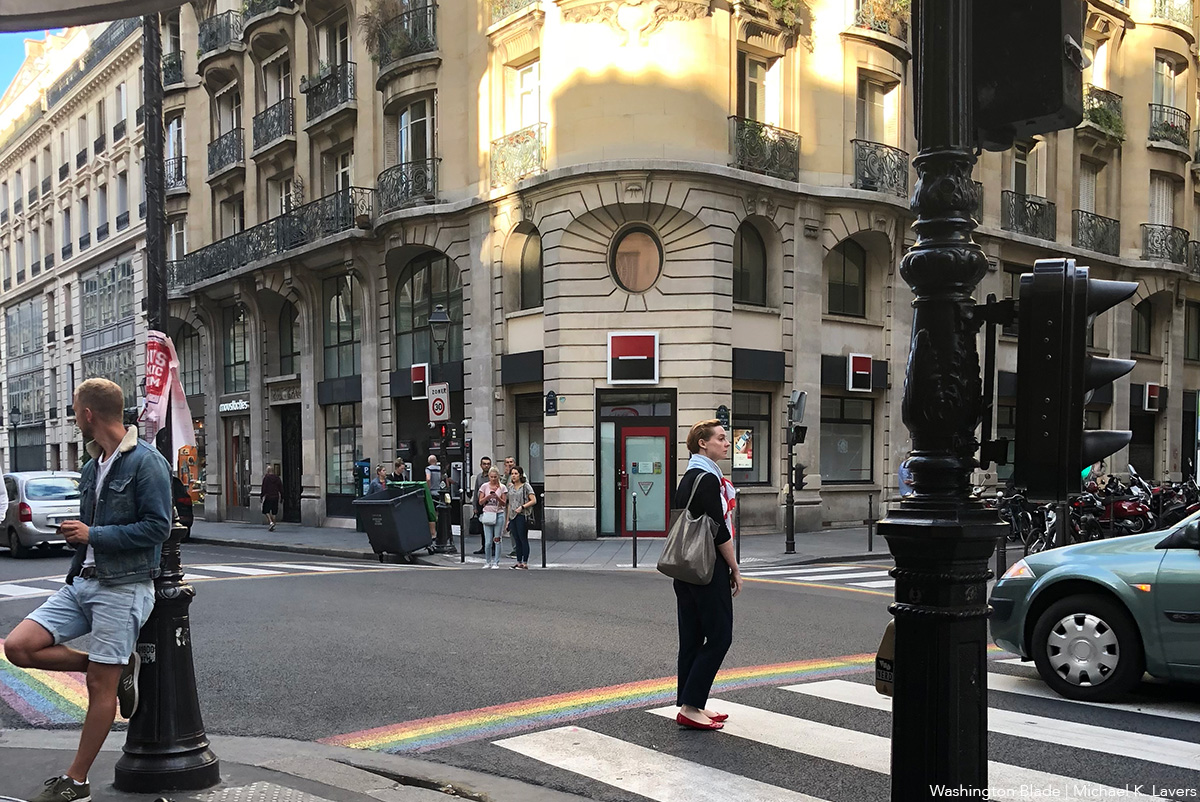
French prosecutors say a man shouted anti-gay slurs at a prominent activist before he attacked him in Paris on Saturday.
Media reports indicate Pierre Picavet, a police officer who is the president of FLAG!, a group within the French Justice and Interior Ministries that defends LGBTQ+ rights, was attacked as he left a bar in Paris’s Marais neighborhood.
The Marais since the 1980s has been center of the French capital’s LGBTQ+ community.
France 24 reported Picavet’s assailant struck him with a bottle. The attack left Picavet hospitalized with internal bleeding, a head wound, and other injuries.
“When I get better, when my wounds have healed, I will continue the fight,” Picavet told Radio France on Monday. “I am particularly shocked, but it tells me that there is still work to do.”
Paris Mayor Emmanuel Grégoire is among those who condemned the attack.
STOP Homophobia (STOP homophobie), a French group that fights against anti-LGBTQ+ violence, on its social media pages published a picture of Picavet in the hospital.
“As a long-standing partner of FLAG!, STOP Homophobia wishes to express its solidarity with Pierre Picavet, his loved ones, and the entire association,” said the group. “STOP Homophobia condemns this assault in the strongest possible terms and reiterates that anti-LGBT violence remains a reality — even in spaces where everyone should be able to move freely and live out their sexual orientation or gender identity without fear of attack.”
STOP Homophobia also praised a bystander who came to Picavet’s aid after the attack, and the first responders and law enforcement personnel who responded.
“STOP Homophobia extends its full support to Pierre, his family, his loved ones, and the entire FLAG! team, and wishes him a full recovery,” said the group.
Reports indicate the assailant, who was born in 2006, was scheduled to appear in a Paris court on Monday at 1:30 p.m. local time.
Poland
Poland begins to legally recognize same-sex marriages from other countries
‘This is an important milestone, but it should not be the final destination’

Poland has begun to recognize same-sex marriages legally performed outside the country.
TVP World, the country’s public broadcaster, reported civil registry offices began to “transcribe same-sex marriages legally” conducted outside of Poland on Aug. 22.
The EU Court of Justice in Luxembourg last November ruled in favor of a same-sex couple who challenged Poland’s refusal to recognize their German marriage. Poland’s Supreme Administrative Court in March reaffirmed the decision.
The couple, who lives in Poland, brought their case to Polish courts in 2019. The Supreme Administrative Court referred it to the EU Court of Justice.
The Polish government in May announced it will recognize same-sex marriages legally performed in other EU countries. Polish President Karol Nawrocki on July 17 vetoed bills that would have extended rights to same-sex couples.
Poland’s Constitutional Tribunal a few days later rejected the recognition of same-sex marriages legally performed in other EU countries. The Love Does Not Exclude Association, a Polish marriage equality advocacy group, in an Aug. 26 press release notes the ruling “does not prevent implementation of these new regulations” because the Constitutional Tribunal is “largely discredited” and the government considers it “to be improperly constituted.”
“This is an important milestone, but it should not be the final destination,” said Maja Heban of the Love Does Not Exclude Association. “No couple should have to cross a border to marry. Our goal is allowing loving, committed couples to marry in Poland in the first place. The law now increasingly recognizes these marriages once couples return to Poland in areas such as healthcare and social security, but significant gaps remain, mainly lack of recognition of same-sex parents which directly impacts security of their children.”
Germany, Belgium, France, Ireland, Spain, and Portugal are among the EU countries in which same-sex couples can legally marry. Andorra, whose prime minister, Xaviet Espot Zamora, is openly gay, and Switzerland are among the other European nations that have extended marriage rights to same-sex couples.

The Netherlands in 2001 became the first country in the world to extend marriage rights to same-sex couples. Activists who participated in this year’s World Pride that took place in Amsterdam earlier this summer marked this milestone.

Netherlands
Trans, nonbinary Americans find refuge in the Netherlands
DAFT visa offers fast-track to permanent residency, citizenship

Editor’s note: International News Editor Michael K. Lavers and Photo Editor Michael Key were on assignment in the Netherlands from July 28-Aug. 10.
AMSTERDAM — A transgender American couple who live in the Netherlands say President Donald Trump prompted them to leave the U.S.
Jack Reaves, who is a trans man, and his wife, Iskara McCoy, who is a trans woman of color, moved to the Netherlands from Reno, Nev., in 2024. The couple now lives outside Utrecht, a university city that is roughly 30 miles south-southeast of Amsterdam.
“We’d been keeping an eye on things during his (Trump’s) first term in 2016, which was pretty terrifying,” Reaves told the Los Angeles Blade on Aug. 24 during a WhatsApp interview with him and McCoy. “We knew that there was a lot of anti-trans legislation and just anti-trans feelings from the Republican/MAGA party at the time.”
The Biden-Harris administration took office on Jan. 20, 2021, two weeks after thousands of Trump supporters stormed the U.S. Capitol — the insurrection took place shortly after Congress began to certify the results of the 2020 presidential election that Joe Biden won.
“Joe Biden was elected, and we were like, okay, well maybe things will turn around,” said Reaves. “But it was very clear very early on in the Biden presidency that that wasn’t going to happen.”
“There weren’t any meaningful changes, and then with Trump getting ready to win the next election and MAGA really looking like they were going to continue to gain more power, we were like, well time to get out.”
Reaves and McCoy are two of the four trans and nonbinary Americans who have moved to the Netherlands with whom the Blade recently spoke. The interviews took place during World Pride, which took place in Amsterdam from July 25-Aug. 8, or in the days after the biennial event ended.
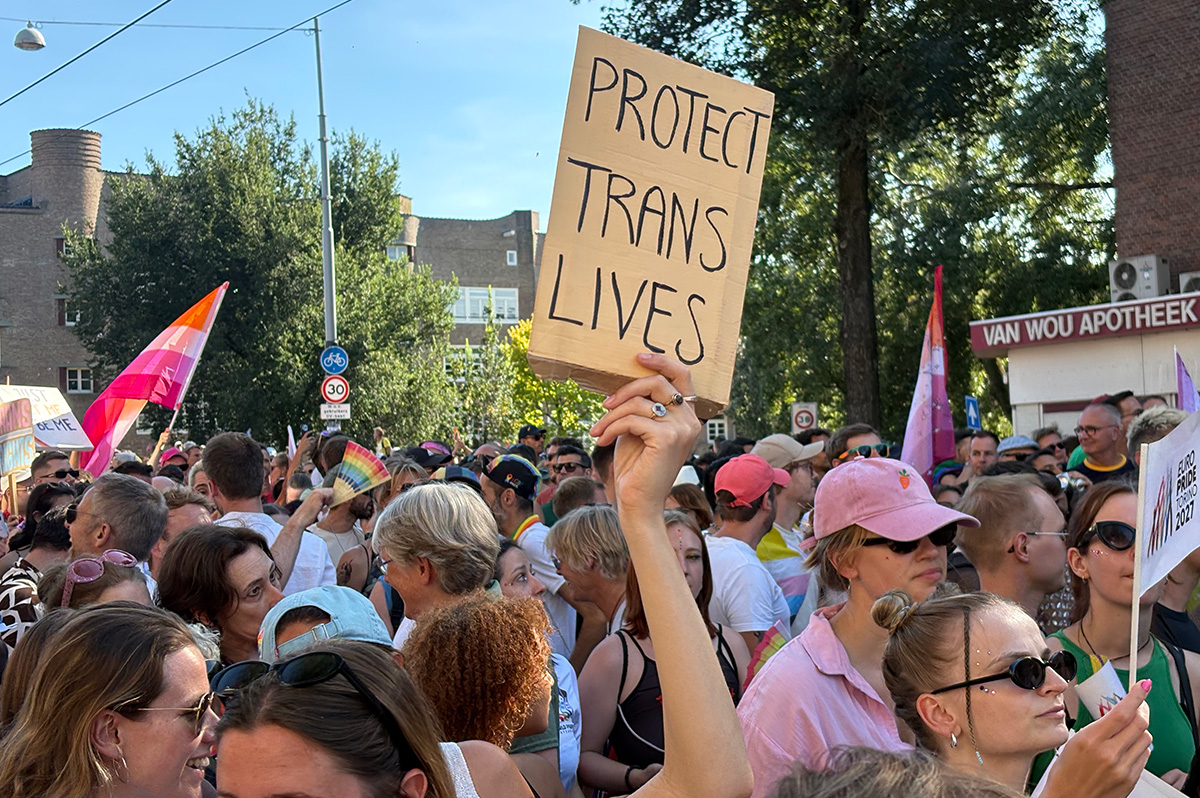
The Dutch American Friendship Treaty, or DAFT, allows American citizens to live and work in the Netherlands as self-employed entrepreneurs.
DAFT visa recipients must keep at least €4,500 ($5,244.19) in a Dutch business bank account and need to register their business with the Dutch Chamber of Commerce. DAFT visa recipients can apply for permanent residency in the Netherlands or the European Union seven years after they receive it.
Reaves and McCoy and the two other trans and nonbinary Americans with whom the Blade spoke for this story either received a DAFT visa or plan to apply for one.
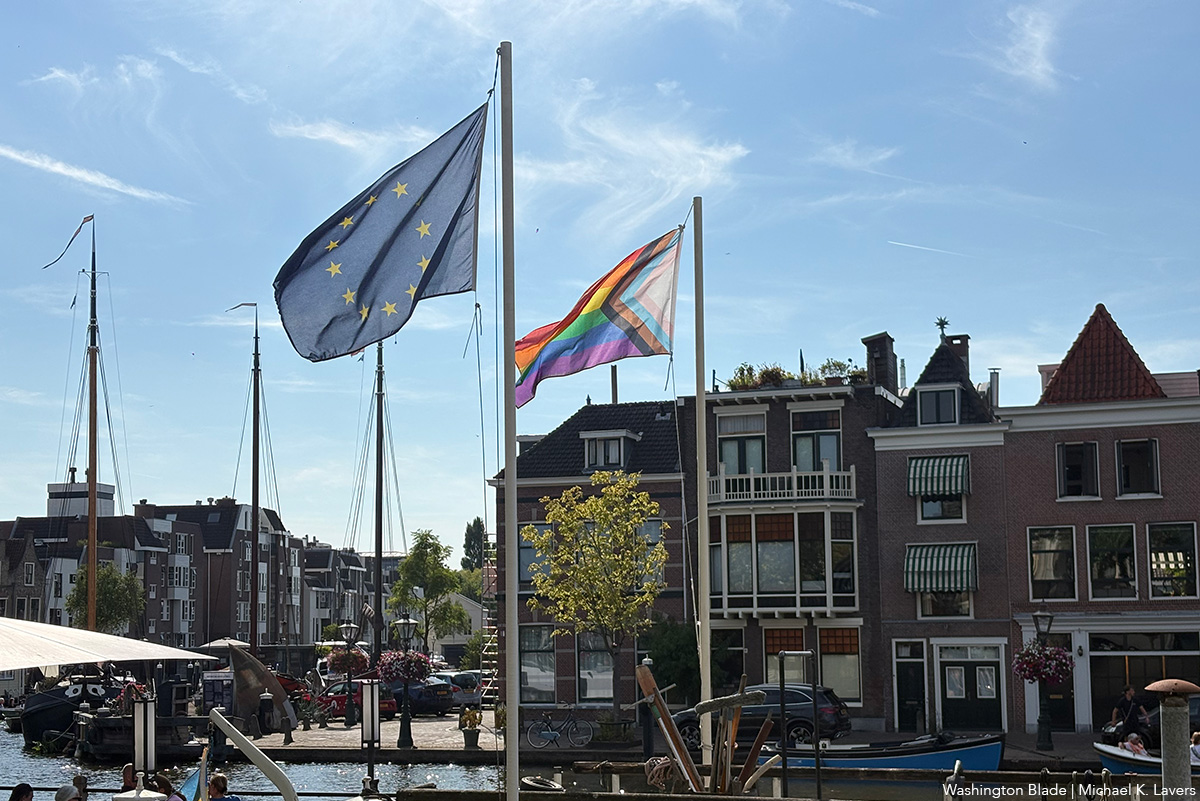
Kai, who is nonbinary, and their husband, who is a trans man, moved from New England to the Netherlands in August 2021. They now live in Haarlem, a small city that is roughly 12 miles west of Amsterdam.
Kai told the Blade on Aug. 20 during an interview from their home that friends moved to the Netherlands in 2017 after they received a DAFT visa.
“The prompt was the 2016 election for them,” said Kai.
Kai and their husband were living in a collective household in August 2020 when they “decided we wanted to have some kind of change.”
“We suspected that politics was going to get worse, even if it got better soon, that it would probably get worse again later, and that the country politically was going downhill,” they said.
Kai told the Blade a lack of promised disability payments and poor health in the U.S. were also factors.
“When I had been to visit the Netherlands to visit the friends that were living here, I found that my body was healthier, even though I was only here for one or two weeks at a time,” they said. “I was able to do more things, eat more things that I couldn’t go or eat while living in the U.S.”
The fourth American with whom the Blade spoke identifies as a “disabled transgender queer” person. He asked to remain anonymous.
He and his daughter, who is also trans, arrived in the Netherlands in July. He referred to the Holocaust and its impact in the Netherlands when the Blade interviewed him in Amsterdam on Aug. 6.
“I’m the trans parent of a trans adolescent who knows our family history, which includes genocide from the Holocaust,” he said, pointing out 85 percent of Dutch Jews died in the Holocaust. “(My daughter) said my grandparents came to New York right before the occupation, and so my daughter said from our history that targeted communities have to get out early, so this was last summer, so how will we know we need to leave and where will we go?”
“I started looking into that, and we started planning our move,” he added.
He pointed out the “murder of opposition politicians” — specifically former Minnesota House Speaker Melissa Hortman and her husband, Mark Hortman, who were shot to death inside their home in June 2025 — and “harassment and prosecution” of journalists in the U.S. — federal authorities in January arrested former CNN anchor Don Lemon less than two weeks after he entered a Minnesota church with a group of protesters who confronted its pastor who works with U.S. Immigration and Customs Enforcement — since the Trump-Vance administration took office as signs he and his daughter may need to leave the U.S.
Federal authorities charged Lemon, independent journalist Georgia Fort and two protesters with conspiracy and interfering with worshippers’ First Amendment rights during the protest.
An ICE agent on Jan. 7 shot and killed Renee Good, a 37-year-old Minneapolis woman who left behind her wife and three children. U.S. Customs and Border Protection agents on Jan. 24 shot and killed Alex Pretti, a 37-year-old nurse who worked for the U.S. Department of Veterans Affairs in Minneapolis.
Pretti and Good were American citizens.
The shootings took place after the Trump-Vance administration deployed thousands of federal immigration agents to Minnesota during “Operation Metro Surge.”
“We were thinking, depending on what happens with the midterms,” said the trans person in Amsterdam with whom the Blade spoke. “But then you’re like, you know what, every day more people are coming and we should just do this thing.”

The Trump-Vance administration since it took office on Jan. 20, 2025, has implemented several anti-trans executive orders and policies.
Trump hours after his second inauguration signed the “Defending Women from Gender Ideology Extremism and Restoring Biological Truth to the Federal Government” that, among other things, declared the federal government will only recognize two genders: male and female. The directive also banned the State Department from issuing passports with “X” gender markers.
The Pentagon reinstated a ban on openly trans servicemembers. The Department of Education has rescinded agreements with school districts that were designed to protect trans students. The Trump-Vance administration’s anti-terrorism strategy specifically targets “radically pro-transgender” groups.
The U.S. Supreme Court earlier this summer upheld state laws banning athletes from school sports teams that correspond with their gender identity and block gender-affirming care for minors. The Trump-Vance administration since it took office has moved aggressively to curtail these treatments.
“On the one hand, it’s like as if people don’t recognize that that these things make it impossible to have a trans life,” said the trans person with whom the Blade spoke in Amsterdam. “But of course, that’s what Project 2025 is trying to do … make it be impossible to exist.”
McCoy said her and Reaves’s oldest child, who is also trans, has an “X” gender marker on their U.S. passport. McCoy’s grandmother with whom she was very close recently died, but her family attended her funeral virtually from the Netherlands “because we didn’t want to risk returning to the States at that point.”
Kai also noted trans and nonbinary Americans who are trying to leave the U.S., but don’t have passports and other documents with gender markers that match their gender identity.
“That’s terrifying, and it prevents you from doing things like leaving the country,” they said. “Even if it’s not a ban on leaving the country, it still prevents you from leaving the country if those things don’t match in the right way, depending on which immigrations person you get at the border.”
“On this end it wouldn’t matter as much,” added Kai. “But on the other end, it does matter and that is super frustrating and exhausting.”
Dutch ‘very into their bureaucracy’
Kai and the three other trans and nonbinary Americans with whom the Blade spoke said navigating the Dutch health care system upon their arrival in the Netherlands was one of their biggest challenges.
“They’re very into their bureaucracy and they’re very into following guidelines as if they’re laws, and they’re the only ways you do things,” said McCoy. “Once they start working for you. They work. Once you’re in the system, once you’re onboarded, once they’re caught up, then everything goes pretty smoothly.”
Reaves noted McCoy “had a little bit easier time as a trans woman who’s already passing.”
“They were just like, oh, well, it’s clear you’re a woman, so here’s your hormones, and here’s the fast path to diagnostics,” Reaves told the Blade.
Reaves, on the other hand, had been on testosterone for six years before he and McCoy moved to the Netherlands. Reaves said it took nearly a “full year of re-diagnostics before I could get back on testosterone and continue to determine care.”
“They were just like, ‘Well, you kind of look like a woman, so we’re gonna make you do the full diagnostic phase again,’” recalled Reaves.
Reaves told the Blade his doctor prescribed him the wrong type of testosterone. Health clinics that specifically treat trans and nonbinary people use what he described as “extremely outdated language,” but Reaves noted the facility’s doctor helped him get an appointment for his top surgery.
“Now that I’m fully onboarded, I think it’s actually been a little bit better than the U.S.,” he said, noting he receives testosterone blood tests at home. “The follow-ups are really easy.”
Kai also discussed the challenges navigating the Dutch health care system.
They said it would “have been a lot harder to receive care” if they had already undergone hormone replacement therapy, seen a psychiatrist, or had had surgeries. Kai told the Blade they “made the choice” to tell the clinic where they were receiving care that they were a man, as opposed to saying they are nonbinary.
“That’s not true, but I look enough like a man, and then I’m going to get the care that I need,” they said. “I’m sure it’s very different and difficult for folks, especially who are nonbinary, to say I am actually a woman, or I am actually a man, and to pretend that … and that’s still what the system says.”
“Just like with any system, if you want to get your needs met from the system, sometimes you have to meet the system where it’s at, and then once you get your needs met, then outside of the system you can be whoever you want,” Kai added.
Kai noted Dutch activists are “working to get some of those laws and some of those policies changed.” Their husband is working with one group “that is working to change things from if you don’t have a psychological diagnosis of being trans, then getting that care is going to be really hard.”
“What this group is working on is trying to get trans care to be — it’s what they use in the U.S., which is like informed consent, which is not what they use here,” said Kai. “But they’re working on putting together something to like push to governmental level to policy level to say that trans care should be informed consent, not the diagnosis.”
Gay PM: Netherlands needs to do more to defend trans people, rights
The Netherlands in 2001 became the first country in the world to extend marriage rights to same-sex couples.
The country’s nondiscrimination and hate crimes law include gender identity and expression. The Dutch government in 2021 formally apologized to trans and intersex people who were forced to become sterile in order to legally change their gender — The Gender Change Act, which was also known as the Transgender Act — was in place from 1985 until 2014.
Prime Minister Rob Jetten, who is the country’s first openly gay head of government, during a World Pride Human Rights Conference panel conceded the Netherlands needs to do more to defend trans people and their rights. Boris Dittrich, the Dutch Senate’s First Vice President and a member of Jetten’s D66 party who was previously global advocacy director for Human Rights Watch’s LGBTQ Rights Program, at the end of the panel asked about protecting intersex babies from what advocates maintain are unnecessary surgeries.
Reaves admitted he and his children are struggling to learn Dutch, but he added he and his family “appreciate” the Netherlands and “really enjoy living here.”
“I struggle in the Netherlands,” Reaves told the Blade. “I don’t speak the language
“It’s hard being away from home and your own culture and the things you grew up with,” he said. “But I’m safe here, and so that like gives it extra points.”
McCoy said their daughter has “experienced zero transphobia here so far.”
Kai told the Blade that their friends warned them that Dutch people would “call you out or they’ll stare at you or will be mean to you” if they “look nonbinary.”
“I had never had that experience,” they said.
All four of the people with whom the Blade spoke said they plan to apply for their Dutch or EU citizenship once they are legally able to do so. They all expressed reservations about returning to the U.S., even once the Trump-Vance administration is no longer in office.
“I’m actually very nervous that even if things turn around in the U.S. as far as getting rid of Trump, that people are still going to be anti-trans,” said the trans person with whom the Blade spoke in Amsterdam. “The poison’s in the water.”
Reaves said the U.S. “doesn’t really feel like it’s a safe place for trans people to come to.” McCoy added she would consider visiting the U.S., but “I would not move back.”
“That’s too risky,” she said. “It can change anytime.”
“It would probably take like a decade of democratic legislative changes before I would feel safe coming back,” added Reaves.
Netherlands
Thailand’s first openly gay senator attends World Pride in Amsterdam
Blade sat down with Pornchai Witayalerdpan on Aug. 7
Editor’s note: International News Editor Michael K. Lavers and Photo Editor Michael Key were on assignment in the Netherlands from July 28-Aug. 10.
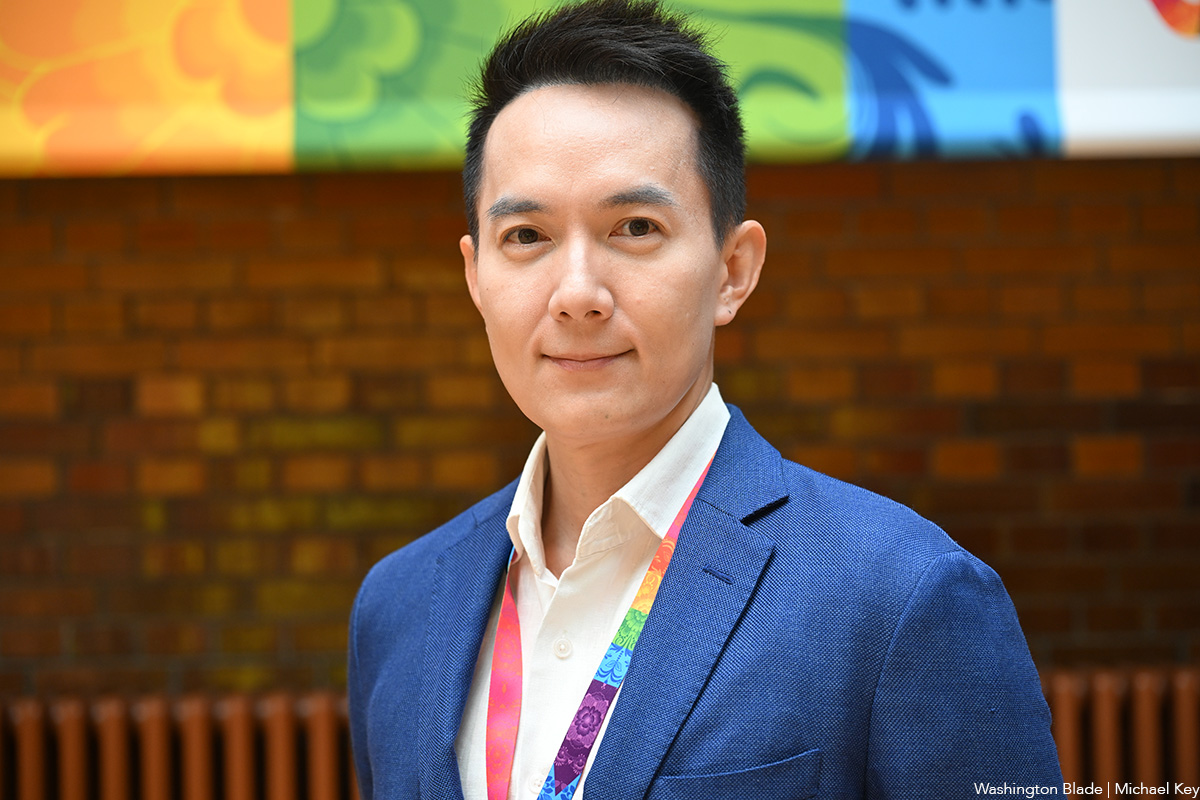
AMSTERDAM — The first openly gay man elected to the Thai Senate says the law that extended marriage rights to same-sex couples in Thailand has positively impacted his country’s global image.
“It totally changed how the world perceived Thailand,” Sen. Pornchai Witayalerdpan told the Los Angeles Blade on Aug. 7 during an interview at the World Pride Human Rights Conference in Amsterdam.
Thailand on Jan. 23, 2025, became the first country in Southeast Asia to allow same-sex couples to legally marry.
The marriage equality bill received final legislative approval in June 2024 when the Senate approved it by a 152-130 vote margin. King Maha Vajiralongkorn signed it a few months later. Then-Prime Minister Prime Minister Paetongtarn Shinawatra is among those who supported the law.
Witayalerdpan was a freelance interpreter before he took office in July 2024.
The independent senator noted Thailand’s marriage equality movement began to gain traction with a lawsuit that the Foundation for Sexual Orientation and Gender Identity Rights and Justice, a Thai advocacy group, filed.
The Constitutional Court in 2021 upheld a law that defined marriage as between a man and a woman. MP Tunyawaj Kamolwongwat of the Move Forward Party later introduced the marriage equality bill that became law.
“It was a coalition of efforts between the civil society organizations, the LGBTQ organizations, and also the Pride movement in Thailand,” Witayalerdpan told the Blade.
Taiwan in 2019 became the first country in Asia to extend marriage rights to same-sex couples.
The Nepalese Supreme Court in June issued a landmark ruling that ordered the country’s government to guarantee full marriage rights to same-sex couples.
The Japanese Supreme Court in March said it will consider six marriage equality lawsuits that have been filed in the country. The Indian Supreme Court in 2023 ruled against marriage rights for same-sex couples. South Korea is among the other Asian countries in which marriage equality efforts are gaining momentum.
Witayalerdpan said Thailand’s marriage equality law could have a direct impact in Japan, which is the only G7 country that does not legally recognize same-sex couples.
“It’s been nothing but a positive effect (in Thailand) after the same-sex marriage law (took effect),” he said.
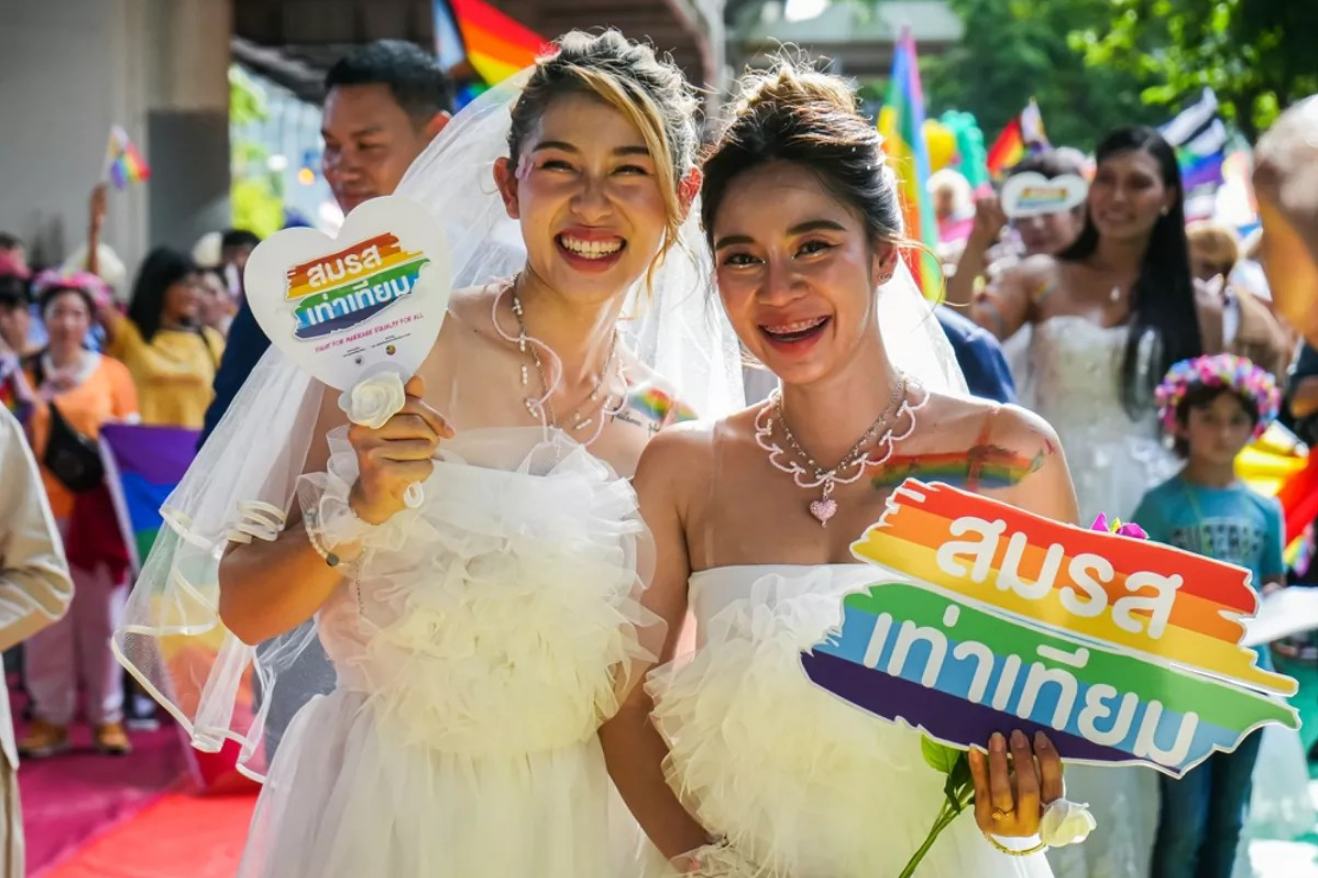
InterPride, the organization that coordinates World Pride events, has announced Bangkok and Barcelona, Spain, are the two finalists to host the biennial event in 2030. (World Pride took place in D.C. in 2025.)
Witayalerdpan told the Blade that World Pride in Bangkok would further improve Thailand’s global image. He also said his fellow lawmakers, in turn, should pass LGBTQ+ rights bills — including proposals that would allow transgender people to legally change their name and gender and enable same-sex couples to have children via surrogates from in vitro fertilization. Witayalerdpan noted the most important bill to him is one that would strengthen Thailand’s LGBTQ+-inclusive nondiscrimination law that took effect in 2015.
Impact of US funding cuts has ‘been very hard’
Witayalerdpan also offered advice to activists in the U.S. and elsewhere around the world.
“Keep on pushing forward,” he told the Blade. “I know that it’s hard for activists in Thailand as well.”
Witayalerdpan acknowledged the loss of U.S. government funding since the Trump-Vance administration took office — which has forced advocacy groups in Asia and elsewhere around the world to close — has “been very hard.” Witayalerdpan noted the global LGBTQ+ and intersex rights movement in response to these cuts has turned to the European Union, the U.K., Canada, and the Netherlands to help fill the gap.
“It’s very good that these countries are providing more funds to the activists in Asia than before because of the Trump situation,” he told the Blade. “It can increase their soft power as well.”
Witayalerdpan said American activists should “wish for a positive result in the mid-term elections.”
“Then there is some resistance,” he added.
Witayalerdpan specifically highlighted efforts to fight against the Trump-Vance administration’s efforts to restrict gender-affirming healthcare.
A federal court in Massachusetts on Aug. 15 struck down a key provision of a U.S. Department of Health and Human Service rule that would have limited access to gender-affirming care under the Affordable Care Act. Maryland and California are two of the 21 states that sued the Trump-Vance administration over the issue.
“You have to show more resistance … to show that we are still here and we will push back when we can,” said Witayalerdpan.
Russia
Russian LGBTQ+ rights group to shut down
Russian LGBT Network in April declared ‘extremist’ organization
A Russian LGBTQ+ advocacy group on Monday announced it will shut down after a court declared it an “extremist” organization.
A St. Petersburg court in April in response to a Russian Justice Ministry lawsuit made the declaration against the Russian LGBT Network.
“For many years, Russian LGBT Network brought together initiatives and activists and supported queer people across the country,” said the advocacy group on its Facebook page. ” However, its ‘extremist’ status has made the previous public format of its work impossible: any connection to the organization may create additional risks for the people we seek to support and protect.”
The Russian LGBT Network formed in 2006.
The group on its Facebook page said it “made this decision” to close “after a thorough assessment of the risks.”
“Continuing our public activities could have put at risk those who took part in the organization’s work, supported it, or received assistance,” said the Russian LGBT Network. “We cannot control the repressive environment, but we can do everything possible to avoid creating additional risks for people. People’s safety comes first.”
The Kremlin over the last decade has faced global criticism over its crackdown on LGBTQ+ rights.
The Russian Supreme Court in 2023 ruled the “international LGBT movement” is an extremist organization and banned it.
Russia in January designated ILGA World, a global LGBTQ+ and intersex rights group, as an “undesirable” organization. ILGA World in response to the designation noted Russians who are found guilty of engaging with “undesirable” groups face up to six years in prison.
Human Rights Watch in May noted the Russian LGBT Network is one of nine LGBTQ+ groups that Russia this year has banned after authorities deemed them “extremist.”
“Russian LGBT Network may close; but dignity, solidarity, and people’s right to be themselves cannot be destroyed,” said the Russian LGBT Network in its statement. “Take care of yourselves.”
Netherlands
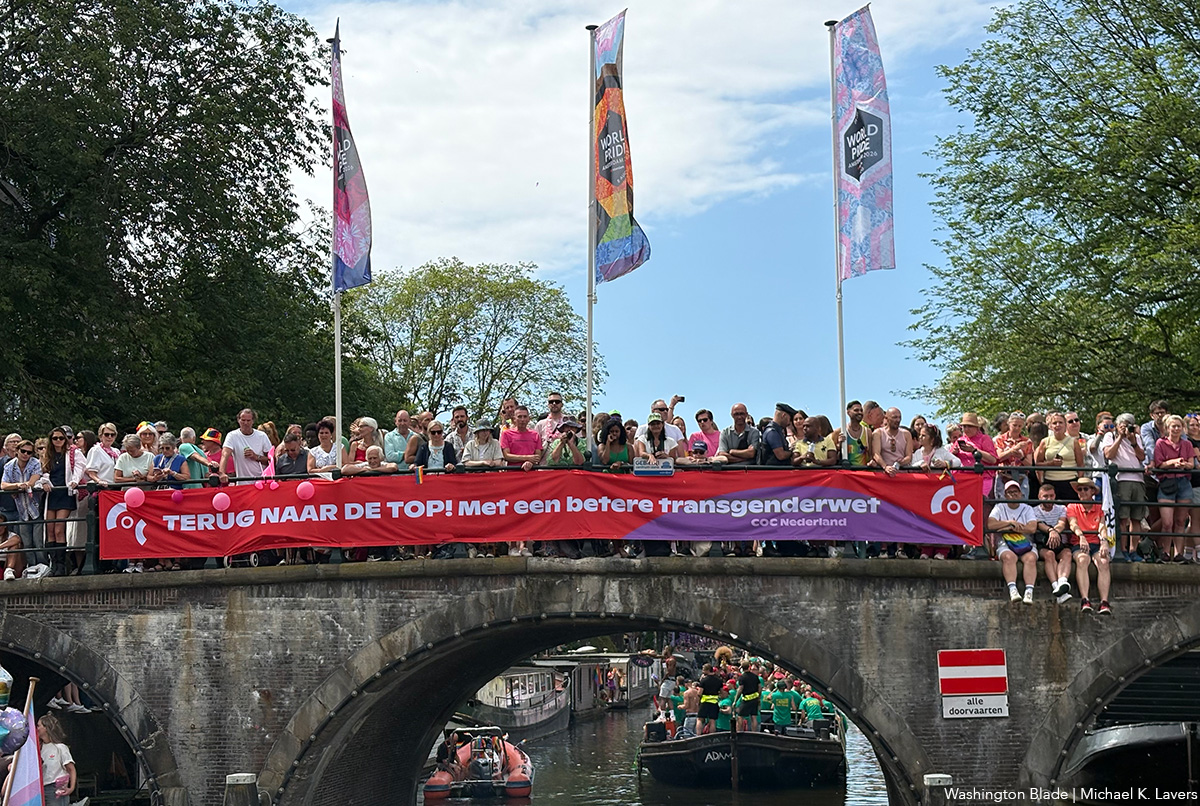
Tens of thousands take part in World Pride March
Event capped off two weeks of celebrations in Amsterdam
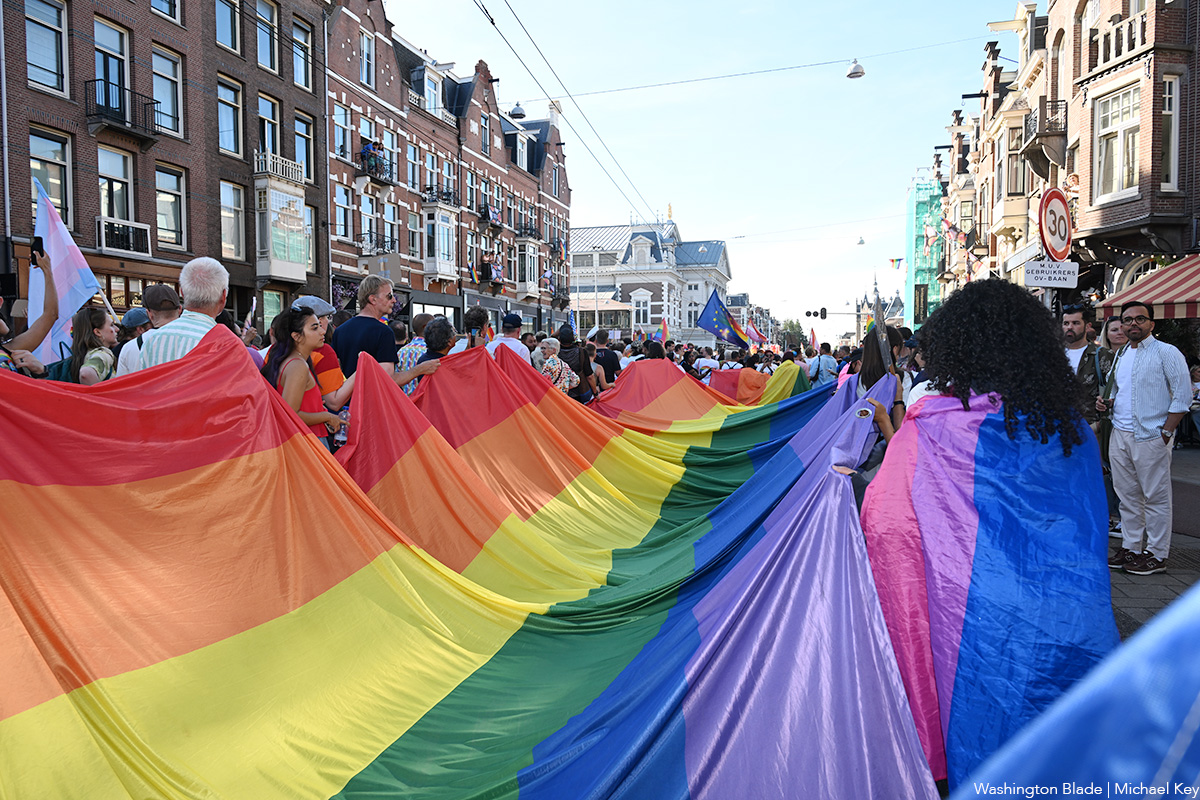
AMSTERDAM — Tens of thousands of people on Saturday participated in the World Pride March in Amsterdam.
Outright International Executive Director Maria Sjödin and Paolo Rondelli, who in 2022 became the world’s first openly gay head of state when he became Captain Regent of San Marino, are among those who participated alongside Massachusetts state Rep. Jack Lewis and Olena Shevchenko, chair of Insight, an LGBTQ+ advocacy group in Ukraine, and others.
Members of D66, the centrist Dutch political party that Prime Minister Rob Jetten heads, also marched.
Jetten in February became the Netherlands’ first openly gay prime minister. He participated in the opening of the World Pride Human Rights Conference on Aug. 5 and spoke on a panel with Rondelli, former Irish Prime Minister Leo Varadkar, and other gay and lesbian current and former heads of government.
(Washington Blade video by Michael K. Lavers)
(Washington Blade video by Michael K. Lavers)
The march took place a week after hundreds of thousands of people lined Amsterdam’s canals for the city’s annual Amsterdam Pride Canal Parade.
A terrorist attack at Berlin’s Christopher Street Day on July 25 left one person dead and more than two dozen others injured.
The incident overshadowed World Pride, which began hours earlier and ended on Saturday.
Dutch authorities increased security measures in the aftermath of the July 25 attack. No incidents were reported during World Pride.

Ind. prosecutor declines to press charges over false Buttigieg child welfare complaint

Remembering the LGBTQ heroes of 9/11 terrorist attacks

Report: 90 percent of LGBTQ+ groups around the world have lost funding since 2025

Grindr settles UK lawsuit over claims it shared users’ personal information

Chris Pappas wins NH Democratic Senate primary

Anti-science, anti-LGBTQ+ movements go hand in hand

New voices, new vision: Trans Chorus of Los Angeles names co-artistic directors for 12th season

The politics of selective outrage: San Diego repeals bathhouse ban

Remembering the life of Ahmaud Arbery with Dr. Alexander Lloyd Blake

‘Here the Whole Time’ delivers queer coming-of-age comedy
-
 opinions2 days ago
Anti-science, anti-LGBTQ+ movements go hand in hand
-
 Music & Concerts3 days ago
New voices, new vision: Trans Chorus of Los Angeles names co-artistic directors for 12th season
-
COMMENTARY4 days ago
The politics of selective outrage: San Diego repeals bathhouse ban
-
 Music & Concerts4 days ago
Remembering the life of Ahmaud Arbery with Dr. Alexander Lloyd Blake
-
 Movies4 days ago
‘Here the Whole Time’ delivers queer coming-of-age comedy
-

 Latin American News2 days ago
‘Fundraiser por Colombia Earthquake Relief’ is a celebration of Colombian culture
-

 El Salvador2 days ago
Mujer trans salvadoreña es encontrada sin vida
-

 Iceland2 days ago
Iceland implements gender-neutral blood donor rules
-

 Congress2 days ago
Everton Blair makes history as first openly gay congressman from Ga.
-

 Books3 days ago
New book examines fashionista Audrey Smaltz’s fabulous life