
Theater
Queer creator blends Shakespeare with iconic musical duo for ‘Invincible’ theatre project
“Invincible” is not the first time “Romeo and Juliet” has been deconstructed & rebuilt as a musical; apart from the obvious example of “West Side Story”
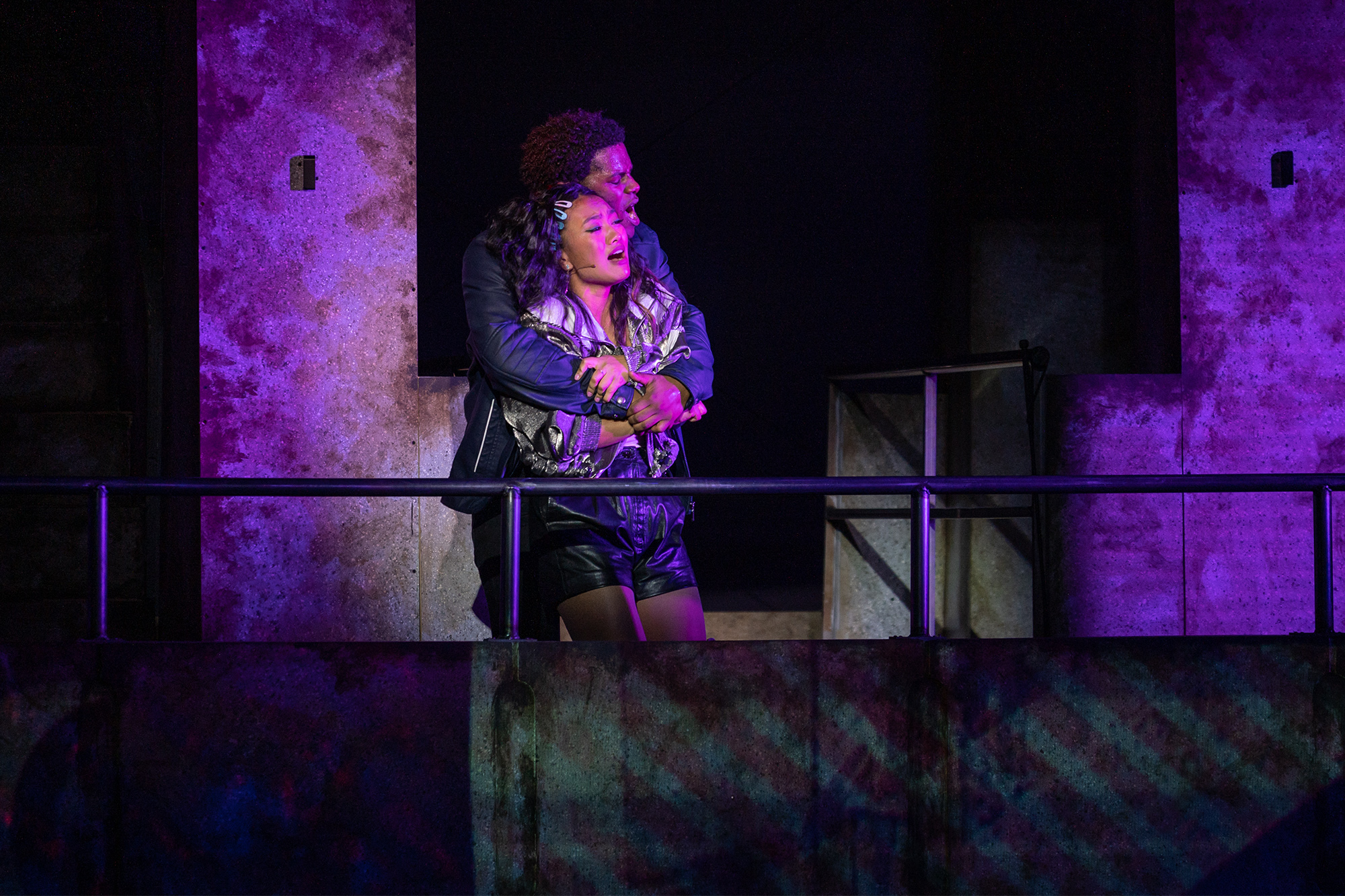
For millions of GenX-ers, the music of Pat Benatar and Neil Giraldo – Benatar’s longtime lead guitarist, collaborator, and producing partner, and her husband since 1982 – has been an iconic generational touchstone for over four decades. This might be especially true for queer GenXers, who found inspiration during their formative years in the defiant spirit that resonated through many of the duo’s songs.
One of those queer GenXers was Bradley Bredeweg, the out co-creator of another queer touchstone, television’s “The Fosters,” which became a hit for five seasons on FreeForm with its story of a lesbian couple raising five adopted children. Now, Bredeweg – a self-described “theatre kid” – is helping to bring Benatar and Giraldo’s music to a new generation of rebellious youth with “Invincible,” a new musical which intricately weaves the couples legendary catalog with inspired new songs to reimagine Shakespeare’s “Romeo and Juliet” for the 21st century.
“When I got into writing for television, I realized that I missed the equal exchange that happens between the people on the stage and the audience,” explains Bredeweg, who spoke with the Blade ahead of his show’s November 22 opening at Beverly Hills’ Wallis Center for the Performing Arts. “I love film and television, obviously, I’m so grateful for it, but after a couple of years of doing it, I was like, ‘I miss that inner theatre child, so I’m gonna moonlight.’”
The result of his “moonlighting” turns Shakespeare’s classic Verona setting into a modern, war-torn metropolis, and places his timeless tale of star-crossed lovers in a time of great transformation. Love and equality are forced to battle for survival as a newly-elected chancellor works to return the city to its traditional roots and destroy a progressive resistance that is trying to imagine peace in a divided world – and if you think that sounds familiar, it’s by design. It’s current run at the Wallis is its world premiere, but if things go as hoped, this is just the first step toward Broadway.
According to Bredeweg, however, it’s far from the beginning of his show’s journey.
“About twelve years ago, I realized I hadn’t read ‘Romeo and Juliet’ since high school and decided to read it again,” he tells us. “The next day I had to take a road trip – this was back in the era when I still had a CD book in my car – and I came across the “Best of” album of Pat Benatar and Neil Giraldo, so I popped it in and started driving. And because the story was obviously fresh in my head, I was listening to all these songs and realizing that if you line them up a certain way they totally tell the tale of ‘Romeo and Juliet.’ I wrote a first draft a couple of weeks later and then I just put it away and forgot about it.”
Much later, in 2015, he walked into a Los Feliz bar called the Rockwell (“It was this really cool kind of spot that we don’t have a lot of in LA, because we’re not a theatrical town”), where cabaret performances were sometimes mounted by visting Broadway talent and Jeff Goldblum would do a gig every Wednesday night. Inspired by the vibe, he suddenly remembered “this thing I had come up with all those years ago” and impulsively pitched the idea of putting it on to the bar’s manager. I said, ‘I’ve got this crazy idea where I want to combine Shakespeare with Pat Benatar,’ and she said, ‘That’s insane, but I’m a huge fan of your show and I love it, so let’s do it.’”
This early incarnation (then called “Love is a Battlefield”) was an unprecedented hit, enjoying a six-month run to sold out houses – that is, until Benatar and Giraldo’s manager attended a performance and recorded a video of the whole thing on his iPhone. He showed it to Benatar and Giraldo, and they were intrigued; but at the time, unbeknownst to Bredeweg, they were working on developing their own life story as a musical using their songs, so they sent a “cease and desist” letter to the Rockwell and the show was forced to shut down.
“It was heartbreaking, for all of us,” says Bredeweg, “because we knew we had something with real potential.”
Then, a year later, he got a call from a producer who told him Benatar and Giraldo wanted him to come to New York and discuss his musical.
“Of course, I said yes and got myself there immediately. We took a meeting on their tour bus, and we started talking about the musical they were developing, and suddenly we all started to move in the direction of doing ‘Love is a Battlefield.’ By the end of it we were all laughing about how we had started out with a ‘cease and desist’ order and here we were talking about coming together to do a show.”
In part, says Bredeweg, the couple was convinced to change course by their discussion of the proliferation of so-called “jukebox musicals” that have increasingly populated Broadway in recent years.
“We talked about how they have a shelf life, especially if they’re focused on a specific artist. They have a built-in audience, but beyond that, how can they stand the test of time? The real test of a timeless musical is if, in 40 years, every high school is doing it. I think that’s why we went back to using their iconic music to reinvent this epic, timeless tale.”
Another part of the appeal was how aptly the couple’s songs fit into Shakespeare’s classic – a coincidence, perhaps, but one that might be better described as synchronicity.
“When Pat and Neil met back in the late seventies it was supposed to just be a working relationship, but they fell head over heels in love with each other,” Bredeweg says. “When I got close to them, they told me they had been called the ‘Romeo and Juliet of the music world’ because the labels and managers and PR people were trying to break them up. They wanted Pat to stand on their own and Neil to just be her producing partner, and so much of what the two of them were creating at that time was about that struggle, about fighting that music industry system and saying, ‘let us figure this out for ourselves.’ That’s why so much of their music works inside of this story.”
For Bredeweg, the chance to realize his vision struck an intensely personal chord, too.
“I was always obsessed with the classics, but as a gay kid growing up in the eighties, I knew I felt different from everyone else, and as much as I loved them, I couldn’t really ‘attach’ to any character inside them. Nothing felt familiar to me, everything was from the point of view of a white cisgender person – and I always had these dreams, if I ever had any say, that I would love to tackle these classics in a different way and reposition them for a more diverse audience.”
In keeping with this mission, “Invincible” doesn’t just make Verona into a more modern city, but a more diverse one as well. The Capulet and Montague houses are run by the women, whose husbands are both dead; Romeo’s chum Benvolio is nonbinary, and falls in love with Juliet’s nurse; Juliet’s cousin Tybalt is secretly in love with her would-be husband, Paris; Paris himself is the city’s new chancellor, seeking the marriage as a means to control the vast Capulet fortune and deploy it to shore up his political power. In Bredeweg’s updated take on the tale, it’s a story about powerful men with powerful motives, with a matriarchy fighting against the traditional patriarchy and a younger generation trying to take control of its own destiny – and to ensure that it includes the freedom to love who they want.
“That’s obviously something the queer community can really understand,” says Bredweg. “We’ve been there and done that, the fight for marriage equality is all about that. It’s very much at the center of the show, and it was a big reason why I wanted to tackle the story, why I’ve rewritten so many characters with queer identities – taking these figures we thought we knew and giving them a more modern point of view.”
“Our culture is shifting in such huge ways,” he continues. “It goes back to my experience of not being able to find myself in these old tales. We are looking at our past, and pieces of art or the written world, or things in our politics, and we’re trying to reinvent these pinnacle moments in a way to make sure that history doesn’t always repeat, to move forward in different directions that are better for all of us. Especially the younger generations – they’ve stepped into this word where they’ve had no say in how chaotic things feel, and they are trying to take control of their identities and their path forward. That’s really what’s at the heart of our show.”
“Invincible” is not, of course, the first time “Romeo and Juliet” has been deconstructed and rebuilt as a musical; apart from the obvious example of “West Side Story,” the recent London import “& Juliet,” now a hot ticket on Broadway, presents an alternative version of the story in which the title character doesn’t kill herself, set to the music of pop songwriter Max Martin – responsible for hits from Britney Spears, the Backstreet Boys, NSYNC, and Céline Dion, among others.
Bredeweg isn’t worried about the competition.
“I never think about that kind of thing,” he tells us. “There’s always room for interpretation with classics of this stature. There’s space for both.”
His production, of course, has the added advantage of showcasing the music of two deeply-beloved icons whose recent induction into the Rock-and-Roll Hall of Fame has catapulted their names back into the public arena in a big way – not that they were ever very far out of it.
For Bredeweg, though, the Benatar/Giraldo connection has always been much more than just a way to make his show marketable. It’s the whole reason “Invincible” even exists.
“Pat captured my heart as a young gay kid for obvious reasons. There was something about her music, and her energy and messaging.
“It made me feel that if someone as powerful as her could exist, then I could, too.”
“Invincible” continues its run at the Wallis until December 18. For tickets and more details, visit their website.




Theater
‘Monster Party’ invites you inside the belly of a queer theatrical beast
Opening April 16th at the Rita House, the interactive production blends camp with history
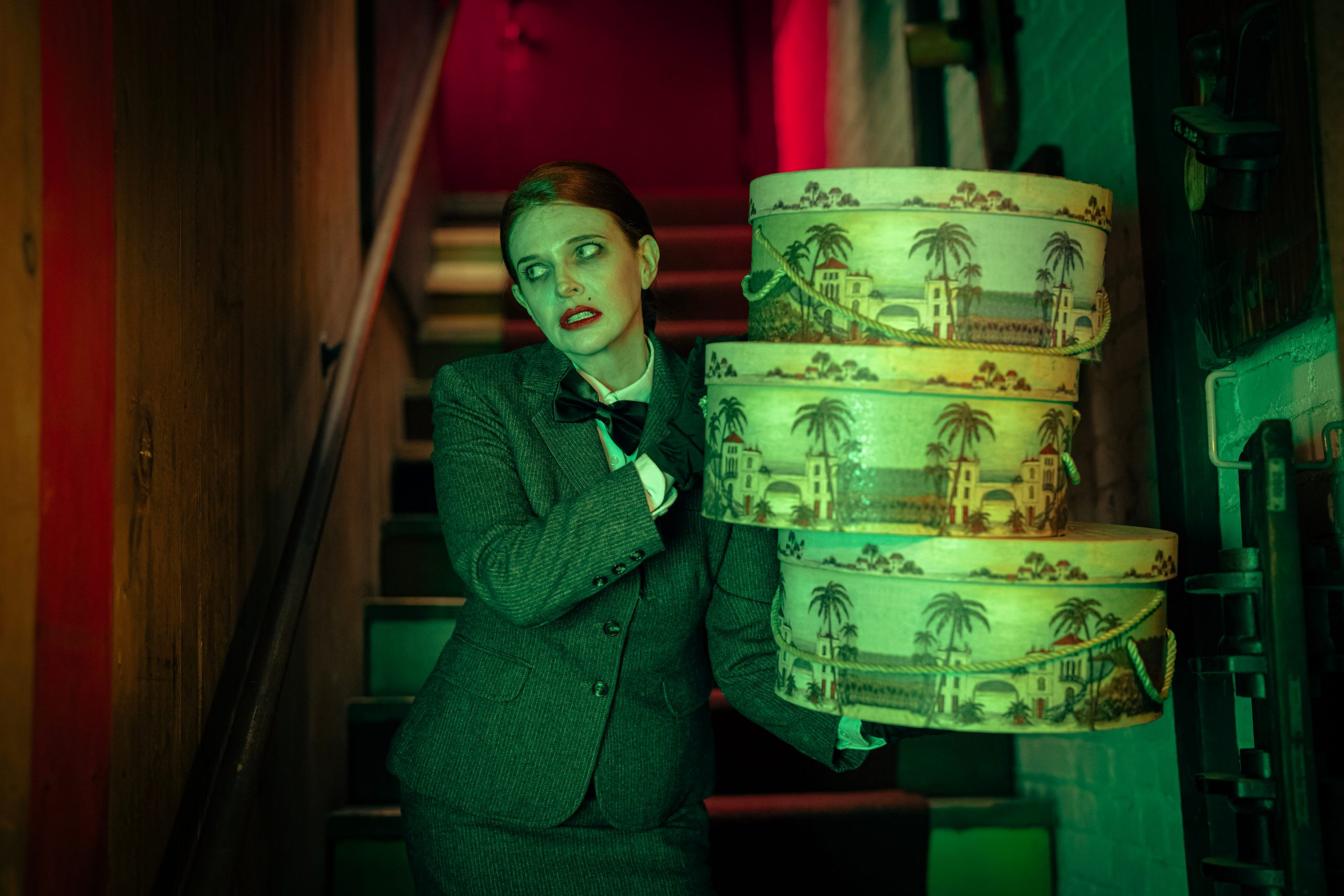
Some have argued that immersive theater is a dying art form – but Monster Party makes a compelling case for its revival. Open April 16-25 at Rita House, this surrealist, LGBTQ+ production is provocative in all the right ways, blending cocktail party decadence with historical reckoning to create a work that can only be defined as ‘campy melodrama.’ Rather than observing from a distance, audience members become active participants in the unfolding narrative.
Audience members wander through the home of The Baroness, a mysterious socialite at the center of it all. Over the course of 2.5 hours, guests are encouraged to mingle, gossip, and interact with performers – gradually weaving themselves into the story. What sets Monster Party apart is that the narrative isn’t simply delivered in a scripted, linear way; instead, it is produced through fragments of conversation, overheard exchanges, and the hazy (often drunken) banter that fills the room.
While Monster Party initially reads as playful chaos – cocktails, games, and audience interaction – something significant unfolds beneath the surface. The story that takes shape draws from a largely under-discussed chapter of American LGBTQ+ history: the Lavender Scare. Set in a stylized version of 1950s Washington, D.C., the show layers supernatural elements onto the real-world persecution of LGBTQ+ government employees, who were outed and fired under the pretense of national security threats.
By revisiting this history, the show feels seemingly relevant, offering audiences a lens through which to reconsider past injustices alongside today’s rising anti-LGBTQ+ sentiment. In Monster Party, the paranoia of that era is transformed into something grotesque and theatrical; it is necessary, immersive storytelling that brings awareness to the broader political world.
But this is not a historical reenactment. Instead, creator Matt Dorado leans into surrealism and camp, using heightened aesthetics to explore the institutional panic of the 1950s. Dorado, who has spent over a decade crafting immersive nightlife and theatrical experiences in Los Angeles, is no stranger to blending spectacle with storytelling. His previous works, including the Drunken Devil series and the grisly dining experience To Live and Di(n)e in L.A., established him as a creator capable of turning unconventional spaces into immersive worlds. With Monster Party, he brings that expertise into a prominent political and historical frame.
Writer, director, and producer Matt Dorado said Monster Party is “very near and dear to my heart,” adding that he has been creating the project since October 2024. He described the show as both “schlocky melodrama” and “gonzo entertainment,” while explaining that its themes have become “strikingly more relevant” amid “violent political upheaval, unfounded moral panic, and deep division.” Dorado said he hopes the piece will challenge audiences “in new and unexpected ways” while remaining a “lurid, campy immersive” experience.
Choosing Rita House as the venue only heightens the effect. The historic Spanish Colonial building provides an ideal backdrop for a story about hidden histories and performative identities. Its intimate rooms and architectural layout allow the production to unfold in multiple directions at once, encouraging audiences to tell their own stories in the process.
Importantly, Monster Party is designed to meet audiences wherever they are. Whether you’re a seasoned immersive theater enthusiast or entirely new to the form, the experience remains inviting, accessible, and thoroughly engaging. And true to its title, the production raises a central question: who – or what – is the monster at the party? Is monstrosity something imposed by society, or something individuals come to embody themselves? These questions don’t arrive with easy answers, but instead are examined through participation, drawing audiences deeper into the show’s world.
With limited capacity and a strong emphasis on creativity, curiosity, and surrendering to the experience, Monster Party stands out as one of the more distinctive theatrical offerings in Los Angeles this spring. Tickets are available at: monsterpartyshow.com
Theater
Speak ‘English’: Pooya Mohseni on reclaiming language and self
In this interview, Pooya Mohseni reflects on her return to English, Sanaz Toossi’s Pulitzer Prize-winning play, a powerful exploration of language, identity, and the Iranian diaspora

In the world of theatre, few works authentically convey the complexity of lived experience quite like Sanaz Toossi’s English does. The play provides its audiences with five unique voices, each one shaped by migration, memory, and the often quiet and always personal negotiations of identity. English invites us into this world, where language takes on the dual roles of both a bridge and a barrier, where storytelling has borders to spotlight the shared humanity that exists beneath our differences. The play also upholds a deep reverence for Iranian culture, its resilience, and its elegance. This culture is properly portrayed not as a tired trope but as a collection of personal histories and emotional truths.
Equally significant is the space English creates for much-needed representation of the authentic varietal. In amplifying trans voices alongside those of the Iranian diaspora, English challenges narrow narratives and insists on a broader and more inclusive idea of belonging brought vividly to life by Pooya Mohseni in her portrayal of “Roya.” Our interview with Mohseni reflects that same soul. Ultimately, English dares us to consider not just how we speak, but how we listen.
English has been described as a “quietly powerful” meditation on language and identity. What drew you back to the role of Roya for this production?
I’ve loved this play since I read it 8 years ago, and through its growth and its many productions that I’ve been a part of, that love has grown and deepened. Roya, specifically, is very special to me, as I see my grandmother and my mom in her, and her strength and class are for the books, so naturally, when I was asked to join the production at The Wallis, there was only one answer.
You originated the role of Roya on Broadway. How has your relationship to the character evolved since then?
As I said earlier, Roya is very special and somewhat personal to me, as I see the strength and struggles of the women I grew up around in her. But what Roya has done for me is push me and guide me to understand those women on a deeper level. That journey has allowed me to understand the women in my family better and grow as a human. I also would like to add that Roya herself as grown, as we, the artists, have grown and evolved, and her strength, her vulnerability and her resolve have become more clear and specific and the character that is being seen at The Wallis is a more evolved and clear version of the character, which I’m very proud and grateful to get to share with our west coast audiences.
The play uses a fascinating linguistic device where Farsi is performed in American accents and English in Iranian accents. How did you approach that as an actor?
At first, it’s tricky, because as soon as you say a sentence in the wrong accent, you would think “no, that was Farsi!” or “did I say it right?” But in this production, our relationships with the text and the characters are so intimate that we don’t have to think about it because it’s become second nature to us. It comes down to clarity of thought and intention, and when you know what the character is trying to communicate, the accent, the right accent, follows.
Roya is navigating both personal and cultural transitions. What aspects of her journey resonate most deeply with you?
I’m an immigrant. I’m the daughter of an immigrant. My grandparents had other children who migrated. This distance, both culturally and geographically, is something I’ve been around since I was a child. I’ve heard the laments, I’ve seen the heartbreaks, and I’ve also seen the determination to keep hope alive. In short, I’ve grown up in a household, like many Iranian households, that either had a Roya or had different people who were parts of Roya, which has always been the force pushing me to make sure that my portrayal of Roya is done with love and authenticity.
How does English speak to the Iranian diaspora, particularly in a city like Los Angeles with such a large Iranian American population?
I believe the success and popularity of English has been in its specificity, which has also made it universal, for Iranians and beyond. Having shared it with many audiences before Los Angeles, I think people, specifically the Iranian diaspora, will see some of their own experiences and struggles in English and hopefully feel some validation that there is this award-winning, universally recognised play which honors their lives, their hardships, and their culture.
Playwright Sanaz Toossi has said the work is also a way to “scream” against the vilification of Middle Easterners. How do you feel this message lands with audiences today?
First: Sanaz is the Queen, and she’s my sister, and I love her with all my soul. Second: The circumstances that propelled Sanaz to write this play are still not only prevalent but have intensified and are even more center stage in 2026. I wholeheartedly believe that English is even more relevant now and will continue to be in the decades to come.
Despite its heavy themes, the play is also quite humorous at times. How do you balance humor with its more undeniable emotional undercurrents?
English is a sublime dramedy in its simplicity, in my opinion. The humor lies in its honesty, riding along the struggles and the heavier moments and thoughts that are expressed. Some people have called it a “comedy with a heart,” but I see it as a drama that also embraces the humor of everyday life and human struggles that we all face. When the balance is struck, the play flows beautifully like a wave that moves and exposes different wonders on a shore.
The play has been widely acclaimed since its 2022 debut. Why do you think it continues to resonate so strongly with its audiences today?
English is honest. It’s not flowery or preachy, and in its truth, through the experiences of its characters, it has connected with the critics and the audiences through all its productions. Audiences are smart, and they don’t like to be pandered to, and I believe that is why different audiences, across generations and backgrounds, have found something in our play that speaks to something personal in their lives. I think that will continue for many years to come.
As an Iranian American and a transgender artist, how do your identities inform the roles you choose and the stories you tell?
As Eve Ensler mentioned in the Vagina Monologues, being transgender is very similar to being an immigrant, because you’re treated, most of the time, like you don’t belong. I was treated that way at school when I was in Iran, and I was treated that way when I moved to New York, and in 2026, as an Iranian American who is also trans, all parts of my identity are under attack. I’ve never been asked to play the person next door, and while that has cut down on the number of things I’m given the opportunity to do, it has also freed me to be me: sassy, unique, and aware of the experiences that differ from mine. I was forced to find MY way because no other way was open to me. I love getting to play outsiders or characters who are outspoken, because I’ve had decades of training. So, having lived my life as me, I choose characters and projects which have heart, grit, and that I feel add something of value to the world, even if it’s just a laugh.
You’ve been open about your experiences with trauma and survival. How has storytelling served as a tool for healing in your life?
If you think about therapy, it’s basically storytelling. It has definitely been that way for me. Especially if the story has some personal connection, either to the Iranian side of me or the trans part of my identity. I’ve been fortunate to have worked on great stories that ring true to some part of me, and through finding the essence of the character, I have found my way through my own heart and soul. It feels strange to say that thousands of people have been witnesses to my therapy through the years, but it is kind of true, and I like to think it’s been not just therapeutic for me, but more like group therapy, shared between the viewers and me.
You’re also a writer and filmmaker. How do those creative outlets influence your acting process?
Being a writer and having been involved in making a couple of films has definitely widened my horizon as an actor. I now know more about what happens in other aspects of a production, so I think it makes me a more aware actor, who also has so much more respect for what it takes to create a story and turn that into a final product, and all the steps that need to be taken for a film to happen.
What do you hope audiences take away from English after leaving the theater?
I hope it reinvigorates their love for theater and what that can be. I hope it makes them think about themselves and others with more love and grace. Maybe, they feel seen by the play, or maybe, just maybe, English helps them see others who have different experiences or sound and look different from them, with more love and curiosity, rather than fear and disdain.
Looking at the future, what kinds of stories or roles are you most excited to explore next?
I love playing matriarchs because I think I have that in me, and more mature roles have so much potential and depth. I hope to continue to play unique and interesting, maybe even really dark characters. I’m not the first person to want to play juicy roles, but having already covered my journey to this moment, I hope to keep going through the path of finding new types of characters to explore: mothers, bosses, villains, and maybe even love interests. But above all, I want to play parts that are written with love and care and house multitudes, instead of tokens and shallow, flat objects of either fetishization or pity. I keep working towards that and will take roles, hopefully, that make me grateful to be a storyteller.
English runs at the Wallis Apr 4, 2026 – Apr 26, 2026
Theater
Aura Mayari discusses the glamorous fascism of ‘Here Lies Love’
The ‘RuPaul’s Drag Race’ alumna discusses her role in the show and what it can teach us about our current political climate.
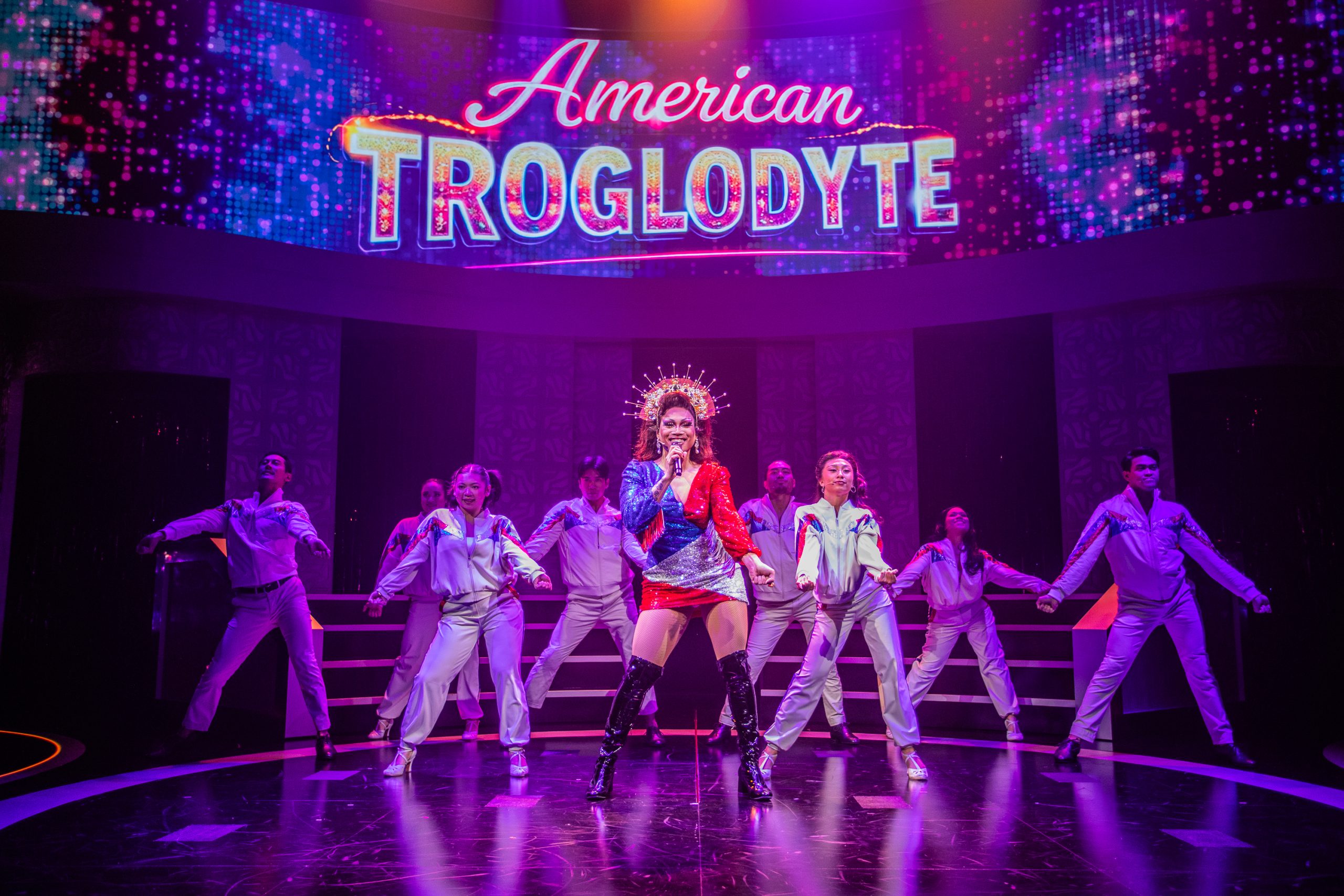
Watching a good musical can be transcendental.
As the more theater-inclined members of the queer community can attest, watching a musical that makes you feel something is a legitimately unforgettable experience. These are productions that feature not only amazing music but resonant themes, drawing on core aspects of the human experience to make viewers feel connected with the artistry taking place onstage. Modern audiences are lucky to have many inventive musicals that they can connect with — but few are as unfortunately relevant as David Byrne’s Here Lies Love.
First premiering off-Broadway in 2013, Here Lies Love documents the glamorously haunting rise of Imelda Marcos, who, with her husband, served as the Philippines’ dictator for decades in the late 1900s. The story uses pop music to document her steady descent into fascism, with its dazzling images reflecting how Marcos used her trademark style as a cover for mistreating millions of citizens she was meant to serve.
In recent years, as the Philippines and the U.S. struggle with fascism, viewers have recognized the production’s political importance, with its themes of fighting oppression becoming more important than ever before. It’s why so many fans were thrilled when it was announced Here Lies Love was coming to LA in what was promised to be the queerest version of the show yet — meaning it was perfect for RuPaul’s Drag Race alumna, Aura Mayari.
“What really caught my attention was the Filipino-ness of this story,” said Mayari, as she sat down with the LA Blade to discuss her role in the show. “In my drag, I really love to intertwine my culture into what I do. And so when I was told that it’s a Filipino story and it’s going to be an all-Filipino cast, I was all in!”
It’s an aspect of the performer’s art that fans know well; Aura first made waves on RuPaul’s Drag Race season 15 as one of that cast’s best dancers (and self-titled ‘trade’ of the season). While on the series, she proudly discussed her experience as a queer Filipino, with the years since seeing Mayari bring her intersectional drag to countless clubs across the country. It made her a perfect fit for a show that merges Filipino culture with visually stunning effects, with the LA iteration creating a new role just for the queen: Imeldific, a drag version of Imelda Marcos who narrates the story to a group of club goers.
Aura spoke about what a personal honor it was to originate this role, explaining, “I moved to the United States [from the Philippines] when I was 11…and I wanted to be American so bad. I didn’t want to stand out, and I wanted to avoid being bullied. I didn’t want to be seen as someone who was an immigrant until after college, when I met a lot of my Filipino friends that I’m still friends with today.” It’s a pride that she was honored to bring into Here Lies Love, and it only grew once she encountered a cast who understood and loved the intersectional identities she showed through her drag. “They embraced my queerness and what I could bring to the table. And I think a lot of what I’ve learned through my Drag Race experience, I was able to use and [help] inspire my cast members to make something as magical as this show is.”
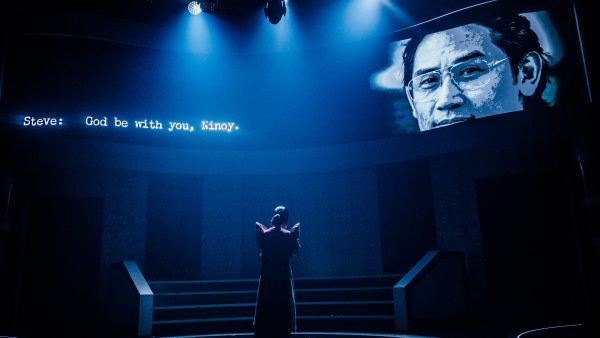
The performer stressed how being a part of this ensemble truly felt like being at home. “We get to eat a lot of Filipino food — people bring in a lot of Filipino snacks, and a lot of Filipino egg rolls!” Aura laughed, describing her experience on set. “Every day, being in the show…it’s so special to me. I’ve never, ever thought to be a part of a project that celebrates Filipino culture and that dives into the history that a lot of people don’t know about. I have learned so much about my own history from this show.”
It’s a history that, unfortunately, we are seeing repeated across the world today.
Since the 2024 election, U.S. citizens have seen numerous attempts by this administration to strip away the freedoms of marginalized communities. And in the Philippines, for many months in 2025, thousands of citizens fought against widespread government corruption through protests extremely similar to the ones that toppled the Marcos regime. It’s a deeply disheartening experience to watch Here Lies Love and realize that not only have the issues portrayed in the show not gone away, in some cases, they’ve also worsened. Aura recognized this fact, but she reminded everyone watching: Here Lies Love’s story doesn’t end with corruption.
“History repeats itself. And it’s really important to know and understand that history — and to fight the erasure of our stories.”
She emphasized how Imelda Marcos is not the only character in this show, that the audience gets to meet many of the real advocates who never stopped fighting against their country’s authoritarianism and eventually toppled their gorgeous dictator. “[Here Lies Love] really reminds us how quickly power can shift and how propaganda can influence people…[it shows] that people have fought things like this in the past, and [their fighting] has worked.” On what these stories are meant to teach the audience, Mayari continued, “I think [the lesson] is: if you do believe in something, anything can change. You just really have got to be aware, and you have to teach yourself [to fight back].” It’s an inspiring message that so many need to hear right now, and that Aura Mayari is delighted to share through her performance as Imeldific eight times a week.
As the interview came to a close, Aura realized that in the span of thirty minutes she’d discussed Here Lies Love’s queerness, innovative storytelling, and political pertinence — and she’d barely scratched the surface of all that this production contains! Recognizing that she would need many hours to speak about everything she’s experienced during her time with the show, Aura summed up her feelings by saying, “It’s so special to me. I’ve never, ever thought to be a part of a project that celebrates Filipino culture and that dives into the history that a lot of people don’t know about. And I have learned so much about [myself and] my history from this show.”
It’s a truly deserved experience for an artist who’s dedicated her career to uplifting her communities. And, for the many people who get to watch Aura perform in Here Lies Love at the Mark Taper Forum in Los Angeles, the show is a good reminder that, yes, the issues we’re facing today have all happened before. But those people fought back, and they won.
So that means we can too.
Here Lies Love is playing at the Mark Taper Forum in Los Angeles from February 11 to April 5, 2026.
Theater
‘Incitation to the Dance’ asks what happens to love when a younger man cuts in
This dark, sexy comedy, premiering at Theatre West, looks at lust and aging in gay romance.

“It takes two to tango. What happens when a third cuts in?” That’s the provocative tagline of the latest dark comedy from writer/director Michael Van Duzer, Incitation to the Dance, running at Theatre West from Feb 13 to Mar 15.
The play follows an older gay couple – Malcolm is a disabled film historian who teaches a course on queer representation in film noir, while his partner Asher is a depressed and out-of-work dance instructor.
Their relationship is thrown off course when Finn, a younger dancer, stripper, and escort, crashes into their lives, exposing desires, regrets, and jealousies that had long been buried.
Van Duzer, as an older gay man with a disability himself, says he was inspired to write the show because of the relative lack of stories about older gay couples on stage and screen. Incitation provided an opportunity to explore the unique circumstances and challenges facing older queer couples.
“The fact that it’s gay men makes it somewhat different. Because of their age, getting actually legally married was not something that was available to them at the beginning of their actual relationship. Malcolm had been married to a woman at one point,” Van Duzer says.
Age and sex play out across multiple dimensions of the drama, with Malcolm jealous of the bond Asher and Finn share over dance, while Asher resents Finn’s status as an up-and-comer while he’s at the twilight of his career.
“They have several layers of rivalry that they explore throughout the play,” Van Duzer says. “They do dance with each other in these stylized dance sequences, eventually dancing out their fury.”
Van Duzer says his play’s use of heightened language and highly stylized dance sequences will intrigue audiences.
“The second dance is a tango Apache, which is a style that was done in the 20s and 30s that came from France and included slapping, hair-pulling, dragging people around, and tearing their shirts open.”
The show got its start nine years ago as part of Theatre West’s writing program as a short play presented as part of the company’s “West Fest,” and Van Duzer has been developing it since.
“The response from the audience was very good, and I saw that there was more to mine in these characters now, maybe because I’m older. I don’t know, maybe because I was no longer in a relationship,” Van Duzer admits.
As he developed the show into a full-length piece, Van Duzer brought more dance elements into it, which naturally also brought to the fore the characters’ relationships to aging and disability.
“Malcolm is reticent to discuss it in any detail, but while his Cane doesn’t slow him down, it is always there. With all of the dance, with his appreciation of it, with him being on stage not dancing, there is this natural chasm that one sees, and I think that the audience will actually relate to that much more deeply than they would to a long monologue about what happened.”
For Van Duzer, who has lived with rheumatoid arthritis all his life and had eight surgeries to treat it, it was less important to tell a tale about Malcolm’s disability than to just see it represented in how it affects his relationship.
“I don’t feel it’s a part of this story to offer explanations, but to just see the difference in not only able-bodied people but people who are dancer-athletes.”
The rawness of the sexuality and dialogue in the show presented some difficulties in casting, Van Duzor says, as some actors were reluctant to take on the piece.
Longtime collaborator David Mingrino has played Asher since the show’s earliest workshops, but Van Duzor tapped stage and screen veteran Michael Gabiano to play Malcolm, and rising star Casey Alcoser as Finn.
“They all have a terrific sense of humor and a couple of them have tried out lines that I absolutely said, ‘Hey, that’s funnier than what I wrote, so let’s go with it,’” Van Duzer says.
That humor helps carry the themes of the play, which Van Duzer says is about understanding how a relationship evolves over time.
“I want audiences to have a better understanding of what happens to a relationship, what really is important in the end.
“People can be very happy as a single person. But if your choice is to be with somebody and really work on that relationship and make it a lasting ‘til-death-do-us-part relationship, I want to share with people that, with a little kindness, with a little humor, with a little attention all at the right time, you can make this thing happen and you can still be your own person pursuing your interests.”
For Theatre West, this play also makes queer history for this long-running venue. Producer Dina Morrone shares with the Blade, “I am thrilled to be a part of this production because Michael Van Duzer’s play is the very first MainStage play/production at Theatre West in its 64-year history that presents a story about an older gay couple. In mainstream theatre, it is not common to see a story with gay characters, let alone an older gay couple featured. In this day and age, it is vital that everyone is represented on our theatrical stages. We need to show that, although it is a gay story, it is a universal one, and that, in the end, we can all relate. We are all one. One love.”
Incitation to the Dance plays at Theatre West, 3333 Cahuenga Blvd, Los Angeles, Feb 13-Mar 15, Fri-Sat 8 pm, Sun 2 pm. Tickets at theatrewest.org.
Theater
‘Table 17’ serves up hilarious musings on love at Geffen Playhouse
New play from rising star Douglas Lyons makes its West Coast debut
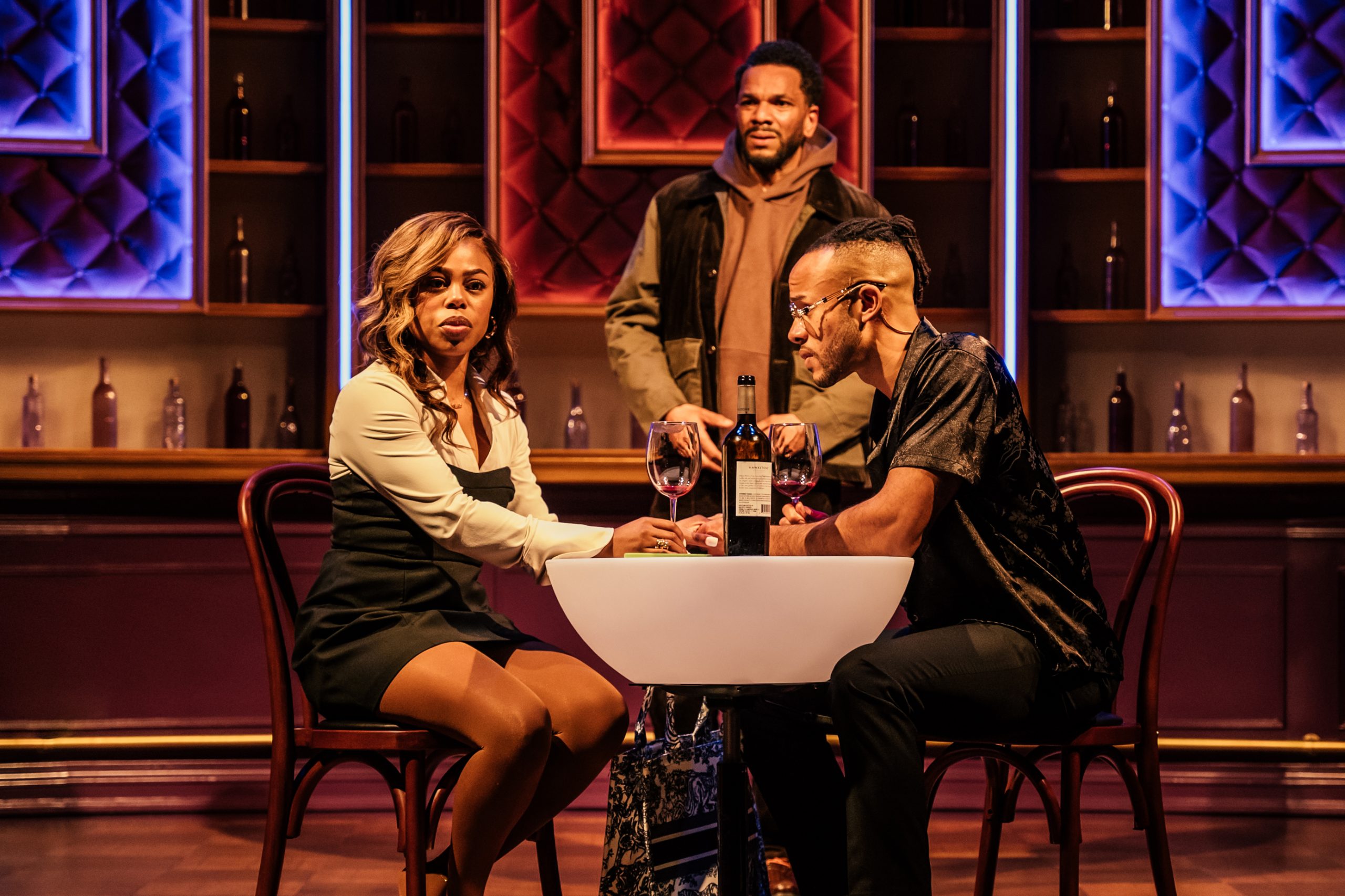
Can we still celebrate the love we have for someone even when the relationship doesn’t pan out? That’s the question at the heart of Douglas Lyons’ hilarious new comedy Table 17, playing at the Geffen Playhouse through Dec 5.
Dallas and Jada meet at a restaurant where they’re seated at the eponymous table two years after their engagement ended to figure out what to do with the feelings they still have for each other.
But there’s more to this meet-up than it first appears, and over the course of their meal, they have to deal with the explosive chemistry between them, the wounds the relationship left them with, and an overbearing queer waiter who gets more entangled with them than anyone would like.
Also, potentially entangled in the show are several audience members. When purchasing tickets, patrons have the option of buying seats at one of five other tables that make up the restaurant set.
Lyons, who’s best known for his GLAAD-award-nominated hit play Chicken & Biscuits, has been making a name for himself with deeply funny plays that tell queer stories, Black stories, and stories about women. His last show in LA was IAMA Theatre’s workshop production of Don’t Touch My Hair.

He says his focus on comedy comes from growing up in a large family where laughter “cut through the drama.”
“I grew up as a preacher’s kid. I learned very early on, because I’m a part of two big families on both sides, that comedy is communication. It was how I was raised,” he says.
“I love giggling. I love being silly. And once I found I had the permission as a writer to create work that made not only me laugh, but my friends laugh and then audiences laugh, I went, why don’t we do more of this?”
Lyons’ work fills a noticeable gap in the theatre scene, which tends to promote heavier dramatic works, and where romantic comedy seems to have mostly disappeared from stage and screen.
“In the 90s and 2000s, rom-com was the sweet spot. But we were hoping to love differently then than we are now. Now you’ve got apps. How we fall in love is different now,” Lyons says. “I mean, in the queer community, Grindr and all these apps and stuff, you’re not meeting people at a bar.”
But Lyons says that Table 17 scratches that itch we have to see love expressed.
“It is in our DNA to desire love, and so when you sit down and you see these two people trying their best to communicate with each other, and you can tell that they love each other, but sometimes they miss each other and they make poor decisions around each other, it’s in some way hopeful,” he says.
“I think traditional rom-coms made it feel like a fairy tale. And in 2025, we know love is not that. I want audiences to be reminded that love is worth exploring and fighting for and pushing.”

The budding bicoastal playwright says Table 17, fresh from an Off-Broadway run that was deemed a New York Times Critics’ Pick and won two Audelco Awards, is perfect for Los Angeles audiences.
“I say this openly—I think New York takes itself too seriously. I think we sometimes want to be so highbrow in New York that we don’t really engage the community. And what [Geffen artistic director] Tarell [Alvin McCraney] is doing at the Geffen that I’ve witnessed, there are all colors, stripes, genders, ages walking through that door and leaving with smiles. That to me is the kind of theater I want to make,” he says.
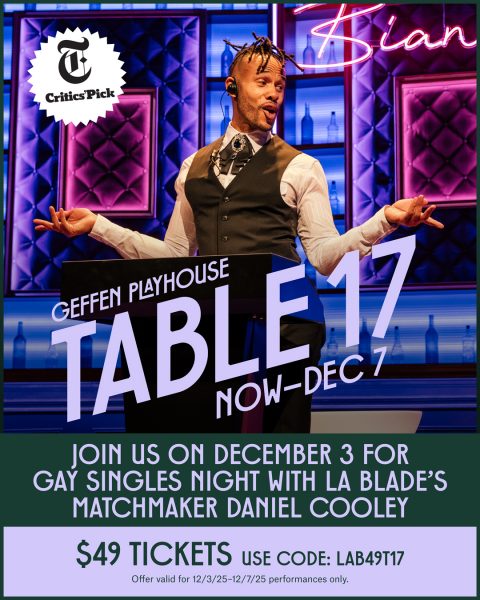
Table 17 plays at the Geffen Playhouse, 10886 Le Conte Avenue, Los Angeles, CA 90024, until December 7. Use code: LAB49T17 for $49 (includes per ticket fee) for Premium, Section A or Section B seating. No ticket limit. No refunds or ticket exchanges. Visit geffenplayhouse.org to purchase your tickets. Code also valid for performances Dec.4-7, including weekend matinees.
Join us for Gay Singles Night with Matchmaker Daniel Cooley, with talk-back after the show! The first ten people to email an RSVP to [email protected] can request two free tickets (while supplies last). Otherwise, use code: LAB49T17
Theater
‘Just Another Day’ brings two veteran actors together for a bittersweet reflection on life: Theatre Review
Patty McCormack (The Bad Seed) and Dan Lauria (The Wonder Years) co-star in a delicate two-hander
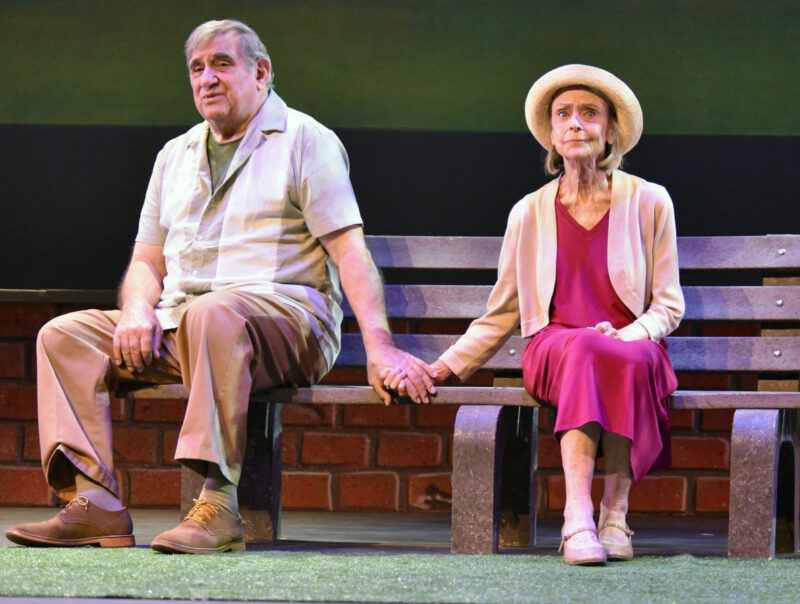
Just Another Day, the new play directed by Eric Krebs and written by Dan Lauria, revolves around a conversation (split into two separate days, two separate acts) between an unnamed older man and woman. It’s a simple set-up, the two sitting on a bench surrounded by open grass and skies, but the conversations they have about life, regrets, and their favorite classic movies reveal deeper layers to this heartwarming story. The play has found an intimate home at The Odyssey Theatre in Los Angeles.
The most emotional part of this narrative, revealed naturally through Lauria’s smart dialogue, is that the comedy writer (played by Lauria, known for The Wonder Years) and highbrow poet (played by Patty McCormack, Oscar-nominated for The Bad Seed) arrive at the bench every day not knowing their identities, or who they are to each other. So when the two reminisce on the dialogue of His Girl Friday and the charm of yesteryear, there’s a bitter irony to the proceedings: the two can vividly remember quotes from old movies, but don’t know the first thing about themselves because of memory issues.
Lauria’s dialogue creates contrast in the way our two leads speak, with Lauria’s talk being much more ordinary and slapstick, while McCormack leads with sophistication and carefully chosen words. Yet the two connect because of their differences; as they try to piece together who they might’ve been to each other in decades past, they form new memories that will certainly guide them through the uncertain present.
While the play is largely a two-hander (minus a humorous offscreen bellringer), both Lauria and McCormack get individual moments to shine in standout monologues, and each character finds themselves going through similar cycles of emotion. Just Another Day is certainly a more muted character study, but Lauria and McCormack consistently bring energy to the stage throughout the 95-minute runtime, especially in a few moments where the two run off the bench, shouting in harmony. A few moments where the two leads interact with the audience while recreating old acts can feel gimmicky and tired, but Lauria’s writing knows not to linger in any one place too long.
The park setting and natural lighting are simple, and all the better for it, but the end of the second act uses a spotlight and more intimate lighting to spark emotion for the audience. While the play does start to go in circles by the end — by design, it’s kind of inevitable — the note that it ends on is appropriately bittersweet.
The casting choices and themes at hand may position Just Another Day as a play for an older demographic, but it’s also the type of story that can connect multiple generations. More than just a nostalgia piece, Krebs and Lauria create a present-day love story with plenty of chemistry to enjoy. This may not be a must-see play, but it’s always nice to be reminded of the power of two veteran actors who haven’t lost a beat.
Just Another Day runs for one last weekend, through September 28th at The Odyssey
Theater
The Palm Springs historic Plaza Theatre to reopen, celebrating its past by looking to the future

From the 1930s, Palm Springs has been the luxury and private oasis for Hollywood’s elite. Due in part to a clause in most actors’ contracts that they remain within a two-hour driving distance from Los Angeles, the city was also well known for keeping secrets. With a long list of classic stars that include Frank Sinatra, Marilyn Monroe, Elvis Presley, Bob Hope, Lucille Ball, and many more, to modern-day A-listers, Palm Springs remains the “it” location to play.
Part of the city’s Hollywood history is the historic Plaza Theatre, situated right in the heart of town on Palm Canyon Drive. Since 1936, the Plaza Theatre has welcomed Hollywood’s golden age of celebrities. The venue quickly established itself as the place legends were seen when it hosted the world premiere of the Oscar-winning film Camille, with the film’s star, Greta Garbo, reportedly slipping in while the lights dimmed. Bob Hope, Jack Benny, Bing Crosby, Frank Sinatra, and more have graced its stage.
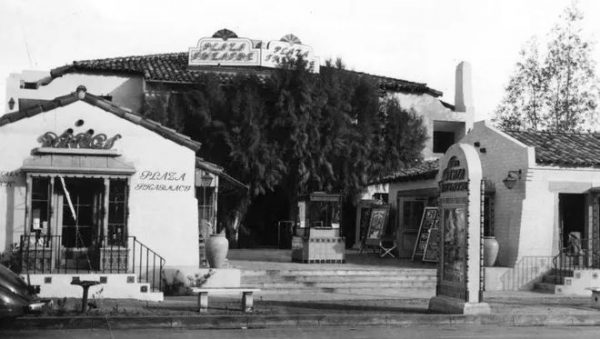
This writer remembers sitting with anticipation as the star-lit ceiling twinkled, and the heavy velvet curtain rose to feature a cast of vaudeville and screen veterans, all aged 55 or more, for the famed The Fabulous Palm Springs Follies, which took residency at the Plaza for 23 years.
Sadly, the Plaza closed in 2014. The building has remained empty, with rumors of bringing it back. Well, the rumors are now fact. Under renovation for the last year, the Plaza Theatre will reopen this December, under management by Oak View Group in partnership with the Palm Springs Plaza Theatre Foundation and the City of Palm Springs.
The majority of the funding for the renovation and reopening has come from the community, with donors contributing amounts ranging from $50 to millions of dollars; a true testament to the community coming together to celebrate the Plaza’s legacy. Getting the ball rolling was a $5 million donation from the co-creator of Wings and Frasier, David Lee.
One of the leaders of the renovation is John Bolton. Bolton, a Senior Vice President for Oak View Group, was brought to the Coachella Valley to oversee the $300+ million Acrisure Arena project and the launch of the Coachella Valley Firebirds hockey team. He has since gotten involved with the Palm Springs Chamber of Commerce and Visit Greater Palm Springs, on a mission to support the community’s growth and local business development.
For Bolton, the Plaza Theatre project isn’t just about business; it has become personal. He shared with the Blade, “I love and adore Palm Springs. For me, getting the opportunity to be involved in this project is so meaningful. It’s so exciting and wonderful to have had this opportunity within a short amount of years to have such a great impact on the entertainment options for the entire Coachella Valley. I got involved in the Plaza project because our company, Oak View Group, donated a million dollars to their capital campaign. I got involved and got on the board and started doing fundraising, and it just kind of evolved from there.”
Bolton will now serve as Senior Vice President and General Manager of the Plaza Theatre. With a keen business sense and passion for the business community, he knows the importance the venue will have when it comes to the region’s economy.
“When you think about Palm Springs and the number of tourists that come here, people are really looking for things to do. This really adds to the tourism aspect of Palm Springs and really having things to do in the evening, which has always been something that I think all of our people involved in tourism have been looking to expand upon and have more opportunities.”
The venue is projected to welcome 135,000 attendees per year, estimated to provide more than $4 million in direct economic impact to the city through sales and transient occupancy taxes. The reopening will have a major positive impact on local small businesses, hotels, and restaurants. The Plaza will also host education programs for students of all ages, as well as community outreach events, engaging with underserved communities.
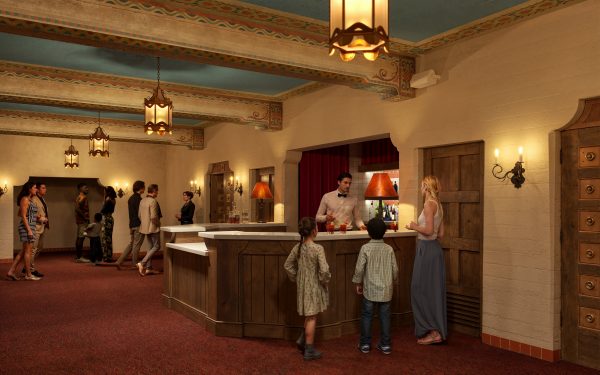
The renovation is extensive. It isn’t just changing the carpeting and slapping on a new coat of paint. It has been a meticulous process that involves preservation while adding cutting-edge innovations for patrons. They have uncovered a 1936 decorative stenciling around the stage and restored it; the Plaza has also added a new cooling system, expanded seating, modern dressing rooms, and a museum area featuring items from Hollywood’s past. But at the heart of all of the renovations has been the mission to keep the venue’s soul intact.

While paying homage to the venue’s past, the Plaza’s programming definitely reflects present-day Palm Springs. The venue’s first week of performances includes Lily Tomlin, Billy Porter, John Waters, and Fortune Feimster; clearly celebrating a certain aesthetic.
Bolton expands, “The demographic of Palm Springs is very LGBTQ-centric. I think that reflects a lot of our programming, but if you look over the vast majority of our shows, it appeals to, we think, everyone. But certainly, those are very popular among LGBTQ audiences for sure.”
On behalf of the Plaza Theatre, what is Bolton’s message to the community?
For me, it’s gratitude. Gratitude for the community stepping up and saying that this is a priority to restore this historic gem and get it reopened. It really is gratitude to everyone who has made this a reality. And then gratitude for those who will be supporting the theater going forward, either through continued donations or buying tickets.
The Plaza Theatre is set to reopen with a full lineup, starting the first week of December. For events and tickets, click here.
Theater
‘& Juliet’ makes an energetic splash in Downtown Los Angeles: Theatre Review
Rachel Simone Webb and Ben Jackson Walker stand out in the North American Tour.

In a jukebox musical twist on Romeo & Juliet, Britney Spears, Katy Perry, and Backstreet Boys songs become hilarious and endearing anthems of newfound love, self-discovery, and fresh starts in the endlessly entertaining North American tour of & Juliet.
Making its successful transition over to Los Angeles, this show’s energetic ensemble immediately stands out. While Romeo & Juliet ends with both of the star-crossed lovers tragically taking their lives, & Juliet posits a simple question — what if Juliet didn’t take her life over someone she knew for just five days?
Beyond giving Juliet a new start, this show features multiple messy relationships that are delightful to watch unfold through Luke Sheppard’s direction. There’s the central dynamic between Anne Hathaway (Teal Wicks) and the deadpan William Shakespeare (Corey Mach), which gets increasingly complicated as Anne is the one attempting to rewrite the story, questioning Shakespeare’s genius and motives in hilarious bits along the way. But the surprise standout comes in the surprise connection between Lance (Paul-Jordan Jansen) and Angélique (Kathryn Allison), Juliet’s nurse and biggest supporter.
Rachel Simone Webb, who stars as Juliet and was a member of the original Broadway cast, takes the stage with her majestic voice in a cover of “…Baby One More Time” — earning a well-deserved standing ovation during the Friday night showing. Another standout, Nick Drake, plays May, who feels a flame for the refreshingly dorky Francois (Mateus Leite Cardoso) after a chance encounter. But things get complicated as Francois proposes to Juliet, feeling like his father, Lance, won’t support him falling in love with the non-binary May.
The hilarious Ben Jackson Walker, who originated the role of Romeo in the original Broadway production, joins the company, making a meal of the moment when the once-dead lover reappears at the end of the first act. Romeo’s appearance means that the rules of the story are constantly being rewritten. And there are certainly moments where & Juliet leans into the meta, but its biggest tool is its sincerity; the show avoids relying too much on its referential framing device as a crux, which it comes close to.
While the colorful staging and costumes that play on both classic and modern fashion certainly add to the production value, there are moments when the flashiness of & Juliet becomes all too distracting. The bottom half of the stage effectively serves as Juliet’s bedroom, a street outside a ball, and a wedding venue without much re-organization needed. The issue comes with the upper half of the stage, which uses a screen with colorful designs that often appear during big music sequences. This makes it often difficult to know where to look with so much movement already happening, taking away from the undeniable stage presence of this incredible ensemble.
Thankfully, the second act of the show slows down, allowing for more intimate moments as Juliet is forced to contend with her lasting feelings for Romeo, Nick questions their place in the world and Anne sees the writing on the wall. As the show builds up to its climactic wedding (in true Shakespeare fashion), truths are forced out into the open, and these complicated love stories find their fitting conclusion.
The Los Angeles production of & Juliet makes for a fun night out on the town, and because the actors embrace the cheesiness without any hesitation, it’s hard not to be singing along by the end. Despite the premise, Juliet’s arc in the show is less about her saying no to love or no to a man, but making an active choice in her life. That’s a choice that all of us deserve to make, and this show celebrates that in true jukebox fashion.
& Juliet runs Wednesday, August 13 to Sunday, September 7, 2025 at the Ahmanson Theatre, Los Angeles / Tuesday, September 9 to Sunday, September 21, 2025 at Segerstrom Hall, Segerstrom Center for the Arts, Costa Mesa
Theater
Geffen Playhouse’s The Reservoir finds queer humor and joy in recovery and loss
Jake Brasch’s electrifying debut mines his own life for intergenerational drama
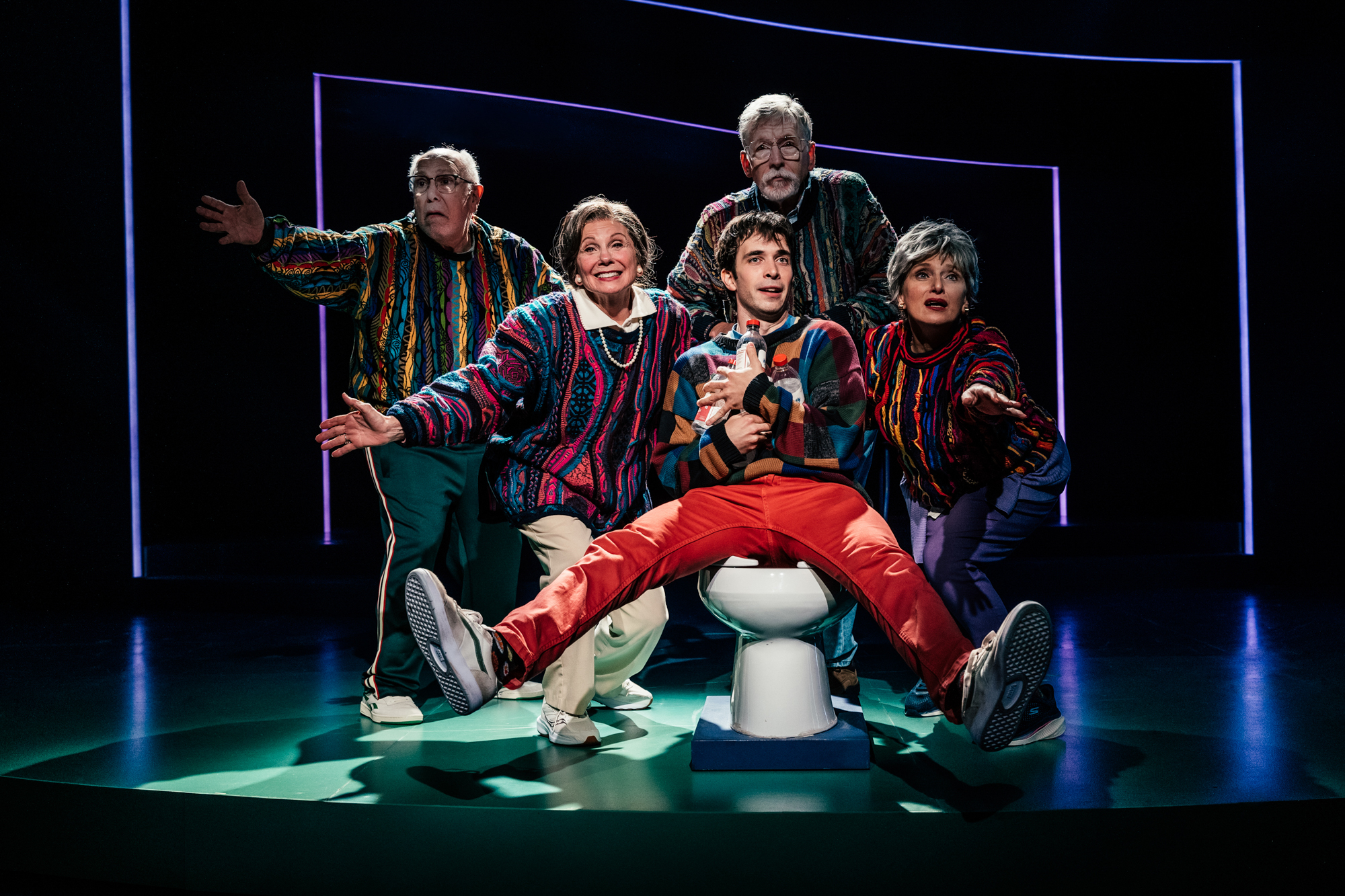
What do you get when you combine an alcoholic twink, a mother at the end of her patience, and a set of grandparents (nearing) the end of their wits?
In the Geffen Playhouse’s production of Jake Brasch’s new semi-autobiographical play The Reservoir, you get a stunning and hilarious drama about recovery and intergenerational connection.
As the play opens, we meet Brasch’s stand-in Josh (Jake Horowitz) in a deeply unflattering circumstance. He’s awoken in the park where he’s passed out drunk, having just returned home to Colorado after taking a medical leave from theatre school in New York due to his alcoholism. His mother, played by Emmy nominee Marin Hinkle (The Marvelous Mrs. Maisel), begrudgingly takes him in on the condition he stays clean and holds down the job she arranges for him at the local book co-op.
Josh then finds himself spending more and more time with all four of his grandparents, at first in an effort to find sympathy that’s in short supply at home, but then in a – sometimes misguided effort to halt their cognitive declines due to aging and Alzheimer’s disease. The project of helping his grandparents build their “cognitive reservoirs” through memory games, trivia, storytelling – and in one hilarious runner, preparation for a late-in-life bar mitzvah – helps distract Josh from his own disease for a time but exasperates his entire family.
Cognitive reserve is a real theory about how the brain can withstand and recover from trauma, betraying the play’s origin as a commission by the Sloan Foundation, which seeks to make connections between science and theatre. But in Brasch’s hands, the science of memory becomes exhilarating and real.
“I started from there, and I was just desperately looking for a pitch for [Sloan]. And then I kind of realized, oh shit, I’m writing about my grandparents, and the year that I moved home to get sober and reconnected with them and found an allegiance with them around the fact that we were foggy, we were all sort of in this space of not knowing, not remembering, and wanting to hold on,” Brasch says.
But while recovery and loss are weighty matters, Brasch, a recent Julliard graduate (spoiler, sorry) who’s making his professional playwrighting debut, finds lots of surprising laughs.
“That’s been a dance with this play,” he says. “This took me a while to learn but it’s about not letting the audience settle into one or the other. As soon as the drama feels like, ‘Oh my God, this is too much,’ we get a big joke. As soon as we feel like this is a sick comedy, we get absolutely knocked over. And I think that is my experience of what it feels like to be in crisis.”
That comedic touch helps deliver a key theme of the show, which is that recovery – both from addiction and loss – is actually a joyous process.
“Oftentimes people think that getting sober is going to mean that their humor and joy and partying is taken away from you. In my experience, it has been quite the opposite and learning to laugh at what’s hard in life has been my saving grace,” Brasch says.
“And specifically with Alzheimer’s, the things that one can do to protect themselves against this disease that we know so little about are just the things that one can do to leave a happy life, right?”
Brasch also finds a fresh angle on the strife between a young gay man and his family by focusing the story on the relationship between Josh and his grandparents. The play provides meaty roles for all four elders, including Carolyn Mignini and Geoffrey Wade as the Christian grandparents who are loving but still uncomfortable about their grandson’s queerness, Lee Wilkoff as the fun-loving grandfather who sometimes overshares in his efforts to preserve his fading memory, and Liz Larsen as the sage who deals in tough love.
“In trying to write something that’s intergenerational… this is sort of my attempt to try to bring a new audience into the theater at the same time that I created a play in which the existing audience feel seen,” Brasch says.
Placing older characters at the heart of the show also helps more conservative audience members swallow the show’s queer themes and storytelling elements.
“I think they’ve overlooked a lot of things that they might not. Otherwise, the play has a lot of profanity in it. It doesn’t follow naturalistic play rules. It’s extremely shaggy and weird and is not staged conventionally and folks have gone with it,” he says.
Centering elders isn’t just a strategy to flatter the subscriber base, though. Brasch is effusive in describing how his genuine connections with his grandparents has enriched his life.
Call your grandma if she’s still around,” he says. “Make those intergenerational connections because I am so grateful that late in the game, I made them and was able to glean so much wisdom and have fun. And God knows, we need intergenerational mutual understanding in today’s day and age.”
The Reservoir plays at the Geffen Playhouse, 10886 Le Conte Avenue
Los Angeles, CA, 90012, through July 20. Tickets at www.geffenplayhouse.org/
Arts & Entertainment
Pivotal years and growing pains take center stage in David Bean Bottrell’s new show
David Dean Bottrell on puberty, panic attacks, and his painfully pivitol years growing up in a teenage wasteland
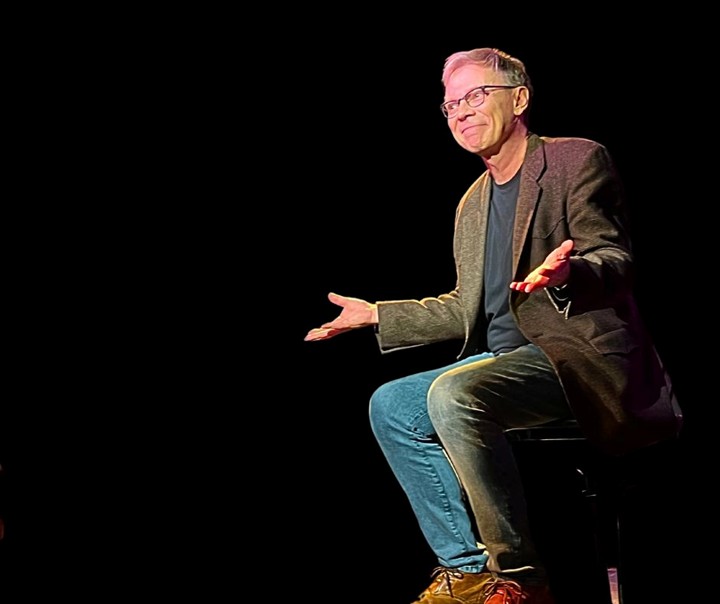
David Dean Bottrell is no stranger to shape-shifting — whether he’s embodying eccentric characters on screen or pouring himself into authentically intimate self-portrayal on the stage. With a career encompassing television, film, writing and teaching: does he ever sleep?
Bottrell has carved out his own space where vulnerability and comedy intersect. His most recent project, “Teenage Wasteland: Thirteen, Fourteen, Fifteen,” is currently touring the country and will soon land in Los Angeles, inviting folks into the honest, funny and often cringey reality of adolescence.
In this interview, Bottrell opens up about the awkward photo that sparked the show, the shock and joy of his first standing ovation and the significance of queer storytelling in today’s cultural climate. Bottrell brings both heart and humor to every story he tells. Whether you grew up a theater girlie, an outcast, or just someone who grew up feeling like they never had the right answers, “Teenage Wasteland” is sure to feel like a long overdue conversation with younger you.
Your new show is currently touring the country and is soon to hit Los Angeles. What was the spark that inspired the creation of “Teenage Wasteland?” Was there a particular memory, milestone, or meltdown that motivated you?
I was looking through some old photos and found this truly hideous picture of myself when I was thirteen. I’m not kidding. It was mortifying. I remembered the day it was taken. I remembered the shirt I was wearing, so I instantly knew I wanted to write not just about adolescence, but early adolescence — when you go from being a cute child to this ugly little rodent with bad skin who suddenly needs to wear deodorant.
It’s such a tough time, probably one of the hardest chapters of life. So much is happening and it doesn’t feel safe to even ask the most basic questions. You usually just have to take your best guess and sometimes you guess horribly wrong.
“Teenage Wasteland,” is subtitled “Thirteen, Fourteen, Fifteen.” What did those three years mean to you? Any stories from that time in your life you’d like to share with the class?
Absolutely! As anybody who’s seen shows can attest, I’m nothing if not a “sharer.” Something I often say at the top of the show is: ‘if you had a happy early adolescence, you should probably just leave now. This show isn’t for you. It’s for the rest of us.’ When I think about that time, the word “survival” comes to mind. The stories are mostly about all the big scary discoveries that keep coming at you.
The show opens with me talking about my first orgasm — which was totally spontaneous and terrifying — and happened in a very awkward and bizarre location. My family was super religious and very uptight about sex, so I’d been told nothing. Not a word about what was happening to my body. I almost asked to be taken to the hospital. Oh, and that hideous picture I found — It’s now on the poster for this show.
You’ve performed your shows on both the east and the west coasts. What’s the biggest difference between an east coast audience and a west coast audience? Do you have a preference? I can keep a secret…
Christ, I hope not. I’m counting on you to blab this to everybody. Surprisingly, the differences are pretty subtle. My shows aren’t stand-up. They’re each a collection of these weird funny stories that all weave into each other. I sometimes describe them as sort of like National Public Radio (NPR), but with a lot more swearing. L.A. audiences like to ride the rollercoaster.
The nuttier the story, the more they love it. New Yorkers love to see how far down the elevator shaft I’ll go. They seem impressed when I download some really uncomfortable shit and still manage to make it funny. I’ve spent my adult life bouncing back and forth between the coasts and I honestly love both groups of people equally — and that’s not me dodging the question.
That’s actually true.
You’ve shared the screen with folks like James Spader, Angela Bassett and Dolly Parton. Tell us, who would’ve been your high school bestie and who would have been your arch frenemy?
Oh man, Dolly would have been my best buddy for sure. She’s a Tennessee gal and I’m from Kentucky, so there’s a strong chance that we’re distantly related. I’ve seen great pictures of her in high school. I’d have happily stolen a can of my mom’s White Rain hairspray and helped Dolly put a few extra stories on those skyscraper beehives she used to wear. I’d have been way too scared of Angela. When I worked with her she was fresh out of Yale, but she already seemed like royalty. I don’t mean she was snooty. Quite the opposite! She was lovely, but she had this beautiful confidence even back then — something I did not have in my high school days. So, I imagine James would’ve been the frenemy. He’s such a brilliant guy and very kind. But he plays his cards close to his chest and he can be a little hard to read. I would never want to compete with him for anything like Prom King. I’m pretty sure he’d have devised some brilliant way to wipe the floor with me.
You wrote the screenplay for Kingdom Come, you’ve directed, you teach and you wrote a book. What haven’t you done yet? Any frontiers you’re looking to cross next?
Other than two years of acting class, I have almost no education, and I bluffed my way into most of those jobs. Primarily because I needed the money. Lately, I’ve been thinking that I might try pole dancing next. I hear the tips are fantastic.
From lawyers to killers and even a blood-thirsty vamp on HBO’s “True Blood,” you have portrayed quite the array of characters throughout your career. In “Teenage Wasteland” you will be sharing part of your own story. What made now the right moment to embrace vulnerability and go autobiographical?
Prior to doing these shows not many people knew my backstory. I tended to hide it. The first time I performed “David Dean Bottrell Makes Love: A One-Man Show” at the Comedy Central Stage in L.A., I had a panic attack ten minutes before the show. I suddenly thought, ‘what the fuck are you doing? You can’t say this stuff?’
But it was too late and the place didn’t have a back door. I was really sweating when I walked out on that stage, but as soon as I said the first line, they started laughing and for the next hour they didn’t stop. I love acting because — at its best, I get to disappear into some odd character that was written by someone else. It’s wonderfully safe in there. But in storytelling, the goal is the opposite. You certainly want people to be entertained; you want to make them laugh, but if you’re not transparent — if you’re not willing to tell a little more truth than you probably should be telling — you won’t be able to hold them. They didn’t come to this show to listen to you say something ‘easy’ and there is nothing funnier than the truth.
You also appeared on “Modern Family,” a show that not only helped normalize queer families for a mainstream audience but also portrayed them with humor and heart. What are some messages that you think the show got right that many politicians today still do not grasp?
I was honored to have been on “Modern Family.” The thing about being queer in a primarily straight world is you have to come out like once a week — to the new person at work. To the dry cleaner. To the doctor. Your new neighbor. It feels endless. Sometimes you feel like you have be a perfect gay Barbie and educate everyone that, for the most part — life is life. We all want respect. We all want a family of some kind. We all want to understand how our iPhones work.
Shows like “Modern Family” just presented these wonderful queer characters with real jobs, real kids, real families and I think it made a big impact. It demystified our existence.
Unfortunately, politicians since the beginning of time, win by creating fear and that sometimes means appealing to the most basic gross instinct of humanity that the ‘others’ are not to be trusted and that they’re up to no good.
You grew up in Kentucky before Ellen was out and RuPaul had a budget. When you look at today’s state of queer storytelling, what makes you hopeful? What still feels hollow to you?
There’s been an incredible, big happy tsunami of change since I was a kid. I remember how important the queer film festivals used to be because we got to come together and see our lives depicted honestly on screen. Now our lives are on streaming services. When I saw “Fellow Travelers” which, granted, was a period piece — some of it was so raw, I felt I should get up and close the curtains. It was thrilling.
I’m really optimistic about what’s possible now, especially with all the super-popular queer stars who can hopefully continue to keep pushing us forward. I feel bad saying this, but I didn’t love “Mid-Century Modern” because (despite being unapologetically gay, which I liked) it still felt a little like “The Golden Girls” in drag. It seemed like the show could’ve been less jokey and maybe taken a fresher look at a group of men walking nervously into a new, possibly less sexual chapter of their lives.
Let’s say a teenage version of yourself sneaks into your show. How do you think they would walk out feeling? What do you hope they walk out feeling?
Wow. Good question. Well, I hope they’d walk out the door excited about their life and a little proud of themself. I never thought of myself as being particularly brave when I was kid. But writing this show made me realize I was much stronger than I thought. I came from a family that wasn’t exactly what you’d call ‘lucky,’ but somehow I instinctively knew how to take my lemons and make lemonade. I had a lot of cousins — and some peers — who took their lemons and planted a lemon grove.
What is something the audience might not expect from “Teenage Wasteland?” Is there a moment that reverberates to your core when you perform it live?
Yes! There are several of them. I think the biggest thing that rings true in the stories is that growing up different; being on the edge of things, can sometimes make you feel lonely or angry or scared. But it also teaches you how to navigate, how to walk yourself home, how to laugh really hard, how to earn love. Most importantly, how to forgive everybody including yourself.

Gay ICE detainee freed after 150 days in detention

How do you vote a child out of their future?

Under new extremism laws, LGBTQ+ Russians must fight to survive

New books reveal style trends for a more enlightened century

Real Estate, real talk, and real WeHo: Marco Colantonio on community, visibility, and reinvention
Real Estate, real talk, and real WeHo: Marco Colantonio on community, visibility, and reinvention
Under new extremism laws, LGBTQ+ Russians must fight to survive

Meet your local go-go dancer: Steven Dehler

The strange, surreal and sensual underground cinema of Quentin Lee

Okaeri is welcoming generations of LGBTQ+ Japanese Americans home
-
 Real Estate2 days ago
Real Estate, real talk, and real WeHo: Marco Colantonio on community, visibility, and reinvention
-
 Russia1 day ago
Under new extremism laws, LGBTQ+ Russians must fight to survive
-
 a&e features3 days ago
Meet your local go-go dancer: Steven Dehler
-
 a&e features5 days ago
The strange, surreal and sensual underground cinema of Quentin Lee
-
 Features4 days ago
Okaeri is welcoming generations of LGBTQ+ Japanese Americans home
-

 Congress4 days ago
Republicans attach five anti-LGBTQ+ riders to State Department funding bill
-

 New Zealand4 days ago
New Zealand blood donation rules shift
-

 Noticias en Español4 days ago
The university that refuses to let go
-

 Congress5 days ago
Bill seeks to block global gag rule expansion
-
 Features3 days ago
A Long Beach Pride spotlight: Nolan Ross Samé-Weil’s journey from struggle to service