
Politics
Kamala Harris emerges as LGBT favorite for 2020 — there’s just one thing
Kamala Harris’ record contains one item that may surprise many of her LGBT supporters
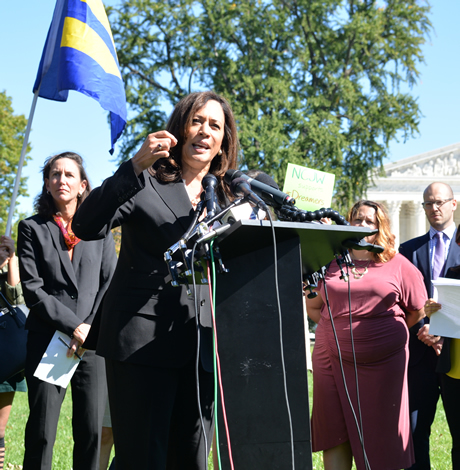
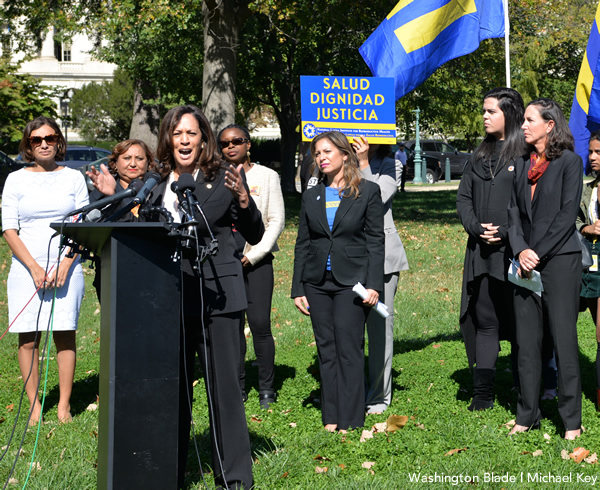
U.S. Sen. Kamala Harris (D-Calif.) sought to block gender reassignment surgery for trans inmates on behalf of California. (Washington Blade file photo by Michael Key)
Sen. Kamala Harris (D-Calif.) was likely chosen as a featured speaker at Saturday’s Human Rights Campaign National Dinner because she’s quickly becoming a favorite in the LGBT community among potential 2020 Democratic presidential contenders.
To recognize her popularity among LGBT people, just find the animated picture of Harris making the rounds on Facebook at the Senate dais brushing her hair back, clasping her hands and blinking her eyes wearily as she’s cut off during a Senate Intelligence Committee hearing. Also check out the widely shared video of her exchange with U.S. Attorney General Jeff Sessions about his Russian connections, which left the Trump official muttering he felt “nervous” under questioning from the U.S. Senate’s only black female senator.
But a look at her LGBT record reveals one wrinkle on transgender rights that may surprise her followers and that has disappointed some trans people.
To be sure, Harris has a staunchly pro-LGBT record. As California attorney general, she declined to defend California’s ban on same-sex marriage Proposition 8 in court. When the U.S. Supreme Court restored marriage equality to California, she officiated at the wedding of Kris Perry and Sandy Stier, the first same-sex wedding after the ruling, and instructed clerks to marry same-sex couples seeking a license with “no exceptions.”
Also as attorney general, Harris in 2015 refused to certify a “Kill the Gays” ballot initiative proposed in California that would have (unconstitutionally) instituted the death penalty for homosexual acts. Despite a legal challenge, a federal judge agreed to relieve her of duty to prepare a title and summary for the measure before it advanced to the signature-gathering stage.
Harris also co-sponsored a bill in the California Legislature with former Assembly member Susan Bonilla to eliminate the “gay panic” defense in cases of murder or violent crime against LGBT people. Gov. Jerry Brown signed the legislation in 2014, making California, along with Illinois, one of two states in the country to ban the plea.
Upon beginning her term as a U.S. senator this year, Harris continued to advocate for LGBT rights. A co-sponsor of the Equality Act, Harris also demanded answers from the Trump administration on the decision to omit questions in the U.S. Census allowing responders to identify their sexual orientation or gender identity. The Trump administration never provided a direct response.
Harris has signed friend-of-the-court briefs arguing transgender people should be allowed to use the public restroom consistent with their gender identity. As California attorney general, she filed briefs in favor of Obama administration guidance supporting transgender students and against North Carolina’s notoriously anti-LGBT House Bill 2. As a U.S. senator, she signed a brief before the U.S. Supreme Court in favor of transgender student Gavin Grimm’s case.
Rick Zbur, executive director of Equality California, said Harris’ record on LGBT rights in her capacities as attorney general and a U.S. senator are nothing short of “impeccable.”
“We’ve known her since she was the DA in San Francisco, and then of course, when she as attorney general was more engaged than any attorney general has been with us in the LGBTQ community,” Zbur said. “[She] really engaged with us and has a really strong commitment and understanding of our issues.”
On transgender issues in particular, Zbur noted Harris as attorney general appointed last year a transgender woman of color, Mariana Marroquin, to the California Racial & Identity Profiling Advisory Board.
Harris will likely tout her record on LGBT rights during her remarks at the 21st annual Human Rights Campaign National Dinner.
But one part of her record she might avoid is her role as California attorney general in 2015 in arguing on behalf of the state to withhold gender reassignment surgery from two transgender inmates who were prescribed the procedure while serving out their sentences. Advocates have made the case that transgender inmates are entitled to receive the taxpayer-funded procedure because denying them medical treatment amounts to cruel and unusual punishment — a clear violation of the Eighth Amendment of the U.S. Constitution.
One case involved Shiloh Quine, who’s serving a term of life for first-degree murder, kidnapping and robbery. The other case involved Michelle-Lael Norsworthy, who was serving time in prison in Mule Creek State Prison in Ione, Calif., for second-degree murder. Both were prescribed gender reassignment surgery, but the California Department of Corrections & Rehabilitation refused to provide the procedure.
The process of the Norsworthy case was quite public as it proceeded through litigation. Although U.S. District Judge Jon Tigar ordered California to grant Norsworthy gender reassignment surgery, Harris in her capacity as attorney general appealed the decision to the U.S. Ninth Circuit Court of Appeals and fought to reverse the decision.
One 29-page brief in the case, signed by Harris, urges a stay on the court order for Norsworthy because the hormone treatment the inmate receives is sufficient — at least for the time being.
“The core of Ms. Norsworthy’s complaint is that Defendants have not provided the particular treatment she wants sex-reassignment surgery and unspecified ‘additional treatment,'” Harris writes. “But the Constitution ‘does not guarantee to a prisoner the treatment of his choice.’ The Eighth Amendment requires that an inmate be afforded ‘reasonable measures to meet a substantial risk of serious harm to her,’ not that she be given the specific care she demands. The ‘essential test is one of medical necessity and not one simply of desirability.'”
Ultimately, both the Norsworthy and Quine cases resulted in settlements. Norsworthy reached an agreement with the state in which she obtained parole. As a result, she was able to obtain surgery through Medi-Cal, a state health care system in California. In the Quine case, the state agreed to grant her gender reassignment surgery as well as clothing and items consistent with her gender identity. The California Department of Corrections & Rehabilitation also agreed to review and revise its policies writ large for transgender inmates and medical treatment, including gender reassignment surgery.
But Harris’ actions in the Norsworthy case have inspired consternation in the transgender community and on Twitter, including from Chelsea Manning, who fought to receive gender reassignment surgery though litigation during her time in prison after the Army initially denied it to her. (A Washington Blade article on Harris’ brief against the court order is among the paper’s top 10 trafficked stories this year — the only story not from 2017 to hold that distinction.)
Zbur said criticism of Harris’ role in the litigation, however, is “really misplaced” because as attorney general she was compelled to represent the position of her client, which in this case was the California Department of Corrections & Rehabilitation.
“As a lawyer for the government, she was constrained in what she could publicly say and do and her client was making decisions, but with us she really working hard to understand the issue, providing information, and I think she was a big part of the resolution, which resulted in the really significant policy changes that were implemented by the Department of Corrections when she was attorney general,” Zbur said.
But the argument Harris was compelled to fight the court order granting gender reassignment surgery to an inmate because that was her responsibility as attorney general raises the question on how she got out of similar duties in an effort to uphold LGBT rights. If Harris could get out of defending Proposition 8 or certifying the “Kill the Gays” initiative, why couldn’t she also opt out of litigation seeking to bar transition-related care to a transgender inmate?
Zbur said the difference between the transgender inmate litigation and the other two situations was that in the former, Harris had a specific client, namely, the California Department of Corrections & Rehabilitation.
“When you have a client, you basically have ethical duties to represent the client’s interest,” Zbur said. “You take direction from the client. And so, she did really have constraints in terms of what she could do, but I think the bottom line is that during that period of time, she was working hand-in-hand with us on a process that resulted in changing the policies at the Department of Corrections, and that’s a really significant thing.”
At the time Harris engaged in the litigation in 2015, Jon Davidson, legal director for Lambda Legal, said the attorney general’s actions were her own choice.
“Even where the decision is made to defend an unconstitutional practice, there’s nothing that dictates the tactics of that defense, particularly once a court has found there are likely ongoing constitutional violations,” Davidson said. “The choice to appeal a preliminary court order and to seek to delay its implementation is just that — a choice. It’s also a very unfortunate one, given that what is at stake here is potentially life-saving treatment that is widely recognized as medically necessary for some people suffering from gender dysphoria.”
It seems the cases weren’t on Harris’ radar, even though her name is on each of the legal briefs, until much later in the process of litigation.
Nathan Barankin, who’s chief of staff for Harris and served as her deputy attorney general, said around 1,100 attorneys are working on cases like these and Harris wasn’t personally aware or involved in the litigation until a later time.
“She did learn about our office’s involvement in this case by reading about it in the newspaper,” Barankin said. “Her reaction to the way the case was being litigated was to work very closely with all of the parties involved to reach what we consider a successful conclusion, which was a permanent change in state prison policy on the treatment of transgender inmates.”
Two years later after the settlements were reached, Lambda Legal struck a different tone on Harris’ handling of the lawsuit.
Peter Renn, a senior attorney in the Western Regional Office of Lambda Legal who works on transgender cases, said the situation changed in the lawsuits as Harris became more involved in the litigation.
“The California AG’s office shifted its handling of these cases significantly after now-Sen. Harris took over,” Renn said. “Initially there was language in briefing for the state that glaringly misunderstood the medical necessity of transition-related medical care and was patently offensive. But then, there was a dramatic change, which seems to have gone along with important policy shifts.”
Supporters of Harris point to the settlements that were reached in the cases as evidence that her role was productive for transgender rights. After all, those agreements created precedent in the state and new policy ensuring transgender people in California prisons can receive gender reassignment surgery.
But not everyone agrees with that assessment.
Amanda Goad, a California attorney who works on transgender issues and identifies as queer, said in a personal capacity calling the settlements in the Quine case an LGBT rights achievement for Harris “does not make sense.”
“Her client CDCR could have updated its policies and made gender-confirming surgery available to incarcerated folks long before it did so under the pressure of a trial court loss in the Quine case,” Goad said. “Harris has done other things that do seem to me to belong under the banner of LGBTQ champion. … Settling a lawsuit that the state was losing — and never should have defended in the first place — just doesn’t fit the bill.”
In her capacity as staff attorney for the American Civil Liberties Union of Southern California, Goad said the policy changes the California Department of Corrections & Rehabilitation promised aren’t being implemented.
“Recent data shows that of the many prisoners who have applied to undergo gender-confirming surgery under the new policy, zero trans women beyond Shiloh Quine herself have actually undergone surgery. (Two men have undergone top surgery.),” Goad said. “Dozens have been denied, and I get letters every week from women extremely upset about their inability to access surgical care.”
Goad also complained about the state continuing to fight transgender prisoners’ access to clothing consistent with their gender identity as well as harassment, sexual assaults and violence endured by transgender women in prison.
That mistreatment, Goad said, is something Harris could address through encouraging enforcement of the Prison Rape Elimination Act and other actions.
“She has a great platform from which to speak out about the broader issues of violence, discrimination, and harassment endured by transgender women of color both inside and outside prison and propose constructive approaches for addressing those problems and their structural causes,” Goad said.
Major transgender rights advocates said the inclusion in Harris’ LGBT record of seeking to deny gender reassignment surgery to transgender inmates was unfortunate — but also urged LGBT people to look at the bigger picture.
Jillian Weiss, executive director of the Transgender Legal Defense & Education Fund, said Harris’ defense of the state in the litigation contrasts with her otherwise pro-LGBT record.
“Sen. Harris has a positive record as a champion of gay and lesbian rights, and that is commendable,” Weiss said. “It is unfortunate that her record also includes having argued that gender confirmation surgery was not a medical necessity for a transgender woman despite a psychological assessment to the contrary. While some public sentiment leans against providing necessary medical services for transgender people who are incarcerated, our Constitution recognizes that denying such vital health care is cruel and unusual punishment. It is our hope that Sen. Harris will learn more about transgender medicine and its importance to trans people.”
(Harris isn’t the only potential 2020 Democratic presidential candidate with an unfriendly record on gender reassignment surgery for transgender inmates. In a 2012 radio interview, then-U.S. Senate candidate Elizabeth Warren said when asked about granting the procedure to an inmate in Massachusetts, “I have to say, I don’t think it’s a good use of taxpayer dollars.” Warren has never corrected that position even as litigation seeking the procedure for the inmate, Michelle Kosilek, proceeded through the courts. Ultimately, the First Circuit ruled against Kosilek, setting binding precedent in that jurisdiction.)
Mara Keisling, executive director of the National Center for Transgender Equality, took an even more lenient approach to Harris’ action on the lawsuit and said her organization would work with her on issues of transition-related care for transgender prisoners.
“Sen. Harris has long been a friend of LGBT people and our causes,” Keisling said. “Notwithstanding her one-time defense of an indefensible and unconstitutional state prison position on trans healthcare, she is now a senator and is very likely to continue being a vote and voice for trans people in the U.S. Senate. She has shown this recently in support of Gavin Grimm and trans service members. I am certain when I first meet her, we will discuss her position in the prison case, and she will continue to grow and continue to support us better and better.”





Federal Government
DOE investigates Smith College’s trans-inclusive policy
Mass. college accused of violating Title IX

The U.S. Department of Education announced on Monday that it opened an investigation into Smith College for admitting transgender women.
Smith College, a private and famously all-women’s college in Northampton, Mass., established in 1871 and opened in 1875, has a long list of women who make up its historic alumni — including first ladies, influential political figures, and cultural leaders.
The DOE released a statement about the investigation into the institution through the Department’s Office for Civil Rights, saying it was looking into the possibility that Title IX of the Education Amendments of 1972 was violated by allowing trans women, referred to in the statement as “biological males,” into women’s intimate spaces protected by IX.
The statement explicitly highlighted that this stems from trans women being granted “access to women-only spaces, including dormitories, bathrooms, locker rooms, and athletic teams” while also allowing their audience into the school itself.
This is the first time the Trump-Vance administration has taken a step into admissions processes, a stark jump past investigating policies that allowed trans women to participate in women’s sports and use women’s bathrooms, and allows for the administration to go more after trans acceptance policy as a whole.
Smith’s admission policy allows for “any applicants who self-identify as women,” including “cis, trans, and nonbinary women,” according to the college’s website, and has since 2015, when it updated its policy.
“The college is fully committed to its institutional values, including compliance with civil rights laws,” Smith’s statement in response to the DOE’s investigation said. “The college does not comment on pending government investigations.”
“An all-women’s college loses all meaning if it is admitting biological males,” said Assistant Secretary for Civil Rights Kimberly Richey. “Allowing biological males into spaces designed for women raises serious concerns about privacy, fairness, and compliance under federal law. The Trump administration will continue to uphold the law and fight to restore common sense.”
This move continues to align with actions the Trump-Vance administration has taken to curtail LGBTQ+ — and specifically trans — rights in America, as members of the administration attempt to break down safeguards and protections that have long been used to protect marginalized communities.
Since Trump took office in his second term, there have been significant legal challenges. According to the National LGBTQ+ Bar Association, there are over 35 court cases that have emerged since his second swearing-in that directly relate to the administration’s attempts to minimize the rights and protections of trans Americans — from medical care and educational protections to military policy.
Much of this anti-trans policy direction was outlined beginning in 2022 with the Project 2025 playbook, which Trump officials have used as a guide to scale back protections for LGBTQ+ people, Black Americans, poor and Indigenous communities, while also increasing costs for lower-income Americans and providing tax cuts to the wealthy and ultra-wealthy. The plans also “erode” Americans’ freedoms and remove crucial checks and balances that have allowed the executive branch to remain in line with the Constitution without becoming too powerful over either the courts or the legislative branch.
Politics
California local elections matter: Here’s a look at Los Angeles
Two debates this week: the Mayor and Governor candidates on Wednesday on KNBC4, and the Gubernatorial debate on Tuesday on CNN

A little over a year ago, it looked as if Los Angeles Mayor Karen Bass, the city’s first woman mayor, would easily win reelection in 2026. But criticism of her handling of the disastrous wildfire in the Pacific Palisades neighborhood in early 2025 has thrown the mayoral race wide open.
As the mayoral primary looms on June 2 and a debate is set for Tuesday night, 14 candidates are vying for the seat, and there are some competitive City Council races as well. Big bucks have poured into the city races, according to the Los Angeles Times, and progressive forces may be looking to repeat the success of Democratic Socialist Zohran Mamdani’s election as New York City mayor last year. In Los Angeles city races, a candidate who wins more than 50 percent of the vote in the primary is elected outright; otherwise, the top two vote recipients face each other in the November general election.
Bass, a former member of Congress, and businessman Rick Caruso advanced to the general election in 2022, in which she bested him by 55 percent to 45 percent. This year, her top rivals in the primary are City Council member Nithya Raman, running to the left of Bass; community organizer Rae Huang, also on the left; software entrepreneur Adam Smith, a moderate; and reality TV personality Spencer Pratt, courting conservative voters. The race is officially nonpartisan, but all the leading mayoral candidates are Democrats, except for Pratt, a Republican.
Bass was in Ghana when the Palisades fire started, and many residents found her response wanting, the L.A. Times notes. Twelve people died as a result of the fire, and thousands of homes were lost. The mayor ended up firing out lesbian fire chief Kristin Crowley, who sued the city, accusing Bass of orchestrating “a campaign of retaliation to conceal the extent to which Bass undermined public safety and transparency,” according to ABC7 Eyewitness News.
Bass leads in the mayoral polls, but many of those surveyed disapprove of her performance, according to a poll by UC Berkeley and the Times. Still, as she touts reductions in homelessness and homicides in the city, she has drawn support from major donors and celebrities. She received perhaps her biggest endorsement Monday—from Kamala Harris. Harris released a statement saying Bass “is the leader Los Angeles needs right now,” multiple media outlets report.
Bass’ big individual contributors include Hollywood producers J.J. Abrams and David Miner, actor Samuel L. Jackson, and philanthropist Edythe Broad, L.A.’s NBC affiliate reports, and the Times analysis shows her far ahead in fundraising.
But Raman may be a formidable candidate from the left—and L.A.’s police union is worried. Raman has been elected to two terms on the council with the support of the Democratic Socialists of America, which touts New York’s Mamdani as a member. The Democratic Socialists haven’t made an endorsement in the L.A. mayoral primary, although many of the group’s members favor Raman. But the Los Angeles Police Protective League, which represents rank-and-file officers, is spending heavily on ads against Raman, who opposed the police pay increases backed by Bass.
The union has spent $400,000 in its anti-Raman campaign so far and plans to spend more than $1 million overall, according to the Times. A recent video ad denounces her opposition to a city ordinance saying homeless people can’t camp within 500 feet of a school.
“Raman has voted over 75 times to allow homeless camps next to schools, daycares, parks, and other sensitive locations, undermining public safety,” the video’s narrator states.
Raman responded with a video defending her record, saying the police pay raises were more than the city could afford and that other services had to be cut “to the bone.”
The police union tried to defeat Raman in her run for reelection to the City Council in 2024 but failed. The union opposed Bass in 2022 and endorsed Caruso, but she and the Protective League are considerably friendlier now.
Another union that has been active in the city races is Unite Here Local 11, which represents more than 32,000 workers in the L.A. area, mostly in the hospitality industry. It endorsed Bass in 2022 but hasn’t endorsed in the mayoral race yet this year. The union, which is familiar to West Hollywood politicians, did not respond to a request for comment.
However, Unite Here Local 11 has endorsed in three City Council races: Eunisses Hernandez in Council District 1, Faizah Malik in District 11, and Hugo Soto-Martinez in District 13.
Malik’s race has been particularly heated. She is challenging incumbent Traci Park. Local 11 “has been furious with Park, who voted against a hike in the minimum wage for tourism workers to $30 per hour,” the Times reports. Park contended that the higher wage would cost many workers their jobs.
Unite Here has spent about $340,000 to promote Malik and denounce Park. Malik is also backed by the Democratic Socialists of America.
In its campaign materials, Unite Here has tried to associate Park with Donald Trump and Immigration and Customs Enforcement, something Park, a Democrat, has called “dishonest and disgusting,” according to the Times.
Park, meanwhile, has the support of the Police Protective League and United Firefighters of Los Angeles City Local 112, which together have spent nearly $900,000 toward her reelection.
Two Los Angeles hotels, in partnership with the California Hotel and Lodging Association, have given $300,000 to a political action committee backing Park as well as Maria Lou Calanche against Hernandez, the incumbent, and Jose Ugarte, one of several candidates seeking to succeed Curren Price, who is termed out of the City Council and is facing felony embezzlement charges.
Back to the mayoral race: Chung is a Presbyterian minister who said she’ll cut police funding and work for affordable housing and renters’ protections. Miller has said his business expertise will serve him well as mayor. He’s also focused on housing and created a nonprofit, Better Angels, to address homelessness.
Pratt, who appeared in the reality TV show The Hills, has harshly criticized Bass, Gov. Gavin Newsom, and other politicians. He has called Bass “trash” and denounced homeless encampments, saying L.A. children have to witness “the filth and degeneracy of the homeless drug zombies,” as reported by the Times. He has touted himself on social media as the only candidate with “the will to clear encampments in this city,” and said getting people into treatment for addiction and mental illness has to be the first step toward reducing homelessness.
They and other mayoral candidates will debate at 5 p.m. Wednesday at the Skirball Cultural Center in L.A. KNBC4, the local NBC station, and KVEA, affiliated with Spanish-language Telemundo, will broadcast the one-hour debate live.
Then at 7 p.m. on Wednesday, KNBC and KVEA will host a one-hour debate with California gubernatorial candidates. It will be broadcast on those stations as well as stations in San Francisco, San Diego, Sacramento, and Monterey. Xavier Becerra, formerly California attorney general and Secretary of Health and Human Services under President Joe Biden, has surged in support since U.S. Rep. Eric Swalwell dropped out due to sexual assault allegations.
But a new California Democratic Party poll shows Becerra tied with Republican businessman and Trump-endorsed candidate Steve Hilton, each favored by 18 percent of respondents. The large number of candidates seeking to replace Newsom, who is term-limited, has led some Democrats to fear a Republican could prevail in California’s “jungle primary” system.
Others in the race include former U.S. Rep. Katie Porter, former L.A. Mayor Antonio Villaraigosa, and businessman-activist Tom Steyer. Becerra has been endorsed by Equality California, the statewide LGBTQ+ rights group. Equality California has not made endorsements in the L.A. city elections.
There will be another gubernatorial debate Tuesday at 6 p.m. Pacific Time on CNN. Candidates who have qualified are Becerra, Porter, Steyer, Villaraigosa, and Matt Mahan, all Democrats, and Republicans Hilton and Chad Bianco.
By Trudy Ring. This is a cross-post from Karen’s LGBTQ+ Freedom Fighters Substack.
Politics
From the desk of Equality California: The latest updates impacting LGBTQ+ people across the state
EQCA shares the local and state political developments that affect LGBTQ+ people across California

We’re proud to partner with Los Angeles Blade to launch a new monthly column bringing you the latest updates impacting LGBTQ+ people across California. Each edition will draw from our weekly Equality Brief, with a focused look at the local and state developments that matter most to our community, including policy changes, legal updates, public health news, and opportunities to take action.
With LGBTQ+ people facing coordinated attacks across the country, staying informed is essential. California continues to play a critical role as both a leader and a line of defense, and the decisions made here have a real impact on people’s day-to-day lives.
In this column, we’ll break down what’s happening, what it means, and what comes next so you can stay informed and ready to take action.
To read more stories and sign up for the weekly Equality Brief, visit eqca.org/equalitybrief.
Supreme Court Rules ‘Conversion Therapy’ is Protected Speech:
In a 8-1 decision, the Supreme Court held that Colorado’s ‘conversion therapy’ ban is likely an unconstitutional violation of free speech. With this ruling — reframing therapy as protected speech — the Supreme Court weakens the ability of state licensing boards to regulate healthcare or to intervene if clinicians use unproven, misleading, or coercive techniques. Justice Ketanji Brown Jackson was the lone dissenter, emphasizing that not only is conversion therapy ineffective, but former participants report that it causes lasting psychological harm.
In response, Equality California is advancing SB 934 by Senator Scott Wiener, which would extend the statute of limitations so survivors of conversion therapy can pursue civil claims against licensed providers who subjected them to these harmful practices. This timely measure builds on California’s existing protections and expands access to justice for survivors. Read our statement.
Nation’s Largest Medical Group Reaffirms Support for Transition-Related Care for Minors:
In its March newsletter, the American Medical Association (AMA) — the largest physician organization in the country — reaffirmed its support for transition-related care for youth, emphasizing that access to care should not be impeded. The AMA is among the nation’s leading medical groups that have repeatedly stated that transition-related care is not only medically necessary for those who require it, but life-saving.
REPORT: 2 in 3 LGBTQ+ Students Feel Unsafe in School:
Glisten (formerly GLSEN) released its 2025 National School Climate Survey this week — a biannual report measuring the experiences of LGBTQ+ youth in K-12 schools — and the results show that hostility toward LGBTQ+ youth has increased, and students feel increasingly unsafe. Among the report’s key findings, 86% of trans students purposely avoid certain areas of their campuses, 62% of LGBTQ+ youth experience harassment due to their sexual orientation, and 68% experience the same due to their gender identity or expression. The report surveyed 2,800 students across the country.
Pentagon Begins Removing Transgender Troops From Service:
According to a new court filing from the U.S. Justice Department, the Pentagon has begun initiating involuntary separation actions against at least two current servicemembers. Cadet Hunter Marquez and First Lieutenant Sean Kersch-Hamer, both members of the Air Force, are challenging the administration’s transgender military ban in the case of Talbott v. United States; the ban is currently in effect pending further legal action.
Federal Judge Strikes Down Anti-Trans ‘Kennedy Declaration’:
On Saturday, April 18, Judge Mustafa T. Kasubhai of the Federal District Court of Oregon summarily invalidated a December declaration from HHS Secretary Robert F. Kennedy, Jr. that sought to severely restrict access to medically-necessary healthcare for transgender youth. In a sweeping and sharply worded rebuke, Judge Kasubhai made clear that the administration’s actions were unlawful and dangerous, directly calling out Kennedy’s “unserious regard for the rule of law” and how such disregard “causes very real harm to very real people.” Following the decision, California Attorney General Rob Bonta issued new guidance for providers and hospitals regarding transition-related care, emphasizing they “can and should continue to provide [care].” Read our statement here.
RFK, Jr. Claims ‘Press 3’ Crisis Line Option Will Be Reinstated:
HHS Secretary Kennedy said in a Senate hearing that specialized services for LGBTQ+ youth through the 988 Suicide Prevention Hotline will be restored after it was abruptly cut last summer. A recent study has found that after the launch of the hotline in 2022, suicide deaths among teens and young adults were about 11% lower than expected, amounting to roughly 4,400 fewer deaths through 2024. It remains to be seen whether RFK, Jr. — who has advanced numerous anti-LGBTQ+ policies — will follow through on that commitment.
Federal Challenge Filed Against Anti-Transgender Idaho Bathroom Ban:
Lambda Legal, the nation’s largest LGBTQ+ civil rights legal organization, and other legal groups filed suit in federal court on Thursday, April 30, on behalf of six transgender Idahoans in a challenge to the recently-passed HB 752. The bill, signed by Governor Brad Little earlier this year, is one of the most severe anti-transgender bathroom bans in the country; a first offense is a misdemeanor with up to a one-year prison sentence, while a second offense is a felony with up to five years in prison. The bill applies to all government buildings and businesses open to the public; Lambda’s Kell Olson and F. Curt Kirschner, Jr. say the law is “…intended to erase the very existence of Idaho’s transgender community.”
STATE LEGISLATIVE UPDATE
Equality California is advancing a comprehensive 2026 legislative package and budget request focused on protecting access to healthcare, strengthening privacy and safety, and expanding support for LGBTQ+ people across the state. At the center is a $26 million budget proposal to safeguard access to transgender healthcare by creating a state-only Medi-Cal funding pathway and stabilizing the provider network in response to increasing federal attacks.
All of our 2026 priority sponsored bills have successfully passed their initial policy committee hearings, and the majority are now in the Appropriations Committee’s “suspense file,” where they will be considered on May 14 alongside hundreds of other measures.
Our legislation includes efforts to enforce LGBTQ+ inclusive curriculum in schools, restore culturally competent crisis support for LGBTQ+ youth through the 988 suicide lifeline, and strengthen privacy protections for patients and providers as out-of-state attacks on abortion and transgender health care intensify. Additional measures expand access to HIV prevention, support transgender veterans, enhance safety at community events, allow people to challenge convictions rooted in gender bias, extend justice for survivors of conversion therapy, protect sensitive LGBTQ+ data, support LGBTQ+ people in higher education, and recognize chosen family in bereavement leave policies. Together, this package helps ensure LGBTQ+ people in California can live safely, access the care they need, and be treated with dignity.
To view our entire 2026 state legislative package, visit eqca.org/legislation
UPCOMING EVENTS
The 2026 San Diego Equality Awards are happening on Thursday, May 28 from 6:00 PM-10:00 PM. We’ll be back at the spectacular Loews Coronado Bay Resort. Be there as we celebrate San Diego City Councilmember Jennifer Campbell with the Vanguard Leadership Award; more honoree and special guest announcements will be coming soon. Get your tickets today!
Our Pride Parties return this summer as we gather in community and celebrate Pride 2026! Rise Up and join us at an event near you! Tickets are on sale now!
Los Angeles: Wednesday, June 10 @ Hi Tops Los Feliz
San Francisco: Tuesday, June 23 @ El Rio
San Diego: Tuesday, July 14 @ InsideOUT
Congress
Republicans attach five anti-LGBTQ+ riders to State Department funding bill
Spending package would restrict Pride flags on federal buildings, trans healthcare, LGBTQ envoys
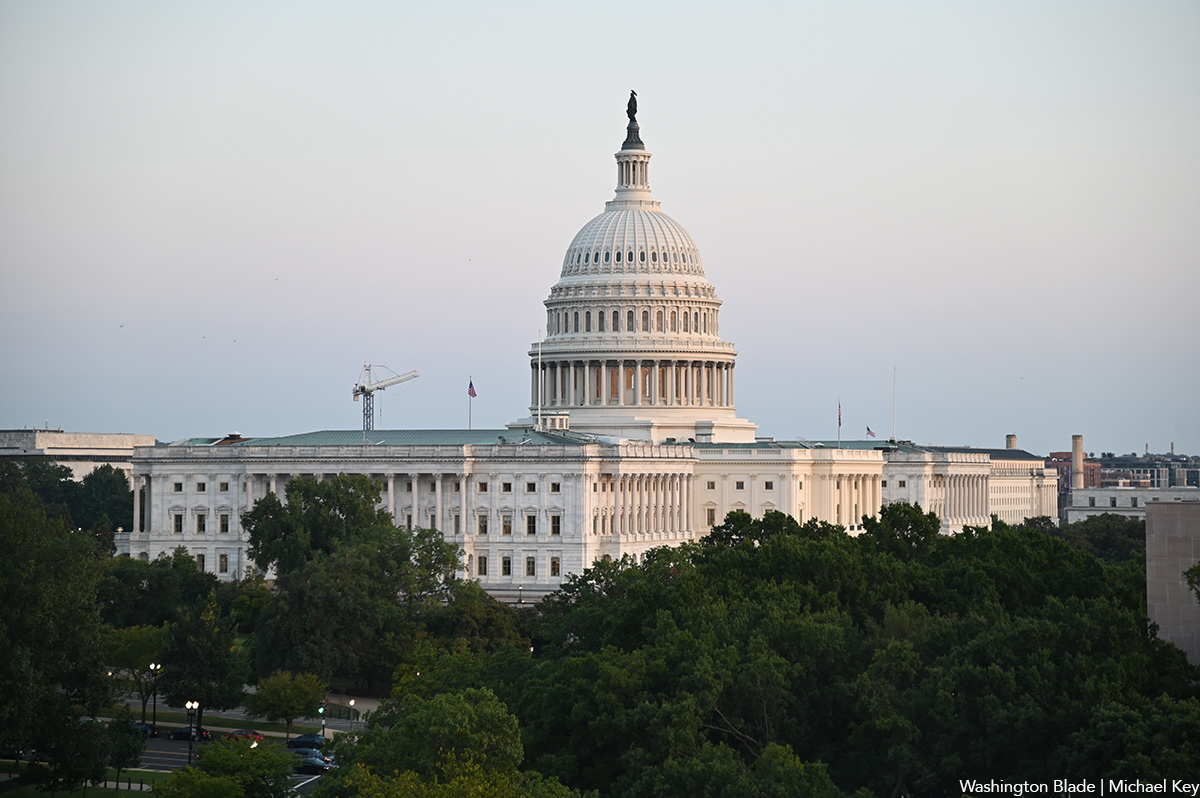
As Congress finalizes its funding for fiscal year 2027, Republicans are attempting to include five anti-LGBTQ+ riders in the National Security and Department of State Appropriations Act.
A rider is an unrelated provision tacked onto a bill that must pass — in this instance, the bill provides funding for national security policy and for the State Department.
The riders range from restricting Pride flags in federal buildings to banning transgender healthcare, but all aim to limit the visibility and rights of LGBTQ+ Americans.
The five riders are:
Section 7067(a) prohibits Pride flags from being flown over federal buildings.
Section 7067(c) restricts the United States’ ability to appoint special envoys, representatives, or coordinators unless expressly authorized by Congress. These roles have historically been used to promote U.S. interests in international forums — including advancing human and LGBTQ+ and intersex rights and other policy priorities. The change would halt what the Congressional Equality Caucus describes as providing “critical expertise to U.S. foreign policy and leadership abroad.”
Section 7067(d) reinforces multiple anti-equality executive orders signed by President Donald Trump, effectively requiring that foreign assistance funded by the United States comply with those orders. This includes rescinding federal contractor nondiscrimination protections, including for LGBTQ+ people.
Section 7067(e) prohibits funding for any organization that provides or promotes medically necessary healthcare for trans people or “promotes transgenderism” — effectively banning funds for organizations that recognize trans people exist. This is despite the practice of gender-affirming care being supported by nearly every major medical association.
Section 7067(g) reinforces two global gag rules put forward by the Trump-Vance administration. One is the Trans Global Gag Rule, which prohibits foreign assistance funding for organizations that acknowledge the existence of trans people or advocate for nondiscrimination protections for them, among other activities. The second is the DEI Global Gag Rule, which prohibits foreign assistance funding for organizations that engage in efforts to address the ongoing effects of racism, sexism, and other forms of bigotry outside the United States.
The global gag rule has its roots in anti-abortion policy introduced by President Ronald Reagan in 1984, when the 40th president barred foreign organizations receiving U.S. global health assistance from providing information, referrals, or services for legal abortion, or from advocating for access to abortion services in their own countries. Planned Parenthood notes that the policy also affects programs beyond abortion, including efforts to expand access to contraception, prevent and treat HIV/AIDS, combat malaria, and improve maternal and child health.
If organizations funded by the State Department engage in these activities, they could lose funding.
This anti-LGBTQ+ push aligns with broader actions from the Trump-Vance administration since the start of Trump’s second term, which have focused on restricting human rights — particularly those of trans Americans.
The House Appropriations Committee is responsible for drafting the appropriations legislation. U.S. Rep. Tom Cole (R-Okla.) serves as chair, with U.S. Rep. Rosa DeLauro (D-Conn.) as ranking member. The committee includes 34 Republicans and 27 Democrats.
For FY27 appropriations, Congress is supposed to pass and have the president sign the funding bills by Sept. 30, 2026.
Congress
Bill seeks to block global gag rule expansion
Policy now bans US foreign aid to groups promoting ‘gender ideology’
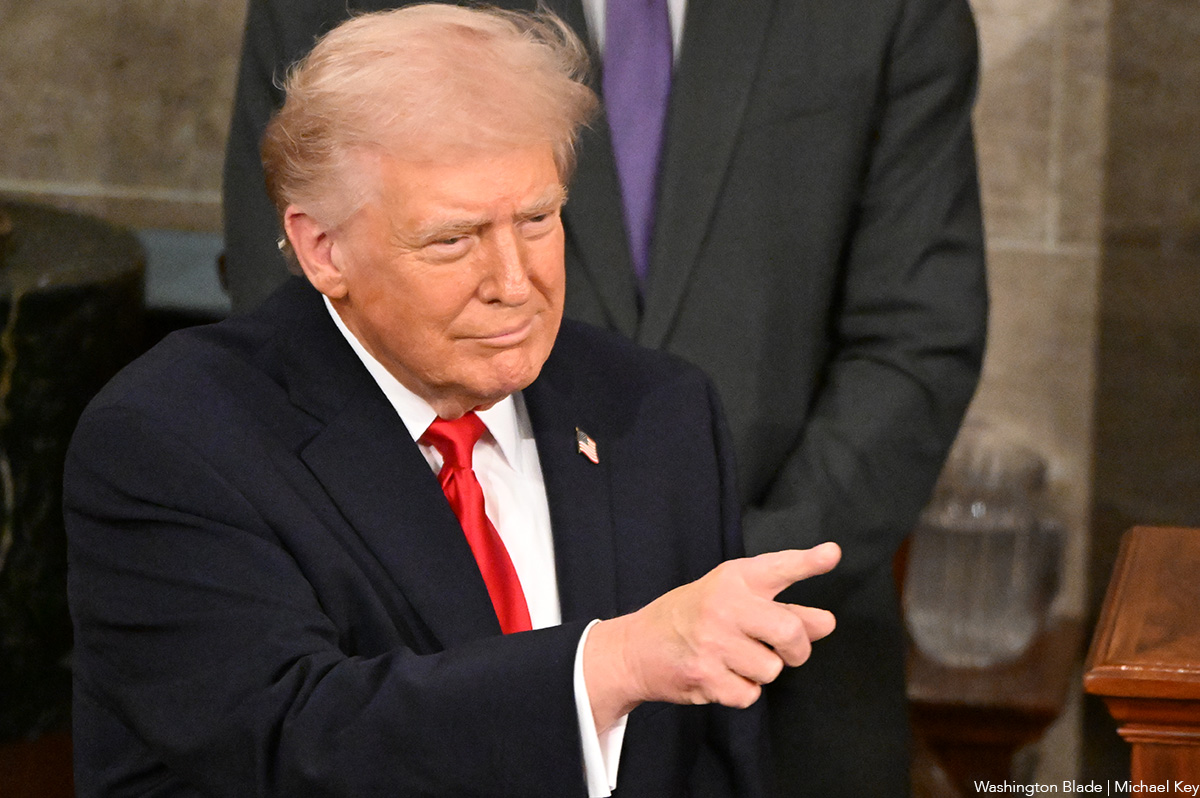
Lawmakers on Wednesday introduced a bill that would block the expansion of the global gag rule.
President Ronald Reagan in 1985 implemented the global gag rule, also known as the “Mexico City” policy, which bans U.S. foreign aid for groups that support abortion and/or offer abortion-related services.
Trump reinstated the rule during his first administration. The Biden-Harris administration shortly after it took office in 2021 rescinded it.
The Trump-Vance administration earlier this year expanded the global gag rule to ban U.S. foreign aid for groups that promote “gender ideology.” The expansion took effect on Feb. 26.
U.S. Sens. Jeanne Shaheen (D-N.H.) and Jacky Rosen (D-Nev.) introduced the Protecting Human Rights and Public Health in Foreign Assistance Act in the U.S. Senate. U.S. Reps. Grace Meng (D-N.Y.), Lois Frankel (D-Fla.), Diana DeGette (D-Colo.), Pramila Jayapal (D-Wash.), Sara Jacobs (D-Calif.), and Gregory Meeks (D-N.Y.) introduced it in the U.S. House of Representatives.
“Using taxpayer money to export the Trump administration’s anti-trans, anti-science, and anti-abortion ideological agenda isn’t just immoral — it’s antithetical to efficient, effective, and rights-based foreign assistance,” said Council for Global Equality Senior Policy Fellow Beirne Roose-Snyder on Wednesday in a press release.
Meng in a Congressional Equality Caucus press release added the Trump-Vance administration’s “crusade against healthcare and global aid is putting millions of lives at risk worldwide.”
“No one will flourish under the new expanded global gag rule,” said the New York Democrat. “These policies weaponize foreign aid and will result in greater harm, particularly for women and girls, marginalized communities, and LGBTQI+ individuals.”
“They should never have been implemented at all, let alone without even a basic public comment process,” she added. “This legislation will reverse these dangerous policies.”
Congress
House Republicans push nationwide ‘Don’t Say Gay’ bill
Measures would restrict federal funding for LGBTQ+-affirming schools
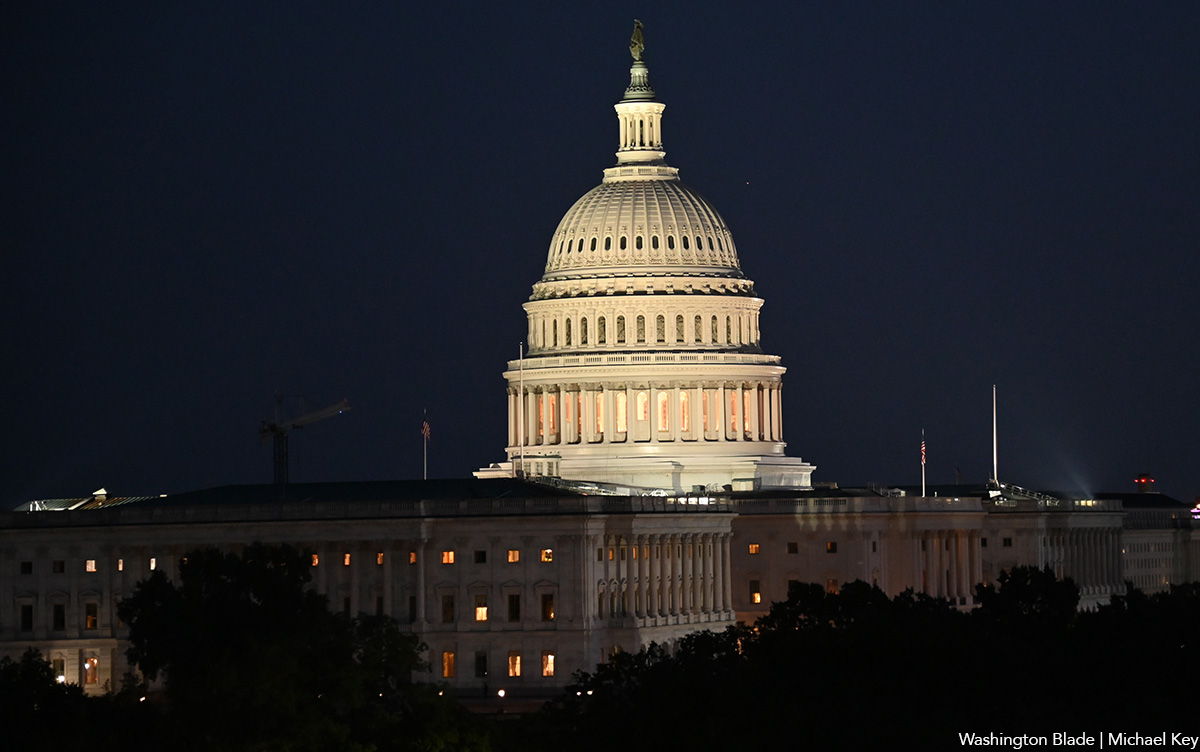
Republicans have been gaining ground in reshaping education policy to be less inclusive toward LGBTQ+ students at the state level, and now they are turning their focus to Capitol Hill.
Some GOP lawmakers are pushing for a nationwide “Don’t Say Gay” bill, doubling down on their commitment to being the party of “traditional family values” by excluding anyone who does not identify with their sex at birth.
The largest anti-LGBTQ+ education legislation to reach the House chamber is House Bill 2616 — the Parental Rights Over the Education and Care of Their Kids Act, or the PROTECT Kids Act. The PROTECT Kids Act, proposed by U.S. Rep. Tim Walberg (R-Mich.), and co-sponsored by U.S. Reps. Burgess Owens (R-Utah), Mary Miller (R-Ill.), Robert Onder (R-Mo.), and Kevin Kiley (R-Calif.), would require any public elementary and middle schools that receive federal funding to require parental consent to change a child’s gender expression in school.
The bill, which was discussed during Tuesday’s House Rules Committee hearing, would specifically require any schools that get federal money from the Elementary and Secondary Education Act of 1965 — which was created to minimize financial discrepancies in education for low-income students — to get parental approval before identifying any child’s gender identity as anything other than what was provided to the school initially. This includes getting approval before allowing children to use their preferred locker room or bathroom.
It reads that any school receiving this funding “shall obtain parental consent before changing a covered student’s (1) gender markers, pronouns, or preferred name on any school form; or (2) sex-based accommodations, including locker rooms or bathrooms.”
LGBTQ+ rights advocates have criticized both national and state efforts to require parental permission to use a child’s preferred gender identity, as it raises issues of at-home safety — especially if the home is not LGBTQ+-affirming — and could lead to the outing of transgender or gender-curious students.
A follow-up bill, HB 2617, proposed by Owens, one of the bill’s co-sponsors, prevents the use of federal funding to “advance concepts related to gender ideology,” using the definition from President Donald Trump’s 2025 Executive Order 14168, making that an enshrined definition in law of sex rather than just by executive order. There is also a bill making its way through the senate with the same text— Senate Bill 2251.
Advocates have also criticized this follow-up legislation, as it would restrict school staff — including teachers and counselors — from acknowledging trans students’ identities or providing any support. They have said that this kind of isolation can worsen mental health outcomes for LGBTQ+ youth and allows for education to be politicized rather than being based in reality.
David Stacy, the Human Rights Campaign’s vice president of government affairs, called this legislation out for using LGBTQ+ children as political pawns in an ideology fight — one that could greatly harm the safety of these children if passed.
“Trans kids are not a political agenda — they are students who deserve safety and affirmation at school like anyone else,” Stacy said in a statement. “Despite the many pressing issues facing our nation, House Republicans continue their bizarre obsession with trans people. H.R. 2616 does not protect children. It targets them. This bill is cruel, and we’re prepared to fight it.”
This is similar to Florida House Bills 1557 and 1069, referred to as the “Don’t Say Gay” bill and “Don’t Say They” bill, respectively, restricting classroom discussions on sexual orientation and gender identity, prohibiting the use of pronouns consistent with one’s gender identity, expanding book banning procedures, and censoring health curriculum.
The American Civil Liberties Union is tracking 233 bills related to restricting student and educator rights in the U.S.
White House
From red carpet to chaos: A first-person narrative of the WHCD shooting
The Blade’s WH correspondent Joe Reberkenny recounts his night at the WHCD after a shooter attempted to gain entry.

It started as any White House Correspondents’ Dinner is supposed to go—I assume. I’ve never been to one before this, but based on other events I’ve attended at the Hilton, including an HRC gala, it all seemed fairly normal.
There was a lot of traffic. Police had blocked off streets encompassing a large portion of Adams Morgan—particularly around the hotel. The president was making his first appearance after boycotting the event during his first term, so there was a sense of anticipation. It took me about 45 minutes to go just under a mile from my apartment to about three blocks from the hotel in my Uber. I waited until the last possible second before I felt like I was going to be late—6:30—to get out of the car, because it was raining and I was wearing my green tux.
I walked up to a group of people checking tickets at the base of the hotel. They seemed to just be glancing at the tiny, index-card-sized tickets rather than conducting any kind of full security screening outside. As I walked from that first checkpoint to the drive-around drop-off area, I joined what was essentially one long line for the red carpet. It eventually split into people who wanted photos and those who didn’t—but again, there was no real need to show anything beyond that small ticket upon entering, and even that wasn’t being checked closely.
A light went off in my head; I felt that, given the speed at which security was checking tickets, they couldn’t fully see the foil logo and tiny table numbers from that distance. I remember thinking that if I had a similarly sized piece of paper, I could have gotten through up to that point.
I also noticed there was no real security checkpoint or metal detectors upon initially entering the hotel grounds—unlike what I had seen at the HRC gala the year before.
I waited about 35 minutes in line in the car drop-off area—without cars, since it had been repurposed to corral press and their guests before entering the building and heading onto the red carpet. I took my photo, then went up the escalator to meet my date, Jacob Bernard from Democracy Forward. They wouldn’t let him onto the red carpet without his ticket, so I gave him his, which I had been holding. He was already inside the venue despite not having his ticket on him and had been at one of the pre-parties.
That also struck me as odd—that you could access a pre-dinner party without a ticket or going through any visible security.
After I found him, we took a photo together at a step-and-repeat past the main red carpet area around 7:45. Oddly enough, a group of my friends—gays who I regularly see on the dance floors of the gay bars of Washington, who work in various government and media-adjacent fields—found me, and we took pictures together. None were White House correspondents or held a “hard pass” to the White House (security credentials that allow entry into the White House complex).
Another light went off in my head that indicated party crashers probably shouldn’t be getting inside to an event that is supposed to be one of the most secure rooms in the country.
After the photos, I could see groups of people being moved from pre-party spaces in various meeting rooms on other floors and directed toward the main floor where the red carpet had been.
My guest and I went back up to the main floor and walked through a small security checkpoint that included only a handful of metal detectors. From there, I went down the stairs from the lobby into the International Ballroom, where we took our seats at Table 200. I talked to a few people I knew—very traditional pre-event chit-chat. The vibes felt good. It was my first time attending, and I was genuinely excited.
Around 8:15, the Marine Corps Band played and “Commandant’s Four” color guard presented the flags. We were then told to take our seats.
They introduced the head table—the president, first lady, vice president, and members of the White House Correspondents’ Association board. Weijia Jiang, senior White House correspondent for CBS News and president of the WHCA, gave a brief speech, essentially saying we would eat first and then move into the main program, which was supposed to feature mentalist Oz Pearlman.
At this point my table, 200 which included members of the Wall Street Journal, the Blade, and a European outlet all started eating. About 15 minutes later, Washington Hilton staff began clearing plates and preparing to bring out the next course.
As they cleared the plates, I heard four loud bangs.
I saw hotel employees immediately start ducking. They seemed to understand the gravity of the situation much faster than most attendees, including myself. At first, it sounded like a tray might have fallen over (but I later found out that wasn’t the case).
After about 30 seconds of watching some people duck, others look around in confusion, and some continue eating and drinking, I got down. I kneeled with my chair in front of me as a kind of barrier. Being at Table 200, I felt somewhat removed from where the actual incident occurred.
Then I saw the president being whisked away quickly by Secret Service, along with the first lady and others at the head table.
My reporter instincts kicked in. I grabbed my phone and started filming. I saw SWAT team members rush into the ballroom and onto the stage, clearing the area. I captured a video of people looking around, confused about what had just happened.
A few minutes later, the room was told by the WHCA president to hold on—that they would provide more information and guidance on what would happen next. There was some indication that they might try to continue the event despite what had occurred.
Everyone started frantically checking X to see if any major outlets were reporting. I was receiving texts from family, friends, and colleagues about the rapidly unfolding situation.
I walked to the bathroom—twice, technically. I couldn’t find it initially because it was hidden behind black curtains. (Later, those curtains were removed, and the men’s room was in clearer view.)
During the first walk to the bathroom, I called my editor to tell him what was happening. He instructed me to start sending copy to another editor, who would get it online. The ballroom had almost no service—it’s in the basement of a 12-story hotel—so it was a challenge. I utilized SMS fallback (since iMessage wasn’t working) to send updates.
I returned to the table, where people were still hovering—calling editors, scrolling, texting, sending photos and copy. I was already drafting my story and sending it in chunks, adding details as I gathered more information.
I walked my guest toward the bathroom again, which was on the opposite side of the ballroom from our table, so I had to cross what felt like a sea of journalists, PR officials, guests, and others on their phones, talking and scrolling. My guest pointed out that the press pool was being held in an alcove away from the ballroom doors and escalator exit—not in the ballroom with everyone else.
“Alive” by the Bee Gees was playing over the speakers in the bathroom, which felt a little too on the nose.
On my way out, I heard someone speaking over a microphone and rushed to the ballroom entrance. WHCA President Weijia Jiang was speaking. She announced that the event was over and the space was being evacuated.
She also said that President Trump would hold a press conference at the White House in about 25 minutes.
That’s when I knew it was a race against the clock.
I called my editor a second time to update him and asked if I should head to the briefing (knowing the answer would be yes). He confirmed.
Then the crowd began to move. People grabbed purses, bottles—some left belongings behind. Even though it was technically becoming a crime scene, no one was actively forcing us out. It felt more like a collective understanding: It was time to go.
I texted my guest: “OK, I have to go to the White House. I’m so sorry to leave you.”
I made my way with the sea of people toward the one exit we were allowed to use and zipped between women in fancy gowns and men looking like penguins.
I put on my hard press pass, opened the Capital Bikeshare app, reserved the closest e-bike, and headed out.
I walked up Columbia Road to 20th and Wyoming, grabbed the bike, and rode down Wyoming, then 18th, cut over to U Street, and went straight down 16th to the White House. That ride was exhilarating. I also filmed an Instagram Reel updating my followers on what was going on. I could see tourists and D.C. residents alike looking at me from their cars and the sidewalk, obviously confused as to why a man dressed in a tux had hopped on a bike.
I got off the bike where 16th Street meets Lafayette Square and darted toward the first White House security checkpoint, where they were verifying press credentials. Luckily, I had mine. After that, it turned into a mad dash. Everyone who made it through started moving quickly.
The sound of heels on what I think was cobblestone—or maybe brick—sticks with me. My own shoes were clacking as I ran toward the White House alongside other journalists in heels and dress shoes.
At the Secret Service checkpoint, there was a separate line for hard pass holders. Having my hard pass let me skip much of the impeccably dressed line of journalists who didn’t think to bring their hard pass with them.
It was probably the most exquisitely dressed press crowd I’ve ever seen—tuxedos, gowns, full makeup. It felt like something out of “The Hunger Games.”
I went through security, put my belongings through the metal detector, entered my code, grabbed my things, and ran to the briefing room.

State Department
State Department implements anti-trans bathroom policy
Memo notes directive corresponds with White House executive order
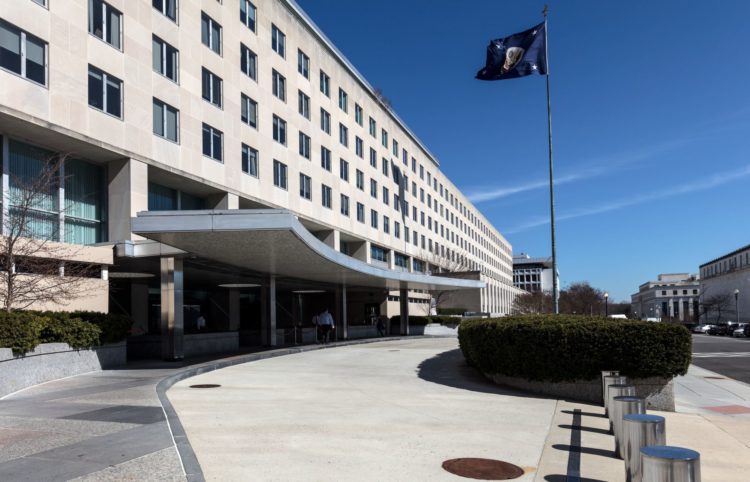
The State Department on April 20 announced employees cannot use bathrooms that correspond with their gender identity.
The Daily Signal, a conservative news website, reported the State Department announced the new policy in a memo titled “Updates Regarding Biological Sex and Intimate Spaces, Including Restrooms.”
The State Department has not responded to the Los Angeles Blade’s request for comment on the directive.
“The administration affirms that there are two sexes — male and female — and that federal facilities should operate on this objective and longstanding basis to ensure consistency, privacy, and safety in shared spaces,” State Department spokesperson Tommy Piggot told the Daily Signal. “In line with President Trump’s executive order this provides clear, uniform guidance to the department by grounding policy in biological sex as determined at birth.”
President Donald Trump shortly after he took office in January 2025 issued an executive order that directed the federal government to only recognize two genders: male and female. The sweeping directive also ordered federal government agencies to “effectuate this policy by taking appropriate action to ensure that intimate spaces designated for women, girls, or females (or for men, boys, or males) are designated by sex and not identity.”
The Daily Signal notes the new State Department policy “does not prohibit single-occupancy restrooms.”
Cuba
Trans parent charged with kidnapping, allegedly fled to Cuba with child
Cuban authorities helped locate Rose Inessa-Ethington
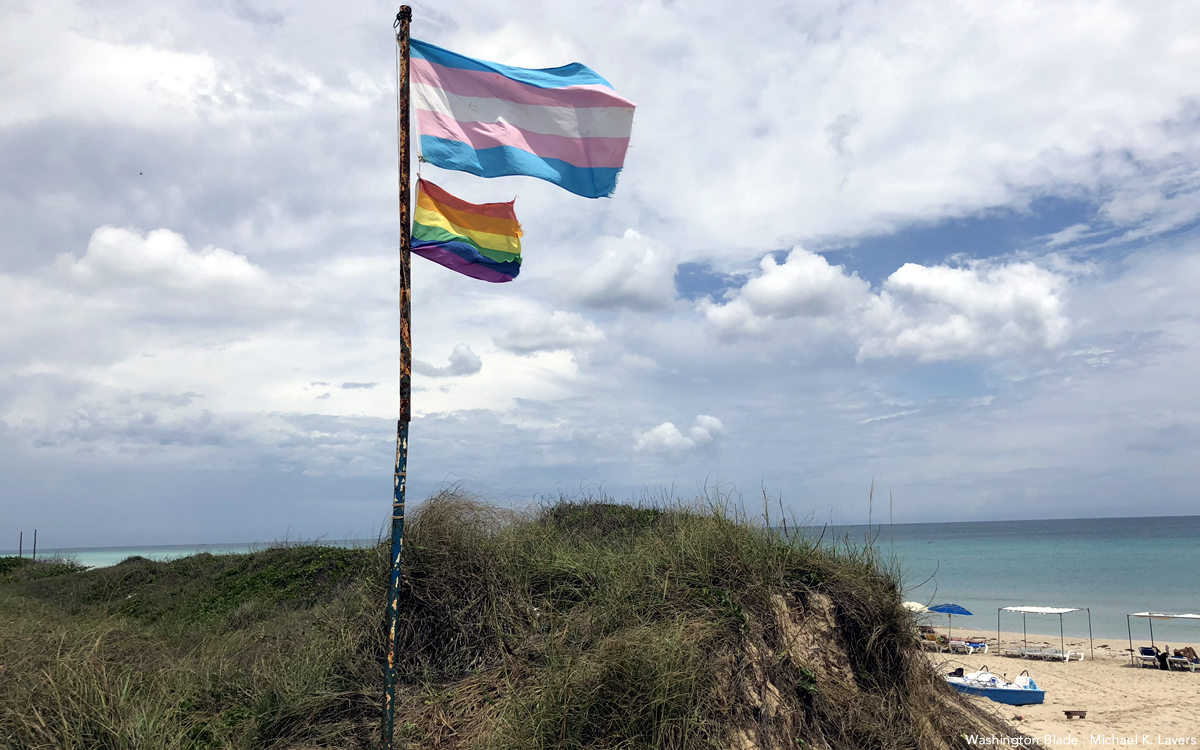
Federal authorities have charged a transgender woman with kidnapping after she allegedly fled to Cuba with her 10-year-old child.
An affidavit that Federal Bureau of Investigation Special Agent Jennifer Waterfield filed in U.S. District Court for the District of Utah on April 16 notes the child is a “biological male who identifies as a female” and “splits time living with divorced parents who share custody” in Cache County, Utah.
Waterfield notes the child on March 28 “was supposed to be traveling by car to” Calgary, Alberta, “for a planned camping trip with his transgender mother, Rose Inessa-Ethington, Rose’s partner, Blue Inessa-Ethington, and Blue’s 3-year-old child.”
The affidavit notes the group instead flew from Vancouver, British Columbia, to Mexico City on March 29. Waterfield writes the Inessa-Ethingtons and the two children then flew from Mérida, Mexico, to Havana on April 1.
The 10-year-old child called her biological mother on March 28 after they arrived in Canada. The custody agreement, according to the affidavit, required Rose Inessa-Ethington to return the child to her former spouse on April 3.
“Interviews of MV [Minor Victim] 1’s family members provided significant concerns for MV 1’s well-being, as MV 1 was born a male, however, identifies as a female child, which is largely believed to be due to manipulation by Rose Inessa-Ethington,” reads the affidavit. “Concerns exist that MV 1 was transported to Cuba for gender reassignment surgery prior to puberty.”
The affidavit indicates authorities found a note in the Inessa-Ethingtons’ home with “instruction from a mental health therapist located in Washington, D.C., including instruction to send the therapist the $10,000.00 and instructions on gender-affirming medical care for children.”
The affidavit does not identify the specific “mental health therapist” in D.C.
A Utah judge on April 13 ordered Rose Inessa-Ethington to “immediately” return the child to her former spouse. The former spouse also received sole custody.
“Your affiant believes that due to the extensive planning and preparation exhibited by both Rose Inessa-Ethington and Blue Inessa-Ethington to isolate MV 1 and take MV 1 to Havana, Cuba, without notifying or requesting permission from MV 1’s mother indicates they are likely not planning to return to the United States,” wrote Waterfield.
The affidavit notes Cuban authorities found the Inessa-Ethingtons and the child.
A press release the U.S. Attorney’s Office for the District of Utah issued notes the Inessa-Ethingtons “were deported from Cuba” on Monday “with the assistance of the FBI.”
The couple has been charged with International Parental Kidnapping. The Inessa-Ethingtons were arraigned in Richmond, Va., on Monday. The press release notes a federal court in Salt Lake City will soon handle the case.
The New York Times reported the child is now back with their biological mother.
“We are grateful to law enforcement for working swiftly to return the child to the biological mother,” said First Assistant U.S. Attorney Melissa Holyoak of the District of Utah in the press release.
The case is unfolding against the backdrop of increased tensions between Washington and Havana after U.S. forces on Jan. 3 seized now former Venezuelan President Nicolás Maduro and his wife, Cilia Flores.
President Donald Trump shortly after he took office in January 2025 issued an executive order that directed the federal government to only recognize two genders: male and female. A second White House directive banned federally-funded gender-affirming care for anyone under 19.
The U.S. Supreme Court last year in the Skrmetti decision upheld a Tennessee law that bans gender-affirming care for minors.
Cuba’s national health care system has offered free sex-reassignment surgeries since 2008.
Activists who are critical of Mariela Castro, the daughter of former President Raúl Castro who spearheads LGBTQ+ issues as director of Cuba’s National Center for Sexual Education, have previously told the Washington Blade that access to these procedures is limited. The Blade on Wednesday asked a contact in Havana to clarify whether Cuban law currently allows minors to undergo sex-reassignment surgery.
White House
Grindr to host first-ever White House Correspondents’ Dinner party
App’s head of global government affairs a long-time GOP-aligned lobbyist

Gay dating and hookup app Grindr will host its first-ever White House Correspondents’ Weekend party on April 24.
The event is scheduled for the night before the White House Correspondents’ Dinner, an annual gathering meant to celebrate the First Amendment, honor journalism, and raise money for scholarships.
The White House Correspondents’ Dinner is organized by the White House Correspondents’ Association, a group of journalists who regularly cover the president and the administration.
An invitation obtained by the Washington Blade’s Joe Reberkenny and Michael K. Lavers reads:
“We’d be thrilled to have you join us at Grindr’s inaugural White House Correspondents’ Dinner Weekend Party, a Friday evening gathering to bring together policymakers, journalists, and LGBTQ community leaders as we toast the First Amendment.”
The Blade requested an interview with Joe Hack, Grindr’s head of global government affairs, but was unable to reach him via phone or Zoom. He did, however, provide a statement shared with other outlets, offering limited explanation for why the company decided 2026 was the year for the app to host this event.
“Grindr represents a global community with real stakes in Washington. The issues being debated here — HIV funding, digital privacy, LGBTQ+ human rights — are daily life for our community. Nobody does connections like Grindr, and WHCD weekend is the most iconic place in the country to make them. We figured it was time to host.”
Hack said the company has been “well received” by lawmakers in both parties and has found “common ground” on issues such as HIV funding and keeping minors off the app. He credited longstanding relationships in Washington and what he described as Grindr’s “respectful” approach to lobbying.
Hack, a longtime Republican-aligned lobbyist, previously worked for several GOP lawmakers, including U.S. Sens. Deb Fischer (R-Neb.), Jon Kyl (R-Ariz.), George Voinovich (R-Ohio), Bill Frist (R-Tenn.), and U.S. Rep. Randy Forbes (R-Va.).
According to congressional disclosure forms compiled by OpenSecrets, Grindr spent $1.3 million on lobbying in 2025— more than Tinder and Hinge’s parent company Match Group.
“This is going to be elevated Grindr,” Hack told TheWrap when describing the invite-only party that has already generated buzz on social media. “This isn’t going to be a bunch of shirtless men walking around. This is going to be very elevated, elegant, but still us.”
He also pointed to the company’s work on HIV-related initiatives, including efforts to maintain federal funding for healthcare partners that distribute HIV self-testing kits through the app.
The event comes at a particularly notable moment for an LGBTQ-focused connection platform to enter the Washington social circuit at a high-profile political weekend, as LGBTQ rights remain under constant attack from conservative lawmakers, particularly around transgender healthcare, sports participation, and public accommodations.

DOE investigates Smith College’s trans-inclusive policy

California local elections matter: Here’s a look at Los Angeles

From the desk of Equality California: The latest updates impacting LGBTQ+ people across the state

A reign defined by commitment and human impact

Ukrainian MPs advance new Civil Code without protections for same-sex couples

Real Estate, real talk, and real WeHo: Marco Colantonio on community, visibility, and reinvention

Under new extremism laws, LGBTQ+ Russians must fight to survive

Meet your local go-go dancer: Steven Dehler

Okaeri is welcoming generations of LGBTQ+ Japanese Americans home

Republicans attach five anti-LGBTQ+ riders to State Department funding bill
-
 Real Estate2 days ago
Real Estate, real talk, and real WeHo: Marco Colantonio on community, visibility, and reinvention
-
 Russia2 days ago
Under new extremism laws, LGBTQ+ Russians must fight to survive
-
 a&e features3 days ago
Meet your local go-go dancer: Steven Dehler
-
 Features4 days ago
Okaeri is welcoming generations of LGBTQ+ Japanese Americans home
-
 Congress4 days ago
Republicans attach five anti-LGBTQ+ riders to State Department funding bill
-

 Noticias en Español5 days ago
The university that refuses to let go
-
 New Zealand5 days ago
New Zealand blood donation rules shift
-
 Features3 days ago
A Long Beach Pride spotlight: Nolan Ross Samé-Weil’s journey from struggle to service
-

 Books2 days ago
New books reveal style trends for a more enlightened century
-

 Movies3 days ago
The queer appeal of ‘The Devil Wears Prada’